

Lit up with outrage
A disaster at a wedding hall gets delayed attention in the press while the IDF investigates a deadly attack on an ambulance
 Add ToI as a Preferred Source on Google
Ilan Ben Zion is an AFP reporter and a former news editor at The Times of Israel.
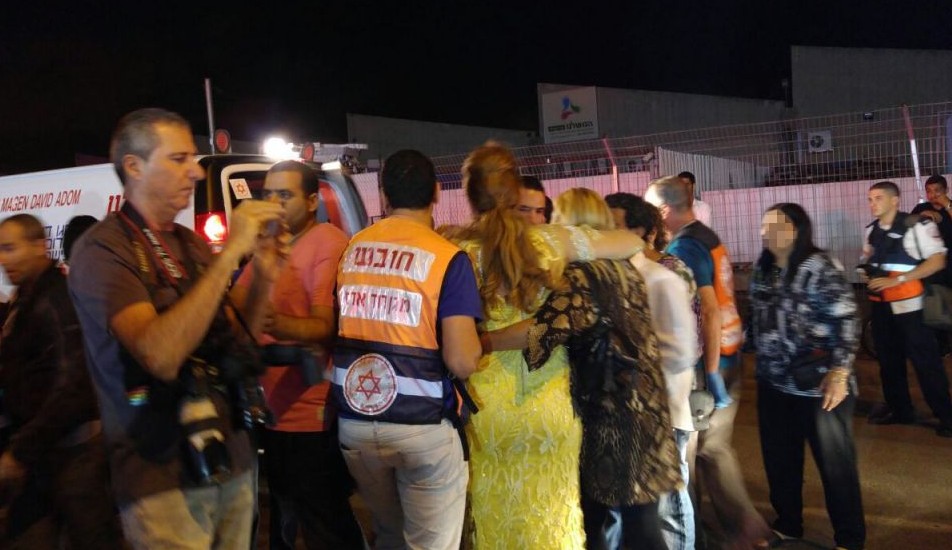
Delayed outrage over a tragic accident at an unlicensed wedding hall mingles with continued outrage over an attack on an IDF ambulance in the Golan Heights and the UN Human Rights Council report on last summer’s Gaza war in the headlines of the Hebrew press on Wednesday.
A massive lighting installation at the Adia event hall in Yavne crashed onto a packed dance floor around midnight on Monday, killing one person and injuring several others, but the incident only makes Wednesday’s papers. Israel Hayom leads off with the “wedding celebration which turned into a terrible tragedy” and reports that 10 ambulances and many police and fire vehicles arrived to help treat the wounded and help move the fixture, which weighed at least half a metric ton. One bystander who spoke to the paper recounts that the noise and commotion reminded her of a terrorist attack.
Yedioth Ahronoth seeks the Dickensian aspect in its coverage, focusing on the bride whose “joyous day turned into tragedy.” “I just looked up at the lighting that’s dripping splendid colors from the fixture, and I said to myself what wonderful innovation there is today,” one of the celebrants tells the paper. “And suddenly before my very eyes the whole thing fell and crashed. Only by a miracle I wasn’t harmed.”
Yedioth Ahronoth reports that the business had operated without a license since opening in September 2014 and for that reason was the subject of a suit filed by the Yavne Municipality. The city charged in May at the Rehovot Magistrate’s Court that the facility was operating without approval from the police, fire department or Health Ministry. Two weeks later, Adia obtained police and fire permits, but still hadn’t received a license from the Health Ministry, which city hall said was still unacceptable.
The engineer who inspected and licensed the hall tells Yedioth Ahronoth that the lighting fixture which fell on the wedding party was not the one he approved and inspected.
“My permit was correct and proper at the time, but many things happened since which changed the fixture, and I’m not sure that’s the same object I approved. In my opinion that’s a new fixture,” he says.
The police are investigating suspected death by criminal negligence on the part of the hall’s owners and the engineer who approved the fixture, whose safety cables weren’t properly installed, Israel Hayom reports. A lawyer representing the hall’s owners said that the disaster was caused by “a higher power.”
The lynching of a wounded Syrian man being transported in an IDF ambulance by a Druze mob in the Golan Heights gets front page coverage in Haaretz, which reports that the IDF’s northern command launched an investigation into the incident. A senior northern command officer said that the masked assailants who attacked the soldiers and Syrian wounded “shot themselves in the foot.” The paper says that the initial investigation paints a “bleak and worrying” picture and that there was a “serious operational snafu.”
Haaretz quotes the IDF reiterating that the Syrians who were injured and being transported to an Israeli hospital for treatment were not Nusra Front fighters, and were injured in combat with the Syrian Army about 20 kilometers (12 miles) from the Israeli border.
Israel Hayom reports that after a tempestuous night Monday, quiet has returned to the village of Majdal Shams, in the northern Golan Heights, but the tension remains. In the wake of the incident, a leader of the Druze community in Israel said he would levy religious and social sanctions on any individuals who acted or will act improperly, the paper reports. An initial investigation by the IDF found, the paper reports, that the medical officer and noncom who were in the ambulance attempted to protect the two injured Syrians with their own lives and limbs.
Haaretz also headlines remarks by Mary McGowan-Davis, the head of the commission of inquiry looking into possible war crimes committed during last summer’s war in the Gaza Strip. She tells the paper in an interview that the main message that the committee wanted to convey to Israel was that it needs to reevaluate its policy concerning the use of military force — particularly the use of heavy bombs — because it brought about the unprecedented destruction of Gaza and the death of 1,500 innocent civilians. She also says that had Israel cooperated with the committee, the resultant report would have turned out differently (suggesting it might have been more in Israel’s favor).








The Times of Israel Community.