

More than a stone’s throw from peace
Violence wracks the opening of the New Year while leaders scramble for a solution to the unrest in Jerusalem
 Add ToI as a Preferred Source on Google
Ilan Ben Zion is an AFP reporter and a former news editor at The Times of Israel.
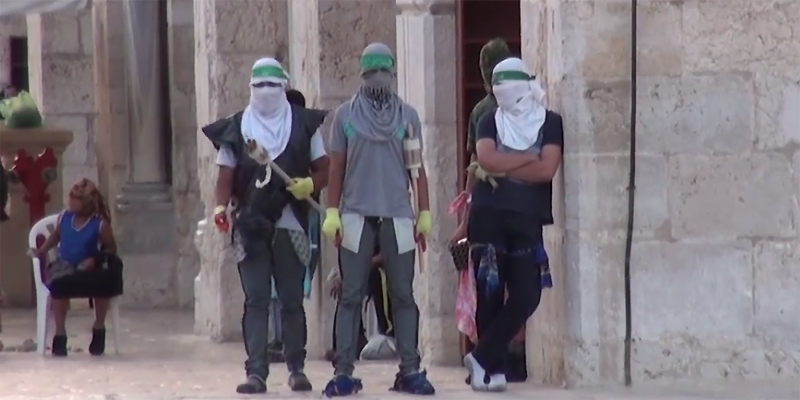
Happy New Year? Not by the looks of the first newspapers of 5776. After a two-day hiatus from newspapers, Israel’s print media is filled with reports on the violence which dominated the news over the Jewish New Year holiday, focusing in particular on the hot button issue: stone-throwing attacks.
The death of a 64-year-old Israeli man on Sunday night when a rock believed thrown by Palestinians struck his car, causing it to crash, dominates the front pages. Yedioth Ahronoth goes for the Dickensian aspect with the death of Alexander Levlovitch (or should it be the Tolstoyan aspect?), noting the tragedy of his murder on the way home from a holiday meal, and how he managed a home for handicapped children.
Alongside Levlobitch’s murder, skirmishes between Israel Police forces and Palestinian rioters on the Temple Mount left 14 officers and 70 Palestinians injured over the course of three consecutive days, according to Haaretz.
Israel Hayom uses by far the most bombastic language, calling the clashes between police and protesters a “battle for the Temple Mount” and Prime Minister Benjamin Netanyahu’s efforts to legislate stronger sentences for stone throwers “the war on the terror of stones.”
According to the paper, in a Tuesday evening meeting convened in Jerusalem, Netanyahu announced that he would advance a fast-tracked law for setting minimum terms for offenders who throw stones or Molotov cocktails, and reassess the regulations for security personnel opening fire, as well as impose severe fines for minors who are caught committing the crimes, and their families.
Haaretz reports that Netanyahu’s “emergency meeting” on the issue of stone throwing was actually scheduled long ago for Wednesday, but was advanced to Tuesday because of the incidents across Jerusalem. Senior officials told the paper that Netanyahu’s office pushed it forward to create the effect of it appearing urgent. Moreover, it says, the Knesset already approved a law to crack down on stone throwers proposed by former justice minister Tzipi Livni, which took over a year to get the green light.
The pundits had two days at home to stew about the issue of the latest spike in terror attacks against Jews and, as expected, they deliver. Yossi Yehoshua writes in Yedioth Ahronoth that the police are losing control of the situation in Jerusalem, and that this is no longer a spate of lone wolf attacks but rather “a pattern that’s been repeating itself for a long time.”
“The police don’t succeed, the punishment doesn’t deter, and the terrorists have legitimacy to continue,” he writes. “That’s how it is on the roads, that’s how it is in the Old City, and that’s how it is on Route 443, one of the two arteries to the capital city of the State of Israel — which has turned into the site of stabbings and stone throwing on a daily basis.”
“As of right now the populace in the West Bank hasn’t gone out to the streets or the familiar places of conflict,” Yehoshua writes. “But it would appear that the worst is yet ahead of us, when thousands of Jewish worshippers will go to Jerusalem for the Sukkot holiday” in the coming weeks.
The solution, he argues, is not with emergency meetings of ministers, but with police action and reinforcements: “There needs to be an urgent improvement in intelligence, there need to be many more arrests, to deploy more undercover agents and snipers, to carry out the law against rioters with all legal means in order to return calm to the capital.”
Rather than pointing the finger at the police like Yedioth Ahronoth does, Nadav Shragai writes in Israel Hayom that the escalation of violence is a result of incitement by Muslims groups. He singles out Hamas and the Islamist Movement.
He calls for a two-pronged approach — both removing rabble-rousers from the Temple Mount and a frontal confrontation with what he calls “the false blood libel of ‘al-Aqsa is endangered'” promoted by Islamist groups which he blames for the rise in violence.
Shragai writes that Israel has made all of the concessions to the Muslims concerning the Temple Mount, particularly the “huge, unprecedented concession, when in 1967 it effectively gave over the holiest place for the Jewish people to Muslim religious authorities, for whom the place is only third holiest, and even forbade Jews from praying there.”
If the violence on the Temple Mount doesn’t stop, he says, Israel should temporarily close the holy site to Muslim visitors. “Perhaps thus the Muslim side will understand that they also still have something to lose there.”





The Times of Israel Community.