

Nobody to talk to
Why is Israel so bitterly opposing Abbas’s new government, when it meets all of Netanyahu’s long-standing demands?

 Add ToI as a Preferred Source on Google
Avi Issacharoff, The Times of Israel's Middle East analyst, fills the same role for Walla, the leading portal in Israel. He is also a guest commentator on many different radio shows and current affairs programs on television. Until 2012, he was a reporter and commentator on Arab affairs for the Haaretz newspaper. He also lectures on modern Palestinian history at Tel Aviv University, and is currently writing a script for an action-drama series for the Israeli satellite Television "YES." Born in Jerusalem, he graduated cum laude from Ben Gurion University with a B.A. in Middle Eastern studies and then earned his M.A. from Tel Aviv University on the same subject, also cum laude. A fluent Arabic speaker, Avi was the Middle East Affairs correspondent for Israeli Public Radio covering the Israeli-Palestinian conflict, the war in Iraq and the Arab countries between the years 2003-2006. Avi directed and edited short documentary films on Israeli television programs dealing with the Middle East. In 2002 he won the "best reporter" award for the "Israel Radio” for his coverage of the second intifada. In 2004, together with Amos Harel, he wrote "The Seventh War - How we won and why we lost the war with the Palestinians." A year later the book won an award from the Institute for Strategic Studies for containing the best research on security affairs in Israel. In 2008, Issacharoff and Harel published their second book, entitled "34 Days - The Story of the Second Lebanon War," which won the same prize.
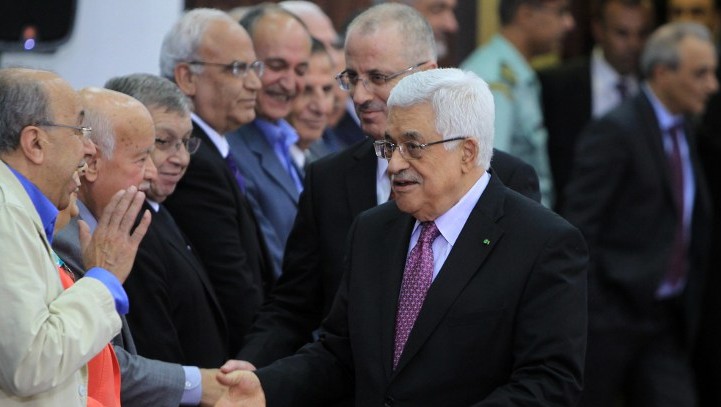
From the moment that Fatah and Hamas signed their Palestinian reconciliation agreement, representatives of both organizations and the Palestinian Authority President Mahmoud Abbas have stressed time and again that there are no Fatah or Hamas representatives in the government. They’ve reiterated that this is a government of technocrats, in which the rulers of Gaza have no role.
Abbas himself said the day after the deal was signed that the government of “national agreement” would recognize Israel, accept previous accords, and reject terrorism and violence of all kinds. He said this at public events and in private evenings, to journalists (this reporter included), businessmen and politicians.
In this respect, it is not a unity government; it is Abbas’s government.
And yet, on the Israeli side, the preference has been to close ears, shut eyes, and shout: “He’s partnered with Hamas. He’s partnered with Hamas.”
For seven years, the Israeli right complained that Abbas had no capacity to act in Gaza. That Hamas was in sole charge there. But now, when a first step has finally been taken to change that (although there’s still a way to go before Abbas can really wield power in the Strip), and Hamas has stepped away from government (but not from effective control), Israel’s decision-makers attack Abbas for linking up with a terrorist organization.
Who exactly did Prime Minister Benjamin Netanyahu, Defense Minister Moshe Ya’alon, Jewish Home leader Naftali Bennett and co. want Abbas to reconcile with? The Likud’s youth wing? How did our respected leaders expect Abbas to regain control of Gaza if not via the elections that this Palestinian unity process is intended to yield? And why is it fine for Israel to make deals with Hamas (such as the arrangement that ended 2012’s Operation Pillar of Defense), but when Abbas does so, Israel rejects all interaction with the new Palestinian government?
It does so without even examining the new government’s position and policies. It issues settlement housing tenders (or more accurately reissues them) to build 1,500 new homes.
One begins to wonder which side it is that is not truly seeking a peacemaking partner. Could it be Netanyahu’s government?
For years, the Israeli government said that a Palestinian unity government would have to accept the Middle East Quartet’s conditions. Well, that’s just happened. The new Abbas government has done precisely that.
For years, our leaders insisted that the Palestinian government not include Hamas representatives. Again, that’s what has just happened.
So maybe it’s time to face the facts: On the Israeli side, they simply don’t want to talk with the Palestinians. They don’t want to negotiate with them. Netanyahu is busy moving to perpetuate the one-state solution without heed to what will unfold here in five to 10 years.
Instead of pausing for a moment to analyze whether the new Palestinian government is good for Israel, we get the all too predictable rhetoric, and the provocative actions that also ratchet up tensions between Israel and the United States.
And who are the two major beneficiaries of Israel’s hasty response? First of all, Abbas, who is gaining popularity among the Palestinian public and also in the White House, where they realize they can make good use of the Palestinian issue and of Abbas to tussle with Netanyahu as part of the ongoing Obama-Netanyahu face-off. And second of all, Hamas — the same terror organization with which Israel signed its 2012 cease-fire, and with which Israel indirectly cooperates in order to maintain calm from Gaza. Hamas is exploiting the diplomatic vacuum, and the expansion of building in the settlements, in order to declare: We told you so!
But then, perhaps there are those who want to see Hamas gaining strength, so that they can say to the Israeli public: We told you so!








The Times of Israel Community.