

Much disposable tableware marketed as biodegradable does not decompose — study
Greenpeace Israel buried an assortment of utensils for six months, finding extensive ‘greenwashing;’ NGO calls for mandatory labeling combined with tough enforcement
 Add ToI as a Preferred Source on Google
Sue Surkes is The Times of Israel's environment reporter
A new Greenpeace Israel investigation reveals that Israelis are paying dearly for single-use tableware labeled “biodegradable” or green, that is anything but.
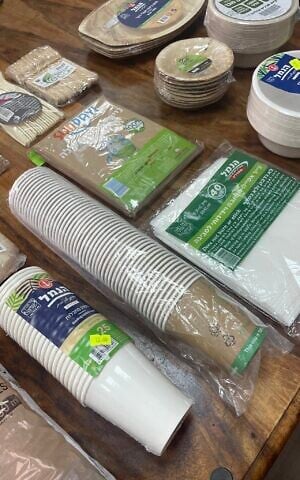
A report issued earlier this month noted that almost some 17% of the population has already bought tableware labeled biodegradable and that 37% intend to switch. More than four in ten (41%) report keeping such utensils for festive home hosting. Despite costing up to four times as much as regular single-use utensils, they have become the new standard for respectable entertaining, Greenpeace said.
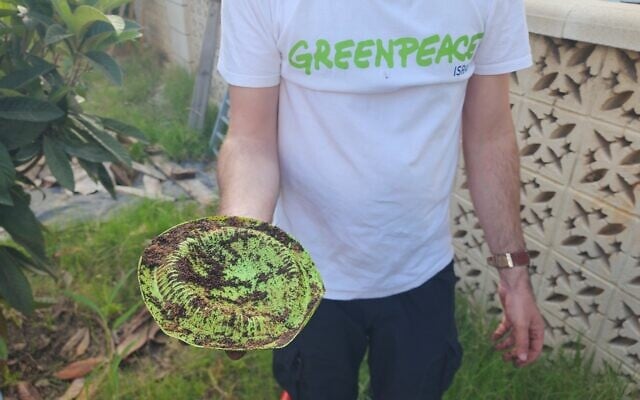
As part of a citizen-science project inspired by Greenpeace Thailand, the NGO bought ten single-use items such as plates, bowls, cutlery, straws, baking paper, and cups, made from materials such as cornstarch, sugarcane, and wood. In cooperation with community gardens in Jerusalem, Herzliya, and Rehovot, the items were buried in general soil and active compost heaps for six months.
Most items branded as biodegradable, such as corn sugar PLA cups or products with d2w additives, did not, and could not, decompose, Greenpeace said.
PLA is a plant-based bioplastic, while d2w is a chemical additive mixed with regular plastics to accelerate breakdown.
Greenpeace said they require controlled conditions in industrial composting facilities with heat above 60 °C (140° F) and constant humidity. Without organic waste separation or industrial facilities in Israel, these items end up in regular landfills, where organic materials emit global-warming methane, and others break down into toxic microplastic particles.
Items like a PLA cup by Italy’s ILIP, a fork from Pure sold at Rami Levy, and a plate by Greengoods promising biodegradation within 90 days remained completely intact when unearthed, the study said.
The ILIP website notes its products are “industrially compostable,” but Israel currently lacks the infrastructure to process them. The Pure fork contained the d2w biodegradable additive banned by the EU because it found evidence of biodegradation to be virtually non-existent in open environments, landfills, or the sea.
Greenpeace cited a response from Greengoods claiming there are no 100% biodegradable plates, bowls, cups, and cutlery in Israel, and that consumers could just dump them into green bins for general refuse.
By contrast, an Eco wooden fork, an Eco Eco sugarcane bowl, an Eco Eco wood sauce cup, and ‘Sunday’ biodegradable baking paper from Super-Pharm disappeared after six months. Yet Greenpeace warned that disappearance is not necessarily a good thing. As the Thailand study proved, many products merely break down into tiny, toxic microplastic particles that poison soil. Either way, single-use manufacturing still wastes enormous natural resources and contradicts the principle of reduction at the source, the NGO stressed.

Greenpeace Israel demanded a mandatory Israeli standard for labeling products as biodegradable or bioplastic, combined with real enforcement against manufacturers using misleading labels without scientific backing.
Israel is a global leader in disposable utensil use. In 2022, a tax prompted a 39% drop in purchases, but when Bezalel Smotrich took office as Finance Minister, his first act was abolishing the tax to please the ultra-Orthodox community.
In July 2025, the marine environmental organization Zalul and others filed a class-action lawsuit in the Lod District Court against major single-use tableware importers and marketers for deceptive greenwashing. In February, in a first ruling in the ongoing case, the court ordered the “Hanamal” packaging and marketing company to remove any signs claiming its products are biodegradable and environmentally friendly.
Globally, about 460 million tons of plastic are produced annually, with only 9% recycled. Greenpeace and other groups are campaigning for a global plastics treaty to ensure sustainable design, safer chemicals, and a transition to a circular economy where waste is reused or recycled.










The Times of Israel Community.