

Germany’s far-right AfD makes gains in local vote, but is fended off by mainstream slates
Nationalist, anti-immigrant party triples its support from five years ago in Lower Saxony’s local elections, coming third in race won by Germany’s leading conservative party
 Add ToI as a Preferred Source on Google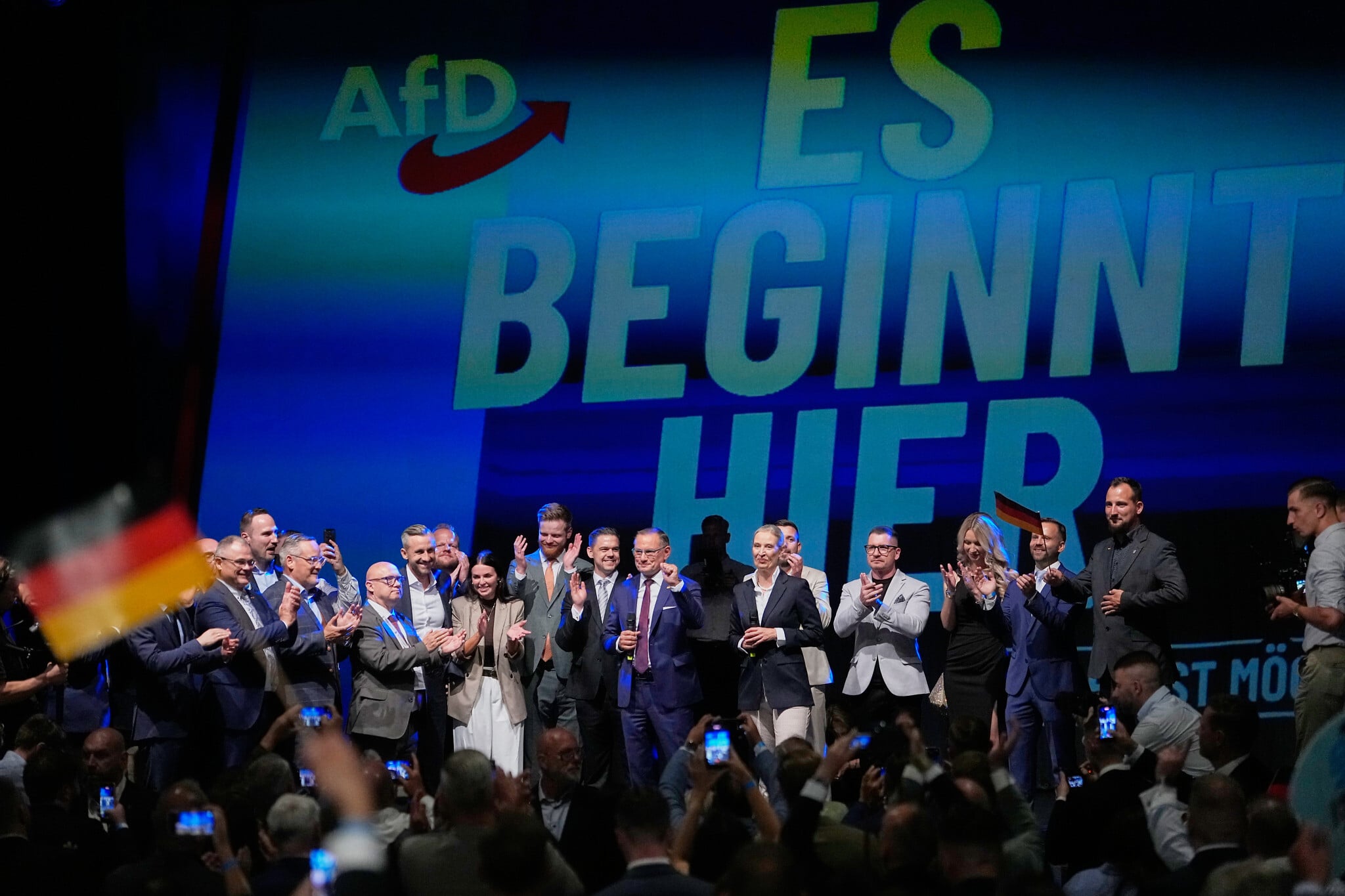
JTA — The far-right Alternative for Germany party tripled its vote in Lower Saxony’s local elections from five years ago, coming in third in a race won by Germany’s leading conservative party.
The nationalist, anti-immigrant AfD siphoned off votes from Germany’s mainstream parties in the northwestern state, home to 8 million people. The election was seen as a test of the AfD’s recent surge, sandwiched between its win earlier this month in the eastern state of Saxony-Anhalt and two upcoming elections in the Baltic coast state of Mecklenburg-Western Pomerania and the capital, Berlin, on Sept. 20.
Since the AfD was founded in 2013, it has been blocked from federal and state governments by what German centrist leaders call a “firewall,” with mainstream parties refusing to form coalitions with the AfD. The party advocates for deporting refugees, opposing multiculturalism, promoting social conservatism and diminishing Germany’s culture of Holocaust remembrance.
The municipal elections in Lower Saxony were watched unusually closely, a week after the AfD’s historic victory in Saxony-Anhalt, laying the groundwork for it to form a state government for the first time. Sunday’s elections decided Lower Saxony’s mayors, district administrators and local council representatives. The state hosts Volkswagen, one of the world’s largest automakers.
The AfD garnered 15.9% in Lower Saxony, more than triple its share of 4.6% in 2021, according to preliminary results.
The center-right Christian Democratic Union (CDU), German Chancellor Friedrich Merz’s party, came in first with 27.2% of the vote, down from 31.7% in 2021.
The center-left Social Democrats (SPD), who lead a coalition government at the state level, came in second with 24.6% of the vote, compared with 30% in the last election. The Greens, a junior coalition partner to the SPD in the state government, saw their vote share drop slightly to 14.1% from 15.9% in the last cycle.
Voter turnout rose to 64.6% compared with 57% in 2021.
Lower Saxony, unlike the other states holding elections, is a large western region. The AfD traditionally has more influence in the east, and Germany’s municipal elections tend to hinge more on well-known figures from established parties, Roger Stöcker, a political scientist at Otto von Guericke University, told the Jewish Telegraphic Agency.
Although the municipal polls delivered some relief to beleaguered Merz after the CDU’s poor showing in Saxony-Anhalt, the AfD still notched significant wins on Sunday. In the industrial city of Salzgitter, AfD candidate Patricia Mair advanced to a runoff election for mayor against Frank Klingebiel, a CDU incumbent. The party also became the largest faction in Salzgitter’s city council, where it is projected to hold 13 seats, followed by the SPD with 12 and the CDU with 11.
The AfD chairman in Lower Saxony, Ansgar Schledde, described his party on Monday as the “clear winner of the evening.”
“We now have comprehensive representation in all district councils and city councils of district-free cities, as well as in hundreds of municipal and town councils,” Schledde said in a statement. “As of today, the AfD is a local party.”










The Times of Israel Community.