

Sympathy for the devil?
After taking the stand, the Hebron shooter is transformed in the populist press from a monster into a confused kid bullied by his commanders. Meanwhile, in the Buchris ‘rape’ case…
 Add ToI as a Preferred Source on Google
Joshua Davidovich is The Times of Israel's Deputy Editor
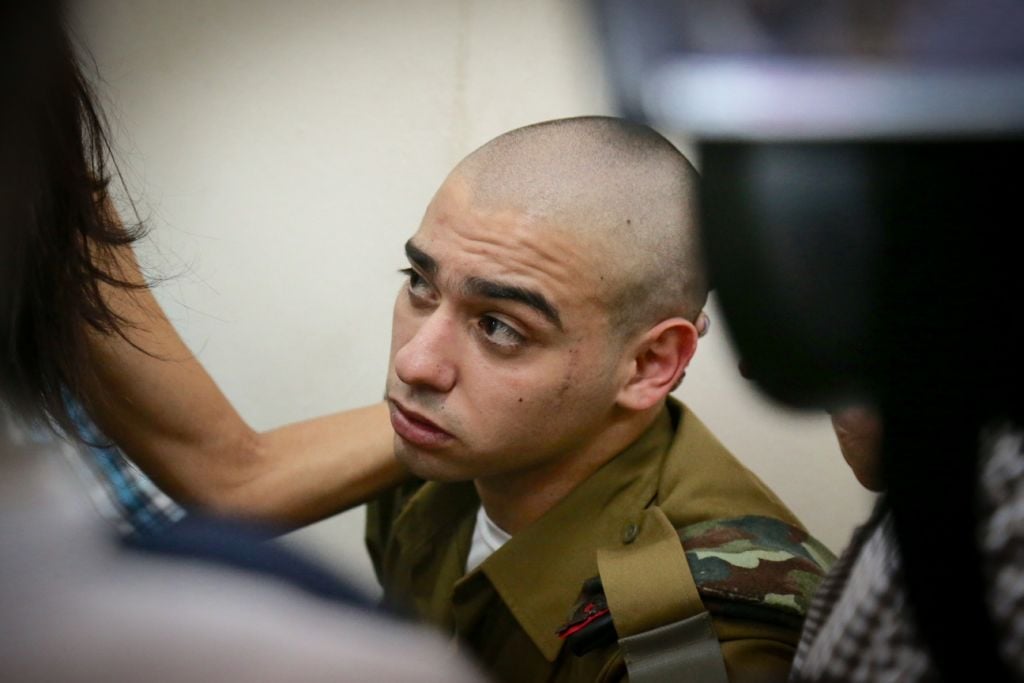
The question of how to cover a person who is in the wrong without seeming sympathetic to his cause is faced by Israel’s newspapers Monday morning, after a soldier caught on tape shooting dead a wounded Palestinian assailant was given a chance to testify in court and give his version of events in a public setting for the first time.
Haaretz, which has made clear it is no backer of the soldier, Elor Azaria, but also aims for a semblance of journalistic balance, peppers its stories with signal words like “claim” to hint at doubt cast upon his version of events.
The paper also highlights the least savvy aspects of Azaria’s testimony, like his conspiratorial “defense” that the shooting was supposed to remain a secret between him and his commanders (never mind the dozens of witnesses and half dozen cameras on hand to capture the March 24 Hebron shooting) and his claim that his commanders were even worse than him.
“According to Azaria’s claim, his commanders acted with indifference given the danger,” the paper, which is the only one not to lead with the story, reports before the jump. “’This should have been a closed military zone. The commanders were indifferent, not dealing with the terrorist at all. The unit commander stood on top of him speaking on the walkie-talkie, not alert to the situation, to what’s happening in the field, to the screams. From my point of view, they didn’t act as expected of commanders,’” the paper quotes him saying.
If Haaretz managed to strike a balance, populist tabloids Yedioth Ahronoth and Israel Hayom fail spectacularly in that regard, offering a sympathetic and uber-humanized account of the shooter and his testimony.
Under a headline reading “They threw me to the dogs,” and surrounded by pictures of a sad-looking Azaria in court with his mother, Yedioth gives a blow by blow (literally — the inside headline is Azaria’s claim that his commander slapped him twice) account of Azaria’s testimony in chronological order, quoting the soldier on the stand at length.
Israel Hayom also gives Azaria ample real estate to make his case, under the headline “I yelled ‘get away’ and I shot him in the head.”
Whereas Haaretz ends its account by summing up the claims against Azaria, Israel Hayom notes only that the cross-examination was pushed off by a day and gives Azaria’s lawyer room to weigh in as well, apparently thinking quoting Azaria’s testimony for 30-odd column inches was not enough.
“Elor testified after four months of waiting to say his piece. His testimony was coherent, clear and lucid, as it was for the police,” his lawyer is quoted saying. “Elor has gone through tribulations since the incident, in which he was caught up involuntarily, on to his commanding officer slapping him instead of listening to him and a battalion commander who didn’t listen to the two feelings of danger he felt, and including a brigade commander who didn’t speak to him at all.”
Whether Azaria’s testimony convinced the judge remains to be seen, but it managed to turn at least one columnist, Yedioth’s Yossi Yehoshua, into someone more willing to consider Azaria’s version of events.
“Even anyone who thinks Elor Azaria messed up and needs to be punished would not have been able to remain apathetic to his testimony in court yesterday,” Yehoshua writes. “He reminded us that behind the ‘soldier shooter’ stands a confused soldier, who perhaps really became frightened the first time he came across a terrorist in his life.”
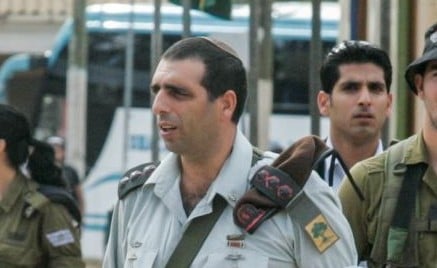
If Azaria thinks his troubles stem from him being a peon in the military machine, he might look over at Brig. Gen. Ofek Buchris, who’s also finding himself in a heap of trouble, for allegedly raping some soldiers.
While Buchris, who at first denied everything and then admitted to kissing a female soldier, seemed to find succor in Israel Hayom a day earlier, on Monday columnist Dan Margalit speaks out against the calls for both the popular general and Azaria to be given a break.
“Many Israelis would like to see both cases wrapped up quickly, and with the idea that ‘we can live with it.’ This is not our country,” he writes. “Many also asked to remove these embarrassing affairs from the day’s agenda, but until now the prosecution has held back as if it doesn’t hear the populist calls. The court will decide if they are guilty or innocent. The social norm is that there won’t be a surrender to populism and the cases will be fully heard.”
In Haaretz’s op-ed page, Yagil Levy trains his sights on another aspect of the army – the military rabbinate, which has come under fire with the appointment of an apparently homophobic cleric as head army rabbi and the outing of the head of a pre-army yeshiva as a homophobe as well.
In his column, Levy wonders where those who are so outraged by their statements were when the whole of the military rabbinate was being turned into a bastion of far-right religious extremism, through the influence of certain yeshivas, without any oversight by the secular majority.
“The common denominator of the attacks on the rabbis’ statements is the weakness of the secular majority, which blindly thought it was raising rabbinic poodles and woke up to the growls of a pit bull. This majority bears responsibility for the infiltration of the rabbis’ views into the army,” he writes. “And so, instead of imposing ideological authority on rabbis, the secular majority should be working to annul their moral influence in the army. Restriction and monitoring of the pre-military programs and hesder yeshivas, if not closing them, is a means of accomplishing this.”








The Times of Israel Community.