

The unpredictable Liberman-Lapid romance
In our Knesset sleuth’s round-up, it’s the maneuvering that’s the main thing
 Add ToI as a Preferred Source on Google
Tal Schneider is a Political Correspondent at The Times of Israel
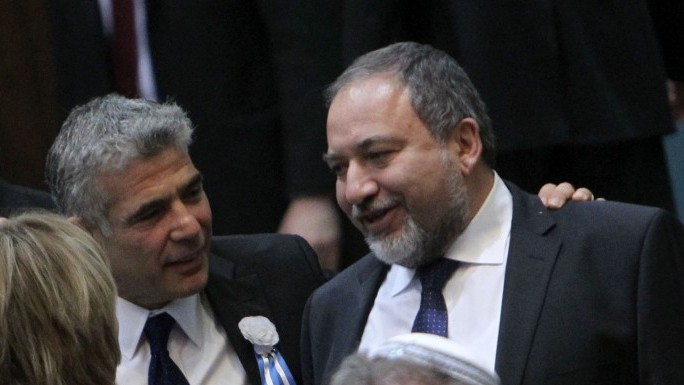
1. Former foreign minister Avigdor Liberman keeps confusing the political establishment. One day on, one day off. Wednesday he took another step toward the coalition. Cooperation between Yisrael Beytenu and Likud in the Judicial Selection Committee, with the appointment of Robert Elituv to the panel, is a meaningless move. None of the Supreme Court justices will be vacating his or her seat before 2017 in any case. Will the 20th Knesset survive till then? It is highly doubtful. But for Liberman, as always, the maneuvering is the main thing.
2. Many people left the Knesset building for Mount Herzl early Monday evening for an official ceremony in memory of the soldiers who fell during Operation Protective Edge. In order to deal with the near-empty plenum during the ceremony, and so as not to hold any debates until the end of the Ramadan fast, the coalition’s leadership decided to announce a two-hour break.
At around sunset, I went out onto the cafeteria terrace. Unfortunately, journalists are forbidden to photograph meetings that take place there. One long, serious conversation took place before my eyes, with the sunset in the background, and was photographed by several people. But since I had been present there too, I chose not to use the photographs that were sent to me. Yair Lapid and Liberman talked and talked in a quiet and calm manner with Jerusalem laid out below them. It was almost romantic.
3. One conclusion I’ve reached after watching opposition MKs over the past several weeks, whenever they try to embarrass the coalition: Zionist Union under Isaac Herzog cooperates very well with Lapid’s Yesh Atid and Zahava Gal-on’s Meretz. This Herzog-Lapid-Gal-on axis works smoothly.
Herzog and Zionist Union’s Merav Michaeli had good reason to choose Karin Elharar’s bill as the fairly simple proposal that all the opposition members could support, and with which they could defeat the coalition in a first reading. Elharar’s is the Bailiff’s Office bill, which provides for a reduction of the Bailiff’s Office’s access to debtors. The bill was portrayed as social-justice legislation that cost the state budget nothing, and of course this was a Yesh Atid bill and not a Zionist Union one.So, with a little maneuvering, it passed its preliminary reading.
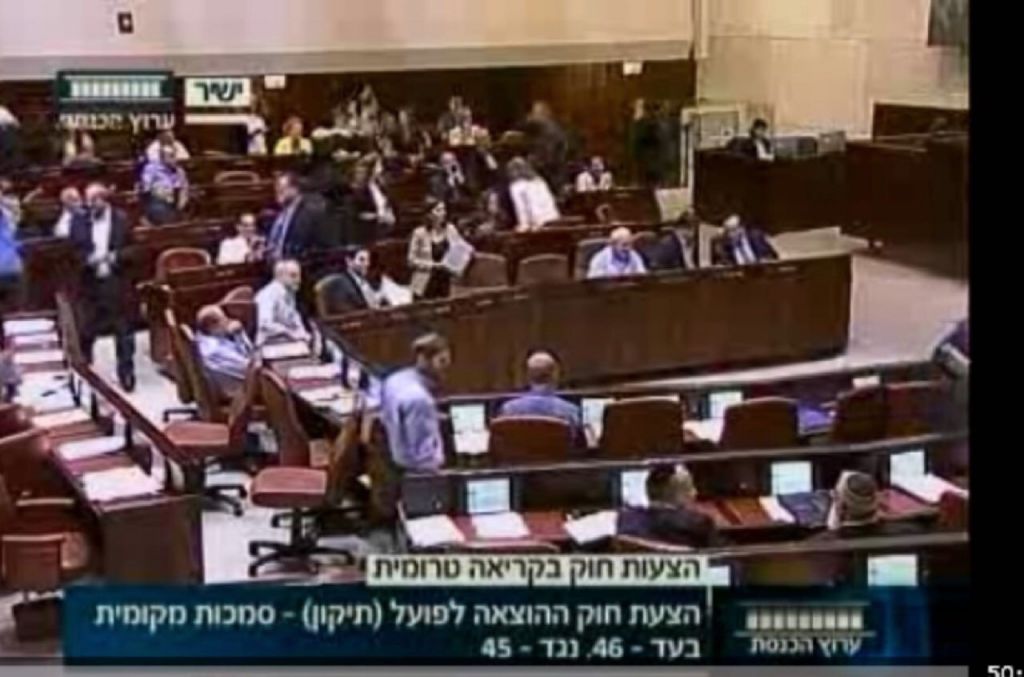
That does not mean the bill has much chance later on, but it is obvious that Lapid, Herzog and Gal-on coordinated effectively. They have 40 Knesset members all told, not all of them obedient by nature. The Joint (Arab) List cooperates with the opposition at times. One day yes, one day no; it depends on whom you ask. But the separatist of the opposition is Yisrael Beytenu. Even with that intimate tête-a-tête between Lapid and Liberman, it is obvious that Herzog is incapable of predicting what Liberman is planning more than an hour or two in advance. Didn’t Tzipi Livni portray herself in the past as a personal friend of Liberman? Where is that connection now?
4. Benjamin Netanyahu spends a great many hours in his chair in the plenum. After a heavy stint last Monday evening and early Tuesday morning, he arrived on Wednesday, too, the day private members’ bills are proposed. Elharar was privileged to be the first Knesset member in many years to pass a bill on a preliminary reading over the government’s opposition. One newspaper reported that it had not happened in six years. In previous Knesset terms, the Wednesday sessions were Netanyahu-free. He would attend only when required to do so, via an invitation backed by 40 MKs’ signatures, and that did not happen often.
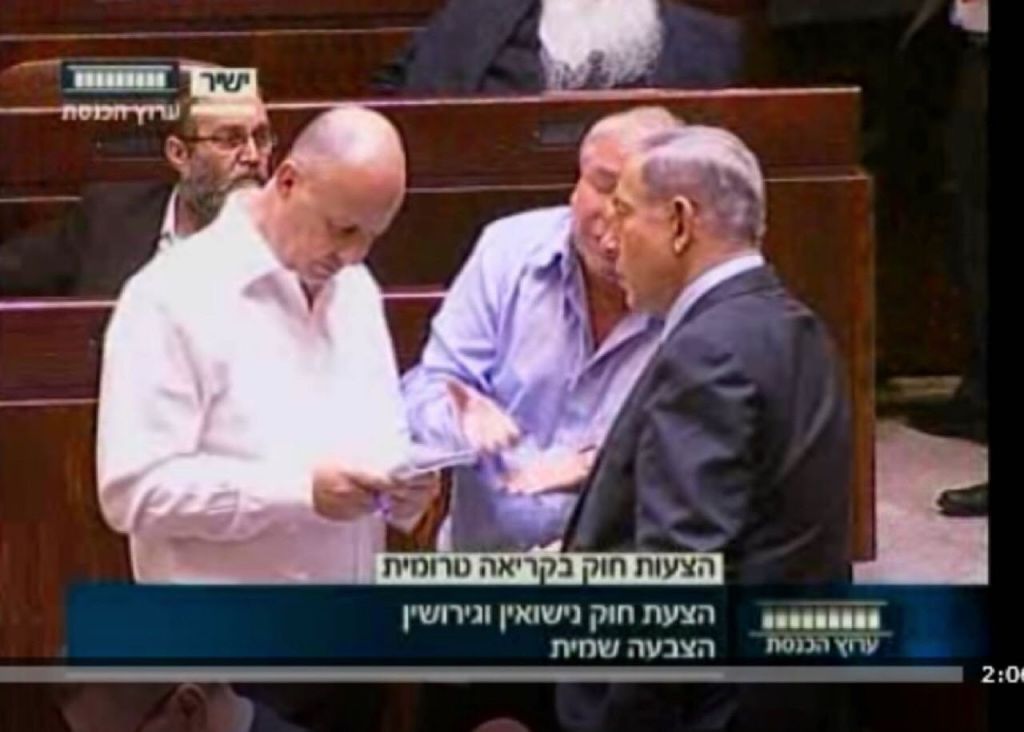
There are about two weeks left of the Knesset’s summer session — which ran shorter than usual because Netanyahu took a long time to form the government. In the ten weeks (give or take), one can already sum up and say that the Knesset is not accomplishing much. Except for an amendment to the Basic Law: The Government that allowed Netanyahu to appoint his ministers and deputy ministers while doing away with the limit of 18 for next time, this Knesset has not been moving anything significant forward.
5. Have you noticed that Finance Minister Moshe Kahlon has been avoiding the media? The last time he sat for an interview was on May 20, on Channel 2’s Meet the Press. Seven weeks have gone by since then, and the finance minister evidently does not think he is required to give an accounting to the public. For him, interviews are a superfluous act.
Not even an open press conference, where real questions may be asked. Press conferences like the ones we see on television series, the kind that are held in other countries. The kind that our prime minister, who has been hurting the basic values of democracy for many years by avoiding answering questions, never holds.









The Times of Israel Community.