

The war on error messages
It’s hard to care about someone in pajamas hitting refresh when people are fighting for their lives in Iraq, but papers show that Saturday’s hack attack is more serious than nerds having fun
 Add ToI as a Preferred Source on Google
Joshua Davidovich is The Times of Israel's Deputy Editor
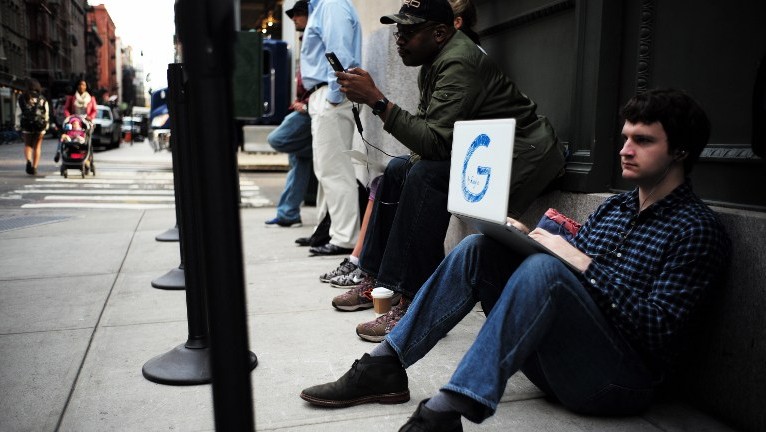
There’s nothing quite like juxtaposing scenes of death and devastation as war rages in the Middle East alongside news of a massive hack attack that shut down some of the biggest internet sites in the US to drive home how silly the whole “first-world problem” thing really is.
That’s at least the first impression one might get from looking at the front pages of Israel’s dailies Sunday morning.
It’s hard to care about people in their pajamas having to click reload on Twitter when you see stories and pictures of murder and rampage as the Islamic State tries to keep its brutal hold on Mosul.
But it doesn’t mean at least one Israeli journalist doesn’t try.
“I opened half an eye to see what the latest polling numbers were saying, but all I could see was the scary message ‘Tweets aren’t loading right now, tap to retry.’ My eyes opened wide, I sat up and my finger hit refresh again and again and again and again, but nothing happened,” Yedioth Ahronoth’s US correspondent Tzipi Smilovitz writes in a piece that has all the drama of a thriller about waiting for the AOL screech.
“The hour was 7:30 a.m. The next time my heart would go back to beating normally was would be 5 p.m. In that time, I suffered an intense panic attack, accompanied by terrible claustrophobia abd the feeling that there’s nothing left to live for,” she adds in what one hopes is a tongue-in-cheek turn that she had no idea would be printed just a page away from a dramatic picture of an Iraqi boy on his bike in front of an oil field set on fire by retreating Islamic State militants.
https://twitter.com/HetavRojan/status/789963434146267136
However, as the papers explain, the hack attack likely wasn’t just some kids in their basement who got tired of playing D&D and watching Cowboy Bebop reruns, but rather something even more sinister – hackers with political aims, possibly Russian, portending dark forces trying to assert themselves on the world stage.
Thus, papers not only makes the story their lead items, but accompany them with commentaries and analyses on what the hack attack means, especially for the future.
Yedioth Ahronoth reports that the hack attack hit the Israeli site-building site Wix among its long list of targets, and that internet users in Israel reported some problems accessing the internet as well.
Haaretz reports that though the hackers claimed to be from Anonymous and New World Hackers, experts “told Politico that there’s not enough evidence supporting the claim that the two groups are indeed responsible for the attack, and that both of them have claimed responsibility in the past for attacks they didn’t carry out.”
The paper’s Amos Harel contends in an analysis that the attack portends a future in which Israel’s internet, and not just beloved website like The Times of Israel, but internet-connected security cameras, military infrastructure, cars and other devices will become targets for attack, though he seems unsure about worried we should be.
“Such an attack could happen in Israel in the future. There are rival countries, or those with vested interests, that could act against Israel. The country’s security and military computer systems are fairly well protected and their interface with civilian systems is limited in a way that makes them hard to strike. Civilian infrastructures, especially those not belonging to the state, are still quite exposed despite considerable progress in recent years in the field of cyber-security,” he writes. “In any case, the cyber-events of the past two days seem like a taste of the future. In the short term, it remains to be seen whether Russia, or hackers associated with it, will be tempted to disrupt the US presidential elections on November 8. In the longer term, it is clear that cyberattacks will be an inseparable part of any future conflict between two countries with technological capabilities.”
Israel Hayom’s Ilan Gattegno writes that the attack puts Israel in a special position to be at the forefront of war on error messages, and maybe make a few shekels off of it too.
“The internet’s fragile infrastructure need to be protected, and in more than one way. This attack was a warning on all those complacent, and another business opportunity for the cyber experts coming up in our startup nation to find new ways to deal with this never-ending war against those trying to stop progress,” he writes.
If those using hacking tools to achieve political ends are trying to stop progress, what do you call the group of barbaric marauders trying to turn the Middle East back into a medieval caliphate, with an emphasis on the evil?
The war on cybercrime indeed seems like child’s play when compared to the war on actual people in Iraq, as government forces try to extricate Mosul from Islamic State’s grip. While the battle is now its seventh day, continued press coverage is helped along by dramatic pictures emerging from the area, including thick clouds of smoke and fire after a sulfur plant was set on fire
“Men, women and the elderly escaping from their homes and waving white flags, kids trying to escape by themselves and whole families losing everything just to stay alive – those are the heartbreaking pictures emerging in the last days from Mosul,” Yedioth’s Smadar Peri writes.
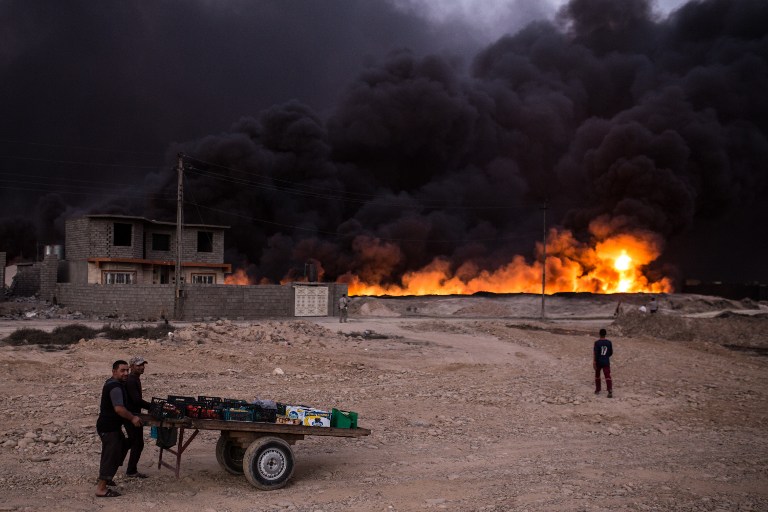
Israel Hayom reports on fears that the sulfur plant burning, which led to some thousand people complaining of breathing difficulties, could be just the start.
“Arabic TV stations broadcasting the battles near Mosul broadcast videos that showed thick smoke covering the city and its outskirts, black smoke from oil wells that mixed with the smoke from the sulfur plant that was burned. A senior source in the Iraqi army told Arabic news outlets that IS fighters blew up the sulfur plant two days ago. The use of poisonous gases came just a few days after US and Iraqi sources expressed fears that IS members could use mustard gas they have,” the paper reports.
Haaretz’s front page is the only one to eschew the battle over Mosul altogether, instead filling it with, among other things, a picture of an upside-down elephant being lifted by a crane, and a sharp uptick in the number of female soldiers enlisting for combat duty.
The paper’s Harel calls that a “quiet revolution,” reporting that the army is using mixed-gender battalions, which he calls light combat, to shore up the border areas, while allowing more important fighting units to train for real warfare or guard more dangerous areas, like the West Bank.
However, switching into analyst mode, he asks whether the idea of putting lady troops along the border could use a rethink.
“The question must be asked as to whether this model is a secure one. The Egyptian border, in particular, could turn into a front against the Islamic State, including attempted terror attacks in Israel,” he writes. “The Gilad Shalit kidnapping in 2006 has shown how Israeli society responds in such cases and the psychological warfare the enemy wages. Although women soldiers have been killed in action in Lebanon and the occupied territories, one cannot help wonder whether the response to the abduction of a female soldier would be more extreme, and whether the willingness of the army brass to risk female combat soldiers on dangerous fronts would then wane.”






The Times of Israel Community.