

With bickering sides at impasse, Iran talks get fresh extension
Zarif meets with Kerry in bid to close gaps, after dismissing US threat to walk away; Putin: Compromise will come ‘soon’
 Add ToI as a Preferred Source on Google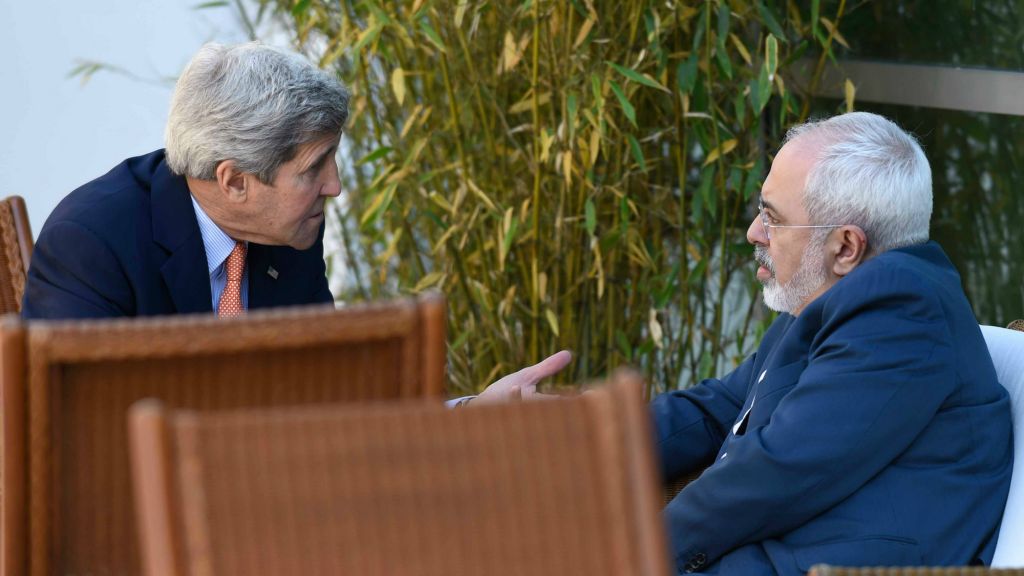
VIENNA (AP) — Talks between world powers and Iran on curbing the latter’s nuclear program switched Friday to a blame game, as Iran’s foreign minister accused the United States of shifting its demands and dismissed a warning that the US was ready to quit the negotiations.
Hours after his comments, Iranian Foreign Minister Mohammad Javad Zarif met again with US Secretary of State John Kerry for another attempt at resolving the differences standing in the way a landmark deal that offers Iran sanctions relief in exchange for long-term, verifiable curbs on nuclear programs that Tehran could use to make weapons.
Still, the sense of drift grew, along with expectations that the talks could continue through the weekend. A senior US official said the preliminary April deal that set up the present negotiations had been extended until Monday. That effectively set a fourth target date for a final accord that initially was supposed to be sealed by June 30.
The tougher rhetoric Friday mirrored the frustrations by the sides as the current round of talks entered its 14th day. After blowing past two extensions, negotiators had hoped to wrap up the talks by Friday, but Zarif’s comments cast doubts that agreement was near.
The sides — the so-called P5+1 of Britain, China, France, Germany, Russia and the United States, and Iran — had hoped to seal a deal before the end of Thursday in Washington to avoid delays in implementing their promises.
By missing that target, the US and Iran now have to wait for a 60-day congressional review period during which President Barack Obama cannot waive sanctions on Iran. Had they reached a deal by then, the review would have been only 30 days.
Iran is unlikely to begin a substantial rollback of its nuclear program until it gets sanctions relief in return.
“If you drive the talks into a dead end then it will be you who will be committing a strategic mistake,” Iran’s parliamentary speaker Ali Larijani said at Friday prayers following the rally in Tehran, addressing the US, “and its outcome will not benefit you since Iran’s nuclear staff are ready to accelerate nuclear technology at a higher speed than before.”
The talks are formally between Iran and six world powers but have devolved into US-Iranian negotiations over recent months, with diplomats saying the other nations were ready to accept terms agreed to by Tehran and Washington. Zarif’s critical comments were thus seen as mostly directed against Washington.
Still, disagreements also have surfaced recently between the US and Russia. Moscow supports Iranian demands for at least a partial lifting of the conventional arms embargo as part of any deal. That’s something Washington opposes — and an issue Zarif appeared to touch on in his comments to Iranian state television.
Beyond “witnessing a change of stances” from the other side, Zarif noted a “different stand” on some issues among the six nations. “This situation has made the work difficult,” he said.
Kerry had warned Thursday the Americans were ready to leave the talks, declaring “we can’t wait forever for a decision to be made.” Zarif, in contrast, said his side was ready to stay and work for a “dignified and balanced deal.”
Foreign ministers or top deputies of all seven nations are expected to join the talks before any impending deal. But while Germany’s foreign minister remains in Vienna, the Russians and Chinese left days ago, and their French and British counterparts followed Friday, reflecting the lack of substantial advances.
British Foreign Secretary Philip Hammond spoke of “painfully slow” progress, telling reporters that ministers planned to re-group Saturday “to see if we can get over the last hurdles.”
Even jokes meant to dispel tensions reflected the raw nerves after two weeks straight at the negotiating table.
“We’re pushing,” said Kerry when asked if there would be a deal this weekend. “Off the balcony,” quipped Federica Mogherini, the top EU diplomat convening the talks, prompting a smile from Kerry and an admonitory wag of a finger.
The scope of access to UN inspectors monitoring Iran’s nuclear program remains one of the sticking points in the talks. The Americans want no restrictions, whereas Iranian officials say they are concerned that unrestricted monitoring could be a cover for Western spying.
Diplomats say Iran’s negotiators have signaled a willingness to compromise on the issue, but hardliners in Iran remain opposed to broad UN inspections. In a message directed to “negotiators on both sides,” Iran’s military spokesman, Gen. Masoud Jazayeri, told Iran’s Fars news agency that “access to the military sites will not be allowed under any circumstance.”
Planning for the day after
Russian President Vladimir Putin said Friday he believed the two sides would “soon” reach a compromise.
“A compromise should be found,” Putin said after hosting a summit of the Shanghai Cooperation Organization in the Urals city of Ufa, where he met with Iranian President Hassan Rouhani on Thursday.
“In my opinion, it will be found soon,” he said.
Putin said he was hopeful that Iran and the P5+1 group would soon agree on guarantees for a successful resolution.
“Not only Iran and talks participants but all of the countries in the region including Arab countries and Israel are interested in this,” Putin said.
“We proceed from the fact that all sanctions against Iran should be lifted,” he said, stressing that this should happen “as soon as possible.”
“We believe this is not the way to solve international problems,” he said.
Iran has insisted that changes be made to the United Nations arms embargo and restrictions on missile sales be eased, a prospect that alarms Tehran’s rivals and US allies in the region.
Putin conceded that the scrapping of sanctions would likely see Iran ramp up oil output but said that the global economy would adjust.
“We are absolutely ready for this,” he said.
Anti-American sentiment remains strong in Iran, though Iranians overwhelmingly welcomed the preliminary nuclear accord in April.
On Friday, tens of thousands of Iranians taking part in the annual al-Quds Day rally marched in Tehran, chanting “Down with America!” and “Death to Israel!”








The Times of Israel Community.