'One chair for every person the government abandoned'
1,019 empty chairs placed in Tel Aviv square to protest coronavirus dead
Standing Together social justice movement says installation highlights empty places at tables for upcoming High Holidays, calls for inquiry into government management of crisis
An aerial view shows chairs installed at Tel Aviv's Rabin Square to symbolize the 1,000 coronavirus deaths in Israel, on September 7, 2020 (JACK GUEZ / AFP)
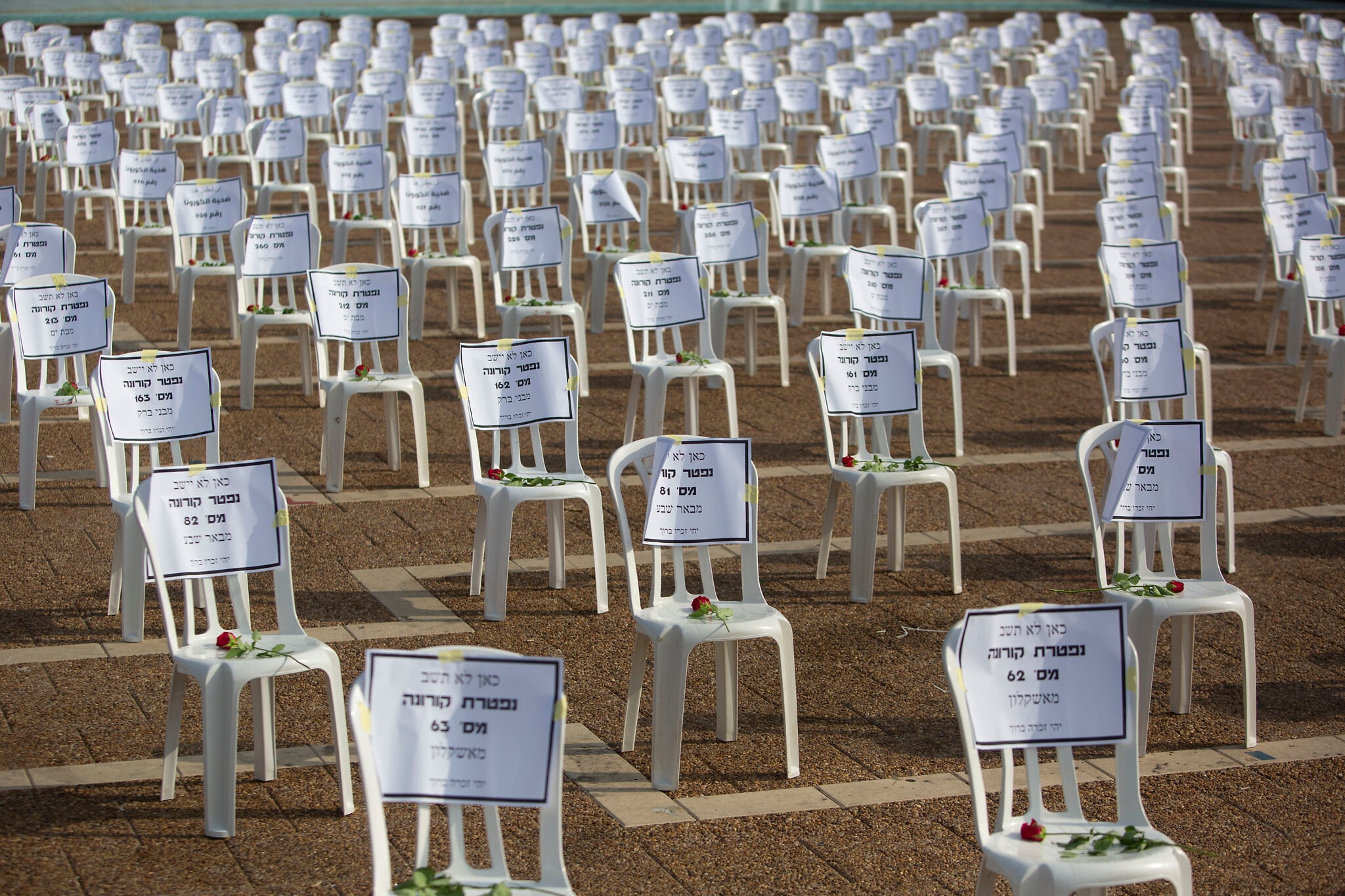
One thousand chairs symbolizing people who died from the coronavirus are placed at the Rabin Square in Tel Aviv, Sept. 7, 2020 (AP Photo/Sebastian Scheiner)
Chairs protesting coronavirus deaths are placed in Rabin Square in Tel Aviv, Sept. 7, 2020 (AP Photo/Sebastian Scheiner)
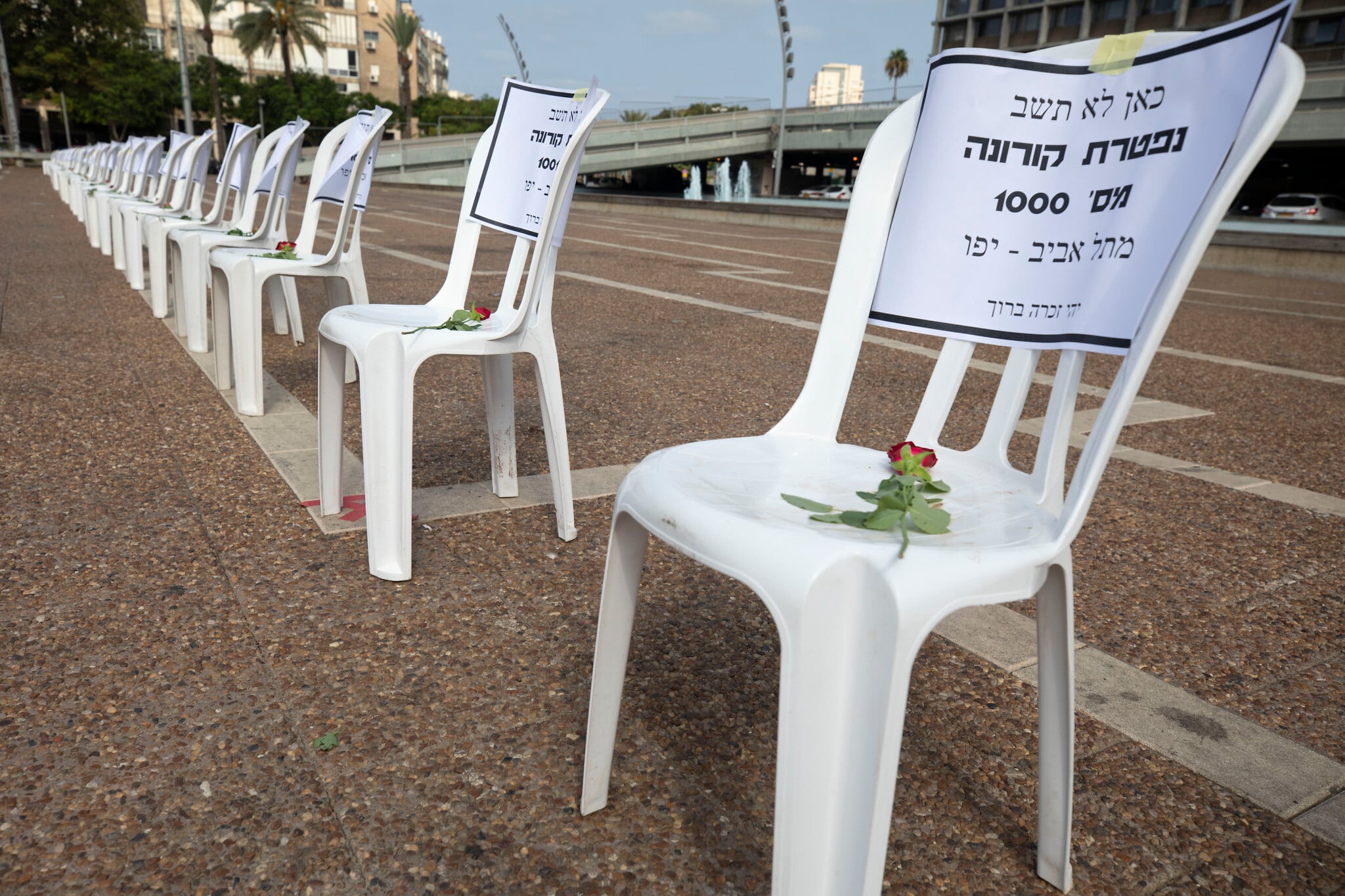
Over 1,000 empty chairs, each one with a rose on the seat, were placed in Tel Aviv’s Rabin Square on Monday morning to protest the government’s coronavirus policies.
Each chair had a sign affixed to it stating: “Here coronavirus casualty number [inserted] from [locality] won’t sit. May their memory be a blessing.”
Organizers of the installation, the Standing Together social justice movement, told the Ynet news site that the chairs were used to highlight the empty places at tables during the upcoming High Holidays, and called for a public inquiry into what it said was the government’s mismanagement of the pandemic.
“The state has no orderly plans to address the issue, and the health of citizens is collapsing. An inquiry committee should be set up immediately to investigate,” said Alon-Lee Green, national director of the organization.
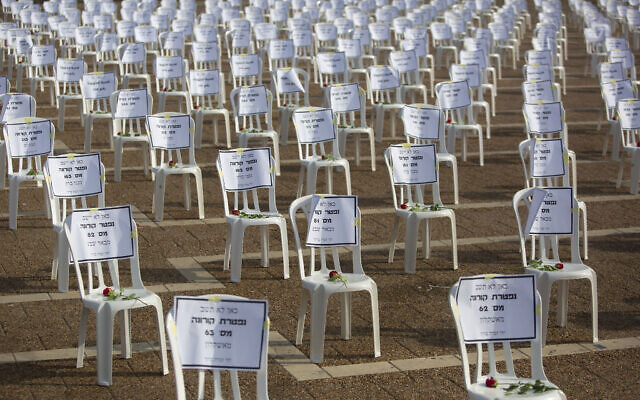
One thousand chairs symbolizing people who died from the coronavirus are placed at the Rabin Square in Tel Aviv, September 7, 2020 (AP Photo/Sebastian Scheiner)
“The empty chairs symbolize the holiday table chairs that will remain empty as a result of the disease and the mismanagement of the health crisis,” he said.
Get The Times of Israel's Daily Editionby email and never miss our top stories
In a statement to Channel 12 news, the organizers said there was “one chair for every person that the government was supposed to look after, but instead abandoned.”
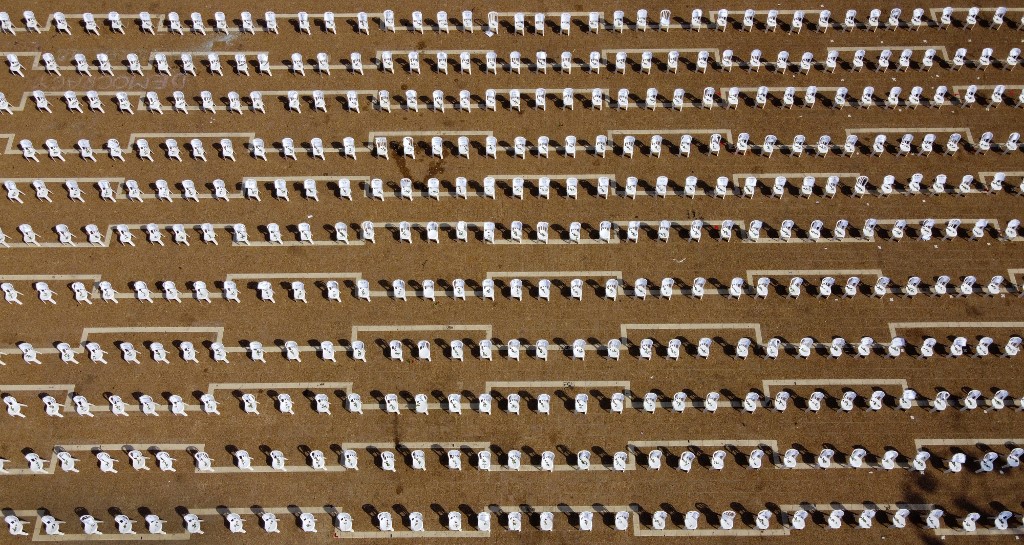
An aerial view shows chairs installed at Tel Aviv’s Rabin Square to symbolize the 1,000 coronavirus deaths in Israel, on September 7, 2020 (JACK GUEZ / AFP)
Chairs protesting coronavirus deaths are placed in Rabin Square in Tel Aviv, September 7, 2020 (AP Photo/Sebastian Scheiner)
The Health Ministry announced on Saturday that Israel passed the grim landmark of 1,000 deaths due to the novel coronavirus, becoming the 49th country in the world to do so.
Advertisement
The identities of the majority of those killed by the coronavirus have not been made public beyond their localities and age at death.

As a multimedia journalist, my job is to take the quality, fact-based journalism produced by The Times of Israel newsroom and make it accessible across every platform — from Instagram posts to podcasts to short-form videos.
This is how many, especially young people, consume news these days. But misinformation is rampant on social media. Our team at ToI produces accurate, responsible short-form reporting on Israel and the Jewish world.
If you believe in the importance of factual social media journalism, please consider joining our reader support group, The Times of Israel Community. Your financial support is essential to sustain responsible multimedia reporting.
We’re really pleased that you’ve read X Times of Israel articles in the past month.
That’s why we started the Times of Israel - to provide discerning readers like you with must-read coverage of Israel and the Jewish world.
So now we have a request. Unlike other news outlets, we haven’t put up a paywall. But as the journalism we do is costly, we invite readers for whom The Times of Israel has become important to help support our work by joining The Times of Israel Community.
For as little as $6 a month you can help support our quality journalism while enjoying The Times of Israel AD-FREE, as well as accessing exclusive content available only to Times of Israel Community members.
Thank you, David Horovitz, Founding Editor of The Times of Israel