

Fighting for her legacy, Environment Minister Silman responds to green groups’ criticism
Slammed for foot dragging, withholding funds from environmental NGOs and attacking them as subversives, Silman tells The Times of Israel: ‘Tell me if someone else did as much as me’

 Add ToI as a Preferred Source on Google
Sue Surkes is The Times of Israel's environment reporter

Likud politician Idit Silman is vigorously defending her tenure as head of the Environmental Protection Ministry, pointing to hard-won legislative victories while dismissing criticism from the country’s green establishment as political prejudice.
Speaking to The Times of Israel, the former Yamina politician — whose high-profile 2022 defection dealt the fatal blow to the short-lived Bennett-Lapid coalition — insisted the ministry was “on the rocks” before she arrived. Brushing aside complaints about high-level resignations, she also blamed the civil service commission for a prolonged vacancy in the chief scientist’s office.
“Nobody can compete with me on professionalism,” Silman said. “Tell me if someone else did as much as me.”
Her list of achievements is, by her own account, substantial, including sweeping regulatory reforms, multi-million-shekel rehabilitation packages for communities in the north and south battered by war with Hezbollah and Hamas, and strategic blueprints for clean transport, food waste and coastal protection. She points proudly to progress on Israel’s first waste-to-energy facility in the south.
Silman did secure a number of notable wins. She shepherded through long-overdue legislation on building waste, overhauled environmental licensing, and stood firm against attempts to lift an import cap on a state-owned pipeline company with a history of devastating oil leaks. She successfully protected a lucrative cleanup and recycling fund from the Interior Ministry’s territorial ambitions and repelled a raid by the National Security Ministry aimed at stripping away the Green Police, the ministry’s enforcement arm.
Her record on broader policy, however, is contested. When a long-gestating climate bill reached its first Knesset reading in April 2024, green groups condemned it as an empty gesture that lacked a dedicated budget and granted the government broad leeway to alter emissions targets. Silman maintains she pushed the bill through to force the finance ministry’s hand, hoping a future administration might flesh it out.

Prominent figures in Israel’s environmental movement nevertheless look forward to the end of her term. Alon Tal, a veteran environmentalist who has observed every holder of the portfolio since 1989 and worked with many, offered a scathing assessment, calling her “the worst environment minister we’ve had, by every conceivable parameter.”
Silman dismisses his verdict as partisan, noting Tal’s past stint as an opposition lawmaker for Blue and White.
Yet Tal points to an exodus of senior career personnel — including the chief scientist, Noga Kronfeld-Shor, who departed in mid-2024 — as a disaster.
“This small, underfunded ministry has always punched above its weight because it had really smart and devoted personnel,” Tal lamented. “We lost a generation of institutional memory… We will have a huge rebuilding job to do.”

Amit Bracha, head of the advocacy group Adam Teva V’Din, praises the rank-and-file officials who remained, but notes that crucial reforms hit a wall once they reached the minister’s desk. Draft legislation on soil rehabilitation, agreed upon by staff, languished without Silman’s endorsement, as did pending regulations on “forever chemicals” and organic waste separation.
Bracha further charges Silman with introducing unprecedented partisan friction into environmental governance.
“Her way to cope with professional criticism has been to accuse environmental groups of attacking the state,” he noted, observing that his organization enjoyed productive working relationships with previous right-wing ministers.
Silman retorts that Adam Teva V’Din is fundamentally “against the state and the government” — part of a broader tendency to cast green NGOs as subversives. In a policy turn currently facing a High Court challenge, she halted millions of shekels in longstanding state funding for environmental research and activities. First, she cited “budgetary constraints,” a claim the Finance Ministry denied. Later, she reportedly told the weekly ministerial meeting that she had blocked the funds because the organizations “fight the state.”

When ministry data released under freedom-of-information laws revealed an 83% plunge in environmental indictments during her term, she dismissed the findings as “fake news” and branded Green Course, the organization that requested them, a “radical group masquerading concern about the environment.”
Silman has also gravitated toward ideological touchstones of the political right. Confronting the persistent problem of illegal waste burning along the Green Line separating Israel and the West Bank, which sends toxic smoke into settlements and communities on the Israeli side, she pledged a firefighting initiative — though she failed to secure funding from the Finance Ministry.
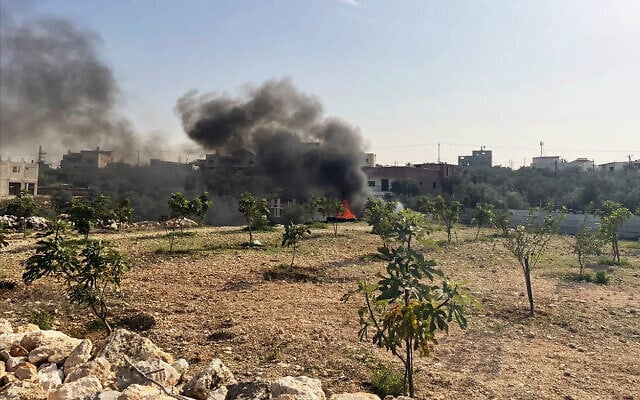
At a committee hearing in December 2025, she agreed that Palestinian waste burners should be shot as “environmental terrorists,” floated extending “environmental sovereignty” over the West Bank, and reportedly told a cabinet meeting that “because the Palestinian people don’t exist, they can’t protect the earth.”
In another unusual policy detour, she instructed officials to reclassify the Nile crocodile from a protected species to a “tended” animal, facilitating a proposal by far-right National Security Minister Itamar Ben Gvir to stock a moat around a prison housing Palestinian detainees. A court injunction halted the initiative in August.

During her interview, Silman urged The Times of Israel to speak with Barak Verker, an activist with the West Bank settler environmental group Green Now. Verker gave the minister credit for taking on 20 years of foot-dragging on building waste and for addressing cross-border pollution, but acknowledged that military administrators in the territories, not Silman’s ministry, have authority over Palestinian polluters.
Perhaps most disquieting for climate advocates was Silman’s decision earlier this year to order a formal review of Israel’s participation in the UN Climate Convention and the 2015 Paris Accord to cut global warming gas emissions. The proposal to potentially exit one of the most significant environmental agreements mirrored US President Donald Trump’s retreat during his first administration.

For now, at least, the formal review’s results should calm Israel’s green groups.
As Silman concluded to The Times of Israel: “We found that at present, there’s no need to leave.”






The Times of Israel Community.