

A deadlier terror finally gets attention: 8 things to know for November 28
Violence toward women is not going away, and the deaths of two teen girls has only raised more alarms and more questions about what is not being done to prevent it
 Add ToI as a Preferred Source on Google
Joshua Davidovich is The Times of Israel's Deputy Editor
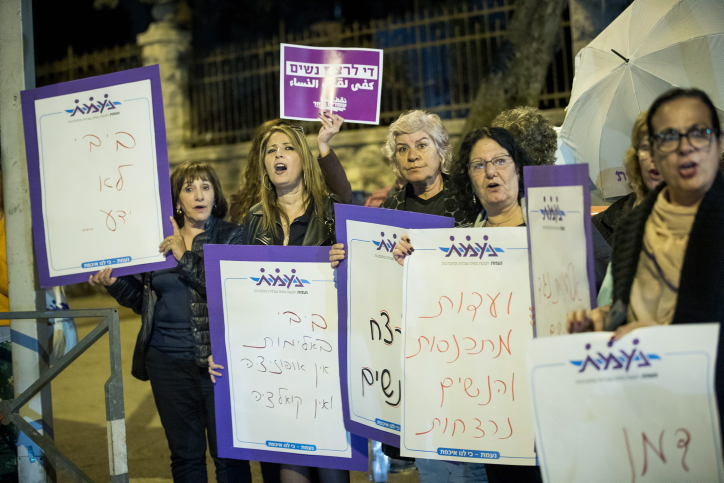
1. Violence can’t wait: 2018 is shaping up to be the deadliest year for female victims of domestic violence in Israel since 2011, with 23 women killed already and another month to go, the Yedioth Ahronoth daily reports.
- In contrast, there have been fewer than a dozen terror victims in Israel over the same time period, even including soldiers killed in the line of duty, but that issue is seen as one of the main factors driving Israeli policy.
- The figures come after two teenage girls, Yara Ayoub, 16, and Sylvana Tsegai, 13, were added to the unfortunate tally just this week, only days after thousands of people around the world marched against domestic violence to mark the International Day for the Elimination of Violence against Women.
- After Prime Minister Benjamin Netanyahu shot down an attempt to establish a parliamentary commission of inquiry on violence against women, lawmakers say they are asking for a re-vote without waiting a month, as is normally required for failed legislation.
- MK Aida Touma-Soleiman, who heads the Knesset panel on the advancement of women in society, tells Yedioth that the two murders justify asking to suspend normal parliamentary procedure: “Any woman could have been in their place and it is simply terrifying.”
2. Missed signs: Much of the press reports are focused on Tsegai, the daughter of Eritrean asylum-seekers, and warning signs that were apparently missed before the murder.
- Haaretz reports that welfare authorities were alerted to her being abused in 2014. The Tel Aviv municipality tells the paper that, in 2017, her mother, whose ex-boyfriend Tesfebarhan Tesfasion is the main suspect, was in touch with welfare authorities, though it is unclear if and how she was helped.
- “He hit them regularly,” a neighbor tells Yedioth Ahronoth. A teacher tells the paper of seeing the girl on Monday and thinking something was wrong: “She looked exhausted and when I asked what was wrong, she said she was just tired, but everything was fine. She didn’t say a thing.”
- However, Hadashot news reports that on Saturday, the young teen did call the police to say that Tesfasion was in her home. “He came to the house, took something, and left,” she told the dispatcher.
3. To underserve and not protect: Police and authorities are being widely condemned for not preventing this and other cases of violence.
- “Questioning whether it was possible to prevent what was coming is not enough and the conclusions need to be made loud and clear,” Hagot-Ron Rabinowitz writes in Israel Hayom.
- “All the warning signs were ringing and the police did not hear,” Einat Lev-Adler writes in Yedioth. “We have no choice but to recognize that the police are bankrupt when it comes to dealing with violence against women. It (the police) can’t stop the terror against women and can’t be a needed defensive shield for the country’s citizens.”
- Haaretz’s lead editorial points to Israel’s refusal to devote services to asylum seekers as a root cause: “They are not entitled to receive social services except in life-threatening situations, and the Labor, Social Affairs and Social Services Ministry does not allocate funds to treat children at risk in this community. This neglect is not the result of human error. The government is determined to get rid of the asylum seekers and refuses to bear any legal and moral responsibility for a population that is in Israel legally.”
4. ‘Don’t care if he’s killed’: A manhunt for Tesfasion is still underway, as of this writing. Hadashot reports on an emotional visit his father made to the family’s mourning tent, speaking of how angry and sad he is about his son’s actions.
- “It’s too bad I didn’t die today, too bad he didn’t kill me instead, I would have preferred that. I’m not going to tell him to go to the police. There’s police who can take him, who can kill him for all I care.”
5. Waiting for Gantz: Meanwhile, new Defense Minister Benjamin Netanyahu, who also happens to be health minister and hold a few other portfolios, held a meeting with former IDF chief Benny Gantz.
- Gantz is seen as a possible juggernaut in upcoming elections and new junkies are watching closely to see if he will start his own party, join an existing one, or possibly not even enter politics.
- Walla news, which broke the story of the meeting, quotes sources saying that the meeting was on defense matters, and Netanyahu’s office backs that up, saying it is connected to him getting up to speed on his new position, which will include meetings with other former IDF chiefs and defense ministers, from Gabi Ashkenazi to Amir Peretz.
6. MBS and Barak: One name notably missing from the list is Ehud Barak, a former defense minister under Netanyahu and a former IDF chief, who has become one of the prime minister’s most vocal critics.
- Haaretz reports that someone who did try to enlist Barak may have been Saudi Prince Mohammed bin Salman. The paper says it obtained a recording of a call between a man claiming to represent MBS, who “said he wanted the former prime minister to help him sell cybertech to assist the Saudis in eavesdropping on their citizens’ and enemies’ phone conversations.”
- Haaretz writes: “The interest shown toward former Israeli army officers and politicians is nothing new. But this time the circumstances are particularly interesting. First, Barak is a former prime minister. Second, the connection was being made in the name of a country, not a company. Third, the country was Saudi Arabia, whose strategic, diplomatic and security interests have been linked with those of Israel. Finally, a person the man said he was representing was none other than one of the most influential figures in the Arab world, and beyond.”
- Barak tells the paper he rebuffed the offer.
7. Stop me if you’ve heard this one before: But Israel Hayom has a report that the coalition is on the verge of collapse, citing a senior coalition source.
- “It seems every week there’s new drama, outbursts and deals, MKs pushing laws on their own. It seems like the beginning of the end. Mostly, it seems like Kahlon wants to take apart the government, but doesn’t want it on his name,” the source says.
- The item, in a paper seen as closely linked to Netanyahu, could be a test balloon from Likud itself to take apart the government and pin it on Kahlon.
8. Shut your mouthpiece: An investigative report on Channel 10 which claimed to reveal the depth that Netanyahu was able to wield control over the Walla News site as part of a suspected quid pro quo with owner Shaul Elovitz is making major waves.
- The report doesn’t just cast a negative light on Walla, but on other news organizations as well, which also operate according to shady interests.
- Haaretz’s Guy Rolnik points out that, at the end of the report, presenter Raviv Drucker hinted at things being even worse at Yedioth, which was the subject of a separate quid pro quo investigation into Netanyahu. But others say it will take something major for people at that paper to fully come forward.
- In the 7th Eye, Hadashot news investigative editor Avner Hoffstein writes that Walla’s case is not new, with Maariv under Nochi Dankner also forcing journalists to work as political mouthpieces and attack dogs, and that many will say one cannot blame journalists for putting their livelihoods before their morals.
- “Indeed it’s tough, but we at least need to try. Journalists in Israel need to get out of the Holocaust mentality and stop being afraid. It’s a simplification, but there’s no better way to say it. The view that ‘we are weak, they will fire us all and so we need to put up with journalistic horrors’ pulls the rug out from under the feet of the moral justification for the profession to exist. We’ll never be able to convince a corrupt politician or harmful mayor to stick to the law and act right if at the same time we allow corrupt publishers to turn us into the exact opposite,” he writes, in his clarion call, doing his best Howard Beale impression. “True, being fired at age 40 with a mortgage and three kids is a terrible feeling. But being fired at the same age without putting up a fight for your values, after they walked all over you for three years — feels much much worse.”










The Times of Israel Community.