

A former Samaritan faces the music of her complicated roots
Israeli actress and musician Sofi Tsedaka takes to the stage to reckon with her upbringing, and her decision to decamp from the ancient sect
 Add ToI as a Preferred Source on Google
Jessica Steinberg, The Times of Israel's culture and lifestyles editor, covers the Sabra scene from south to north and back to the center

It’s been more than a decade since Israeli actress Sofi Tsedaka first began making music combining the languages, rhythms and chants of the three cultures in which she was raised, Samaritan, Arabic and Israeli.
Her shows with ensemble Sofi and the Baladis, including an upcoming performance in Tel Aviv on March 19 ahead of an international tour this spring and summer, are a celebration and amalgamation of those distinct groups that make up her roots.
“This show is about different languages,” said Tsedaka, sitting in her Ramat Aviv apartment on a recent weekday morning. “I grew up with those three cultures, Samaritan, Arabic and Jewish, and we’ve taken the three languages and combined them into one, to show the beauty and connection between them.”
It’s what Tsedaka, 41, has tried to do for most of her adulthood, ever since she broke with the tiny, ancient sect she was born into and began the process of converting to Judaism at the age of 18, and completed that transition three years later.
אנחנו מתרגשים אש להציג בפניכם את הקליפ החדש שלנו "השלום על משה". (עיבוד והפקה: יניב טייכמן | בימוי:בטינה פיינשטיין | צילום:תומר פוקס)המילים בעברית עתיקה והן מתארות את גדולתו של משה רבנו שהיום ממש זה יום הולדתו… מזל טוב משה!אהה… ויש גם הופעה חגיגית מיוחדת לפורים במרכז האתני הרב תחומי ענבל תל אביב ב-21.3 שם נארח את רחלה , זמרת ענקית ונפלאה שהיא גם חברה אהובה שלנו.כרטיסים ממש כאן: https://inbal.smarticket.co.il/%D7%A1%D7%95%D7%A4%D7%99_%D7…נשמח לראותכם!
Posted by Sofi Tsedaka Office-סופי צדקה on Wednesday, August 31, 2016
She wasn’t the first in her family to do so; she followed her three elder sisters who also converted, leaving the sect’s compound in Holon, just outside Tel Aviv.
At the time, Tsedaka, a natural beauty with dark red hair, was engaged to a fellow Samaritan, but she ended up leaving him.
“I did it behind my father’s back,” she said. “It was only after I had my daughter, who’s now a soldier, that I could look back and realize what I did. I left from a place of rebellion.”
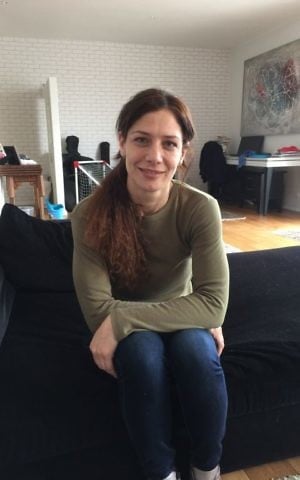
But she always kept parts of who she had been.
The name, Tsedaka, is the Hebrew word for charity. Tsedaka’s first name, Sofi, is the Hebrew word for final or end, as Tsedaka’s father wanted her to be the last girl in his line of daughters.
Yet when Tsedaka converted, she was told she had to change her name to Sarah, which felt strange.
“I’m Sofi Sarah on my identity card,” said Tsedaka.
She was also told she was now Sarah, the daughter of Abraham. Tsedaka’s father’s name was Baruch.
“My father had phenomenal knowledge of the Torah,” said Tsedaka. “And he gave me that love.”
Still, it was a complicated community in which to be raised.
‘A beauty in all three religions’
The Samaritans are named for Samaria, a region in the northern West Bank, and have lived in the Holy Land for thousands of years. The most common frame of reference is the parable of the Good Samaritan in the New Testament, although the Samaritans believe they are remnants of Israelites exiled by the Assyrians. Their religion is closely related to Judaism, although they are not Jewish, and follows a version of the Old Testament.
In 2013, there were 756 Samaritans, according to the sect’s official website. Half live near the West Bank city of Nablus on Mount Gerizim, the group’s holiest place and the site of its annual Passover sacrifice. The other half live in a compound in the Israeli city of Holon, near Tel Aviv.

Tsedaka grew up in Holon and spent weekends and holidays in Mount Gerizim. She studied in Israeli schools, attending classes in the Samaritan language and religion in the afternoon, and also spoke Arabic. But she began resisting the religion’s strictures in her teens, following in the footsteps of her older sisters.
After Tsedaka’s final conversion at 21, she married a Jewish man, with whom she had her daughter, and they later divorced. Tsedaka became a successful model, and host of children’s TV shows and a soap opera star.
She now has two children, her older daughter, now a soldier in the Israeli army, and a younger, 5-year-old son. Tsedaka isn’t Sabbath observant, but lights candles on Friday night and is a “believing person,” she said, who regularly studies Torah and the Talmud in her home, where the shelves are filled with religious tomes alongside her son’s puzzles and soccer balls.
Tsedaka never returned to the Samaritan compound, but retained a relationship with her parents, although she, her sisters and her father were all excommunicated from the sect.
הבלאדים מגיעים לפאפאיתו …פם פררם פם פםביום ראשון הקרוב 19.3.2017 מופע השקת אלבום – להזמנת כרטיסים https://eventbuzz.co.il/baladis
Posted by Sofi Tsedaka Office-סופי צדקה on Tuesday, March 14, 2017
It was about a decade after her conversion to Judaism that Tsedaka began working on her first album, “Berashet,” the Samaritan word for Bereshit, or Genesis. She saw it as an attempt to reconnect and make peace with her past, by telling the story of the Tsedaka family.
“I see the beauty in all three religions, and that’s what made me want to do this,” she said.
The music is a melding of traditional Samaritan sounds and dialects, as well as ancient Hebrew and Arabic dialects and prayers, set to the background of the oud and kanun, an ancient string instrument.
“They’re instruments that are beyond time,” she said.
The roots of Tsedaka’s musical journey can be traced to the making of “The Lone Samaritan,” a documentary about Tsedaka’s personal history, made by filmmaker Barak Heymann.
During the making of the film, she met a musicologist and started examining the connections between the Samaritan, Arab and Jewish languages and liturgical poems.
“It’s about connecting bridges for me,” said Tsedaka.
Tsedaka has continued her other stage work, yet finds the musical career infinitely satisfying, given its deep connections to her complicated story.
“You can choose to do this work or it chooses you,” she said. “But when you bring yourself, your family to your work, you’re the most connected to it.”
“I stand on a stage no matter what I do,” she said. “What I want, when I’m onstage, is to make you feel emotions, to give you something that you’ll take home and think about. The platform doesn’t really matter.”
Sofi and the Baladis will perform March 19, at Tel Aviv’s Papaito. They’ll be touring in Spain in May, and will reach the US next October, when they tour for a month with Arts Midwest World Fest.









The Times of Israel Community.