

A veteran of ‘Israel’s Vietnam,’ sculptor casts his traumas in bronze
Dan Reisner sought a way out of PTSD following his military service in Lebanon; now he’s using lockdown to create artwork that incorporates Arabic words
 Add ToI as a Preferred Source on Google
Jessica Steinberg, The Times of Israel's culture and lifestyles editor, covers the Sabra scene from south to north and back to the center
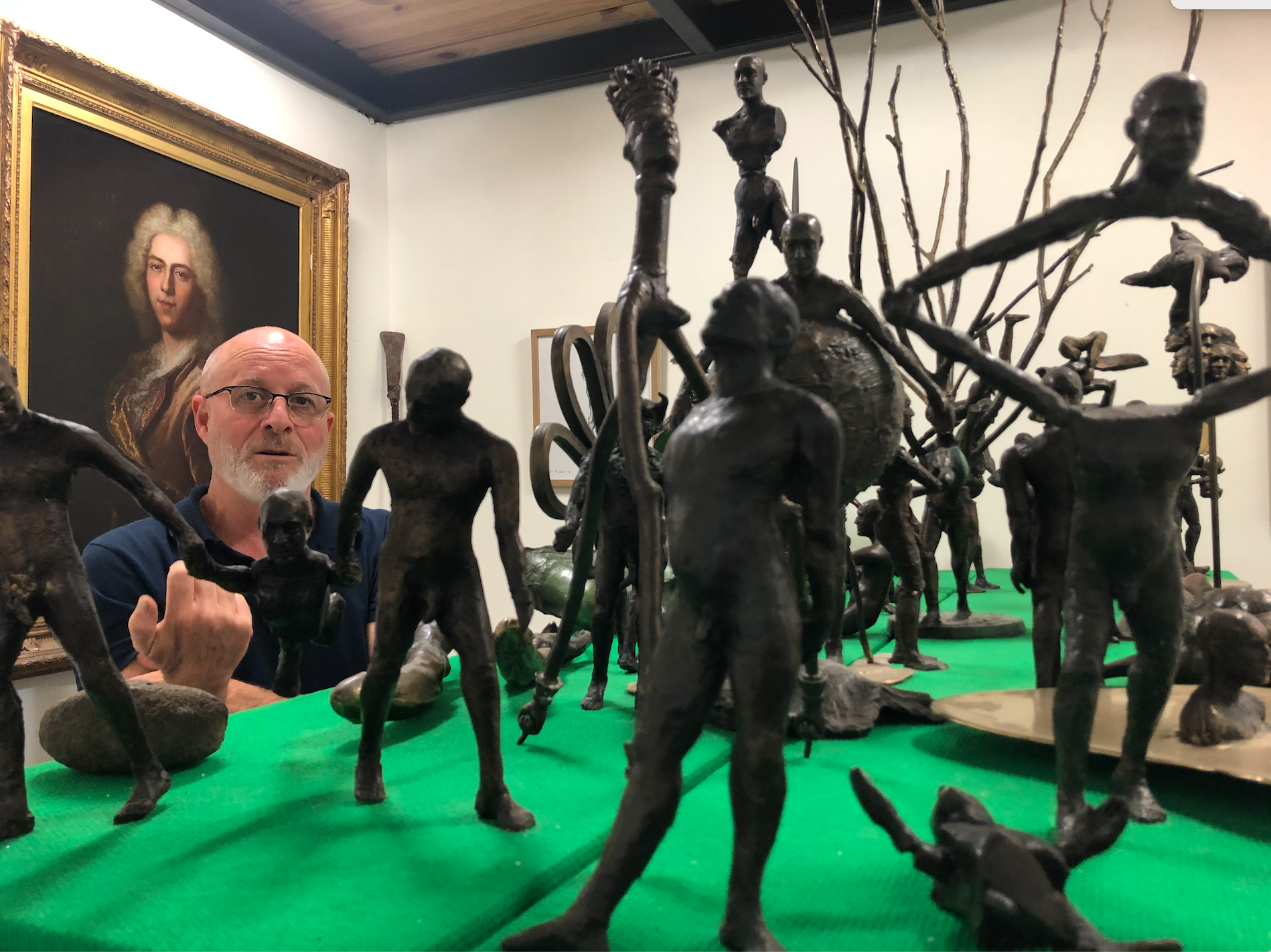
For sculptor Dan Reisner, art is about healing. It is integral to his works, as essential for him as the bronze that forms the sinuous lines of most of his sculptures.
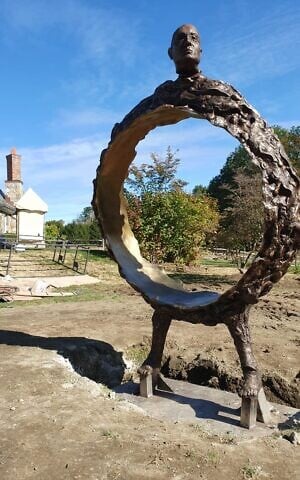
Reisner, who is known for creating massive outdoor installations, also works in marble, iron, and cement. Some pieces are fantastical, while others channel memory and loss, and still others evoke historical moments.
A growing collection of bronze figurines — hand-sized pieces all made in Reisner’s own image — are on display in a small room at the back of his Jaffa studio. They depict the emotions and trauma that their creator experienced personally.
The dozens of self-portraits represent the sculptor’s different identities. One has two heads, another has its torso depicted as a gaping hole, and a third is about to step into a lake of molten lava.
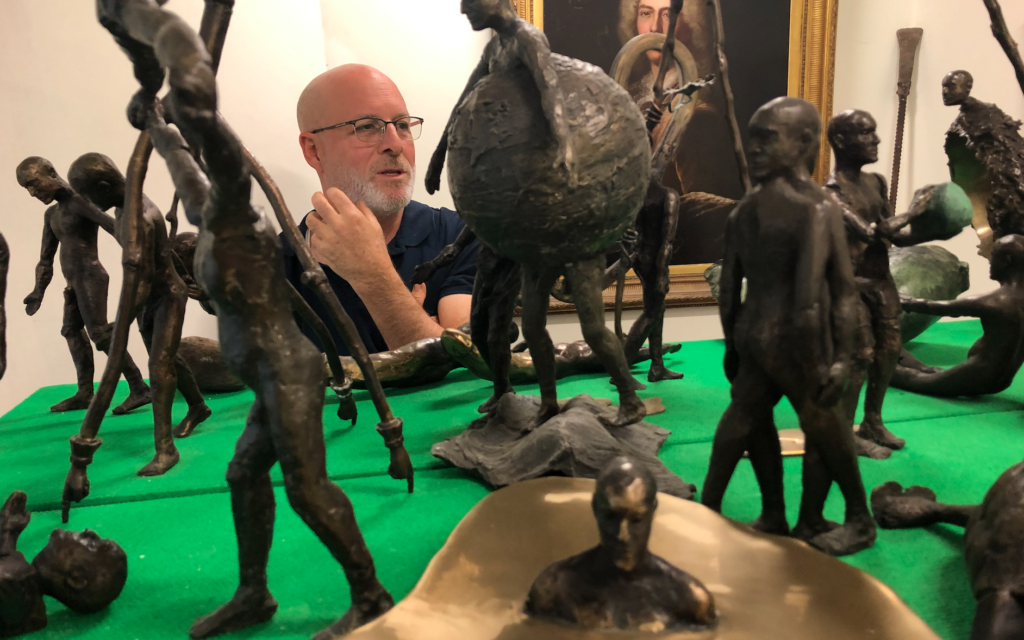
These are intense works, full of emotion, sorrow, and inner pain, present in Reisner’s work for the last 20 years. Their creation is part of his therapy for the post traumatic stress disorder (PTSD) that he suffered as a result of his years as a soldier in Lebanon, from 1983 to 1986, when he served as a combat medic for a paratrooper unit.
“The sculptures have to be honest about what they’re trying to show and to show our vulnerability, which is part of the statement of the work,” he said.
He thinks of Israel’s first Lebanon War, fought to oust Palestinian terrorists in southern Lebanon, as the country’s version of Vietnam, due to many Israelis’ sense of detachment from the war that was being fought on their northern border.
It wasn’t until the outbreak of the Second Intifada, in 2000, that Reisner finally began working his way out of his trauma.
“What I understood immediately was that I’m going to find my way out of it,” he said. “One door said post-trauma, and the ability to sink into that, and the other one said exit, and it was pitch dark and I didn’t know what it would be. That’s what I chose, the exit.”
As he searched his feelings, seeking to understand what he did not know, he would cast them in bronze. He calls it, “From Strait to Create.”
“We’re creating inner objects,” said Reisner. “Most people are creating these inner objects and they don’t know how to translate them into the world, so they’re walking around with heavy loads.”
Clients buy these intensely personal works, finding they spark responses in themselves and others. Others learn the process themselves in Reisner’s Jaffa art studio in the Noga neighborhood, where he has been living and working for the past 30 years, along with other artists who have rediscovered the formerly grimy, rundown area.
“The role of the artist, my role, is to be the one who’s creating these sculptures, in order for others to see that it’s possible to put them out in the world,” said Reisner, who thinks people have become more aware of art given the creativity that has been unleashed with smartphones and social media. “It’s amazing to see people when they look at the sculptures. In the millisecond before they think, they recognize their own sculpture that reflects their own situation, their own sphere.”
It is that reaction that he aims to teach to those who work with him. He wants people to recognize the core reaction in their life, what is happening and what isn’t happening, due to whatever unsolved places they are struggling to escape from.
“Art is about healing, it’s about change and inspiration,” he said. “We heal and show each other that change and new possibilities are there.”
Reisner uses a casting method that has been in place for thousands of years.
He first sculpts in wax, then dips the wax sculpture into a thin, ceramic liquid that wraps the wax from the outside, dipping for 10 days until there is a thick outer layer. The ceramic is then baked until the wax evaporates and the ceramic mold is hollow and precise, and can receive the heat of the bronze.
The bronze is poured into the ceramic mold, cooled and then chiseled into its final shape.
“Your insights and ideas are cast,” he said. “That’s why the bronze is so amazing, when you see the process of how the liquid bronze is poured into its cast, an amazing moment and in a way, a cast is a kind of golem — you break it open to let it out.”
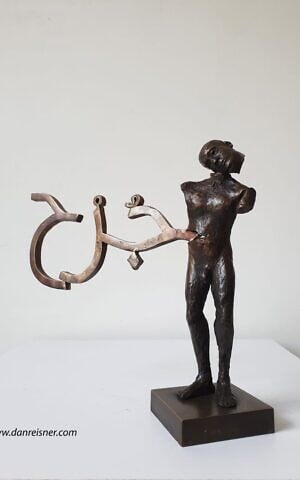
Currently, having been home for more than month during the coronavirus pandemic, Reisner is working on a new series of his bronze figures, adding a new element: words cast in elegant Arabic script. He has spent time recently studying and learning Arabic.
One of the figures includes the word for wound, the other for compassion.
“It’s a way to share and widen the way I’d like to express myself,” he said.
“To show we’re sharing so much together here in our country and in the world, a moment to stop and look at things that we take for granted.”
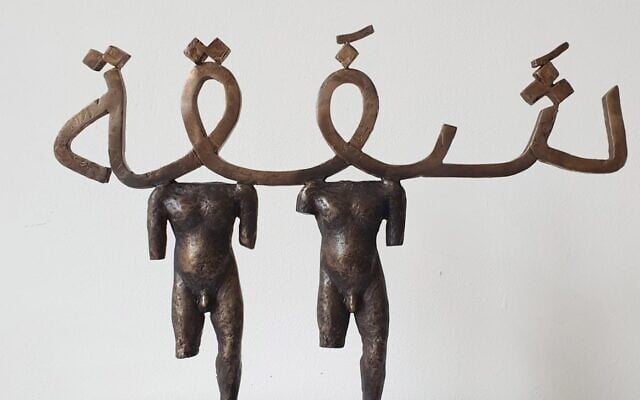
He has spent most of the last month holed up in his studio, on the bottom floor of his apartment building, as the coronavirus pandemic rages.
“I’m used to being secluded and creative, and figuring out what to learn from it and how to delve into that,” he said. “Most of the time you feel like you’re tackling the feelings by yourself and going through something very private. But in this situation, we’re sharing something so strong, together. It’s not just me, the artist, or me with my family, but any ripple, we’re all sharing it, all of humanity. It’s a very empowering moment.”



The Times of Israel Community.