

Outrage at US soldier’s Afghanistan massacre
Assad owes Annan some tough answers, and violence erupts in Iran ahead of the Persian new year
 Add ToI as a Preferred Source on Google
Elhanan Miller is the former Arab affairs reporter for The Times of Israel
Wednesday’s Arab headlines feature the somewhat mysterious proposals of Kofi Annan to Syrian President Bashar Assad, and his yet unknown response to them.
Qatar-based news channel Al-Jazeera reports that there is still an opportunity for a diplomatic solution to the Syrian crisis, adding that Annan was studying the answers conveyed to him by Syria. On Wednesday morning, however, it was unclear what those answers were.
According to the London-based daily Al-Hayat, Annan’s mission focused on three goals: attaining a ceasefire, allowing humanitarian aid to enter Syrian cities and beginning a political dialogue. The daily reports that Assad’s response to Annan’s proposals require “clarification.” Al-Hayat reports that the Syrian army has taken over the northern city of Idlib, which was controlled by army deserters, causing fear that the city may experience a fate similar to that of Homs.
Saudi-owned daily A-Sharq Al-Awsat reports that although Annan did not specify the exact nature of his proposals, he stressed that the international community has “other solutions” if Syria responds in the negative. The daily quotes sources close to Turkish Prime Minister Recep Tayyip Erdogan expressing concern that a positive response from Assad may only be an attempt to buy more time. Ankara, says A-Sharq Al-Awsat, has suffered from Syrian “positiveness” many times before.
Issam Abdullah, commenting in Saudi-owned news website Elaph, predicts an imminent American military intervention in Syria, but warns against possible negative repercussions.
“The American intervention must be limited, taking into consideration the inclusion of democratic forces within the Syrian opposition which want to establish a pluralistic and humane regime in Syria,” writes Abdullah. “The opposition must not turn into armed militias threatening Syrian civil society, and [the Americans] should learn the lessons from events in the region dubbed ‘the Arab Spring.'”
Columnists outraged at Afghanistan massacre
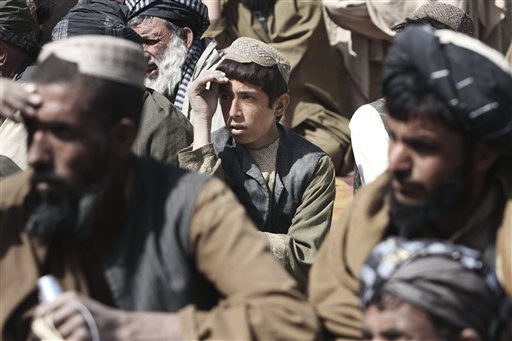
A shooting spree carried out by an American soldier in Afghanistan outraged a number of Arab columnists Wednesday.
In a column titled “American militia in Afghanistan,” Al-Hayat columnist Abdullah Iskandar links the shooting to previous actions of American soldiers, including the burning of Qurans and urinating on bodies of Afghan fighters.
“Despite all of this, the America’s political and military leadership continues to consider these as individual actions,” writes Iskandar. “But this denial, coupled with the political failure to secure reconciliation and the military failure to eradicate the Taliban strongholds, raises questions about what American soldiers are doing in Afghanistan.”
American and NATO forces, concludes Iskandar, are now waging a war against Afghan society and have become “armed militias” fighting the people of Afghanistan, “or so, at least, believe the Afghans.”
Abd Al-Abri Atwan, the editor of London-based Al-Quds Al-Arabi, does not mince words, as usual, in describing the latest American fiasco in Afghanistan.
“After 10 years of occupation and seven billion dollars spent every month, and following the killing of some 100,000 Afghans and 5,000 NATO soldiers, the terror-fighters have become terrorists and murderers committing crimes that dwarf those of the so-called ‘terrorists,'” writes Atwan.
He is even more outraged by the Pentagon’s classification of these actions as “individual.”
“We disagree with the American Defense Department on this characterization and argue that this soldier, in his terrorist action, stems from a culture of hatred to anything Muslim, reflecting the belief of the military and political institutions in the United States.”
“These American massacres, coupled with policies hostile to the Islamic world and completely biased toward Israeli aggression, encourage terrorism and help extremists organizations recruit supporters,” concludes Atwan.
Something moving in Iran?
As Iran prepares to celebrate the Persian new year, some indications are emerging in the Arab press Wednesday of political shifts and instability in Iran.
Dubai-based news channel Al-Arabiya reports that a state of emergency was announced in Tehran following the takeover of a Basij base in the Sadiqiyah neighborhood in the capital. Basij is a volunteer militia loyal to the regime. The takeover followed an explosion in a gas station in Tehran during the festival of fire which precedes the Persian new year Nowruz.
Meanwhile, Egyptian independent daily Al-Masry Al-Youm reports Wednesday that “for the first time in Iranian history,” President Mahmoud Ahmadinejad was questioned by parliament on a number of political and economic matters.
The daily reports that the questioning is a “slap in the face” for the Iranian president who was “resoundingly defeated” in parliamentary elections that took place in Iran earlier this month.






The Times of Israel Community.