

As influence of AI, big data grows, cyber experts discuss tech safety and trust
At international conference in Tel Aviv, experts speak of need to protect public from hazards of algorithm-run lives
 Add ToI as a Preferred Source on Google
Sue Surkes is The Times of Israel's environment reporter

Cyber experts on Tuesday called for a new focus on cyber education to train the professionals needed to ensure that autonomous vehicles are safe.
Dr. Jacob Mendel, head of research cooperation with industries at Tel Aviv University’s Interdisciplinary Cyber Research Center, told a panel at the 5th International Conference and Exhibition on Homeland Security and Cyber that today’s airplanes were so full of electronic parts that it was important to test each one for vulnerability to cyber attack.
Not only were there not enough design engineers with cyber knowledge, he said, but there were insufficient numbers of ‘good hackers’ to test such products out.
“You have to ‘attack’ the device, to use the maximum knowledge we have today to protect it,” he said, calling on production companies to create departments for cyber security alongside those for sales, marketing and engineering.
Dirk Hoke, CEO of Airbus Defense and Space, Germany, warned, “even if you’ve secured your own company, your suppliers and sub suppliers may be exposed. The whole ecosystem needs to be protected.”

Hoke presented a visual depicting how transport might look in 2030. It showed air taxis and a little girl pointing a remote control at a crate of vegetables being delivered by a drone.
Yochai Corem of Cyberbit -– a subsidiary of the Israeli defense technology company Elbit Systems — called on the government to “push, educate and regulate” cyber education.
Tuesday’s presentations focused heavily on issues of artificial intelligence and human trust in them.
Roey Tzezana, billed as a US-based researcher in futures studies, spoke from California via a tablet attached to a physical robot that moved on the stage.
Tzezana described the growing presence of algorithms in our lives — pieces of code which provide the instructions for artificial intelligence (AI) systems. By connecting algorithms together, artificial neural networks are created.
It was algorithms which decided whether you would get a loan from a bank, which recommended friends and products for you, shaped the behavior of the stock market and determined the prices on Amazon, he said.

“An algorithm is a brainless way of doing things — a set of precise steps that if obeyed mechanically, will lead to a desirable outcome,” he explained.
But today, algorithms were actually ‘learning’ from massive amounts of data. If they saw enough pictures of a beef burger, for example, they would eventually be able to generate their own picture of one.
“As a result of artificial neural networks, we have algorithms that are more effective than humans at deciphering human conversation, recognizing numbers, recognizing faces, and beating even the top human players at Go [an abstract strategy board game].
Tzezana described how Chinese authorities are using facial recognition algorithms in their surveillance systems to identify individuals in a crowd of 60,000 people.
The Chinese government is reportedly forcing Muslim Uyghur citizens from the restive Xinjiang region in the country’s north west to download a surveillance app called JingWang Weishi (‘web cleansing’) that records information about each device and scans it for certain files. If an undesirable file is found, the app sends a message to the phone’s owner with an instruction to delete it.
“Who gave algorithms permission to impact our lives?” Tzezana asked rhetorically. “We did,” he replied, adding that algorithms could also cause mayhem.
In one case in 2012, an electronic trading company, Knight Capital Group, lost more than $450 million in half an hour after a faulty algorithm bought stocks in multiple companies, worth billions of dollars, continuing to pay more and more as the stock prices rose.
In another example, algorithmic pricing on Amazon once pumped the cost of a book about flies to more than $3.5 million.
“Soon, we will be surrounded by algorithms, robots and autonomous cars,” Tzezana said. “An autonomous taxi will chose who to pick up and who not. Your Amazon door lock will lock you in your house if Amazon doesn’t like you.”
This artificial power was already so vast that people were withdrawing their trust and voting with their fingers by abandoning giants such as Facebook, Tzezana claimed.

And in losing trust, they were falling back on gut instincts such as fear, doubt, and xenophobia.
“If you are a company providing services based on data, you must realize that people don’t trust as easily as they did before. They want to know there is someone to trust. They want companies to be more transparent, to be regulated – not necessarily by the government but by the public, by some sort of mediator.”
Russell Roberts, chief information officer for the US Department of Homeland Security’s Transportation Security Administration, noted that machines were “not good in gray areas” and had the biases of their creators built into their learning.
“If you are driving your Mercedes in a few years’ time and a truck crosses you, and there’s a cliff on one side and a family on the sidewalk on the other, the Mercedes will protect you and take out the family,” he said. “You don’t decide.”
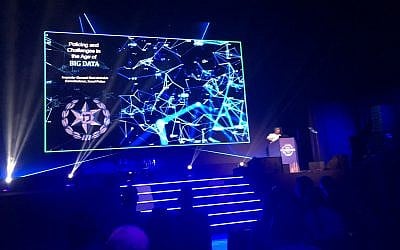
Israel police chief Roni Alscheich said that just as countries were turning to web attacks before activating real armies, so criminals were moving to a cyber world in which they could steal money online without having to physically rob a bank, commit pedophilia without leaving the house and run a casino online rather than risk a police raid.
New challenges faced the force, he said. While collecting online information to catch terrorists had public support, doing the same to catch criminals provoked protest over invasion of privacy, he noted.
The police now had to find which smartphone or computer was used to commit an offense and to prove beyond reasonable doubt the identity of the offender who sat at the keyboard or held the phone while the offense was committed. This was a new form of evidence with which the courts had to become accustomed.
Through engagement with big data, the police had learned to view crime in terms of networks rather than hierarchy, Alsheich went on. By attacking the hubs, they were managing to weaken entire networks.
New methods of big data analysis had led to significant decreases in property crime (down 15 per cent this year compared with 2017) and car theft (down almost 20% last year and a further 18 % this year), he said.
However, complaints about neighbor-related problems such as noise and parking disagreements had risen sharply over the past decade and now accounted for half of all complaints to the police by the public.

High residential towers were isolating people and driving them to seek social connections on social networks, Alsheich added. Residents of neighborhoods were becoming estranged from one another, less tolerant of those they did not know, and more likely to turn to the police if there was noise from the apartment above.
In response, the police were focusing more on community initiatives, he said.










The Times of Israel Community.