

At sensitive meet, Obama and Netanyahu carefully present themselves as allies
PM needs to restore Israel’s bipartisan US legitimacy; Obama doesn’t want to alienate pro-Israel Democrats. And so the two made life easy for each other in joint White House presser

 Add ToI as a Preferred Source on Google
David Horovitz is the founding editor of The Times of Israel. He is the author of "Still Life with Bombers" (2004) and "A Little Too Close to God" (2000), and co-author of "Shalom Friend: The Life and Legacy of Yitzhak Rabin" (1996). He previously edited The Jerusalem Post (2004-2011) and The Jerusalem Report (1998-2004).
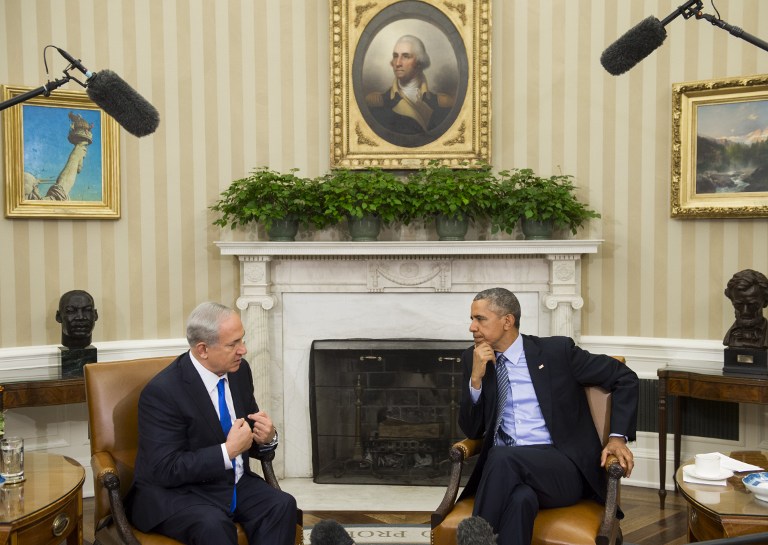
WASHINGTON — After a year of acrimonious and public differences, US President Barack Obama and Israeli Prime Minister Benjamin Netanyahu made a demonstrable effort to present themselves as allies bound by shared interests at the White House on Monday.
Netanyahu had gone to the extraordinary length of lobbying In Congress against the president over the Iran deal in March. Obama has repeatedly attacked the prime minister’s settlement policies. Each thinks he knows better than the other about how to run both of their countries.
But Obama does not want to move toward the end of his term in open dispute with Israel and its supporters in the United States. He may soon be entering the last year of his presidency, but he wants to ensure that it is a Democrat who succeeds him, and thus to avoid alienating voters for whom Israel is a key concern.
And Netanyahu, accused by many critics of turning Israel into a partisan issue in the United States through the ferocity with which he campaigned against Obama’s Iran deal, would plainly like to begin working to bolster the previous, long-time bipartisan support for Israel in the American body politic.
Thus, in their remarks to the press at the start of their first meeting since last October, the two leaders were manifestly respectful of each other, and even helpful to each other, belying all the frictions that lie beneath.
Obama spoke of the imperative to work together to counter common security threats. He talked of the need to get “a head start” on a new framework for long-term American defense assistance. He acknowledged the deteriorating security situation in the region. He said he would be seeking the prime minister’s “thoughts” on how to get back on the path to peace with the Palestinians.
These were all subjects he was bound to raise, but his choice of words was engaging, not demanding or hectoring.
Even on that most bitterly contested of their issues, the Iran deal — the “historic mistake” as Netanyahu has termed it — the president was magnanimous. Their disagreement, he asserted, was confined to the “narrow” issue of the specific accord — but did not extend to the shared awareness of the need to ensure Iran not get the bomb, and to blunt Iran’s destabilizing activities. Infuriated though he may have been by Netanyahu’s battle against the deal these past months, Obama was showing a willingness to now move ahead. He and Netanyahu, he said gently, would be “looking to make sure we find common ground” on the issue.
For his part, Netanyahu also highlighted the desire to work together — and the shared values, interests and destiny that underpin this most vital of Israel’s alliances.
He sought to reassure the president that, even though the White House has concluded that it cannot broker an Israeli-Palestinian accord in the time Obama has left, Israel would “never give up our hope for peace” and specifically for the two-state solution — featuring, as Netanyahu put it, “a demilitarized Palestinian state that recognizes the Jewish state.”
He took a few moments to thank the president personally for ensuring “generous assistance” to bolster Israeli security over the years, and stressed his own and the Israeli public’s personal “appreciation” for those efforts.
And he handled that Iran deal in perhaps the most effective way possible: He didn’t mention it.
Needless to say, furthermore, nobody spoke of that little matter of the new Netanyahu media chief who in March branded Obama anti-Semitic.
Their press statements over, the public display of mutual re-engagement successfully negotiated, Obama tellingly waved away the idea of taking questions, and allowed himself to quietly say “Good” in summation.
Job done publicly. And then off to work in private.






The Times of Israel Community.