

Bank pushes human touch by mocking virtual services
As Israeli banks close branches and go digital, one institution banks on customers hankering for a more personal connection
 Add ToI as a Preferred Source on Google
Simona Weinglass is an investigative reporter at The Times of Israel.

Several weeks ago, a mysterious commercial began making the rounds on YouTube. It shows a typical Israeli kindergarten, and announces with fanfare that the “first digital kindergarten” in Israel has opened on a moshav in the Sharon region.
Everything about the kindergarten is ordinary, except that the preschool teacher is actually a telepresence robot. In one scene, a boy tries to give his teacher a hug, and knocks the robot over. In another scene, a girl asks the teacher to help her wipe herself in the bathroom and the teacher says, “Wipe yourself!”
“We believe in the child’s intuitive ability to independently navigate the digital space,” says the teacher, Tzila. “After 30 years in the conventional education system, to transition to educating from home is a refreshing change!”
But then the inevitable happens: Tzila’s battery runs out. The children are stunned. One five-year-old child who watched the commercial with this reporter concluded, “It’s better to have a teacher who is a real person and not a machine.”
Mysterious sponsors
At first, the digital kindergarten commercial was launched on YouTube without any explanation of who was behind it. A few days later, Mizrahi Tefahot, Israel’s third-largest bank, took credit, with the slogan “Presented as food for thought from Mizrahi Tefahot.”
“The commercial went a bit viral, we got about a million views,” said a source at the bank, although he could not specify whether these views were organic or the result of paid promotion.
“It generated a lot of discussion. Some people said ‘This is terrible.’ Others said, ‘Great idea.’ Not everyone understood that it was in jest.”
But the source said that Mizrahi Tefahot made the commercial to underscore what he sees as a disturbing trend.
“The two big banks, Leumi and Hapoalim, are moving in the direction of digital,” he said. “Their philosophy is that the digital will replace the human, they’re closing branches and laying off workers.”
In 2014-2015, the number of bank branches in Israel fell by 77 out of a total of more than 1,000 banks. Most of the branches were closed by the two major banks, Leumi and Hapoalim. According to the Bank of Israel, 17 percent of all personal banking transactions are conducted over the internet, as opposed to at a branch, and this percentage is expected to rise. Israel’s Supervisor of the Banks Hedva Bar has instructed each of Israel’s banks to present a plan for make themselves more efficient by the end of this year. These plans are almost certain to include closing more branches and laying off more staff.
“At Mizrahi Tefahot, we are going in the opposite direction,” said the source, whose bank has, in fact, closed almost no branches in recent years. “We believe that for things like investment advice, mortgage counseling and tips on how to manage your bank accounts, there is no replacement for a human banker.”
This digitization of banks, which is part of a global trend, can be felt keenly at the corner of Nordau and Ibn Gabirol Streets in Tel Aviv, for instance. Three years ago there were three banks there, all of which were closed and later replaced by a single flagship “digital branch” of Bank Hapoalim, where there are no tellers and only a handful of employees. Visitors to the sleek branch, which resembles an Apple Store, conduct all their transactions on tablets, with employees approaching customers if they need help.
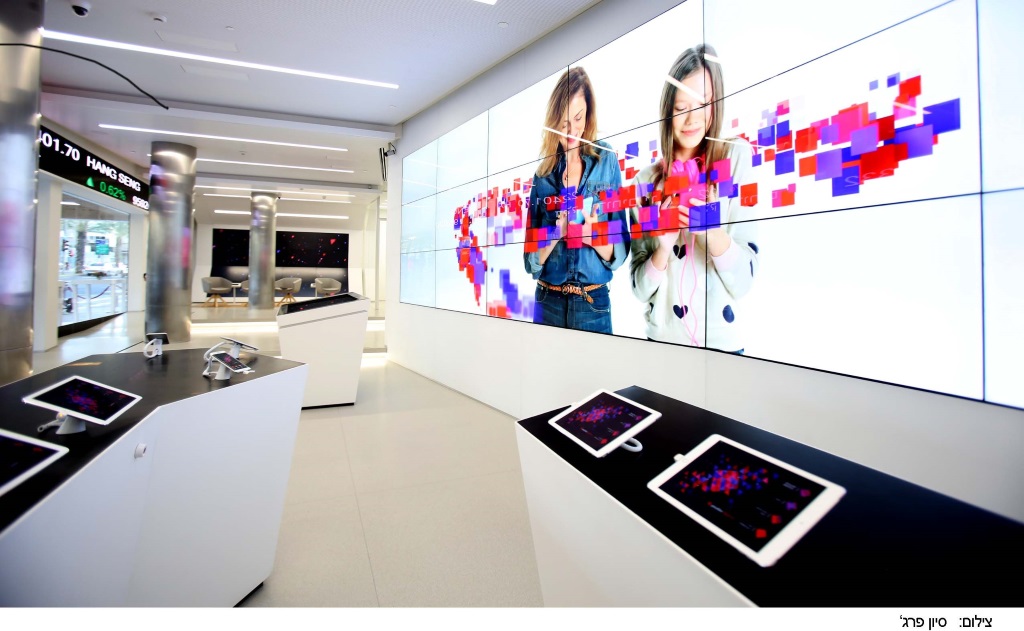
People in the neighborhood have complained that the branch is often empty, while the closure of other bank branches leads to long lines at the ATM outside.
“That branch is a failure,” said Noa Zlotnik, a spokeswoman for the labor union of Israel’s First International Bank. “Who needs a digital branch when you can do the same thing at home over the internet?”
Hanoch Livne, chairman of the worker’s union at the First International Bank, told The Times of Israel that the fear of being replaced by robots, smartphones or tablets looms very large for bank workers in Israel today.
“The banks are making the customers into bank tellers. They’re making customers do the work without paying them.”
Livne thinks this is bad for both the customers and the banks.
“Customers used to be loyal to banks, or to a particular branch, because they knew the person who gave them service. This is disappearing. The banks want everything to be digital, in part to save on salaries.”
The large banks, for their part, say they are just giving customers what they want as well as streamlining their operations.
However, Livne compares the trend he sees in the banking world to what happened recently when he tried to get his internet service fixed.
“It’s impossible to get a person on the phone. The fastest way to get my internet restored is to call the competitor and sign up with them. Because when they want to sign you up, they answer the phone right away. This is the same thing that’s happening to banking,” he says. “The personal touch is going away, pretty soon it will be the human up against a machine.”










The Times of Israel Community.