

Bereaved families to Liberman: Don’t appoint Yair Golan as IDF chief
Former deputy head of the army once compared trends in Israeli society to Nazi Germany, said soldiers must take risks to avoid harming Palestinian civilians
 Add ToI as a Preferred Source on Google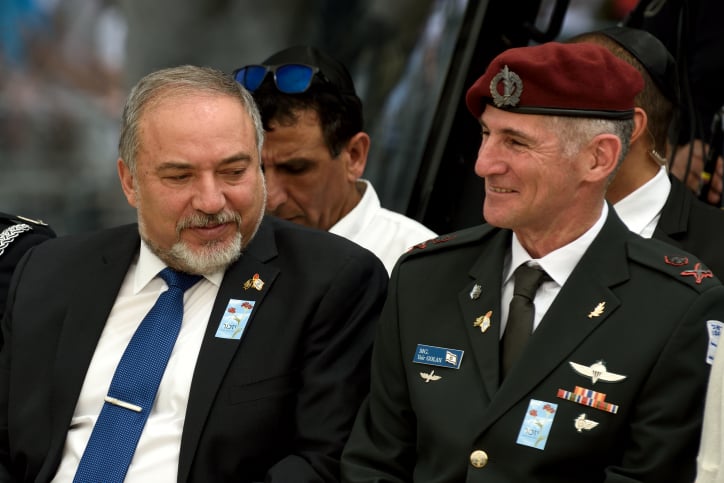
More than 100 members of bereaved families have written a letter to Defense Minister Avigdor Liberman asking that a former deputy IDF chief, who made several controversial statements about the mistreatment of Palestinians by the army, not be considered to become the next chief of staff, Hadashot news reported Sunday.
The families objected to the possible selection of former deputy chief of staff Maj. Gen. Yair Golan, saying he had made a series of “outrageous” statements that indicated he took “unnecessary risks with the lives of his soldiers.”
Liberman has begun the process of selecting a new IDF chief of staff to succeed Gadi Eisenkot, who ends his term as commander of the military on December 31.
The selection process — developed at the recommendation of the military advocate general — consists of six stages, with the leading candidate seen as the current deputy chief of staff, Maj.-Gen. Aviv Kochavi.
Kochavi, 54, who until recently was the commander of the Northern Command, previously served as head of Military Intelligence and as commander of the Gaza Division during the 2005 disengagement from the Strip.
In addition to Kochavi and Golan, other potential contenders are Eyal Zamir, until recently commander of the Southern Command, and Nitzan Alon, who formerly served as commander of the Central Command and is currently a project manager on Iran.
“A worrying picture comes from these statements of a commander who is prepared to take unnecessary risks with the lives of his soldiers,” the letter said of Golan. “As bereaved parents, siblings and spouses these quotes very much concern us. A man who thinks the blood of our children is cheap cannot protect or command them.”
Golan once said it was “intolerable” that Israeli soldiers place Palestinian civilians in harm’s way instead of themselves.
“In the presence of civilians we take upon ourselves risks, and rightly so,” he was heard saying on recordings made in 2006. “It’s unacceptable that in the name of preventing risk we would decide that now we are going to mow down an apartment building. You would kill women, children, those involved. It’s intolerable.”
If “an army unit needs to take risks in order not to harm bystanders, yes, it will take those risks not to harm bystanders,” he said.
Later in the recording, he warns soldiers that not every suspect person is a terrorist and tells them they can’t just kill people.
“Not in every combat situation are we all right-wing, are we all about to be slaughtered, and not every woman is hiding a terrorist behind her,” said Golan, then a commander in the Judea and Samaria Division. “I expect commanders to understand situations and take reasonable steps.”
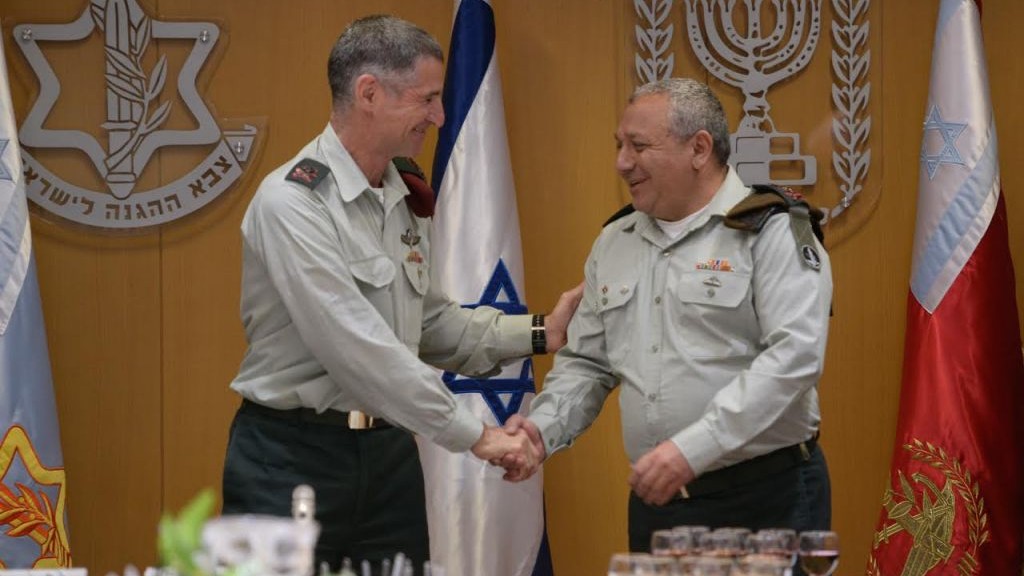
Golan also drew public ire in a national Holocaust Remembrance Day ceremony in 2016, when he compared trends in Israeli society to those of pre-World War II Germany.
At an official ceremony in front of the Western Wall in Jerusalem, the major-general had said that “if there is something that frightens me in the memory of the Holocaust, it is identifying horrifying processes that occurred in Europe…70, 80 and 90 years ago and finding evidence of their existence here in our midst, today, in 2016.”
While his critique of Israeli society was likely aimed at support for Jewish extremist actions, Golan specifically touched upon the issue of moral flaws within the army, saying the strength of the IDF was its ability to thoroughly investigate and punish wrongdoers “and take responsibility for the good and the bad” without justifying their actions or attempting to cover them up. The speech came amid handwringing over the case of Elor Azaria, a soldier who shot and killed a wounded and disarmed Palestinian assailant in Hebron months earlier and who was convicted of manslaughter.
Eloquent in both Hebrew and English, Golan holds a master’s degree from Harvard University. He was wounded but continued to command during a shootout with Hezbollah fighters in 1997 and was a well-regarded officer in the IDF, holding a number of top positions, during his 37-year career.
Judah Ari Gross and Michael Bachner contributed to this report.







The Times of Israel Community.