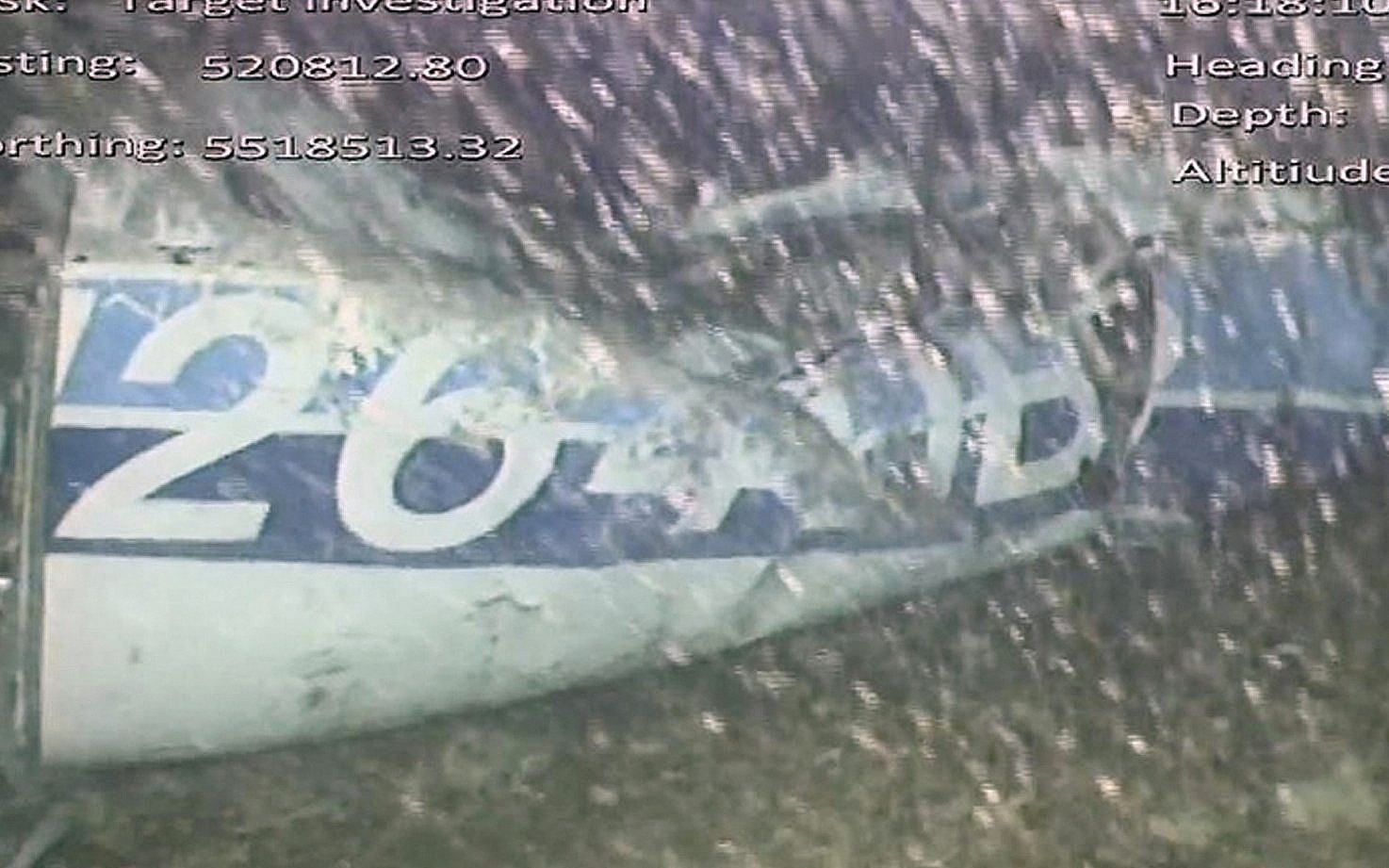
In this image released on February 4, 2019, by the UK Air Accidents Investigation Branch (AAIB) showing the rear left side of the fuselage including part of the aircraft registration N264DB that went missing carrying soccer player Emiliano Sala, when it disappeared from radar contact on January 21 2019. (AAIB via AP)
LONDON (AP) — One body is visible in the seabed wreckage of a plane that went missing carrying Argentine soccer player Emiliano Sala and his pilot two weeks ago, air accident investigators said Monday.
Sala and pilot David Ibbotson were on board the small aircraft that disappeared from radar over the English Channel on January 21 as it flew from the French city of Nantes to Cardiff, Wales.
Sala, a striker who played for Nantes in the French top flight, was preparing to start a new career in the Premier League at Cardiff.
Wreckage from the plane was located on Sunday after Sala’s family raised funds for a private search by American-born shipwreck-hunting specialist David Mearns that was conducted in conjunction with British air accident investigators.
In this photo from January 30, 2019, a Nantes soccer team supporters stops by a poster of Argentinian player Emiliano Sala and reading “Let’s keep hope” outside La Beaujoire stadium before the French soccer League One match Nantes against Saint-Etienne, in Nantes, western France. (AP Photo/Thibault Camus, File)
An underwater remotely operated vehicle surveyed the seabed and confirmed an object was the missing Piper Malibu aircraft, with the registration N264DB visible in a picture of the fuselage released Monday.
Get The Times of Israel's Daily Editionby email and never miss our top stories
“One occupant is visible amidst the wreckage,” the Air Accident Investigation Branch said in a statement. “The AAIB is now considering the next steps, in consultation with the families of the pilot and passenger, and the police.”
Investigators say they plan to release an interim report into the accident this month.
Advertisement
Help us report truthfully on social media
As a multimedia journalist, my job is to take the quality, fact-based journalism produced by The Times of Israel newsroom and make it accessible across every platform — from Instagram posts to podcasts to short-form videos.
This is how many, especially young people, consume news these days. But misinformation is rampant on social media. Our team at ToI produces accurate, responsible short-form reporting on Israel and the Jewish world.
If you believe in the importance of factual social media journalism, please consider joining our reader support group, The Times of Israel Community. Your financial support is essential to sustain responsible multimedia reporting.
We’re really pleased that you’ve read X Times of Israel articles in the past month.
That’s why we started the Times of Israel - to provide discerning readers like you with must-read coverage of Israel and the Jewish world.
So now we have a request. Unlike other news outlets, we haven’t put up a paywall. But as the journalism we do is costly, we invite readers for whom The Times of Israel has become important to help support our work by joining The Times of Israel Community.
For as little as $6 a month you can help support our quality journalism while enjoying The Times of Israel AD-FREE, as well as accessing exclusive content available only to Times of Israel Community members.
Thank you, David Horovitz, Founding Editor of The Times of Israel


 Add ToI as a Preferred Source on Google