

Bombing the war drums into submission: 9 things to know for July 22
Israel portrays Hamas as begging for a ceasefire after the weekend’s bombing campaign, but the calm is seen as temporary as the Syrian White Helmets brief stay in the country
 Add ToI as a Preferred Source on Google
Joshua Davidovich is The Times of Israel's Deputy Editor
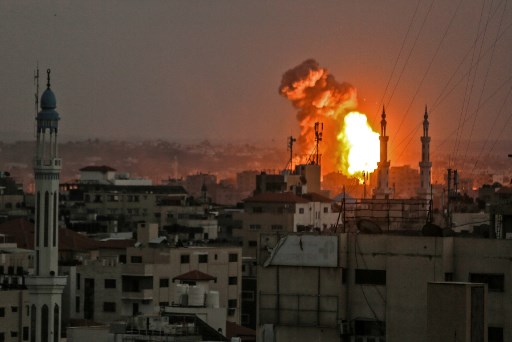
1. How close were Israel and Gaza to reaching full-out war over the weekend? According to Israel’s Channel 10 news, Egypt told Hamas that Israel would launch a war “within two hours” if it tried responding to a massive air raid that came in retaliation for the killing of an IDF soldier on Friday.
- Instead, the sides reportedly reached a ceasefire, and the war drums are behind them, for now.
- “Israel did bomb Hamas battalion headquarters, but was careful not to target senior Hamas officials. Hamas refrained from firing rockets deep into Israel even after coming under fire. The result is a U-turn on the precipice – war was avoided, perhaps just for the time being,” writes Amos Harel in Haaretz.
- Unlike Syria and other places where Israel uses plausible deniability to keep from bragging about putting its enemy down, in Gaza, it seems to go out of its way to portray Hamas as on its knees and begging for a ceasefire.
- Tabloid Yedioth Ahronoth goes for the rah-rah, with a top headline reading “Hamas blinked” and playing up an editorial cartoon of Hamas leader Ismail Haniyeh holding a rocket launcher, facing a tank and yelling out “pause the game,” in Israeli slang.
- The paper reports that Hamas turned to five different channels — including Qatar, Egypt and the UN’s Nikolay Mladenov — to ask Israel to cease hostilities.
- “Hamas absorbed a serious blow and requested a ceasefire via Egypt, committing to stop arson terror via kites and balloons and the border terror,” fellow tabloid Israel Hayom quotes a senior Israeli defense official saying.
- The paper also notes that Israel is rebuffing reports that it agreed to ease the Gaza blockade as well as call off its air raids.
2. Yet like a bad horror movie itching for a sequel, there are enough loose ends to get everything tangled up in fighting again, and there is little delusion that things are actually settled.
- ToI’s Avi Isscharoff notes that bringing things to the edge and then pulling back, which seems to be a weekly occurrence, seems to be Hamas’s strategy, but it’s playing with very literal fire: “By relentlessly causing fires on the Israeli side of the border, Hamas is keeping the discussion going in Israel, and in the US, about a possible agreement with Hamas and maintains the terror group’s centrality as a key entity in the Palestinian sphere. The question is whether Haniyeh and his colleague Yahya Sinwar understand that having Gaza make international news because of the loss of life could ultimately lead to a wider conflict.”
- “This round ended at the same place where the 2014 war ended four years ago,” Yedioth’s Nahum Barnea writes. “All the problems that led to that conflict and to the current confrontation are still hanging in the air. Nothing has been solved, nothing has moved forward, and in actuality, the problems have gotten worse.”
- Israel Hayom’s Yoav Limor writes the sides did little but buy themselves some time but praises Israel’s own strategy, which he says has managed to keep things relatively calm on the border and avoid loss of life, until now. Now, he says, those who said we shouldn’t go to war because the low-level conflict had not led to any loss of life will have a harder time making their case.
- “It seems there’s also a price to the campaign on the border. It doesn’t mean we need to launch an operation, but we definitely need to understand that keeping from one has a price,” he writes.
3. Sunday marks the fast of Tisha B’av, when Jews mourn the loss of their two ancient temples. According to Abraham Rabinovich’s fascinating account of the Yom Kippur War, as Syrian forces advance on the Golan, Defense Minister Moshe Dayan began using a shocking phrase, warning that Israel was in danger of losing “the third temple,” i.e. the state.
- Over 40 years later, the Golan is securely in Israel’s hands and that’s good news for the Syrian civil defense volunteers, known as White Helmets, who were spirited out of the Syrian Golan and into Israel last night, over fears they would be targeted by Syrian and Russian forces advancing on Quneitra.
- Official reports put the number of people transferred in the rescue, including the White Helmets and their families, at 800.
- The volunteers had already been transferred to Jordan, from which they will be absorbed by Western countries, by the time the story emerged on Sunday morning.
- The imminent rescue was first reported by the Associated Press early Friday, though with no mention of Israel (though it seemed obvious a crossing at Quneitra would have to involve Israel in some way).
- According to the German daily Bild, the rescue had been talked about for several weeks, but there was no actual green light until the last moment. The German reporter notes that the area was cordoned off, though he managed to get a video of jeeps and buses taking part in the operation.
Evacuation of white helmets plus families still ongoing here at syrian israeli border. Plan is to drive asap to jordan. @BILD pic.twitter.com/KcBOdduM2t
— Paul Ronzheimer (@ronzheimer) July 22, 2018
- An individual involved in the rescue tells Hadashot news the effort was “one of the most moving operations. There were lots of children.”
- The rescue is notable for being the first time Israel has allowed healthy Syrians to escape into the country. Jerusalem has adamantly refused to allow Syrian refugees in and a highly touted plan to allow in 100 orphans a couple of years ago seemingly fizzled away.
- Haaretz reports that the White Helmets were put on a bus that took them straight to Jordan without stopping, and that the operation was over by 6 a.m.
4. Syria’s state-run media is also reporting on the operation, though their account calls the White Helmets “terrorists,” and accuses them of helping carry out chemical attacks.
- A separate story by state run media about rebel fighters leaving the Quneitra region under an evacuation agreement claims “Israeli weapons” were found on some of the fighters being put on buses.
- Though Israel has maintained a policy of non-intervention (aside from bombing Iranian positions and Syrian posts in response to errant shells), Syria has long viewed its humanitarian aid as support for the rebels and some saw its bid to retake Quneitra as a form of cutting off a so-called supply chain.
- Israel has reportedly recently agreed to accept Assad’s continued rule as part of a deal with Russia to keep Syria away from the border, and it’s unclear if the Kremlin will care about its involvement in saving the White Helmets. Given the army’s lack of keeping the operation a secret, though, it’s unlikely they are very worried.
5. The drama at the border gets fairly little coverage in the Hebrew press, with most news sites focusing on the large protests in Tel Aviv and elsewhere for LGBT rights.
- Pictures broadcast by media show hundreds in Tel Aviv blocking the central Ayalon highway, and a smaller crowd outside the Prime Minister’s residence at Jerusalem’s Paris Square (a tiny traffic circle where a crowd of more than 100 would be forced to block traffic due to lack of room)
- The protests came after the Knesset refused to back surrogacy rights for gay would-be dads, and many news sites have shown support for the demonstrations letting workers go on strike.
- The Walla news site, which changes its logo to a rainbow flag in support, runs a liveblog pulling out all the graphic bells and whistles to cover the protests.
- “The public anger is understandable … I hope the protest will be heard in the halls of the government and courts and will bring an end to the injustice,” lawyer Haggai Kalai, who is suing over the law, tells the site.
6. In Haaretz, Or Kashti writes that the fight for LGBT equality resembles other fights in Israel for equality and against ultra-Orthodox hegemony.
- “The broad support for this fight is encouraging and heartwarming. Hopefully it will be a gateway to civil support for battles in other areas. Recognition of secular-liberal power can be infectious.
- Much of the anger is against Prime Minister Benjamin Netanyahu for his apparent about-face on the issue. Netanyahu has maintained he was forced into not supporting it for coalition reasons, and that he actually is for gay surrogacy.
- The sympathetic coverage in Israel Hayom, normally seen as closely following his stance on most issue, may serve as an indication he is telling the truth.
- “The process of bringing in a surrogate child from outside is long, expensive, complicated and sometimes forces couples to decide between being parents or buying a home,” the paper writes.
7. Another unpopular law — allowing internet censorship — was stopped at the last minute by the intrepid reporting of ToI’s Raoul Wootliff. On Friday, Wootliff laid out how he caught a clause which could have led Israel to look more like Iran and tries to figure out who put it in there and how nobody else knew about it.
- “In discussions with The Times of Israel, both backers of the bill who fought for a more robust application of the censorship provisions, and Knesset members who sought to limit its reach, said they had simply not understood that the law could apply to the entire internet,” he writes in one passage, terrifying for what it means for other legislation that slips through the net.
- 8. In the Forward, Sam Sokol writes about a battle between religious and secular council representatives over whether cafes and other establishments should be closed on Tisha B’av, or should put up signs bragging that they are open.
- “Asked how opening a restaurant was any different from an ultra-Orthodox family barbecuing on Yom HaShoah, he replied that the two days of mourning were fundamentally different and that there was no consensus on the traditional fast,” Sokol writes of councilman Reuven Ladiansky, pushing for the “open on Tisha B’av” signs.
- That reasoning dovetails with a recent survey which finds “more than half of Israelis see Tisha B’Av as just another day on the calendar,” according to JTA.
- “This stands in stark contrast to other national days of mourning like Yom Hashoah or Yom Hazikaron, where ‘only a small percentage of Jews (9 percent and 5 percent respectively, most of them ultra-Orthodox) claim they are just regular days,’” JTA quotes from study author Camil Fuchs.
9. In ToI, Amanda Borschel-Dan uses the day as a peg to look at how the expansion of a pluralistic prayer plaza at the Western Wall could end up damaging archaeological finds attesting to the destruction of the Second Temple in 70 CE.
- “Jewish tradition states the Second Temple was destroyed because of “sinat chinam” — baseless hatred and infighting among the Jewish people. Today, as the Israeli government pushes forward with a construction plan designed to bridge gaps with Diaspora Jewry, archaeologists fear that the evidence that preserves a previous time of destructive Jewish factionalism is set to be erased from history,” she writes.





The Times of Israel Community.