

Burial society gears up for COVID-19 funerals, as health officials lay out rules
Ministry initially bans religious funeral rite for coronavirus victims, then backtracks; chevra kadisha volunteers, in protective gear, being trained to deal with virus casualties
 Add ToI as a Preferred Source on Google
Marissa Newman is The Times of Israel political correspondent.
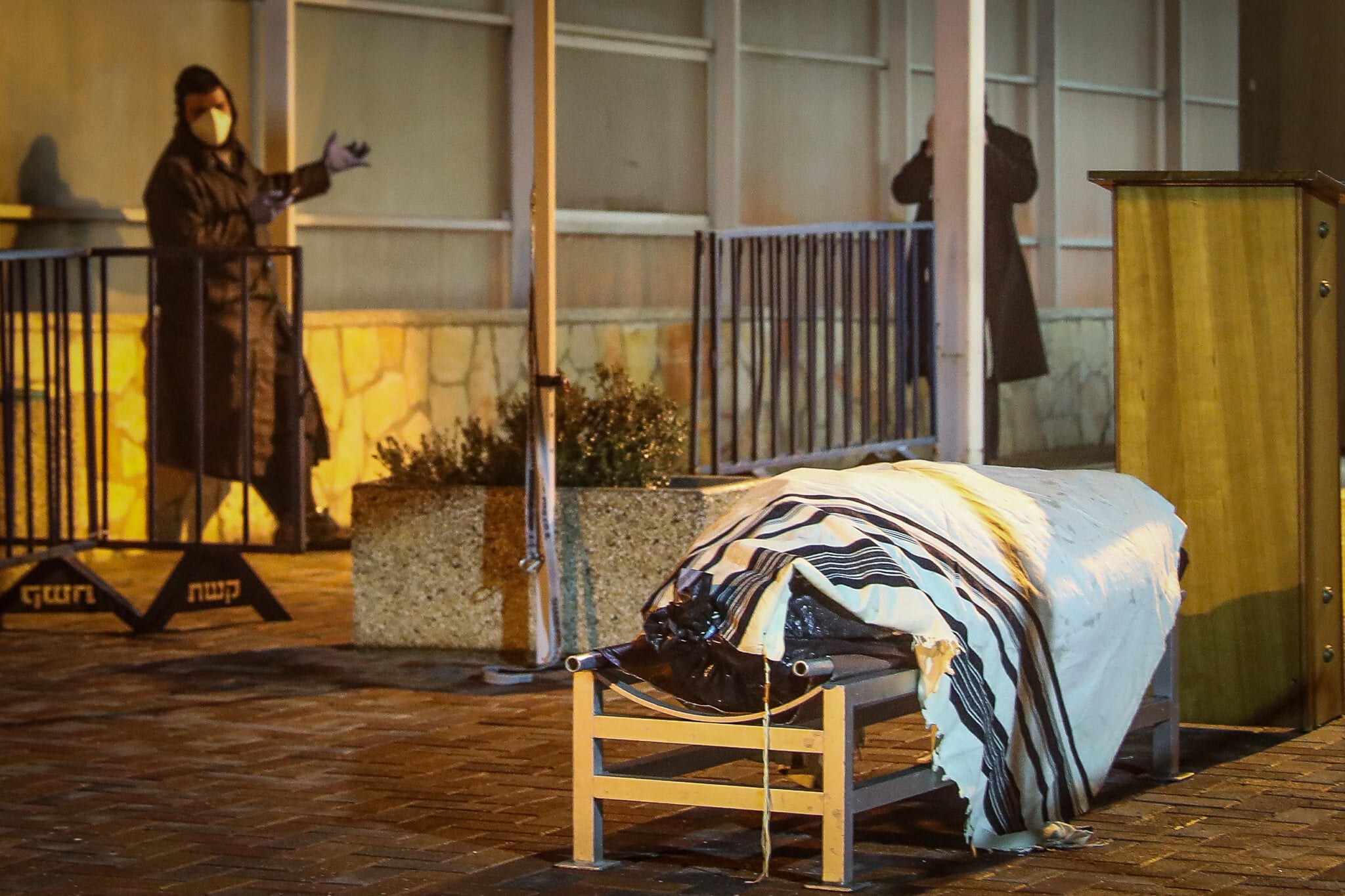
Israel’s religious burial authorities have set up four specialized units for the interment of victims of the COVID-19 pandemic, in coordination with Health Ministry regulations, which will see volunteers perform traditional Jewish funeral rites while in full protective gear.
As the virus began to spread in Israel, the Health Ministry 10 days ago released an order banning the country’s religious burial society, the chevra kadisha, from conducting the tahara purification rite on future fatalities of the coronavirus over fears of contagion.
But following meetings between officials in the Health Ministry and Religious Affairs Ministry, the health authorities reversed its previous position last week, setting up new regulations allowing for the religious pre-burial ceremony. The initial order and its reversal came before Israel saw its first death from the virus on Friday, 88-year-old Aryeh Even, a Holocaust survivor from Jerusalem.
Israel’s Health Ministry is led by Yaakov Litzman, an ultra-Orthodox politician; burials in Israel for Jewish citizens are handled by the state religious authorities.
“What we explained to the health minister and the religious affairs minister is that in this period, when people’s morale is already at rock bottom, we cannot let the family members, or anyone who has a friend, a neighbor, who passes away and is buried like — excuse me — not like a human being, we can’t do it to the morale,” said Dov Gelbstein, the head of the special Jerusalem chevra kadisha coronavirus unit, who oversaw Even’s Saturday night burial at the Givat Shaul cemetery.
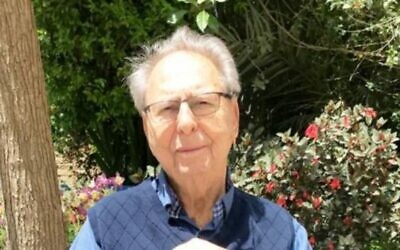
“So even if it’s a matter of money, if it’s a matter of time, of training, we must give them the appropriate respect — not only for religious reasons, but for reasons of morale, and for the public,” he told The Times of Israel.
The revised Health Ministry rules, publicized on March 17, set out conditions under which the religious tribute honoring the deceased — which sees their bodies thoroughly cleaned and doused in water in a series of purification rituals, before being dressed in the white linen shrouds in which they are buried — may be conducted.
It lays out strict disinfectant regulations for both the state’s burial society and the medical teams handling the remains, and requires all those in contact with the bodies to wear full-body protective gear. Autopsies are not required for COVID-19 victims, though if performed also force pathologists to take sterility measures.
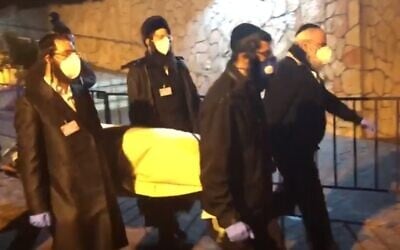
In addition to the traditional shrouds, or tachrichim, the victims must also be buried in plastic to prevent the spread of the disease, but do not need be interred in a separate part of the cemetery, according to the regulations.
The bereaved are not permitted to touch the bodies, but do not need to keep any distance from their loved ones’ remains during the funeral, it said. Mourners at the funeral do not require any protective equipment, it said.
The Health Ministry also banned indoor funerals, saying all eulogies and prayers preceding the burial must be held outdoors. First-degree relatives of the deceased who are confined to home quarantine must receive special dispensation from the Health Ministry to attend the funeral. Attendance will be capped in accordance with the broader Health Ministry rules on public gatherings, it said, which currently are limited to 10 (some 20 people were reportedly permitted to attend Even’s funeral).
Nearly 1,000 people have been infected with the virus in Israel as of Sunday, and the Health Ministry has warned the numbers of dead will likely rise.
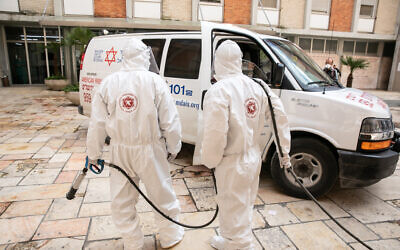
A Religious Affairs Ministry spokesperson confirmed four chevra kadisha units have been set up to conduct funerals for Jewish victims of the pandemic in line with Health Ministry rules.
The Health Ministry did not respond to a request for comment on its reversal of policy.
According to Gelbstein, the ritual pre-burial customs would be performed in special isolated facilities set up in Jerusalem, Tel Aviv, and in the north and south of the country. Both male and female volunteer staff are being trained on the health regulations (for the purposes of the tahara ritual, women perform the ceremony on women, men on men, for reasons of modesty).
“Caution is essential, but at the same time, we can treat them like the hospitals do, like the medical staff does, like Magen David Adom when they take samples from coronavirus patients,” said Gelbstein.
כעת בירושלים, נערכים להלוייתו של אריה אבן ז"ל.
(צילום: גחש״א קהילת ירושלים) pic.twitter.com/0SrRb0Q52Q— אהרן רבינוביץ (@AronRabino1) March 21, 2020
Four days after the Health Ministry regulations were revised, the new chevra kadisha coronavirus unit in Jerusalem was met with its first COVID-19 burial.
Aryeh Even, said Gelbstein, was treated with “respect for the dead of the highest possible order.”



The Times of Israel Community.