

Director Amos Gitai accuses government of ‘cozying up to anti-Semites’
At movie premier in Venice, Israeli filmmaker appears to refer to Netanyahu’s friendship with Hungarian leader Orban, says country’s ‘open society’ at risk
 Add ToI as a Preferred Source on Google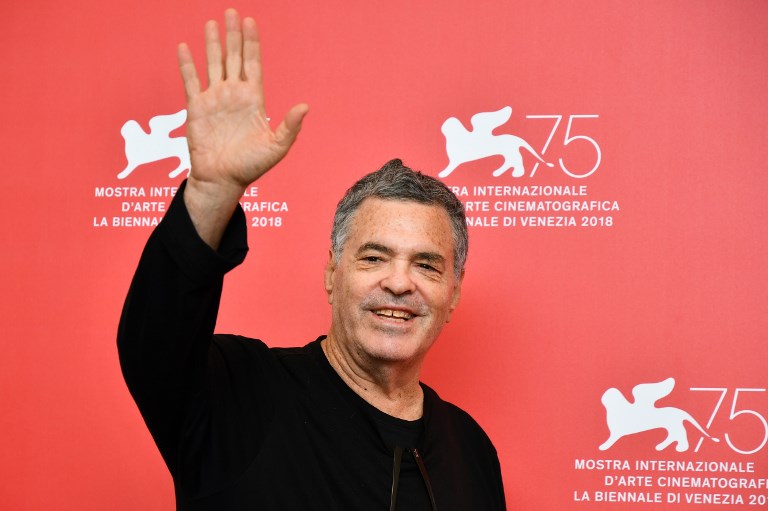
Israeli film director Amos Gitai lambasted the government Monday for trying to “turn culture into propaganda,” and for cozying up to the “worst anti-Semites in Europe.”
The left-wing filmmaker warned that Israel’s “open society” has been put at risk by Prime Minister Benjamin Netanyahu’s right-wing government, as the artist premiered two new documentaries at the Venice film festival.
“It used to be said that the best homage that an artist can make to his country was to be critical of it,” he told reporters. “Strong cultures don’t always need to be caressed. But in Israel now there is a big debate about the minister of culture of this very bad government who thinks that all culture is propaganda.”
He was referring to Culture Minister Miri Regev, who has repeatedly verbally clashed with members of Israel’s culture elite, many of whom are critical of the government.
Gitai, 67, who was badly wounded in the 1973 Yom Kippur War, insisted that he and other Israeli liberals “love our country, but the direction the country is taking is very problematic. The government can destroy the very idea of an open society.”
The director, who said his next project will be about the origins of European anti-Semitism, blasted Netanyahu for what critics called his “illiberal bromance” with Hungarian leader Viktor Orban.

Orban drew criticism last year for praising Miklos Horthy, Hungary’s World War II-era ruler, who introduced anti-Semitic laws and collaborated with the Nazis.
Critics have also accused Orban of employing anti-Semitic tropes against the Jewish Hungarian-American billionaire philanthropist George Soros during his reelection campaign. In denouncing Soros, Orban said Hungary’s enemies “do not believe in work, but speculate with money; they have no homeland, but feel that the whole world is theirs.”
Despite global Jewish condemnation of those remarks, Netanyahu praised Orban for combating anti-Semitism and thanked him for Hungary’s pro-Israel stance.
Gitai said people have to speak out “when you see Netanyahu shaking hands with the worst anti-Semitic leaders in Europe — and at the same time he allows shooting unarmed Palestinian protesters in Gaza. He only believes in physical force. This is very un-Jewish so it needs to be criticized.”

He was referring to the March of Return protests organized since March 30 on the Gaza border, in which 125 protesters have been killed by Israeli fire. The clashes, which Gaza’s Hamas rulers have orchestrated, have included rock and Molotov cocktail attacks on troops, as well as attempts to breach the border fence and attack Israeli soldiers.
The Hamas terror group, which seeks to destroy Israel, has acknowledged that dozens of those killed were its members. During that time, a Gaza sniper killed an Israeli soldier.
Gitai screened two films at the festival, “A Letter To a Friend in Gaza” and “A Tramway in Jerusalem,” both trying to warn of where Israel’s “intransigence” might lead it.
He also said anti-Semitism is still deep in the “DNA of European society,” so it is no surprise it should be resurfacing across the continent.
“Its origins are religious, the Church brought up generations to hate the Jews, they burned Jews and discriminated against them and humiliated them for centuries.”
But the Jews have survived and “prevailed. They are still around which is impressive, but they should not forget the lessons.”










The Times of Israel Community.