

World leaders reject Trump’s stance on nuclear accord
European and Russian officials say they stand by deal with Tehran, while Saudi Arabia and Israel welcome US president’s strategy
 Add ToI as a Preferred Source on Google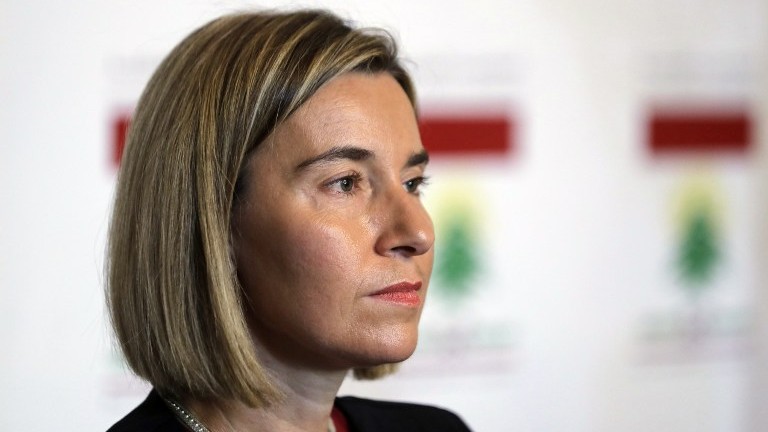
The EU’s top diplomat Federica Mogherini said Friday that the Iran nuclear deal was “working and delivering,” insisting US President Donald Trump did not have the power to terminate it.
Mogherini, who was touted as a Nobel Peace Prize candidate for her work on the 2015 agreement, said the EU would abide by it and she expected other parties to do the same.
“We cannot afford as an international community, as Europe for sure, to dismantle an agreement that is working and delivering,” she said after Trump announced he would not certify the agreement, and warned he may yet walk away from it.
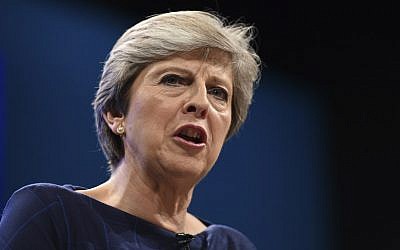
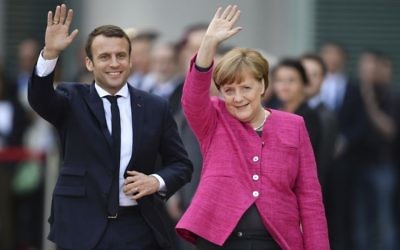
The leaders of Britain, France and Germany also said they remain committed to the nuclear deal. British Prime Minister Theresa May, French President Emmanuel Macron and German Chancellor Angela Merkel said they “stand committed to its full implementation by all sides,” according to a joint statement released by May’s Downing Street office.
The leaders said they “encourage the US Administration and Congress to consider the implications to the security of the US and its allies before taking any steps that might undermine the JCPOA, such as re-imposing sanctions on Iran lifted under the agreement.”
The three leaders said they were concerned about Iran’s ballistic missile program and that they “stand ready to take further appropriate measures to address these issues.”
Russia’s foreign ministry, meanwhile, criticized the new Iran strategy announced by Trump as one using “aggressive and threatening rhetoric,” but said it expected the nuclear deal to stay intact.
The ministry in a statement said it expected Trump’s decision to withdraw his support for the deal “would not have a direct impact on the implementation of the deal” but was “an element of (US) domestic debate.”
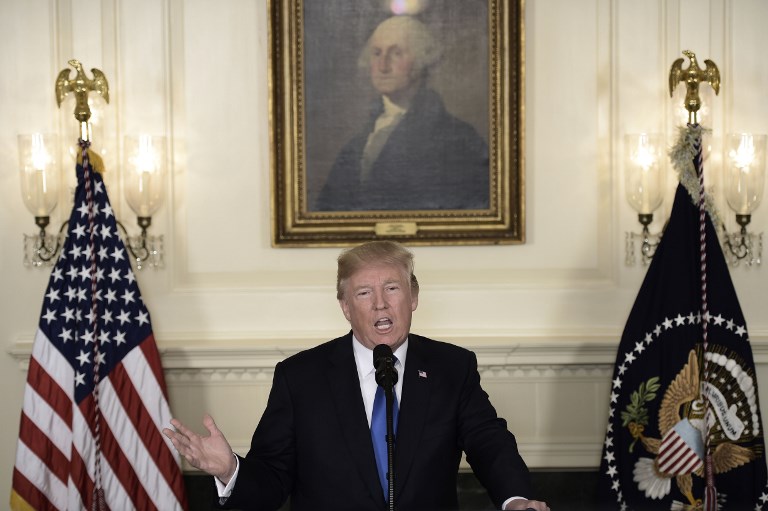
Trump stopped short of withdrawing from the deal to curb Iran’s nuclear program but said it would be under continuous review and he could pull out “at any time.”
Mogherini stressed, however, that the accord reached between Iran and Britain, China, France, Germany, Russia and the United States after 12 years of bargaining, “does not belong to any single country.”
“To my knowledge there’s not one single country in the world that can terminate a UN security council resolution that has been adopted, and adopted unanimously, and implemented, and verified,” she said.
“It is clearly not in the hands of any president of any country in the world to terminate an agreement of this sort. The president of the United States has many powers (but) not this one.”
Both the US government and UN nuclear inspectors say Iran is meeting the technical requirements of its side of the bargain, dramatically curtailing its nuclear programme in exchange for sanctions relief.
But Trump said the agreement had failed to address Iranian action in the Middle East and its missile program, adding that he would support efforts in the US Congress to work on new measures to address these issues without sinking the deal.
Reaction to Trump’s statements in Saudi Arabia and Israel, meanwhile, was positive.
Riyadh said it backed Trump’s “firm strategy” on their regional rival.
The Sunni monarchy in Saudi Arabia has for years accused Shiite Iran of “destabilizing” the Arab world. The region’s two powerhouses also support opposite sides in the wars in Syria and Yemen.
The two countries severed diplomatic ties in January 2016 after Iranians stormed Saudi Arabia’s embassy and consulate in response to the execution of a prominent Shiite cleric.
Saudi Arabia and its fellow Sunni Arab states had strong reservations over the deal but reluctantly accepted it.
In Friday’s statement, Riyadh said it would continue working with the United States and other world powers to “deal with the dangers represented by Iran’s policy on all levels.”
Israel’s Prime Minister Benjamin Netanyahu also congratulated Trump on his “courageous decision” to “confront Iran’s terrorist regime.”
In a video posted to YouTube, the Israeli leader said: “If the Iran deal is left unchanged, one thing is absolutely certain — in a few year’s time, the world’s foremost terrorist regime will have an arsenal of nuclear weapons.”







The Times of Israel Community.