

Hope springs eternal for participants at Maine’s ‘Seeds of Peace’
Summer campers from across the Middle East learn the communication skills that have eluded their elders for decades
 Add ToI as a Preferred Source on Google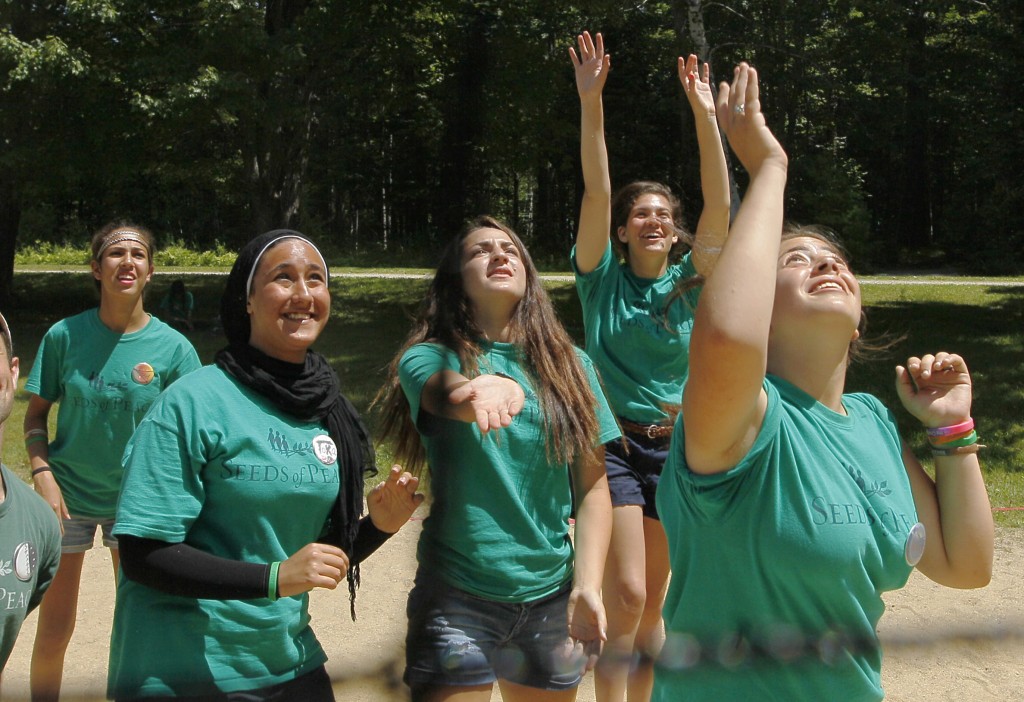
OTISFIELD, Maine (AP) — The Arab Spring uprisings have brought a new sense of optimism to young people from troubled nations as they spend time at a special camp nestled in the hills of western Maine where they confront and resolve their differences.
“It gives me the feeling that everything is possible and nothing is impossible,” said 17-year-old Lina, who witnessed the regime change in her home country of Egypt, on a sunny afternoon at the lakeside Seeds of Peace camp. “We believe that with change, peace is possible. We believe we are the leaders of the future.”
Seeds of Peace is now in its 20th year of bringing together children from countries in conflict. The more than 200 campers this summer — the most in the camp’s two decades — include Israelis, Palestinians, Jordanians, Egyptians, Indians, Pakistanis and Afghans.
The 3 1/2-week session also comes as a regime change in Egypt ensues, invigorating the optimism that young campers like Lina can carry their message into the world. Out of security concerns, the camp has a policy against campers revealing their full names.
“The media and politicians make it seem impossible for ‘enemies’ to want to live together,” said Hatem, 16, also from Cairo. “Camp doesn’t end when you leave. It begins when you leave.”
The pine-shaded camp features outdoor activities such as soccer, volleyball, cricket and swimming, interspersed with dialogue sessions, the core of the program. Campers, working with facilitators, are encouraged to voice their views that reflect conflicts and seek to resolve their differences.
“We’re not here to shy away from the conflict. We’re here to confront it,” said Eric Kapenga, communications director for the nonprofit camp.
The camp was founded by John Wallach, a foreign news correspondent and co-author of two books about the Middle East; Wallach died in 2002. Since its founding, more than 5,000 campers and educators from 27 countries have attended Seeds of Peace.
Other states and countries also have children’s camps and programs based on similar culture-sharing themes. The Manhasset, New York-based nonprofit Tuesday’s Children, for example, creates programs that bring together children and families whose lives have been dramatically altered by terrorism.
The Maine camp’s activities are designed to build trust. Youngsters from different countries and varied backgrounds are paired up on the camp’s ropes course, where teammate trust can be crucial in keeping safety-harnessed participants 30 feet (nine meters) aloft.
The New York-based peace program has also branched out to a new venue — the sea — to promote its goals. A 125-foot (38-meter) schooner this summer made a Portland, Maine-New York-Boston voyage with 18 camp graduates, or “seeds,” working cooperatively as crew members. It’s the second year of the Seas of Peace program, said Leslie Lewin, the organization’s executive director.
The Seeds program is committed to keeping connections active with campers after they graduate, through a variety of seminars and other gatherings all over the world. More than 65 Seeds graduates are currently meeting in Ireland for a program on conflict resolution.
“Given what’s going on in the world today, our work is probably more important than it’s ever been,” Lewin said. Conflicts remain to be resolved in a number of regions. With the Arab Spring, “we’ve seen real results from young people who want to make a difference in the world, and that gives us more motivation to support these talented and committed young people.”
Among the graduates are a filmmaker whose video went viral and became an anthem for the Egyptian revolution, a Palestinian who is working through the United Nations for Mideast peace and a news anchor on Israeli TV, Kapenga said.
Majib, a 24-year-old Seeds counselor from Afghanistan who first came to the Maine camp in 2002 and is a news correspondent in his country, said the program opened his eyes for the first time in his life to “a huge spectrum of views.”
“Even if I don’t agree with different opinions, at least I can tolerate them,” he said.
Liav, a 26-year-old counselor from Haifa, Israel, said lessons from Seeds of Peace can be transmitted through all kinds of contacts graduates will have in their professional lives. Liav is eyeing an environmental career that could bring her into contact with Palestinians over issues such as water rights.
“I feel the main thing I’ve gained here is the ability to talk and listen,” she said.
Copyright 2012 The Associated Press.






The Times of Israel Community.