

Iran arrests demonstrators in 2nd day of anti-regime protests
Authorities say several dozen people gather in Tehran, and most disperse quietly; rallies also reported elsewhere in the country
 Add ToI as a Preferred Source on Google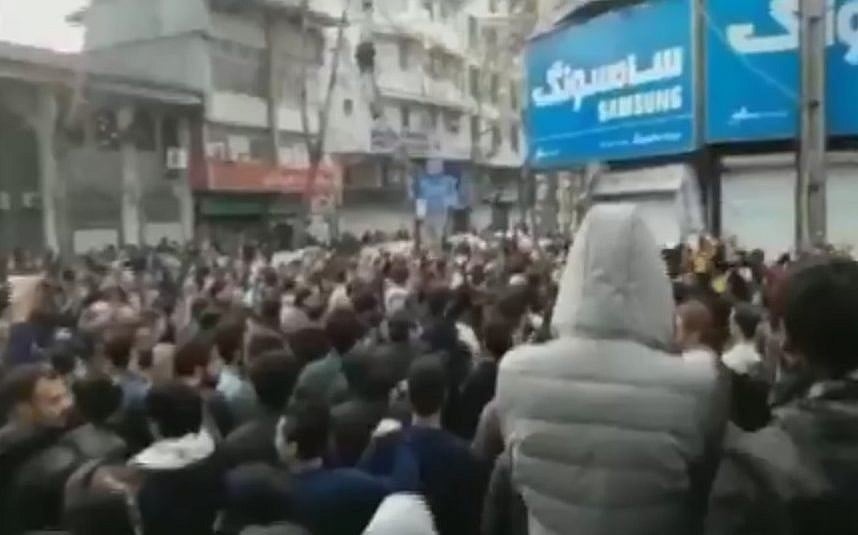
Iranian officials reported fresh protests over the struggling economy on Friday, a day after dozens were arrested in second city Mashhad.
First Vice President Eshaq Jahangiri suggested hardline opponents of the government may be behind the demonstrations, which spread to Tehran and the city of Kermanshah in western Iran on Friday, though numbers reportedly remained small.
“Some incidents in the country these days are on the pretext of economic problems, but it seems there is something else behind them,” Jahangiri said in comments carried by state broadcaster IRIB.
“They think by doing this they harm the government,” he said, but “it will be others who ride the wave.”
Young residents of #Kermanshah, clash with anti-riot forces using water cannon to disperse the protestors. Thousands took part in Kermanshah protest today, chanting "death to dictator, death to Rouhani", according to the network of the PMOI/ MEK inside #Iran. #FreeIran pic.twitter.com/qi6OIANCfH
— Shahin Gobadi (@gobadi) December 29, 2017
Tehran’s deputy provincial governor Mohsen Hamedani said “less than 50 people” had gathered in one of the city’s squares and several had been arrested after refusing to move on, according to the reformist newspaper Etamad.
He said they were “under the influence of propaganda” and were “unaware that the majority of these calls to protest come from abroad.”
The rally in Kermanshah appeared larger — with hundreds shown protesting in videos shared on social media — and was reportedly focused on those who lost money in the collapse of unauthorized lending institutions in recent years.
“Protesters asked for clarifications on the fate of their accounts and police dealt with them with tolerance despite them having no permission to protest,” the conservative Tasnim news agency reported.
Protests were also reported in the city of Rasht.
#MEK network #Iran: #HappeningNow ,1000s demonstrating in #Rasht chanting "our country is becoming the thieves' house" referring to the extent of corruption within regime officials. At the same time people protest the arrest of a protester by #IRGC & #Basij forces. #FreeIran pic.twitter.com/CYylJYZf2k
— Iran Freedom (@4FreedominIran) December 29, 2017
It came a day after 52 people were arrested in Mashhad, an important pilgrimage site, for protesting high prices and the poor state of the economy under President Hassan Rouhani.
Videos published by reformist media group Nazar showed people chanting “Death to Rouhani” while others shouted “not Gaza, not Lebanon, my life for Iran,” reflecting anger in some circles that the government is focusing too much on regional politics rather than tackling domestic problems.
One lawmaker said these protests were also rooted in the collapse of credit institutions and other financial scandals.
#Iran – #Mashhad, Protesters respond by throwing stones when state security forces threw teargas at them. #protest #CNN #News @Reuters #Foxnews #APF #AP #IRGC_Out pic.twitter.com/uuhXpmcEZ9
— Iran Freedom (@4FreedominIran) December 28, 2017
Unauthorized lending institutions mushroomed under former president Mahmoud Ahmadinejad due to weak regulation of the banking sector.
An uncontrolled construction boom left many banks and credit companies stuck with toxic debts, which combined with soaring inflation and the chaos caused by international sanctions, pushed many to default on their debts.
يذكر السيدة مريم رجوي في رسالة مريم رجوي بمناسبة بدء العام الدراسي في #إیران شجعت الشعب الإيراني وخاصه الطلاب الجامعات قائلة: ” وعليكم أن تحاصروا هذا النظام البائد بتصعيد احتجاجاتكم ومقاومتكم. #Neishabour #Kashmar #Shahroud #Noshahr #mashad #Protest #Iran #HumanRights #مشهد pic.twitter.com/b12duXCvql
— إيران الحرة (@IranAlhurra) December 28, 2017
Since coming to power in 2013, Rouhani has shut down three of the biggest new credit institutions — Mizan, Fereshtegan and Samen al-Hojaj.
He tasked the central bank with reimbursing lost deposits, but many are still waiting for compensation.
On Thursday,people in #Mashhad,#Iran held a major demonstration in the Martyr’s Square in protest to the high cost of goods and commodities and the rise in the daily price of items
???? pic.twitter.com/4fc7mdHz2h— Mete Sohtaoğlu (@metesohtaoglu) December 28, 2017
Mashhad was among the areas hardest hit by the closure of Mizan, which had around one million accounts, according to the official IRNA news agency.
Kermanshah was particularly affected by problems at another credit institution, Caspian, according to the Tasnim agency.






The Times of Israel Community.