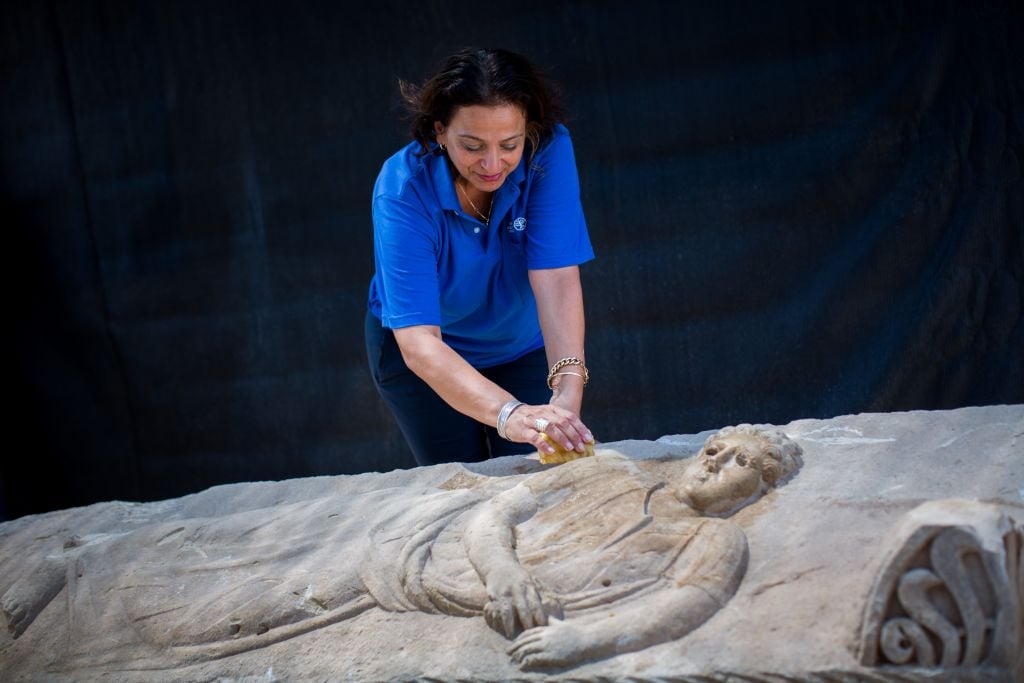
As Israeli antiquities authority worker cleans an 1,800 year-old stone sarcophagus outside the Israeli antiquities authority storage facility in Beit Shemesh on September 3, 2015 (Photo by Yonatan Sindel/Flash90)
Israeli authorities have recovered a Roman-era sarcophagus that construction workers sought to hide after digging it up at a building site, officials said Thursday.
The limestone coffin, estimated at 1,800 years old and discovered last week during work on a new neighborhood in coastal city Ashkelon, was described as “unique” by Gabi Mazor, a retired Israel Antiquities Authority archaeologist and expert on the era.
The contractors who encountered the find opted to extract it themselves with a tractor, damaging it before hiding it beneath a stack of metal sheets and boards, according to the authority.
Police have questioned the contractors on suspicion of not reporting their find and of damaging it, and the authority pledged that legal proceedings would be pursued against those involved.
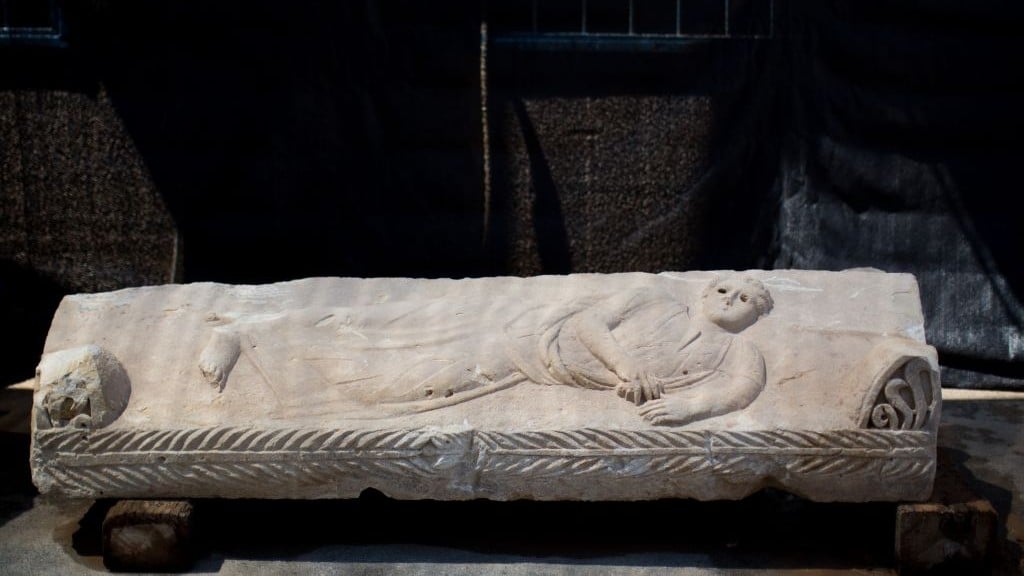
View of a 1,800 year-old stone sarcophagus outside the Israeli antiquities authority storage facility in Beit Shemesh on September 3, 2015 (Photo by Yonatan Sindel/Flash90)
An authority spokeswoman said they did not know why the contractors had attempted to conceal the find.
Get The Times of Israel's Daily Editionby email and never miss our top stories
Mazor said the decorations on the sarcophagus were particularly noteworthy.
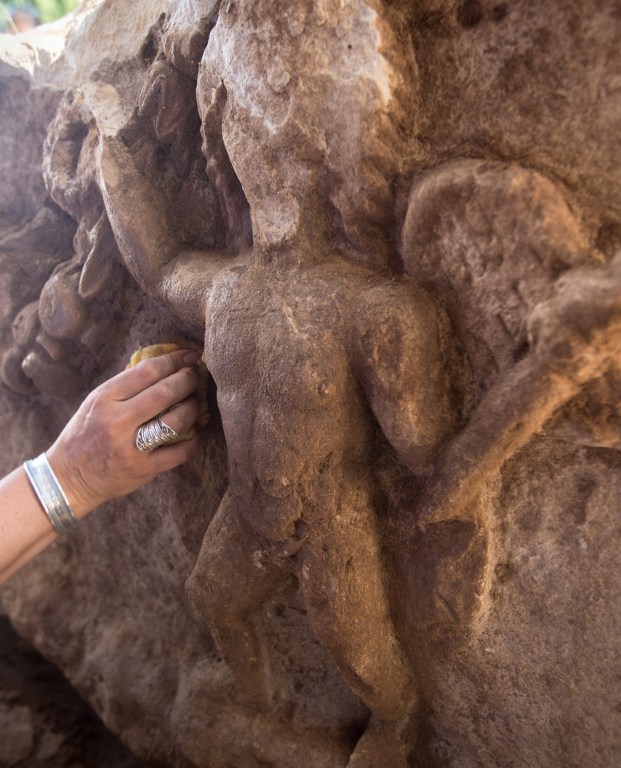
An Israel Antiquities Authority (IAA) worker cleans naked cupids on a unique Roman-era sarcophagus at a warehouse in Bet Shemesh on September 3, 2015. (AFP PHOTO/MENAHEM KAHANA)
“All its sides are decorated, with very impressive and beautiful decorations. Quite a few sarcophagi are found in Israel, but nearly none of them are decorated, and those that are usually have wreaths and other floral themes” and not much more, he said.
The lid of the sarcophagus has an image of a man — apparently representing the deceased — leaning on his left arm, wearing a short embroidered shirt, with Roman-style curls and no beard, implying he was young.
Advertisement
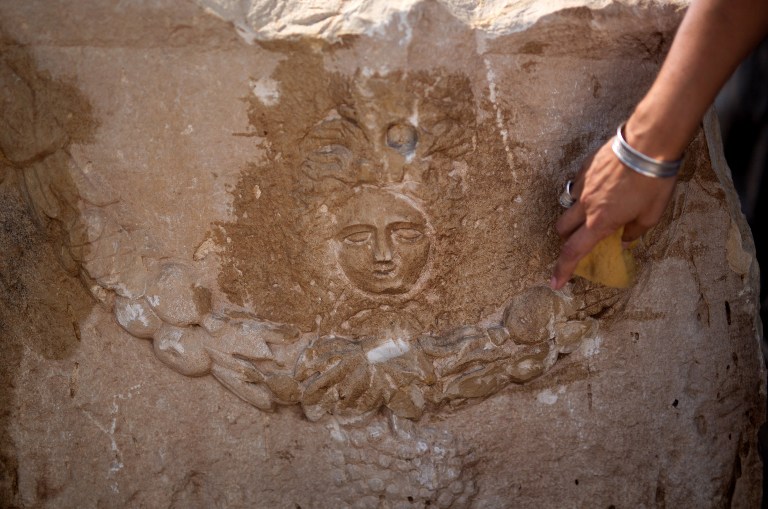
Around the coffin are engraved images of “bulls’ heads, naked Cupids, and the head of the monstrous female figure Medusa which includes remains of hair together with snakes, part of a commonly held belief in the Roman period that she protects the deceased,” Mazor said.
A member of the Israel Antiquities Authority (IAA) cleans the head of the monstrous mythological female figure Medusa which includes images of the venemous snakes that she was said to have as hair on a unique Roman-era sarcophagus adorned with the carving of a young man at a warehouse in Bet Shemesh on September 3, 2015. (AFP PHOTO/MENAHEM KAHANA)
Ashkelon was at the time a mixed city, comprised of pagan Romans and Jews, as well as Samaritans, but Mazor said the decorations leave little doubt the sarcophagus belonged to a Roman.
The presence of the two-ton, 2.5-meter (eight-foot) long sarcophagus at the construction site suggested there may be a mausoleum and other coffins at the site.
Help us report truthfully on social media
As a multimedia journalist, my job is to take the quality, fact-based journalism produced by The Times of Israel newsroom and make it accessible across every platform — from Instagram posts to podcasts to short-form videos.
This is how many, especially young people, consume news these days. But misinformation is rampant on social media. Our team at ToI produces accurate, responsible short-form reporting on Israel and the Jewish world.
If you believe in the importance of factual social media journalism, please consider joining our reader support group, The Times of Israel Community. Your financial support is essential to sustain responsible multimedia reporting.
We’re really pleased that you’ve read X Times of Israel articles in the past month.
That’s why we started the Times of Israel - to provide discerning readers like you with must-read coverage of Israel and the Jewish world.
So now we have a request. Unlike other news outlets, we haven’t put up a paywall. But as the journalism we do is costly, we invite readers for whom The Times of Israel has become important to help support our work by joining The Times of Israel Community.
For as little as $6 a month you can help support our quality journalism while enjoying The Times of Israel AD-FREE, as well as accessing exclusive content available only to Times of Israel Community members.
Thank you, David Horovitz, Founding Editor of The Times of Israel


 Add ToI as a Preferred Source on Google