

Jerusalem of Trump, Ashdod of Liberman
The US president’s comments on the capital are seen as a win for Israel and the defense minister’s weekend consumerism may be a win for his party
 Add ToI as a Preferred Source on Google
Joshua Davidovich is The Times of Israel's Deputy Editor
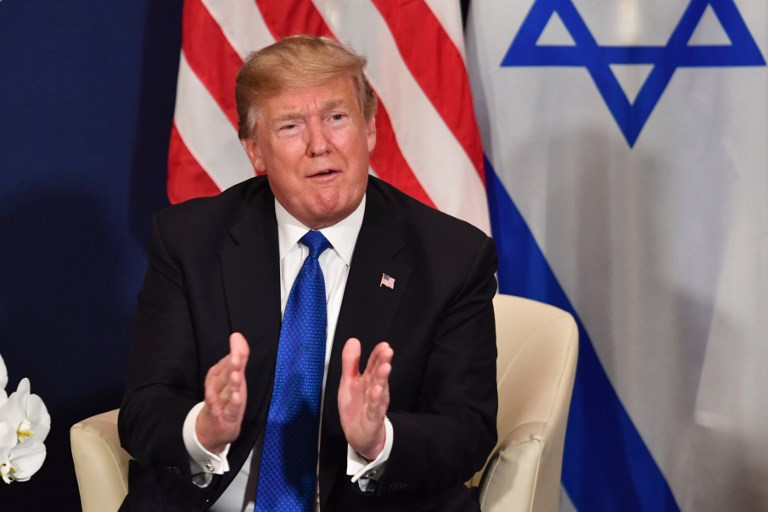
If the front pages of Israeli newspapers are an accurate reflection of the zeitgeist of the nation, then what they say Friday morning is that there is not much doing in US president Donald Trump’s strongest comments yet about withholding Palestinian aid and taking Jerusalem “off the table.”
While the news is certainly near the top of coverage, only Israel Hayom leads its front page with coverage from Davos, and even then the treatment is somewhat modest by the paper’s standards. The other dailies, meanwhile, devote far more front page real estate to domestic issues, such as the plight of African migrants deported from Israel and heavy rains across the country.
What coverage there is of the meeting between Trump and Prime Minister Benjamin Netanyahu focuses mainly on the president’s assertion that he’s made talks easier by removing Jerusalem from negotiations, and that if the Palestinians don’t come to the table, they will lose out on the almighty dollar.
“No talks, no money,” reads a headline in Israel Hayom, writing that, “Trump dramatically shifted the parameters of all future talks between Israel and the Palestinians, and for the first time clearly placed the full burden of responsibility for creating a peace process on the Palestinians.”
In Yedioth’s telling, Trump “sharpened his stance against the Palestinians.”
Haaretz, though, notes that what changed isn’t necessarily the parameters of the talks but the administration stance, with his statements “contradicting what he himself said and what his vice president recently told Israelis: that the US decision to recognize the city as Israel’s capital will not influence the final status of its borders.”
Apparent u-turns notwithstanding, Israel Hayom columnist Amnon Lord writes that Trump’s alignment with Netanyahu won’t spell the end of the Palestinians, but it does signal the demise of “Palestinianism.”
“There is a country called Israel and it has a capital and that’s the truth, and it needs to be recognized. This is the correct side of history,” he writes. “Is it possible now to return to talks? The answer is yes. But the Palestinians will need to get used to a situation in which Israel comes to the table from a position of strength, and the goals of talks will be limited to upgrading Palestinian sovereignty to something less than a state. What are thought to be the core issues won’t come up anytime soon.”
Jerusalem may be off the table, but Defense Minister Avigdor Liberman’s future is certainly up for debate, with the Yisrael Beytenu head making news both for fights over Shabbat and who can be heard on the army’s radio station.
Liberman’s decision to go shopping in Ashdod to protest the city trying to shut stores on the Jewish day of rest — seemingly at the behest of Interior Minister Aryeh Deri — speaks volumes about the right-secular party and its future, Haaretz’s Yossi Verter writes.
“Liberman’s perfectly normal act of weekend shopping – which only in Israel is headline news – is shaking up the coalition, some of whose members are demanding the prime minister’s intervention. What this shows is that Yisrael Beiteinu intends to run independently in the next election,” he writes.
In Yedioth, Sima Kadmon also notices Liberman trying to help himself to some media attention and votes.
“After weeks of relative quiet, Avigdor Liberman went this week on the attack. It began with a well-publicized visit to Ashdod on Saturday and continued throughout the week, raising the question of whether there is a connection between the number of mandates received by Yisrael Beytenu in the recent polls and the defense minister’s activism on issues that are not in the military sphere,” she writes. “When I ask the question to Liberman, he says in his refined language that whoever says this is a complete idiot.”
Liberman’s various plays have gotten little attention in Israel Hayom, seen as closely aligned with Netanyahu, a possible sign that the prime minister indeed sees him as an increasing threat. Then again, the right-wing paper never quite aligns with the other dailies, and while attention has focused elsewhere on pilots and others who are fighting against Netanyahu’s plan to deport migrants, the paper runs an interview with pilot-cum-MK Yoav Kisch (Jewish Home), who says he’ll fly the migrants back to Africa himself if need be.
“The infiltrators, who returned of their own will, were mostly from Eritrea,” he says, using the government’s preferred term for asylum-seekers. “If there were truly danger to their life there, as they claim, they would do everything to go back to some other place. The claim that Israel is sending these migrants to their deaths is lies and slander.”
In Haaretz, though, reporter Tamar Baras finds that life isn’t exactly peaches for those sent back to South Sudan , with famine, war, and children dying. Rami Gudovich, a social worker dealing with the migrants, says some 100 who have returned to South Sudan have died, there have been several accounts of rape, and things are just as bad in other East African countries as well.
“Sometimes I think it’s better to go back to Israel and be in jail,” one former asylum-seeker tells the paper.








The Times of Israel Community.