

Live updates (closed)
 Add ToI as a Preferred Source on Google


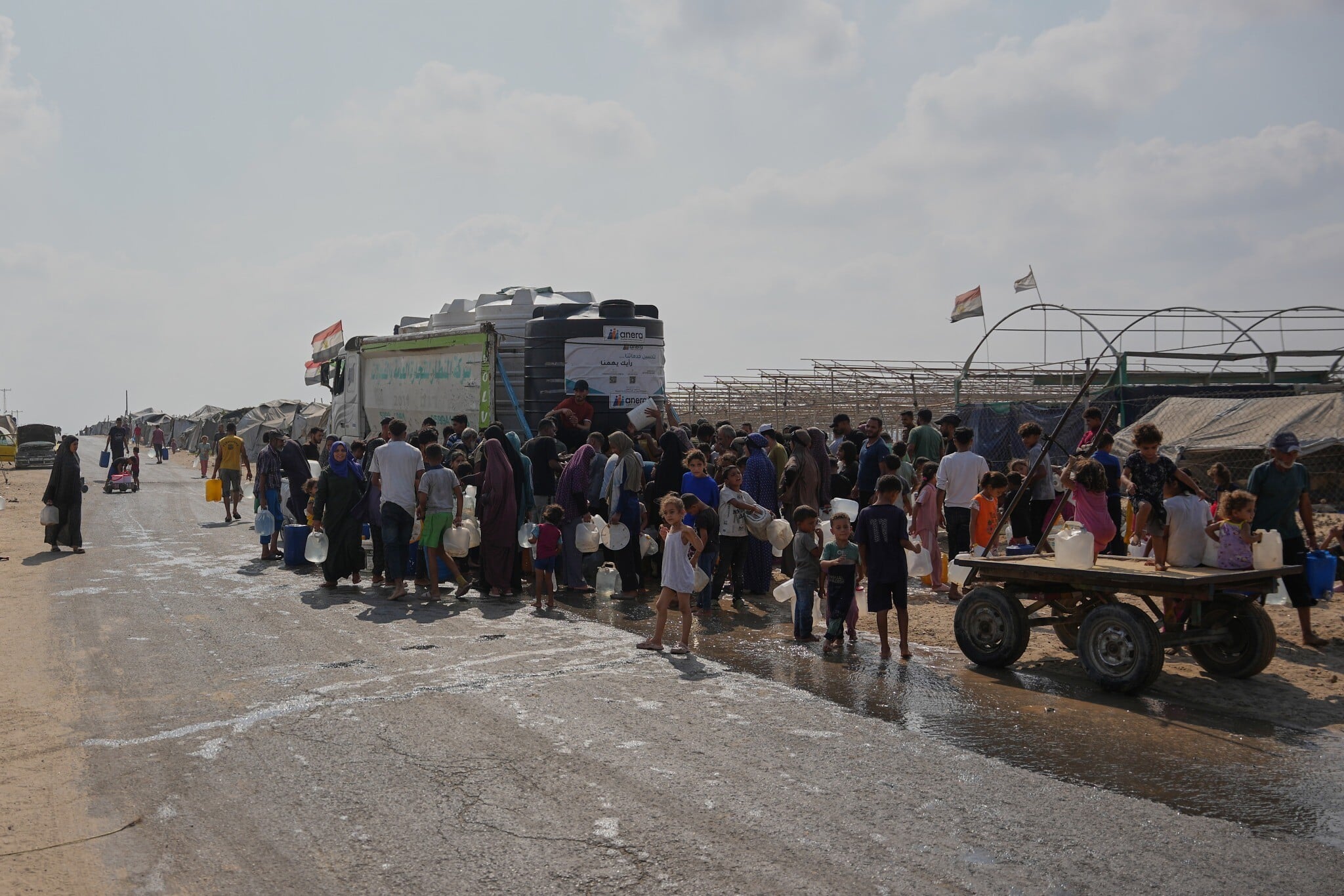
Key updates, 14 August 2026:
Israeli rescue, humanitarian delegation to take off for Colombia tonight after earthquake
Israel’s combined search-and-rescue and humanitarian aid delegation will take off from the Nevatim Air Force base for Colombia tonight, the Foreign Ministry says, following the earthquake that struck the South American nation.
The delegation will fly in an Israeli Air Force plane.
The 80-strong group — named Brit Re’im, or covenant of friends — consists of IDF soldiers and officials from the Foreign and Defense Ministries. It is being led by the IDF Home Front Command and the Foreign Ministry. The search-and-rescue unit is being commanded by Brig. Gen. (Res.) Yossi Pinto, commander of the IDF National Search and Rescue Unit.
The delegation will distribute food and water to victims of this week’s deadly earthquake, and will embark on search-and-rescue missions.
AG: New appointments affecting agency probing cops too politicized, could hurt election integrity
Attorney General Gali Baharav-Miara says in a Supreme Court filing that Justice Ministry Director-General Itamar Donenfeld inappropriately pushed through an appointment to the committee that will select the leadership of the Department of Internal Police Investigations, politicizing it.
The DIPI is a Justice Ministry department that investigates police.
Baharav-Miara calls on the court to halt appointments to the committee and to the DIPI’s top jobs, citing concern that an unduly politicized DIPI could “instill fear in officers, investigators, prosecutors and journalists” and “harm law enforcement’s ability to perform its duty to ensure the integrity of the coming election,” on October 27.
The Knesset in June passed an amendment that would move the DIPI from the State Attorney’s Office to the direct control of the justice minister. Baharav-Miara, who has criticized the legislation, filed the brief to the court as part of petitions against the measure.
The amendment empowers a five-member committee to appoint the two top officers of the new DIPI, the majority of which would be controlled or influenced by the justice minister or the ministry’s director-general.
The committee members, according to the amendment, are the Justice Ministry director-general; the civil service commissioner; a criminal defense attorney chosen by the justice minister in consultation with the Public Defender’s Office; a person with experience in interrogations or criminal prosecutions who is chosen by the Justice Ministry director-general in consultation with the civil service chief; and a retired judge chosen by the head of the Knesset State Control Committee, which is always chaired by a member of the opposition.
Baharav-Miara charges that Donnenfeld exercised undue influence over the selection of the person he’s meant to appoint in consultation with Civil Service Commissioner Doron Cohen.
Between that candidate, the lawyer appointed by Levin, and Donnenfeld himself, “the result… is that a majority of committee members — three of five members — are representatives of the minister, or were appointed with his significant involvement,” Baharav-Miara says.
Moreover, she notes that the amendment passed by the Knesset sets three members as the legal quorum for the committee to make personnel decisions in the new DIPI.
“These facts… illustrate the political involvement in establishing the committee, and the politicization of law enforcement that the amendment is leading to,” Baharav-Miara says.
Saudi Arabia says MBS, CENTCOM chief discussed defense ties and reducing regional tensions
Saudi Arabia’s Crown Prince Mohammed bin Salman met the commander of US Central Command, Brad Cooper, and discussed defense cooperation between the kingdom and the United States as well as efforts to reduce regional tensions, the Saudi state news agency says.
Vance: Top war aim is keeping down gas prices for Americans, No. 2 is preventing an Iranian nuke
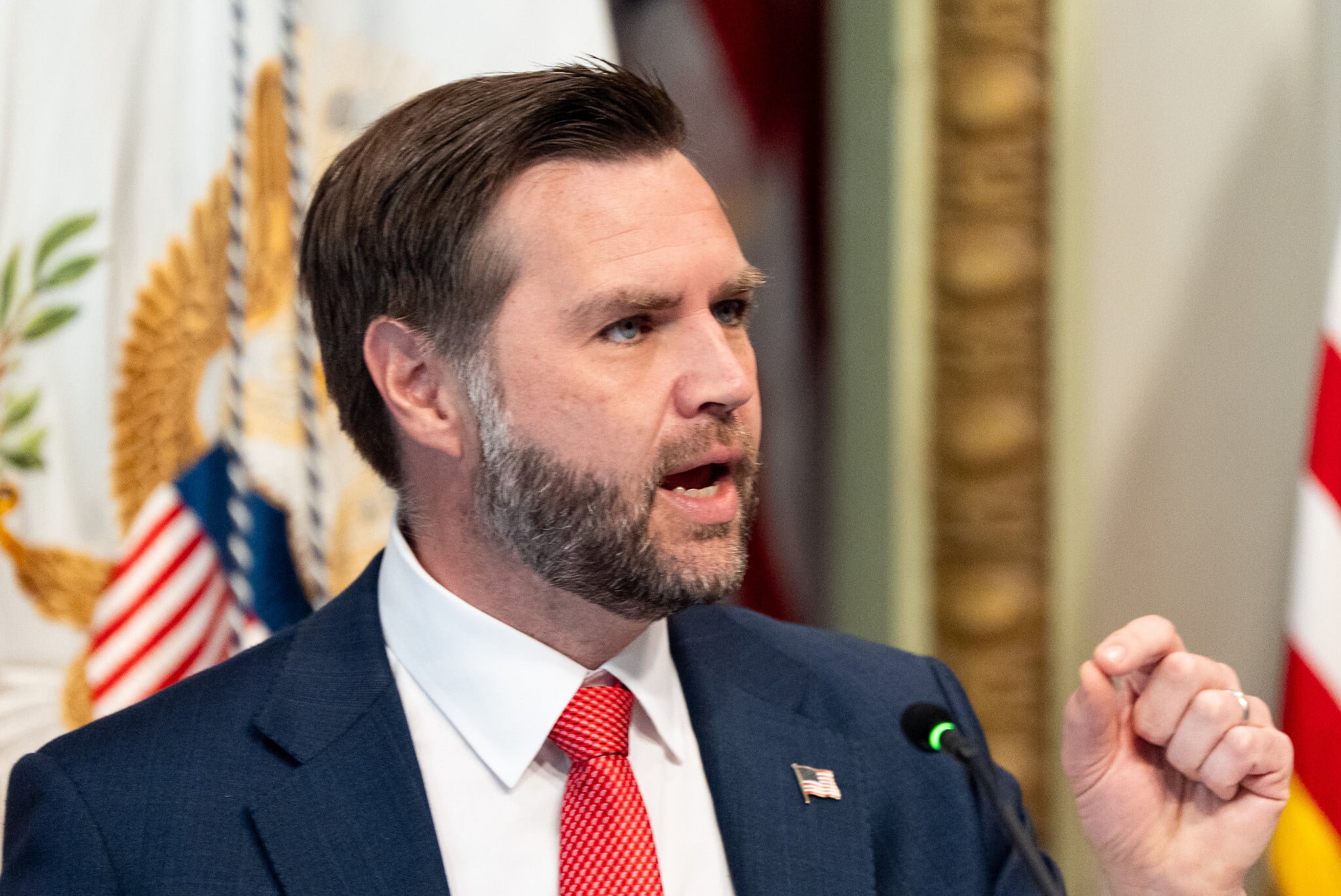
US Vice President JD Vance speaks during a roundtable event in the Eisenhower Executive Office Building on the White House campus, August 5, 2026, in Washington. (AP Photo/Alex Brandon)
US Vice President JD Vance declares that the Trump administration’s top goal in the war with Iran is to “keep oil and gasoline cheap for Americans.”
“And then, obviously, goal number two is ensure that Iran never gets a nuclear weapon,” Vance tells Fox News. “I feel confident we’re accomplishing both of those goals, but it’s inherently an unpredictable thing, because the Iranians themselves are unpredictable, and they sometimes don’t honor the commitments they’ve made to us.”
Vance is also asked how does the endgame look.
“The thing I can say with confidence is I think this ends with the United States in a stronger position, with Iran not having a nuclear weapon, and with the Strait of Hormuz returned to a place where oil and gas prices are stable for the American people,” Vance says. “Sometimes we’re focused on the energy piece of it because we want Americans to be able to afford the price of oil and gas. Sometimes we’re obviously focused on the military nature of it. Sometimes we’re focused on the nuclear program.”
He adds: “I think what is really happening is that you’re seeing a president of the United States at the height of his authority with a lot of tools — diplomatic, military, and economic. What I think is really going on from the inside is that we’re using those tools very selectively, very strategically, to get the outcome that the president of the United States needs to get for the benefit of the American people.”
Treasury’s Bessent says US ‘to apply measures’ on Iran that ‘have never been seen in history’
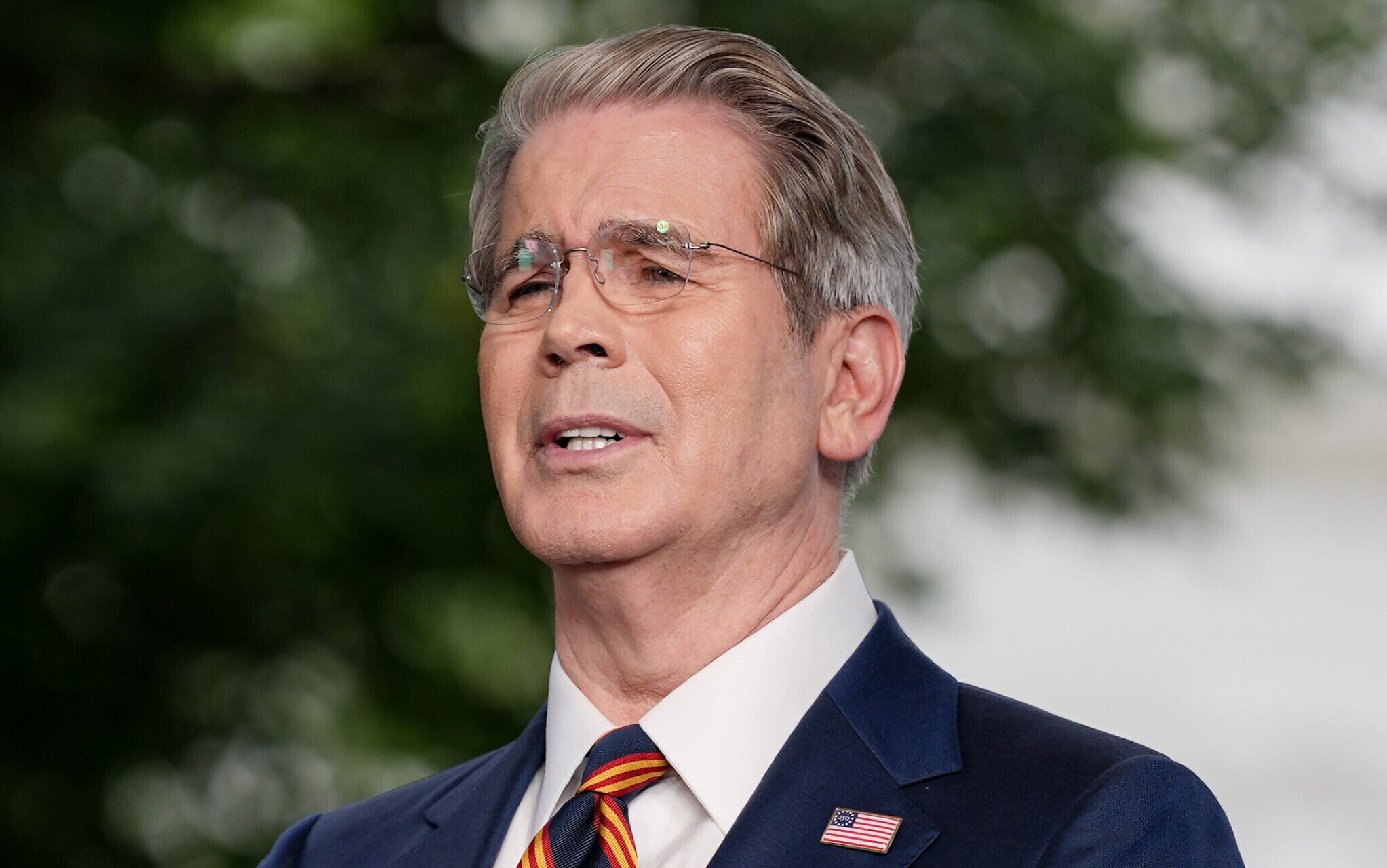
US Treasury Secretary Scott Bessent speaks during an interview with Fox News outside the White House, July 30, 2026, in Washington. (AP Photo/Julia Demaree Nikhinson)
US Treasury Secretary Scott Bessent says that the United States is going to apply measures that have “never been seen” on Iran.
“Watch this space for more announcements coming next week because we are going to apply measures like have never been seen in the history of economic isolation on a country,” Bessent says in an interview on on Newsmax’s “Rob Schmitt Tonight” program.
“It will be a combination of economic isolation like the world has never seen before, and the continued blockade in the Strait of Hormuz that will keep anything from going in or out of the Iranian ports,” Bessent says.
Board of Peace confirms Kushner to visit Israel and Egypt next week to discuss Gaza plan

US Special Envoy Steve Witkoff (L) shakes hands with Board of Peace top envoy Nickolay Mladenov, right, next to US President Donald Trump's son-in-law and key adviser Jared Kushner, during a meeting of the Board of Peace at the World Economic Forum (WEF) annual meeting in Davos, Switzerland, on January 22, 2026. (Fabrice COFFRINI / AFP)
The Board of Peace confirms Jared Kushner’s trip to Israel next week and reveals that the top adviser to US President Donald Trump will make a subsequent stop in Cairo.
Kushner will be joined by senior Board of Peace envoys Nickolay Mladenov and Tony Blair, an official from the US-controlled panel overseeing the postwar management of Gaza tells The Times of Israel.
“In Israel, we will continue the constructive conversations that we are having on how to advance the President’s historic Comprehensive 20-Point Peace Plan,” the Board of Peace official says.
“The United States and Israel agree on the end state, which is a demilitarized Hamas. We will hear the concerns that have been raised and talk about next steps. What is critical is that we both agree on the desired outcome and are finding ways to accelerate progress,” the official continues, appearing to reference Israel’s opposition to the Board of Peace’s disarmament plan, which was approved by Hamas on July 30.
“In Cairo, there are meetings planned with the Egyptians and the other mediators. We will concretize next steps on roadmap implementation,” the official says.
“All of these meetings show the determination of all parties to advance the President’s plan and see peace, prosperity, and sustainable security emerge in a Gaza that is demilitarized and where Hamas has ceded full authority to the Palestinian technocratic government, enabling reconstruction for the benefit of the people of Gaza,” the official adds.
A source familiar with the matter has told The Times of Israel that Kushner, Mladenov and Blair will arrive in Israel on Sunday.
US military has lost around 1/4 of its Reaper drone fleet amid Iran war — report
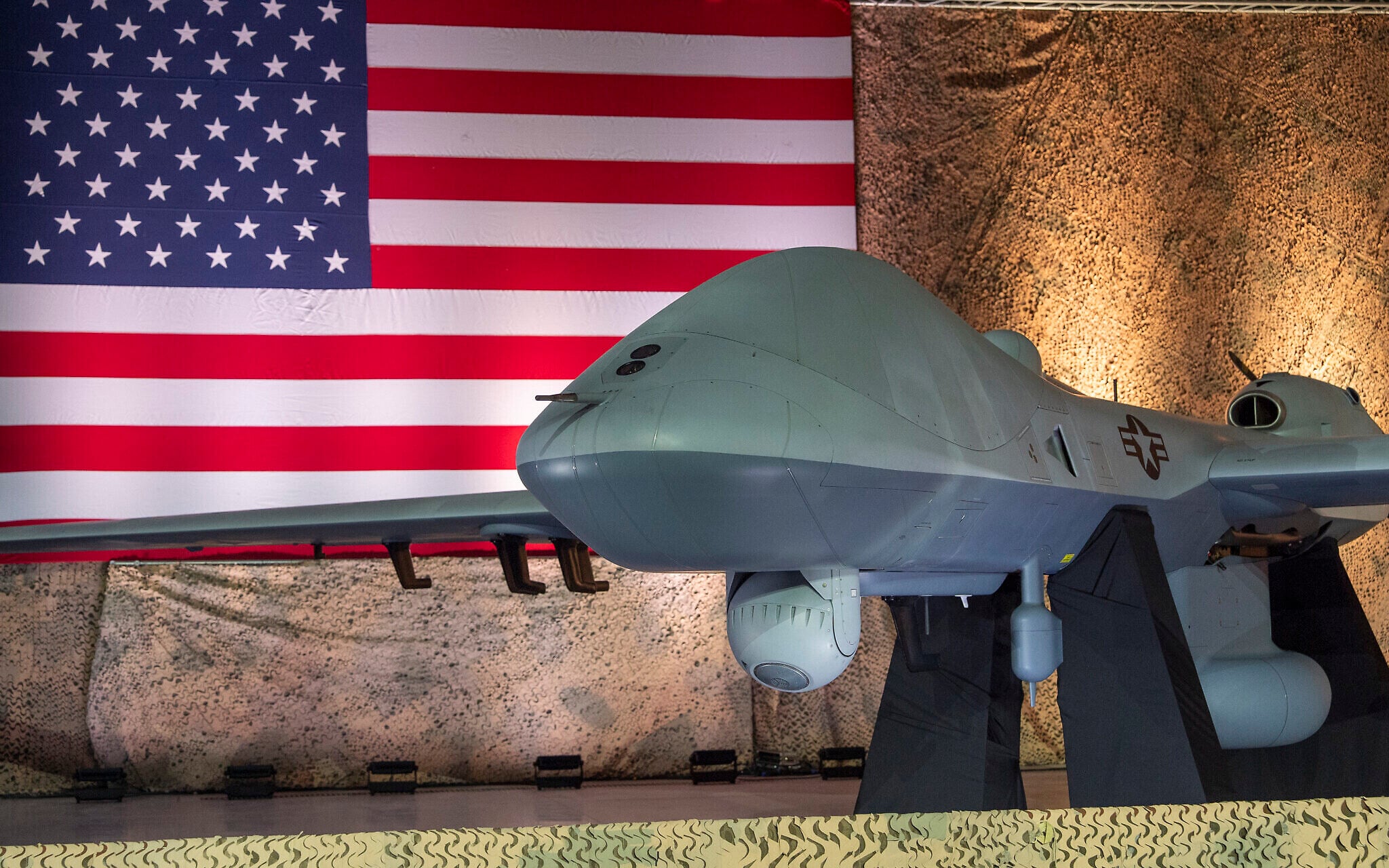
A MQ-9 Reaper drone is on display before US President Donald Trump speaks at Al Udeid Air Base, May 15, 2025, in Doha, Qatar. (AP Photo/Alex Brandon)
The United States military has lost some 25 percent of its fleet of Reaper drones amid the war with Iran, the Washington Post reports.
A US official cited by the newspaper says not all of the 45 drones that were lost were shot down, with an unspecified number of the unmanned aircraft crashing after losing communication with their operators.
The report doesn’t specify how many drones were downed by Iran itself, as it notes that Iranian proxy groups in Iraq and Yemen also possess capabilities to shoot down Reapers.
El Al cancels launch of direct flights to Hanoi, citing ‘lack’ of security approval

An El Al plane takes off at the Ben Gurion International Airport, outside of Tel Aviv, August 4, 2026. (Yossi Aloni/Flash90)
El Al announces it’s cancelling the planned launch of direct flights from Israel to Vietnam’s capital Hanoi later this year, citing the “lack of necessary approval” from security officials.
The airline says that customers who already bought tickets can either fly to Hanoi by way of Bangkok, choose another final destination or receive a refund.
Travelers looking to fly directly to Hanoi from Israel can still do so with fellow Israeli carrier Arkia.
Netanyahu refers to UK as the ‘Islamic republic of Britain’
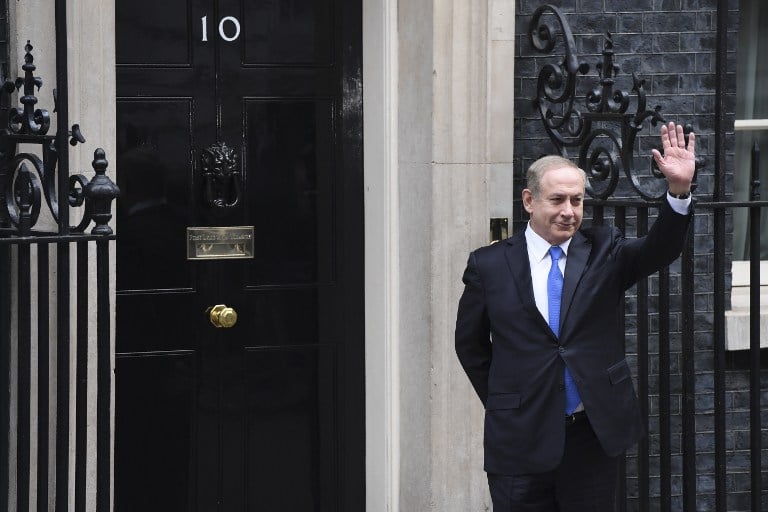
Prime Minister Benjamin Netanyahu waves to the media after arriving at 10 Downing Street in London for a meeting with British counterpart Theresa May on February 6, 2017. (AFP Photo/Chris J Ratcliffe)
Prime Minister Benjamin Netanyahu refers to Britain as an “Islamic republic” during a lengthy podcast interview with Army Radio.
Discussing Winston Churchill’s son Randolph Churchill and grandson Winston Spencer Churchill, who like the World War II-era UK prime minister were journalists, Netanyahu says the pair “came here and covered the Six Day War in a very positive way for us.”
“Try to find that now in Britain, which you could call the Islamic republic of Britain,” Netanyahu chuckles (Hebrew link).
He then responds “yes” when the interviewer asks “if all of Europe isn’t already like that, no?” apparently referring to Muslim communities in countries there and many European governments’ increasingly critical postures toward Israel in recent years .
“The first nuclear Islamic republic will be the Islamic republic of Britain,” Netanyahu further jokes. “We’re making sure there won’t be another one in Iran.”
Farage claims ‘overwhelming’ win as count still underway in UK by-election

Britain’s Reform UK party leader Nigel Farage arrives at a polling station in Walton on the Naze, August 13, 2026, to cast his vote for the Clacton on Sea by-election. (AP/Richard Pelham)
Britain’s hard-right leader Nigel Farage declares victory in a by-election in Clacton as the vote count is still underway.
“The verdict is in and it is a convincing and overwhelming win… we have secured far more votes than we got in the general election of 2024,” he says at an event in Essex, which is broadcast on X.
IDF warns Tel Aviv residents to expect sounds of explosions due to military drill
The IDF says that a military drill will be carried out this morning at the Kirya headquarters in the heart of Tel Aviv.
According to the IDF, the drill will include “active movement of security forces and vehicles” around the area, as well as the sounds of gunfire and explosions.
The IDF says the drill was preplanned and assures residents to not be concerned about any security incident.
Residents say IDF soldiers leave most homes in Qusra, while settlers still present
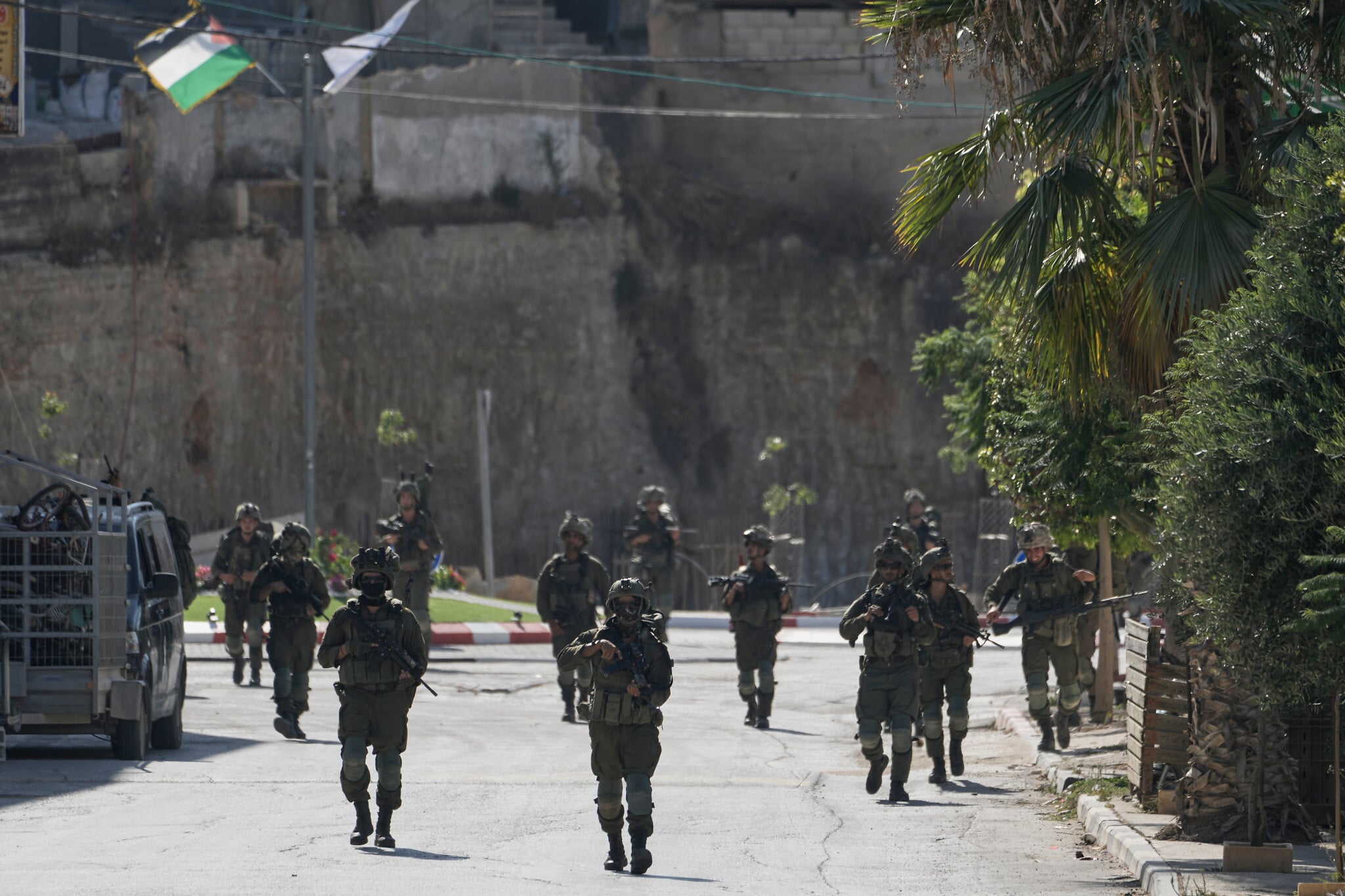
IDF soldiers patrol the streets of the West Bank village of Qusra, south of Nablus, August 13, 2026. (AP/Majdi Mohammed)
Soldiers last night left most of the homes in Qusra, south of Nablus, that they had entered as part of an operation to evacuate outposts in the area, residents of the village tell the Times of Israel.
IDF troops entered the homes yesterday morning as part of the operation, but several hours later the military reversed course and announced that troops would not stay in inhabited homes.
Settlers set up an outpost that has been blocking the homes of two families on the edge of the village for the past six days, prompting a major IDF operation and widespread international condemnation.
The soldiers left all the homes in the village except for one of the besieged homes, belonging to Yusuf Hassan, the residents say. However, they add, settlers still remain outside the families’ homes.
World War II Memorial in DC vandalized with red paint: ‘Clean hands dirty $’
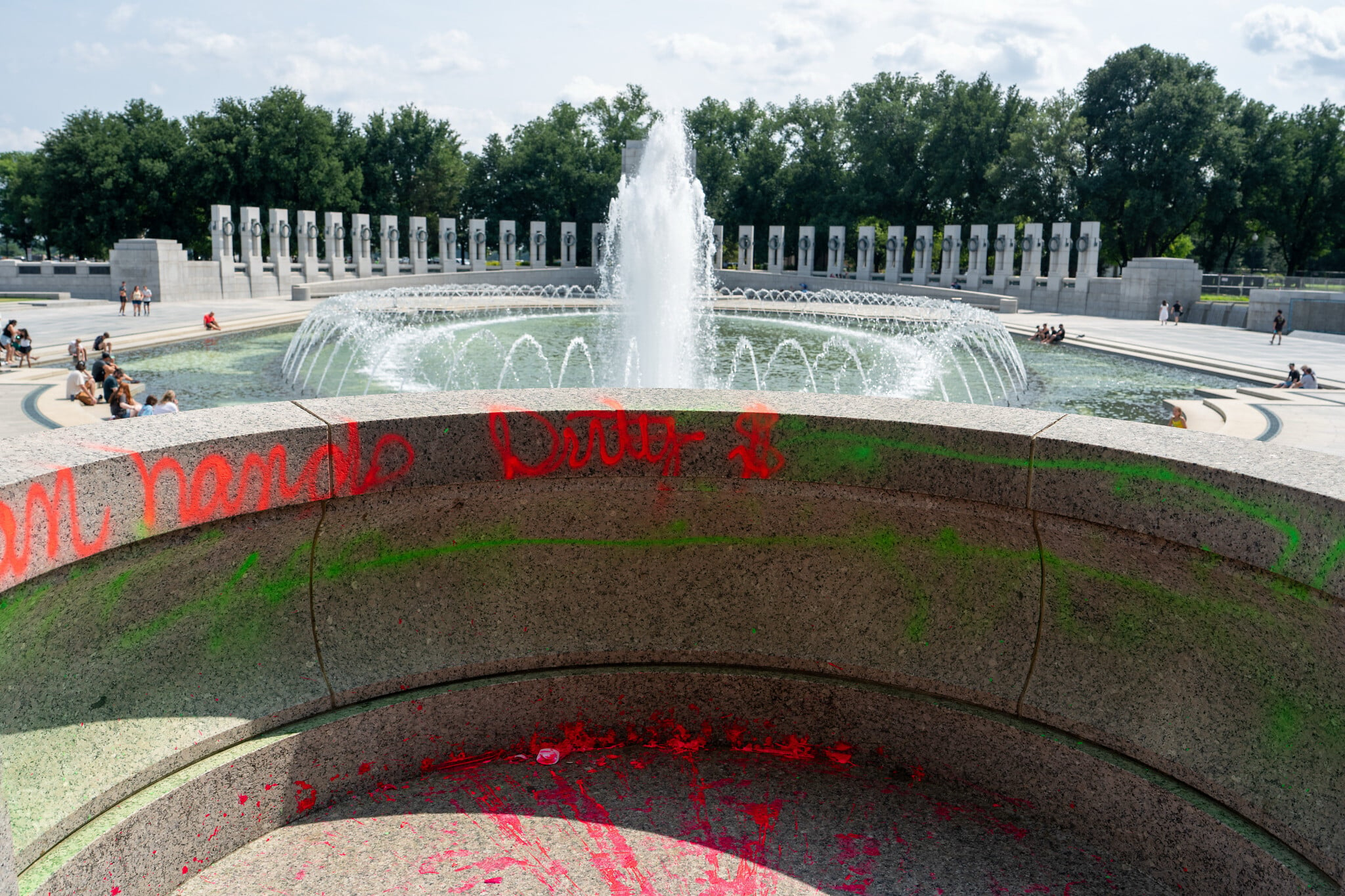
Damage seen after vandals poured bubble soap and painted graffiti on the World War II Memorial in Washington, DC on August 13, 2026. (Andrew Leyden/ZUMA Press Wire)
The World War II Memorial on the National Mall in Washington, DC, was vandalized last night, with bubbles filling a fountain and “Clean hands dirty $” written in red paint.
The Interior Department released a statement late last night saying: “Our US Park Police are on the scene and the investigation is ongoing. The public should know we will find the person responsible for this disgusting act.”
The Friends of the National World War II Memorial, a nonprofit organization that helps maintain the site, says: “There are many places in our country for expression, debate, and disagreement. A national memorial honoring those who served and those who never returned home should never be used as a canvas for vandalism.”
The Veterans of Foreign Wars calls the vandalism “an act of profound disrespect, a slap in the face to the veterans who served and sacrificed and to the families who carried that burden at home.”
Nigel Farage regains UK parliamentary seat, fights off Count Binface challenge
Britain’s Reform UK party leader Nigel Farage arrives at a polling station in Walton on the Naze, August 13, 2026, to cast his vote for the Clacton on Sea by-election. (AP/Richard Pelham)
Nigel Farage, leader of Britain’s populist Reform UK party, regains his parliamentary seat in an election he triggered to bolster his position against allegations of financial impropriety.
Farage wins 22,239 votes in the southern English seaside resort of Clacton, beating his main challenger, Count Binface, a satirical character created by a comedian, who secured 9,455 votes, after the main political parties boycotted the contest.
Health Ministry rules out suspected case of Ebola in Israel
The Health Ministry announces that an individual suspected of having contracted Ebola after returning from the Democratic Republic of the Congo does not have the disease, according to laboratory tests.
The tests were carried out in accordance with professional protocols and accepted international guidelines for dealing with high-risk infectious diseases.
The ministry emphasizes that, as of now, no confirmed case of Ebola has been diagnosed in Israel.
Ebola is not transmitted through the air; infection occurs through direct contact with a symptomatic patient or with blood, bodily fluids, or secretions.
The ministry reiterates its call to the public to avoid non-essential travel to areas with active Ebola transmission. Travelers returning from these regions who develop a fever or unusual symptoms within 21 days of their return are asked to stay home, avoid contact with others, and call the hotline at *5400.
Amid Qusra chaos, Katz asserts he will transfer civilian enforcement in West Bank from IDF to police
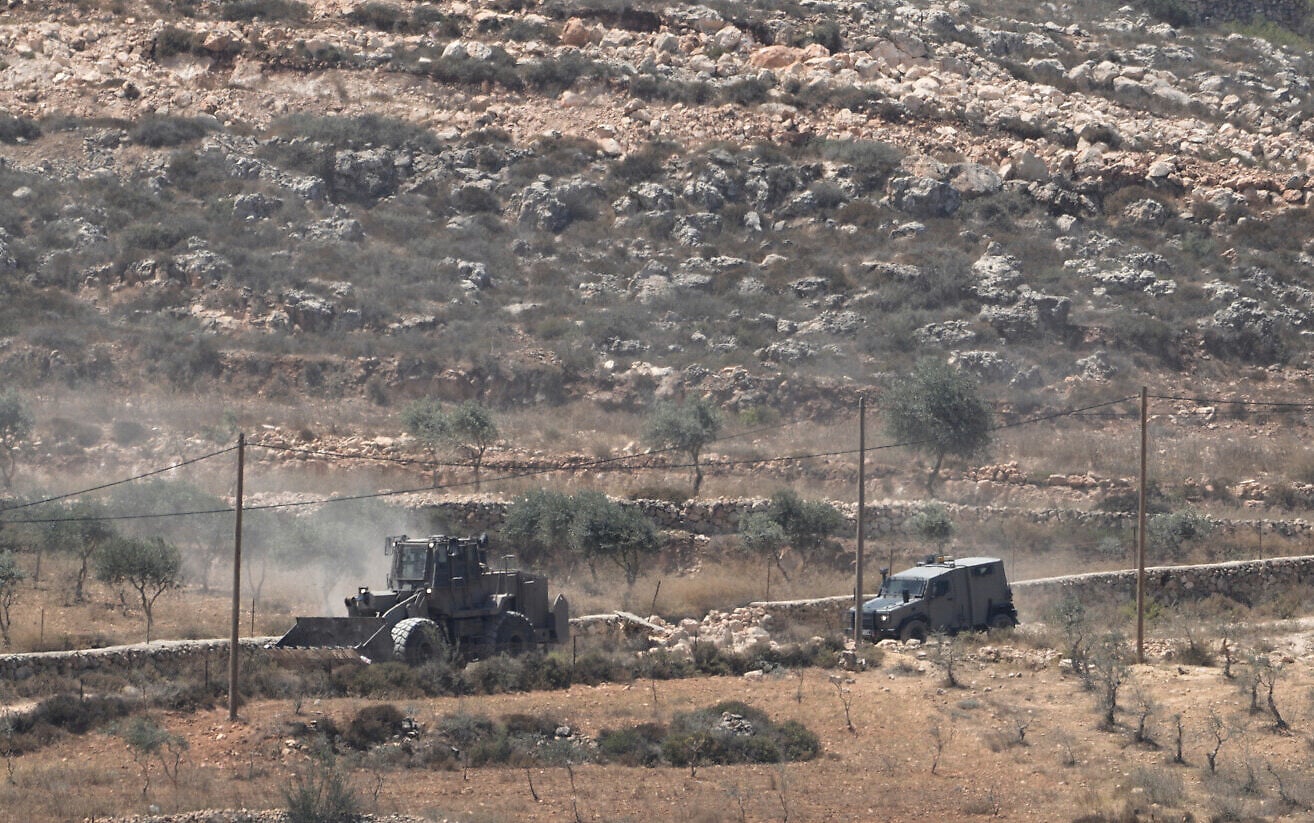
Israeli army vehicles operate near Palestinian houses, besieged by Israeli settlers, in the West Bank village of Qusra, south of Nablus, August 13, 2026. (AP Photo/Majdi Mohammed)
Defense Minister Israel Katz says he has instructed the IDF to formulate a plan that would see the transfer of civilian enforcement powers in the West Bank from the military to the Israel Police.
A statement from Katz’s office — amid ongoing clashes in the village of Qusra — says that the defense minister is looking into a plan that would see enforcement against Israelis committing crimes in the West Bank moved to the police, which will “prepare and establish a force suitable for dealing with and handling civil matters and be granted all the necessary powers and budgets.”
The statement adds that Katz issued the directive after a meeting yesterday with IDF Chief of Staff Lt. Gen. Eyal Zamir and other senior military officials.
The defense minister suggests that the military’s job is to counter terrorist activity and protect Israel’s borders, not “chase youth in the hilltops,” a characteristically dismissive approach to the rampant and deadly settler violence exploding in the West Bank.
Katz says tackling Israeli violence in the West Bank “is not the role” of the IDF “nor is it capable of handling the enforcement of civil issues” there, due to the “expected welcome increase in the number of settlers” in the wake of the current government’s approval of new West Bank settlements.
It was not immediately clear what impact such a measure would have on the ground, and it is highly unlikely that Katz would be able to carry out such a significant move in the lead-up to a national election.
Israel has never formally annexed the West Bank, therefore the IDF has been responsible for enforcement in the area. Such a move by Katz would appear to be yet another step toward annexation, something the current coalition has been pushing for but Prime Minister Benjamin Netanyahu has stopped short of amid heavy international pressure.
In the current situation, the IDF can anyway only briefly detain Israeli citizens involved in criminal activity in the West Bank before handing them over to the Israel Police. Police then often release the settlers without charges, and only on rare occasions are Israelis charged in instances of violence against Palestinians in the West Bank.
Critics have asserted that enforcement has dropped even lower after National Security Minister Itamar Ben Gvir — who has a long history of association with ultra-nationalists in the West Bank — took control of the ministry overseeing the Israel Police.
IDF confirms killing Hamas commander who held multiple Israelis captive in Gaza
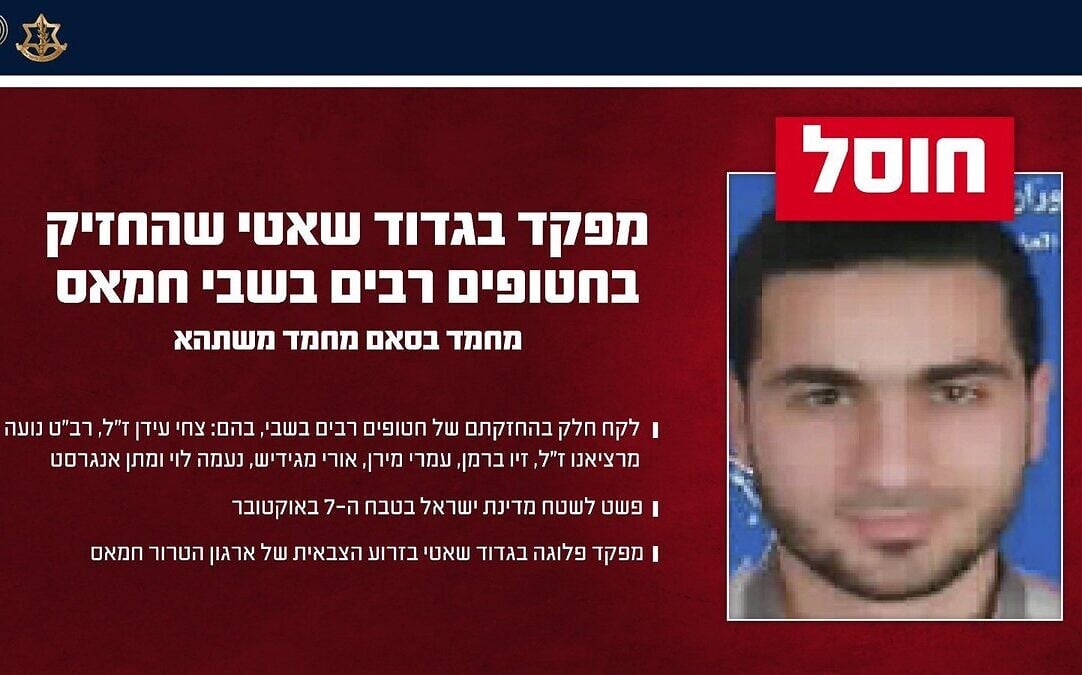
Hamas commander Muhammad Bassam Mushtaha, who the IDF says was killed as the result of an airstrike in Gaza on July 30, 2026. (IDF)
The IDF announces that a Hamas commander who invaded Israel on October 7 and held multiple Israelis hostage in Gaza has been killed in an Israeli airstrike.
According to the military, Muhammad Bassam Mushtaha, a commander in Hamas’s Al-Shati battalion, was killed as the result of an airstrike in northern Gaza two weeks ago, on July 30. Palestinian media outlets had reported last week that he died of his wounds several days after the strike.
The IDF says that Mushtaha was responsible for holding a number of Israelis captive who were kidnapped on October 7, 2023, including Tsachi Idan — who was slain in captivity in December 2023 — Cpl. Noa Marciano, who was killed in Gaza in November 2023, as well as Ziv Berman, Omri Miran, Ori Megidish, Naama Levy and Matan Angrest — who were all later freed or rescued.
In recent weeks, Mushtaha “attempted to advance terrorist plots against IDF forces and citizens of the State of Israel,” and therefore was targeted, the IDF says.
An analysis by The Times of Israel last month found that the IDF has in the past few months stepped up a large-scale retribution campaign with the avowed aim of hunting down and eliminating every single terrorist who took part in the October 7 massacre.
UAE condemns ‘hostile Iranian attack’ on two vessels in Strait of Hormuz
The United Arab Emirates blames Iran for attacks on two vessels linked to its state-owned oil company as they passed through the Strait of Hormuz.
The UAE foreign ministry denounces what it calls “the hostile Iranian attack” targeting two vessels affiliated with the Abu Dhabi National Oil Company (ADNOC), “with no injuries reported.”
ADNOC confirmed that “two of its vessels were attacked while transiting” the waterway last night, adding the situation was “brought under control,” the official WAM news agency reports.
Residents say activists blocked from delivering food to besieged homes in Qusra
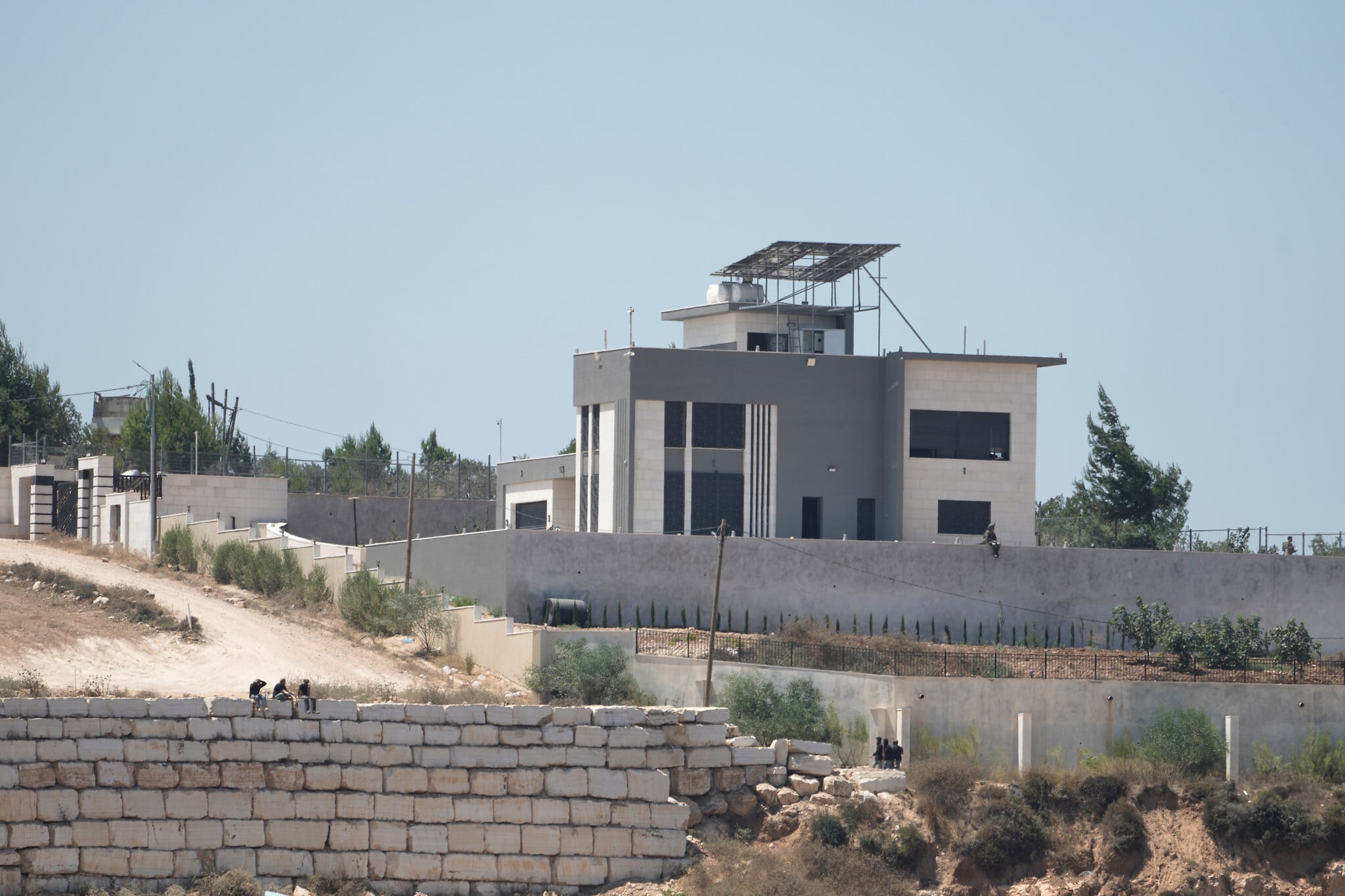
Israeli settlers gather in front of Palestinian houses they are besieging in the West Bank village of Qusra, south of Nablus, August 13, 2026. (AP/Majdi Mohammed)
Dozens of Israeli activists arrived this morning at the besieged homes in the West Bank Palestinian village of Qusra and brought food, which they left several meters from the entrances to the homes, according to footage filmed by residents of the besieged homes.
However, Qusay Abu Ridi, a resident of one of the besieged homes, tells The Times of Israel that Border Police forces currently stationed at the entrances prevented the activists from entering and delivering the food.
Over the past hour, Border Police forces once again dismantled a makeshift structure erected by settlers at the entrance to the homes, but there are no known arrests of settlers.
The settlers then fled the entrance to the homes, and a Border Police force is now stationed at the site.
מספר פעילים ישראלים הגיעו הבוקר לבתים בקצה קוסרה עם אוכל התקרבו עד למטרים ספורים ואז נבלמו על ידי כוחות מג"ב ששוהים שם עכשיו (אחרי פירוק נוסף של האוהל). השאירו את האוכל סמוך לכניסה לבתים pic.twitter.com/Kn4MpCN4AZ
— Nurit Yohanan (@nurityohanan) August 14, 2026
MK Cassif says he was delayed from entering Qusra by Israeli security forces
Hadash MK Ofer Cassif says he was briefly blocked from entering the West Bank village of Qusra where extremist settlers have laid siege to Palestinian homes.
Cassif, the only Jewish MK in the Arab-majority party, says in a statement that he arrived today at Qusra “to see with my own eyes what’s going on and to try and assist the besieged Palestinian families, who are being denied food, water and medicine just to protect a den of terrorists that was reestablished again today.”
הגעתי היום לכפר קוסרה כדי לראות במו עיניי את המתרחש ולנסות לסייע למשפחות הפלסטיניות הנצורות, מהן מונעים מזון, מים ותרופות רק כדי להגן על קן טרור מתנחבלי שהוקם היום שוב.
בכניסה לכפר עיכבו אותי כוחות הכיבוש בטענה שמדובר בשטח B, ולאחר זמן קצר אף הוציאו צו שטח צבאי סגור, ניכר… pic.twitter.com/77GjIBIDUL
— Ofer Cassif עופר כסיף عوفر كسيف (@ofercass) August 14, 2026
He says that Israeli security forces detained and delayed him, telling him it was a closed military zone, before eventually allowing him to enter the area after the intervention of a Knesset officer.
“This is exactly what apartheid looks like,” he writes. “This is exactly what the occupation looks like.”
Earlier, residents of some of the homes told The Times of Israel that activists were stopped from delivering food to the homes and had to leave it a distance away from the area.
The IDF has been operating on and off for days to remove the settler outpost established at the entrance to the homes, but the settlers have repeatedly rebuilt the structure and refused to leave the area.
US missionary kidnapped in Niger has been released, says Christian group
Kevin Rideout, a US missionary who was kidnapped in Niger, has been released and is in good health, says the Christian group he worked for.
Rideout, 50, was kidnapped from outside his home in the Nigerien capital Niamey last October, according to SIM International. At one point, he was believed to be held in neighboring Mali by the Sahel branch of the Islamic State group.
But it was unclear which group held Rideout at the end of his captivity as he may have been moved, the New York Times reports, citing an unidentified US official.
The administration of US President Donald Trump has made Rideout’s release a priority in its latest strategy on African Sahel states, after years of fighting extremism found limited success.
“We are grateful to confirm that our good friend and brother in Christ, Kevin Rideout, has been released after over nine months in captivity,” SIM International says in a statement.
“Kevin is in good health in the care of US officials,” the group says, adding that he will soon be reunited with family.
Airports Authority blames presence of US refueling tankers for major delays at Ben Gurion
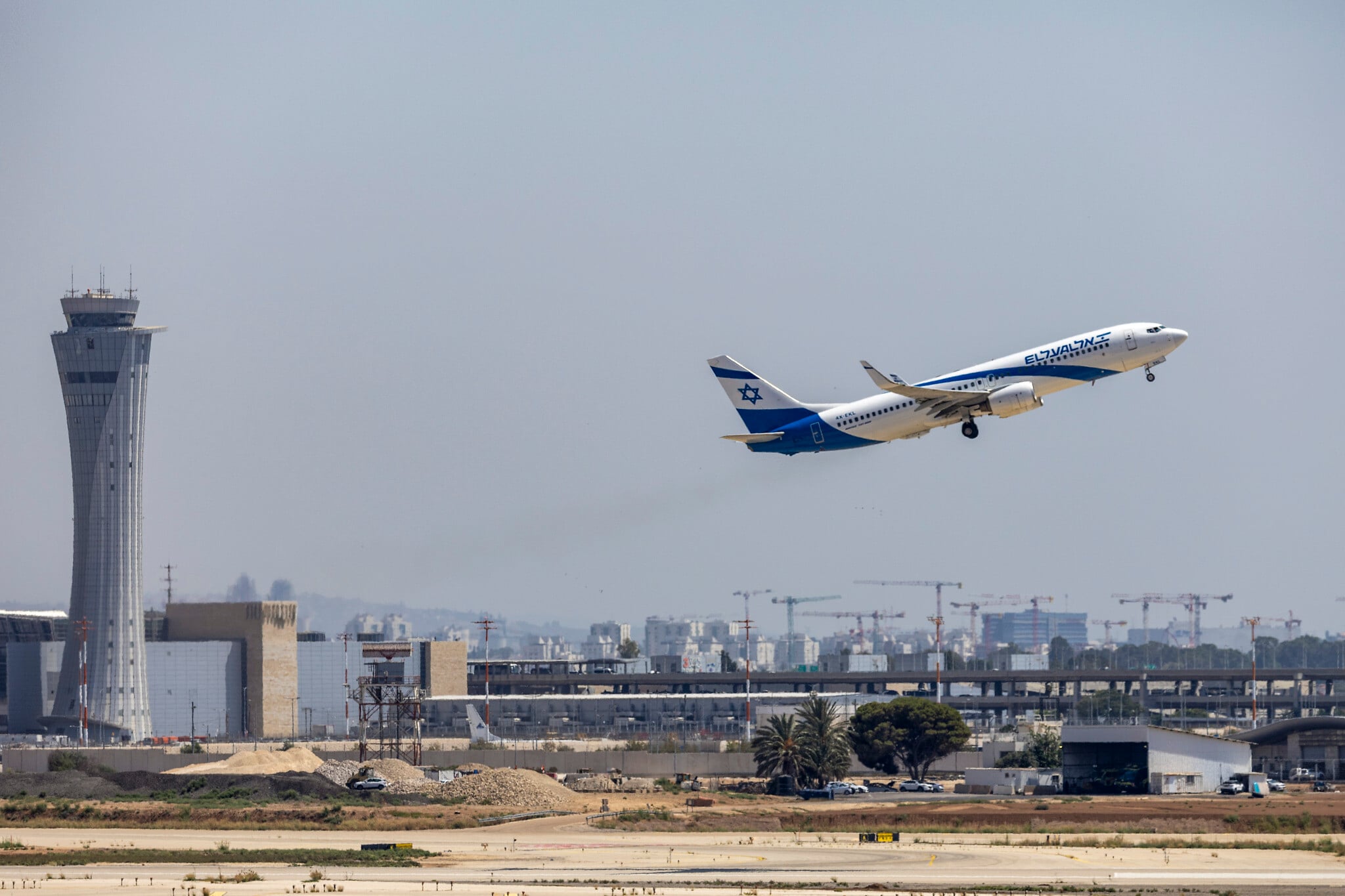
An El Al plane takes off at Ben Gurion Airport, outside Tel Aviv, August 4, 2026. (Yossi Aloni/Flash90)
The Israel Airports Authority says in a statement that significant delays are being caused at Ben Gurion Airport due to a confluence of factors, including the ongoing presence of American refueling tankers.
In a statement, the IAA says that it experienced a backlog of 90 flights in just three hours due to traffic congestion over Greece, a high amount of summer flight traffic and US refueling planes parked at the airport.
“When a large number of flights arrive in close proximity, a reduced availability of parking spaces reduces operational flexibility and increases pressure on ground systems,” the IAA says, denying reports that a shortage of workers is causing delays.
The IAA says the high volume of activity — with more than 90,000 passengers slated to pass through the airport today — causes delays, including onloading and offloading luggage and “the entire handling chain.”
The IAA website shows that 10 of the 17 flights slated to depart between 9 a.m. and 12 p.m. today were significantly delayed.
The ongoing presence of US tankers at Ben Gurion Airport has been a point of contention, and Transportation Minister Miri Regev vowed last month that only 20 would be allowed at the airport at any given time, with the rest redirected to military bases around the country.
It is not immediately clear if the limit of 20 tankers has been enforced at Ben Gurion Airport amid US pressure to allow more to stay on the ground there.
MK Elazar Stern announces Yesh Atid exit ahead of likely run with Eisenkot
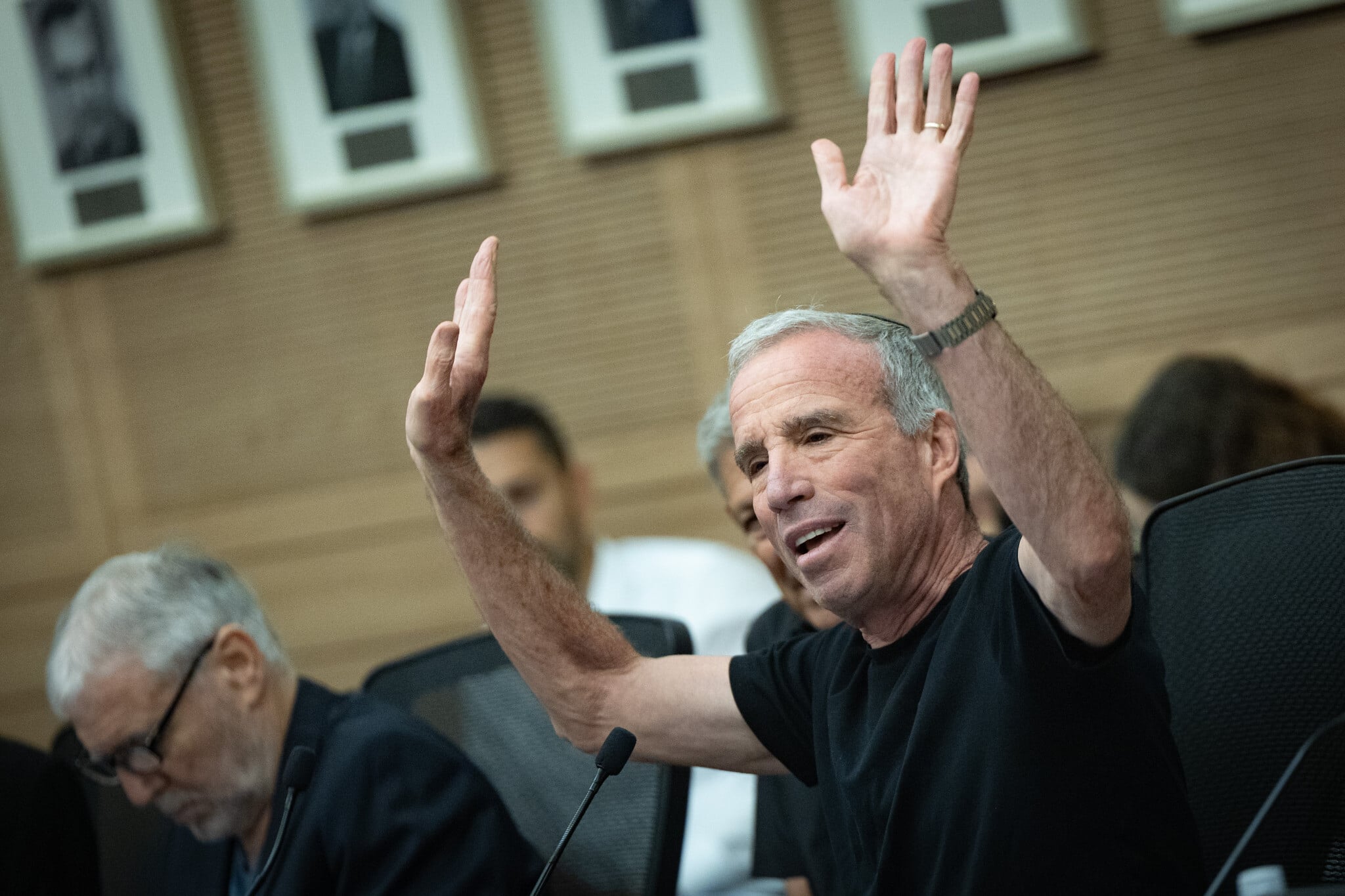
Yesh Atid MK Elazar Stern speaks during a Foreign Affairs and Defense Committee meeting at the Knesset in Jerusalem, July 13, 2026. (Yonatan Sindel/Flash90)
Longtime Yesh Atid MK Elazar Stern has announced that he is resigning as a Knesset member with the party after 11 years in office.
Stern has indicated in recent interviews that he is likely to join Gadi Eisenkot’s Yashar party ahead of the national election scheduled for October 27.
In a statement, Stern says that he is “convinced that if I remain in politics,” he and Yesh Atid will continue to collaborate in a way to “get the State of Israel out of the very serious situation that the current government has brought us into.”
Yesh Atid chair Yair Lapid — who has joined forces ahead of the election with former prime minister Naftali Bennett in the B’Yachad party — says he thanks Stern “for his many years of friendship and partnership in working for the State of Israel and wishes him success in the future.”
Yashar is polling significantly ahead of the B’Yachad slate in recent surveys.
Stern was the subject of controversy in 2021 over comments he made asserting that he had ignored sexual harassment complaints during his time as head of the IDF’s Manpower Directorate. In response to the backlash, Stern dropped his candidacy for head of the Jewish Agency but remained a member of Knesset.
Video shows settler firing into air amid clash with Palestinians and Israeli activists
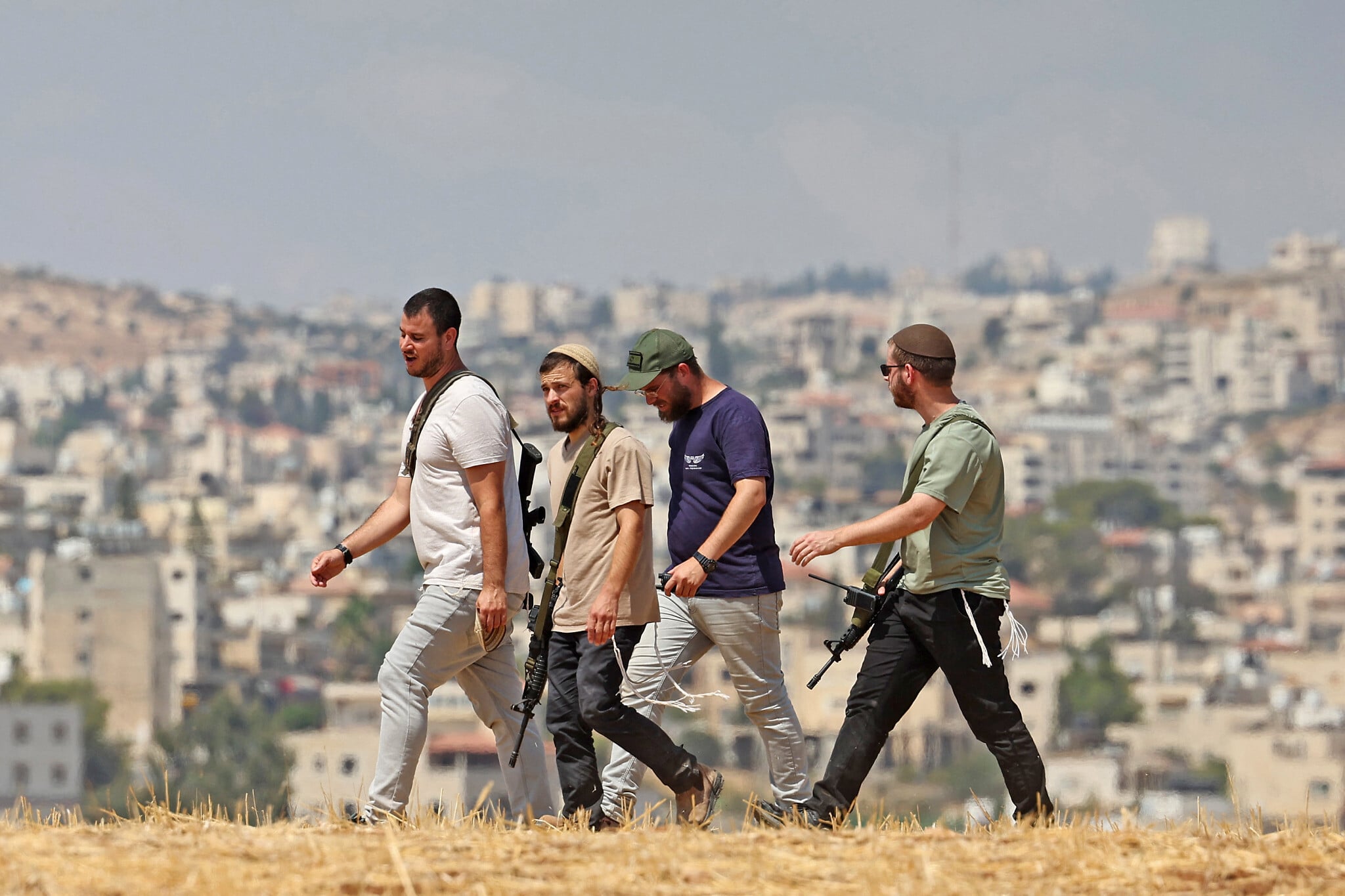
Israeli settlers walk through an open field in Beit Sahur, south of Bethlehem, in the West Bank on August 14, 2026. (AHMAD GHARABLI/AFP)
An armed settler was filmed firing into the air and then pointing his weapon at Palestinians and Israeli activists who had arrived at privately owned Palestinian land in the Beit Sahour area near Bethlehem in the southern West Bank.
According to Mia Biran, a “Combatants for Peace” activist who was at the scene and spoke with The Times of Israel, around 100 Palestinian and Israeli activists arrived at the site this morning together with the Palestinian owners of the privately owned land, following a settler takeover of an abandoned building that raised concerns that settlers would take control of the entire area.
Clashes between settlers and Palestinians in the Beit Sahour area near Bethlehem in the southern West Bank on August 14, 2026. (Courtesy)
Biran says that after the group reached the building and began removing Israeli flags that settlers had hung there and replacing them with Palestinian flags, shots were fired.
The site is on the outskirts of Beit Sahour, in Area C, which is under Israeli civilian and security control. There is also a military post in the area.
“Eight to 10 settlers arrived, all of them armed,” says Biran.
After people shouted in Hebrew, “Don’t shoot,” the gunfire stopped, according to Biran. The settler who fired into the air can then be heard shouting, “Get out of here.”
Clashes between settlers and Palestinians in the Beit Sahour area near Bethlehem in the southern West Bank on August 14, 2026. (Courtesy)
In another video, another settler can be heard shouting, “You’re messing with the wrong people.”
Biran adds that soldiers arrived at the scene shortly afterward and said it was a closed military zone, but did not present an order and did not remove the settlers from the area.
The IDF has yet to issue a response.
Palestinian Authority VP denounces Katz plan to put police in charge of West Bank law enforcement
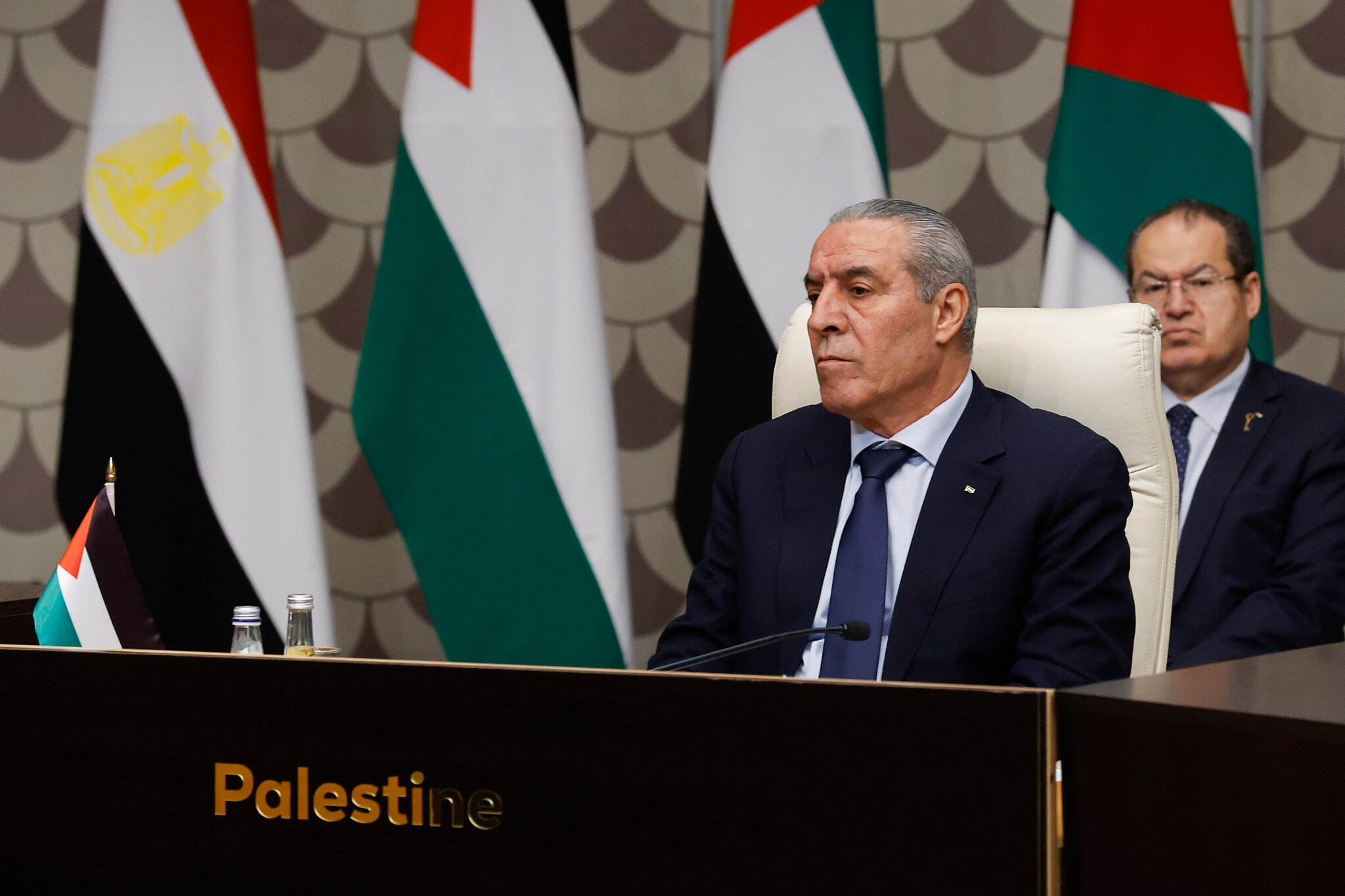
Secretary General of the Executive Committee of the Palestine Liberation Organization (PLO) Hussein al-Sheikh attends a meeting with US Secretary of State Antony Blinken and other foreign ministers, amid the ongoing conflict between Israel and the Palestinian Islamist group Hamas, in Amman, Jordan, Nov. 4, 2023. (Jonathan Ernst/Pool photo via AP)
Palestinian Authority Vice President Hussein al-Sheikh condemns Defense Minister Israel Katz’s plan to transfer the authority to enforce civilian law against Israelis in the West Bank from the IDF to the Israel Police.
In a statement carried by WAFA, the PA’s official news agency, al-Sheikh says the move “represents a new attempt to impose Israeli law and sovereignty over the occupied West Bank, including East Jerusalem, and to entrench the unlawful annexation of Palestinian territory.”
“Israel has no sovereignty over any part of the territory of the State of Palestine occupied in 1967,” the statement says.
It adds that Al-Sheikh urges “the international community, particularly the UN Security Council, to assume its responsibilities, halt these unilateral and dangerous Israeli measures, and compel Israel to comply with international law and international legitimacy resolutions.”
Analysts say it is unlikely that Katz’s broad proclamation is likely to become reality, considering that Israel has no civilian authority in the West Bank since it has never formally annexed it. Such a move would have enormous legal implications and is also likely to face roadblocks since it comes in the lead-up to a national election.
France urges Israel to arrest settlers besieging Palestinians in Qusra
Israeli army vehicles operate near Palestinian houses, besieged by Israeli settlers, in the West Bank village of Qusra, south of Nablus, August 13, 2026. (AP Photo/Majdi Mohammed)
France calls on Israel to arrest and prosecute rogue settlers blockading Palestinian homes at Qusra in the West Bank and to protect the civilian population.
“France strongly condemns the occupation of several Palestinian homes in the village of Qusra in the West Bank by Israeli settlers, as well as the acts of violence committed against Palestinian civilians,” the foreign ministry says.
Report: US officials urging Netanyahu to condemn settler siege of homes in Qusra
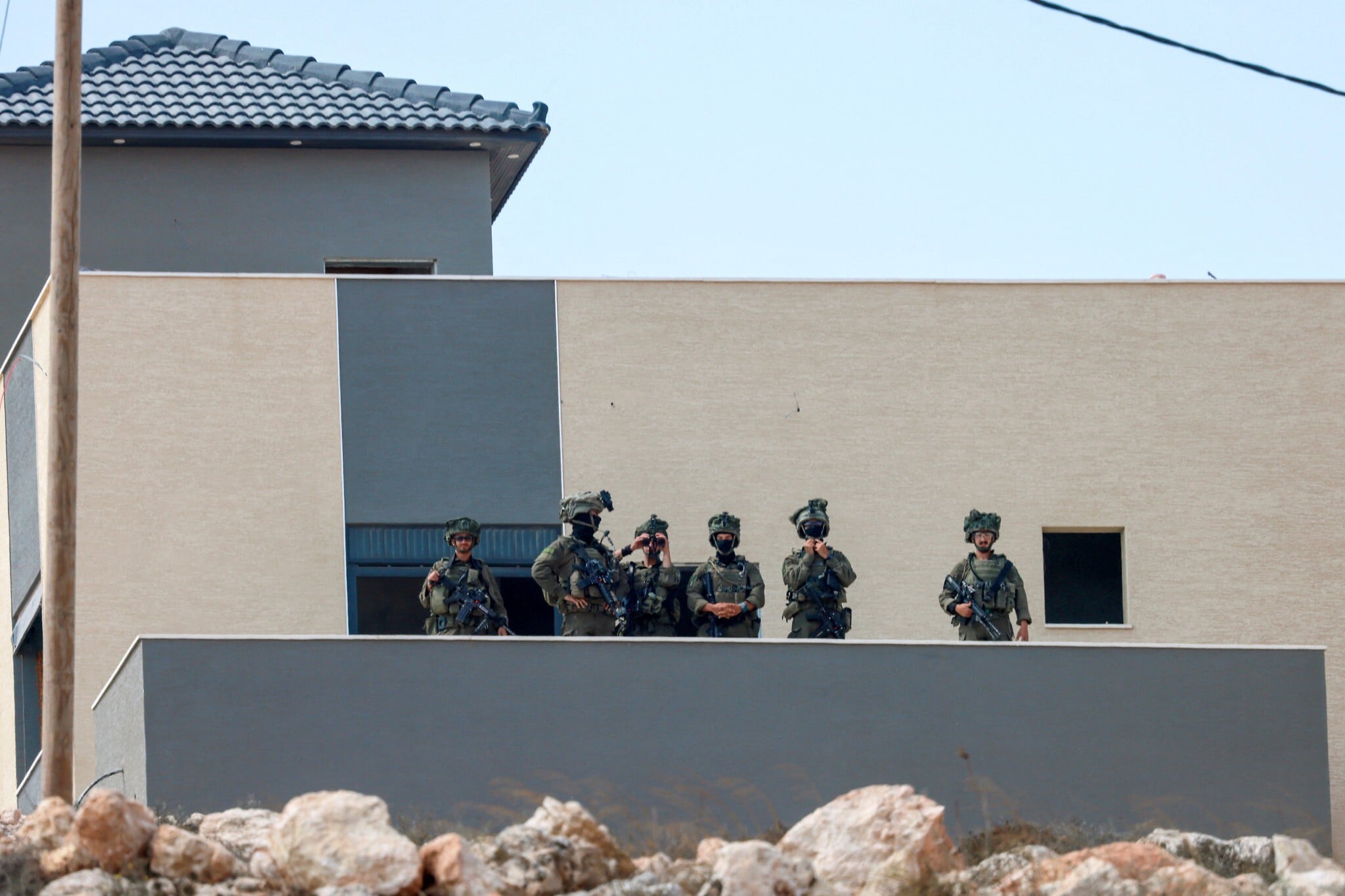
Israeli soldiers take position in a building located adjacent to the home of a Palestinian family besieged by Israeli settlers in the village of Qusra, south of the city Nablus, in the West Bank, on August 14, 2026. (Jaafar ASHTIYEH/AFP)
US and Israeli officials tell Reuters that the United States wants Prime Minister Benjamin Netanyahu to publicly condemn a siege imposed by extremist settlers in a Palestinian village.
The siege has already drawn public US criticism: US Ambassador to Israel Mike Huckabee — a strong supporter of Jewish settlement in the West Bank — condemned the settlers besieging a Palestinian home yesterday as “Israeli terrorists.”
A US official and an Israeli official say today that White House officials are pressing Netanyahu to publicly condemn the ongoing incident.
Washington began to protest after learning that the home of a Palestinian-American was among those under siege, say the two officials, who spoke on condition of anonymity to describe sensitive discussions, of which they had knowledge.
Netanyahu has not publicly commented on the events in Qusra. Neither his office nor the White House immediately responded to requests for comment.
‘Mr. President, he is winning’: Netanyahu aide tried assuring Trump PM polling well amid lackluster numbers

Prime Minister Benjamin Netanyahu (left) and US President Donald Trump meet in the Oval Office on July 28, 2026. (GPO)
During their July 28 meeting in the Oval Office, US President Donald Trump reportedly asked Prime Minister Benjamin Netanyahu how he was doing in the polls ahead of the October 27 Knesset election in Israel.
Netanyahu hesitated in responding, leading one of his advisers to pipe in and say, “Mr. President, he is winning,” according to the Axios news site.
Virtually no poll shows Netanyahu with the ability to form a coalition, and recent surveys have his Likud party trailing Gadi Eisenkot’s Yashar.
Delving into why Trump hasn’t endorsed Netanyahu ahead of the upcoming election, Axios, citing two senior officials, says the US president likes the Israeli prime minister personally but has been frustrated with some of his policies and decisions as of late, particularly pertaining to Iran, Lebanon and Gaza.
“Bibi is his own worst enemy,” Trump has said about Netanyahu, according to two people who have spoken to the president recently.
A former US official told Axios that Netanyahu’s poor performance in the polls is also what has led Trump to refrain from endorsing him to date.
Despite Trump’s apparent hesitation in endorsing Netanyahu, the premier’s rivals Eisenkot, Naftali Bennett and Yair Lapid have still expressed concern that the president will endorse the premier anyway, according to two of the opposition leaders’ aides who spoke to Axios.
Accordingly, the opposition figures have funneled back-channel messages to Trump’s circle urging him to remain neutral in the upcoming Israeli election, the aides said.
IDF says it punished 5 soldiers who photographed stripped, bound Palestinian detainee

A social media post by an Israeli soldier depicting a bound Palestinian detainee from Gaza, with the caption, "Good morning." (Courtesy)
The IDF says it has punished five soldiers for stripping a Palestinian detainee, strapping him to a bed, blindfolding him, tying his hands to a wooden rod behind his back and photographing him.
The army, in a statement, claims the Palestinian was trying to hurt himself and that was why the soldiers from the largely Orthodox Netzah Yehuda tied him up.
However, the IDF acknowledges that the manner in which the soldiers dealt with the situation went against the army’s “values.”
One of the soldiers posted the photo of the detainee from Gaza on Instagram, with the caption, “Good morning.”
Following an investigation into the incident, the army says that the commander involved was transferred to a different position, while his deputy was reprimanded.
Another soldier who tied the Palestinian down was sentenced to five days in military prison and removed from combat.
A fourth soldier who took the photo was sentenced to five days in military prison.
A fifth soldier involved was barred from leaving base for two weeks.
No disciplinary action was taken against two more soldiers involved in the incident but who were not from the Netzah Yehuda battalion.
“Both abusive treatment of detainees and the public sharing of humiliating or degrading images of them can constitute war crimes,” says Oneg Ben Dror from Physicians for Human Rights Israel (PHRI)
The picture “confirms what thousands of testimonies from Palestinian detainees have exposed, and what we and other organizations have been reporting for nearly three years now,” she adds.
Eisenkot praises Stern after Yesh Atid departure announcement, raising speculation of party swap
Yashar chief Gadi Eisenkot praises MK Elazar Stern after the latter’s announcement that he is leaving Yesh Atid, raising speculation that he may switch parties.
“I hope to see him continue in public service for the people of Israel,” Eisenkot says in a statement.
A day before announcing his departure from Yesh Atid, Stern said he believed Eisenkot is the “only leader who has consensus support.”
‘This is what’s happening every day in the territories’: Democrats MK laments inaction against violent settlers
Democrats MK Gilad Kariv posts footage from earlier today showing an armed settler invading private Palestinian land and illegally firing into the air to try and oust left-wing protective presence activists.
The activists were on site at a village near Beit Suhour outside of Jerusalem to try and protect a Palestinian family that has come under repeated attack from settlers who established an illegal outpost on their land.
“Fifteen minutes from Jerusalem, on the outskirts of Bethlehem and Beit Sahour. A violent nationalist aims a weapon at activists from the protective presence and fires into the air — all of this on the private land of a Palestinian family that a gang of hilltop settlers has taken over.” Kariv writes.
“The army arrived and removed the activists, while members of the settler gang returned to the outpost they’ve established in a home belonging to the Palestinian family,” he continues.
“This is what happens every day in the territories,” Kariv says.
“This weapon will eventually end up being used to spill blood, and we will all be unable to truly say the verse from this week’s Torah portion from the portion of Shoftim: “Our hands did not shed this blood, nor did our eyes see it done.”
רבע שעה מירושלים.
בפאתי בית לחם ובית סאחור.
לאומן אלים מכוון נשק אל עבר פעילי נוכחות מגינה ויורה באוויר; והכל בשטח פרטי של משפחה פלסטינית שכנופית גבעות השתלטה עליו.הצבא הגיע והרחיק את הפעילים. חברי הכנופיה חזרו למאחז שהם בבית השייך למשפחה הפלסטינית.
זה מה שקורה כל יום בשטחים.… pic.twitter.com/AtOulNQ7dK
— גלעד קריב (@KarivGilad) August 14, 2026
Key Update
Likud backbencher Tsega Melaku announces she won’t run in party primaries
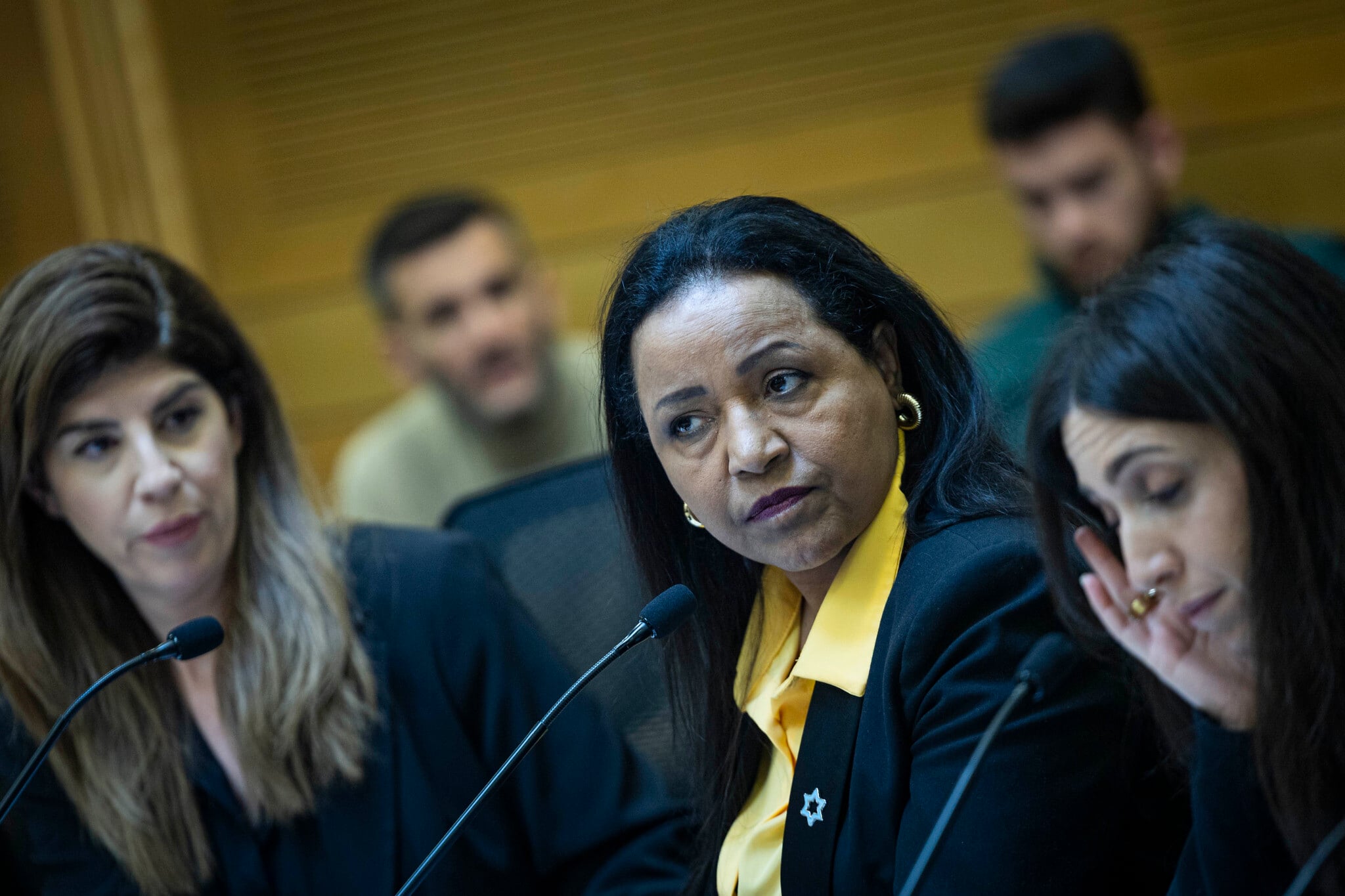
MK Tsega Melaku leads the Special Committee for the Communications Law at the Knesset on February 24, 2026 (Yonatan Sindel/Flash90)
Likud MK Tsega Melaku announces that she will not run in the upcoming Likud primaries, joining Eliyahu Revivo and Moshe Passal who made similar decisions in recent days.
All three were unlikely to perform well enough in the primaries to make it into the next Knesset.
Palestinians say settlers siphoned off water that irrigated their crops for pool they can’t access

Israelis visit the Fasayil springs near the Palestinian village Fasayil, where residents say that Israeli settlers diverted water from the spring causing crops to die, in the West Bank, August 9, 2026. (Mohamad Torokman/Reuters)
On a searing summer day, Israeli settlers splash in a West Bank pool created by siphoning off water that had irrigated Palestinian crops, one of many seizures of water resources across the territory.
The spring served as a lifeline for the nearby village of Fasayil in the fertile Jordan Valley, where Palestinians have relied on it for generations for food, employment and to supplement irregular Israeli supplies to their domestic taps.
“Our water supply remains cut off to this day, depriving us of the water we depend on for our homes, our livelihoods, and our agricultural land,” says Saad Nemer, who farms the land.
Israeli settlers seized his irrigation pipeline in June, channeling the water to an ancient pool in an archaeological site, Nemer says.
Israeli settlers in the occupied West Bank diverted a spring that was a lifeline for the Palestinian village of Fasayil, cutting irrigation pipes in June and converting it into a tourist attraction, leaving nearby farms barren https://t.co/yzqIHVNnla pic.twitter.com/JdZ0wHICTD
— Reuters (@Reuters) August 14, 2026
Soon after, settlers advertised it as an Israeli tourist attraction and Finance Minister Bezalel Smotrich pledged financial support.
“They are now in the process of developing a recreational park around the pool,” Nemer says.
The seizure of the spring at Fasayil is part of a pattern that Palestinians say is designed to make their lives in the West Bank untenable. Israeli settlers have attacked at least 160 water and sanitation sites across the Palestinian territory this year, United Nations data shows.
Nemer’s greenhouses and fields would normally be full of eggplant, zucchini and watermelons, but without water he has not been able to plant in the scorched land.
“The settlers cutting off our water has caused us losses and has meant that many families will lose their work and their livelihoods,” he says.
Nemer says that an employee had been beaten up by settlers and he himself had faced threats for attempting to approach the spring as far back as two years ago.
Yishai Shreiber, 21, an Israeli settler who had come to swim in the pool near Fasayil on an August afternoon, says Palestinians would not now dare approach.
“Now that they see this entire mass of people, all these large groups of Jews coming here to bathe, they are afraid to come here,” says Shreiber, taking pride in the fact that Palestinians don’t dare try and reach the spring.
Shreiber says the West Bank belonged to the Jewish people, and that if Palestinians don’t want to accept Jewish authority, they should leave.
Nemer shows Reuters a 2025 land ownership document from COGAT, the Israeli military agency which enforces civilian policy in the occupied territories.
He also presented a map drawn for the 1957 registration of his title deeds showing that his land included both the spring and the pool.
COGAT and Smotrich do not respond to requests for comment.
Key Update
Hormuz traffic slows further after US threatens more economic pressure on Iran
Transit through the Strait of Hormuz appeared to grind to a near standstill on Friday after two more ships were attacked there and the United States said it could maintain a naval blockade of Iran indefinitely.
A senior Iranian source said on Wednesday that there had been no progress in talks to build on a June agreement to end the war. Since the ceasefire renewed in the June deal broke down, Iran has resumed attacks on ships it accuses of trying to transit the strait without its permission.
The United Arab Emirates’ Abu Dhabi National Oil Company said two of its vessels were attacked transiting the strait on Thursday evening. The UAE government blamed Iran, which made no immediate comment.
Two vessels passed through the narrow waterway on Friday, according to analysis from ship tracking firm Kpler: a grain ship entering Iranian waters and an empty dry bulk ship going in the other direction.
A separate empty liquefied petroleum products tanker was sailing into the Gulf via the strait, the data showed. There were no crude oil shipments visible on Friday.
Nine vessels passed through the strait on Thursday, up from five on Wednesday but below the average of 12 for August.
Some ships may pass through undetected with their transponders off, but the figures are nowhere near the more than 130 ships that traversed the Strait of Hormuz daily before the war launched by the US and Israel on Iran in February.
Key Update
While Netanyahu mum, Leiter condemns settler violence in Qusra
Israeli Ambassador to the US Yechiel Leiter condemns the siege by settlers of Palestinians in Qusra.
“What we saw in the village of Qusra this week is not what it means to settle the land,” Leiter says in a video statement.
“When a gang of hooligans wreaks havoc with gratuitous violence, diverting energy from Israel’s own military and law enforcement, while claiming that it is for the sake of the land – that is a distortion, even a sacrilege,” he argues. “The Land of Israel is not only a place we are commanded to inhabit. It is a place where we are commanded to live by justice.”
Leiter is one of the first Israeli officials to publicly condemn the violence in Qusra, though the White House was apparently hoping that Prime Minister Benjamin Netanyahu would weigh in on the matter himself.
While the IDF has also called out the violence, it has yet to clear the settlers from the area, and they continue to maintain a siege of two Palestinian homes.
None of the settlers involved in the siege — including those who cut the homes’ electricity and water lines — have been arrested.
Netanyahu’s government has been accused of ignoring and sometimes tacitly backing such attacks.
This week's Torah portion is a great reminder that, as we are commanded to settle and inhabit the land, we must build a society that is worthy of the land we live in.
Shabbat Shalom ????️????️ pic.twitter.com/eULqoluS4X
— Ambassador Yechiel (Michael) Leiter (@yechielleiter) August 14, 2026
IDF says it killed Hamas commander planning attacks on troops in Thursday strike
A Hamas company commander who was advancing attacks against Israeli troops was struck and killed in the southern Gaza Strip yesterday, the IDF announces.
The military says the Thursday strike in Khan Younis killed Hudhaifa Khaled Suleiman Qawari, a commander in Hamas’s Khan Younis Brigade.
During the war. Qawari had been involved in training Hamas terrorists, transporting weapons and acting to restore the group’s capabilities, according to the IDF.
The IDF justifies the strike amid the ceasefire by saying that Qawari had recently been advancing attacks on troops. “The terrorist posed a threat to our forces and was eliminated in an aerial strike,” the army adds.
Earlier, the IDF announced that a strike two weeks ago in northern Gaza killed Muhammad Bassam Mushtaha, a commander in Hamas’s Al-Shati battalion, who invaded Israel on October 7 and held multiple Israelis hostage.
French national reportedly released on bail in Thailand after brutal attack on Israeli mother, daughter
Thai authorities have reportedly released a French national on bail after he attacked a 62-year-old Israeli woman and her 23-year-old daughter in Koh Phangan last week.
Paul William Bercu Gaubert was released after making a $3,200 bail payment, the Ynet news site reports.
Both of the Israeli women were seriously injured in the attack. The older victim remains in the hospital.
The pair, who asked not to be identified, say Gaubert approached them at a waterfall and asked where they were from. After the daughter told him they were Israeli, he attacked them both. They each have required surgeries for the injuries sustained.
‘HE’S A DANGER’: Man Accused of Brutally Beating Israeli Mom and Daughter Released in Thailand
The man who beat an Israeli mother and daughter in Thailand so badly they each had to undergo two surgeries as a result of their injuries has been released on $3,200 bail, the pair… pic.twitter.com/9YYZ4hyvEs
— Jewish Breaking News (@JBreakingNews) August 14, 2026
‘Surrounded’: Israel’s new West Bank settlements bring chaos to Palestinians
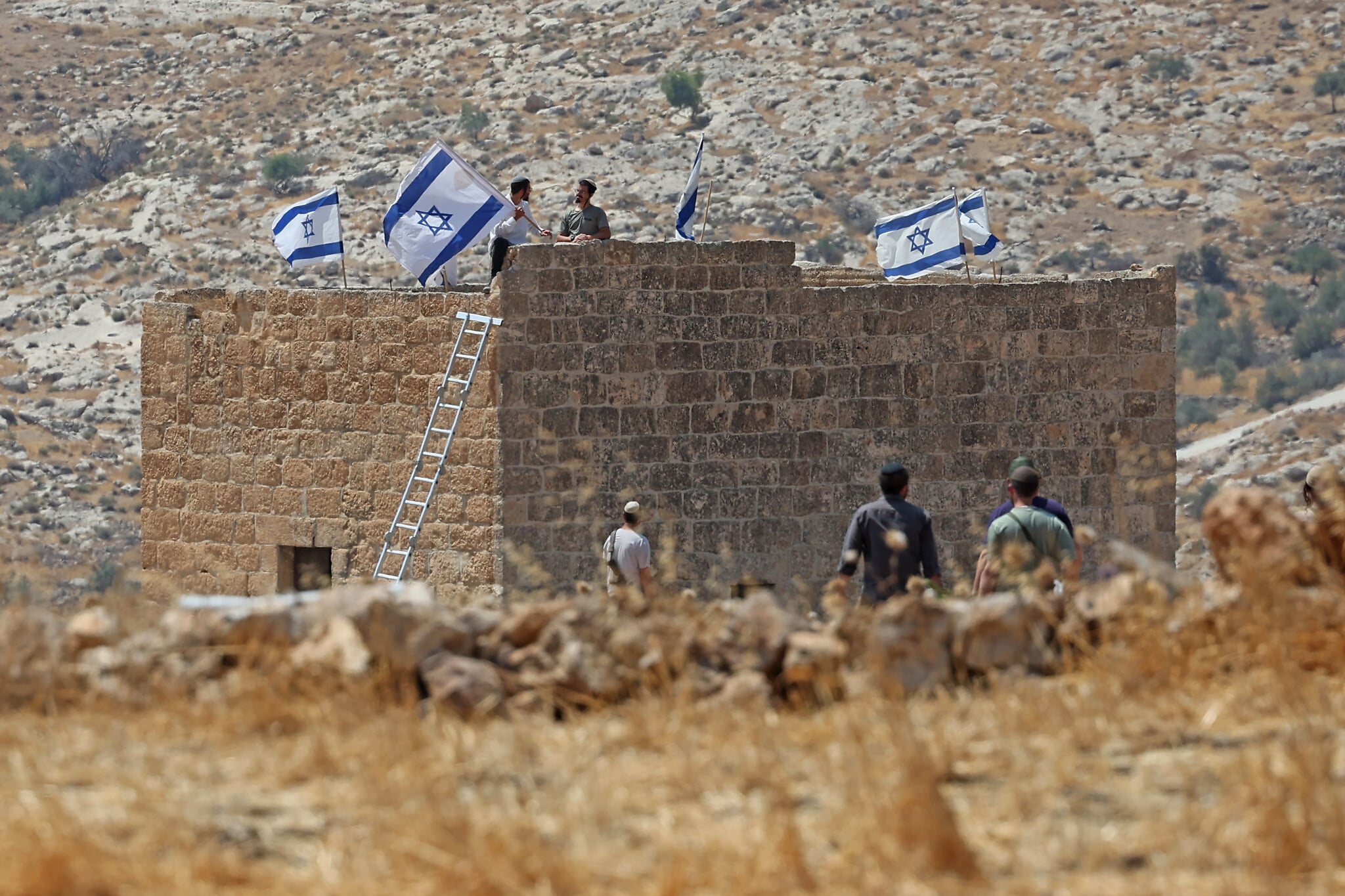
Israeli settlers install flags over a Palestinian house seized by them, in Beit Sahur, south of Bethlehem, in the West Bank on August 14, 2026. (AHMAD GHARABLI/AFP)
Palestinian Amin Rahal and his three brothers haven’t gone to work in weeks, instead taking turns guarding what remains of their land atop a West Bank hill from incursions by nearby settlers.
“We never leave the place unless we have two people here,” says Rahal, a 31-year-old father of three, pointing to the roof of a settler’s newly installed prefabricated home 100 meters from his house.
“They’ve stolen hens, land with olive trees, damaged the sage bush in our backyard with their ATVs, brought their sheep into our courtyard, and more,” he tells AFP.
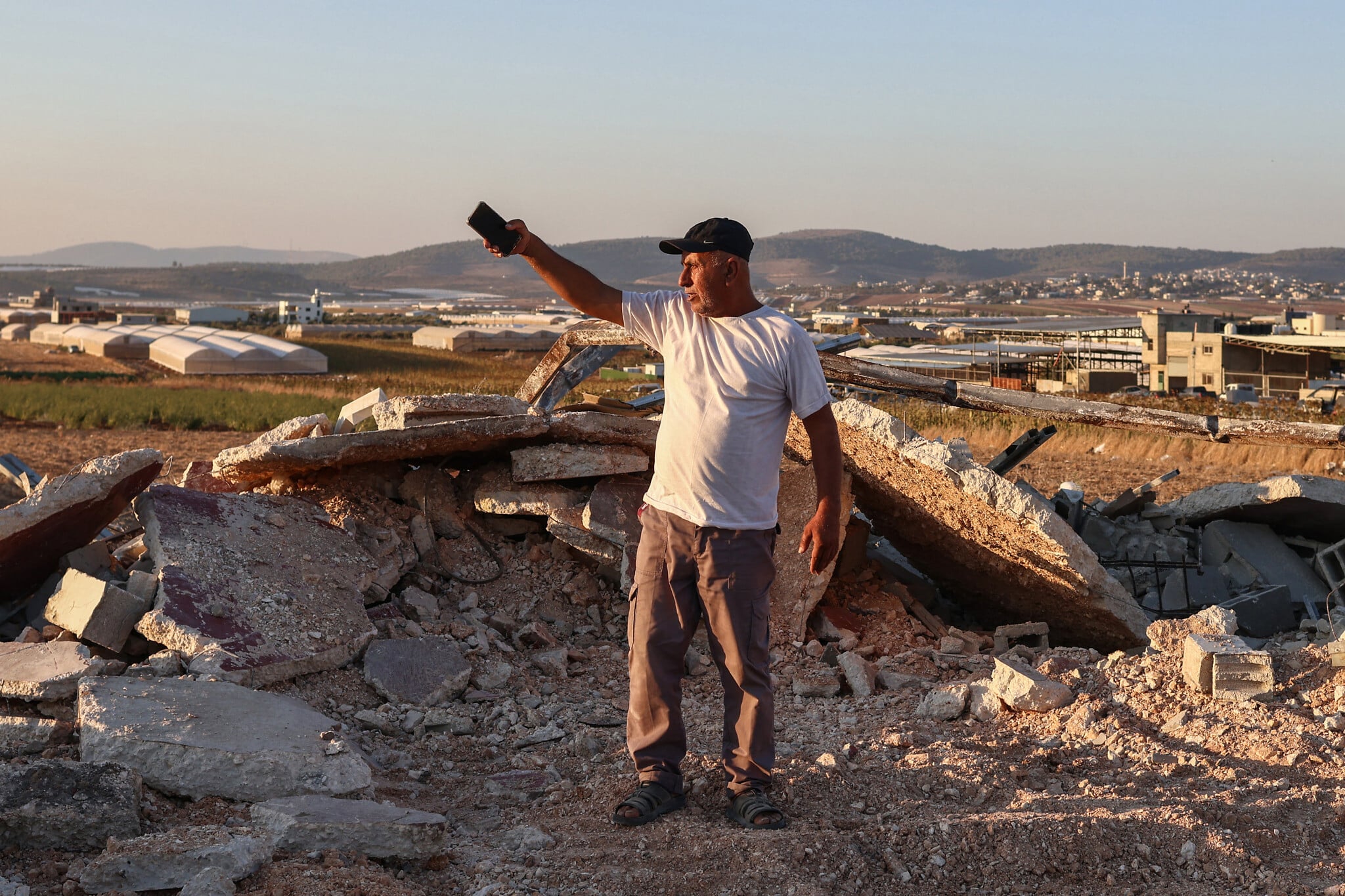
Last week, settlers from the newly inaugurated Israeli settlement of Emek Dotan just below his home put up a rope across his land and forbade him and his family from crossing it.
A chicken farm and many olive trees stand on the other side of the rope and are now lost to the Rahal family under threat of violence.
“Our fear is that they will attack the children, burn one of the houses, attack us at night and break into the houses,” as has happened in other West Bank villages where settlers have moved in, he says.
1. אלוף פיקוד האפרטהייד, המתנחל בלוט, התעלה על עצמו גם במושגיו. ב-8 ליולי הוא חתם בין היתר גם על 15 צווי תפיסה עבור כביש עוקף חדש שיסלל בין שתי התנחלויות חדשות/מתוכננות: עמק דותן ונעה. הכביש יסלל בעיקרו בתוך שטח A. בלוט נרתם בכל הכוח לסייע לממשלה להקריס את אוסלו. שרטוט מקורב. pic.twitter.com/zYVzYP2o2W
— Dror Etkes (@dror_etkes) July 28, 2026
Across the West Bank, such accounts have become common, with the UN’s Office for the Coordination of Humanitarian Affairs reporting an average of six incidents per day involving West Bank settlers in 2026.
These include theft, vandalism, arson, beatings and sometimes murder, with Palestinians complaining that most crimes against them go unpunished.
Key Update
Trump confirms release of US missionary kidnapped in Niger
Kevin Rideout, a US missionary who was kidnapped in Niger last year, has been released, President Donald Trump confirms.
The news of the release of Rideout had first been relayed by the Christian group he worked for, SIM International, which said he had been kidnapped from outside his home in the Nigerien capital Niamey last October.
“I am proud to announce that Kevin Rideout, a wonderful Christian Missionary, is back in United States Custody,” Trump says in a post on his Truth Social network.
“Kevin was kidnapped by Jihadi terrorists in West Africa,” Trump says, without offering more details.
An American missionary who was kidnapped in Niger in October has been released, his organization said Friday.
Kevin Rideout “is in good health in the care of U.S. officials,” SIM International said in a statement.
Read more: https://t.co/SPIPKYt2nR pic.twitter.com/QVZvDEs1VP
— ABC News (@ABC) August 14, 2026
SIM International says Rideout is “in good health in the care of US officials,” adding that he will soon be reunited with family.
The Trump administration had made Rideout’s release a priority in its latest strategy on African Sahel states, after years of fighting extremism found limited success.
Niger, governed by a military junta for three years, has been plagued by jihadist violence and saw a spate of kidnappings of Westerners last year.
Wamaps, a collective of journalists in West Africa, said last year that Rideout was “abducted just a few streets away from the presidential palace right in the city center in a zone which hosts international organizations.”
At one point, he was believed to be held in neighboring Mali by the Sahel branch of the Islamic State group.
Investigators said increasingly convinced Israelis’ disappearance in Vienna not nationalistically-motivated

An undated photo showing Mali (left) and Liel Yahalomi, an Israeli mother and daughter who went missing in Vienna on August 7, 2026, and were found alive and well in Argentina on August 14, 2026. (Israel's Embassy in Austria)
A source familiar with the police investigation into the weeklong disappearance of Israeli mother and daughter Mali and Liel Yahalomi in Vienna says it is looking less and less likely that it has to do with their nationality or health.
The source says authorities believe the pair are still alive.
While Israeli police have placed a gag order on the case, Hebrew media continues reporting on it extensively.
Channel 12 cites what it says is an Austrian media report claiming that the Yahalomis may have escaped to South America.
Houthis say they targeted Aramco in Saudi Arabia’s Najran with drone
Yemen’s Houthis say they targeted an Aramco facility in the Saudi city of Najran with a drone, the group-run SABA news agency reports, citing a military source.
The source says the attack was in response to what it described as Saudi military aircraft violating Yemen’s sovereignty by entering airspace over the northeastern part of Saada governorate.
There is no immediate confirmation from Saudi authorities or Aramco. It was not immediately clear from the report whether the facility was hit.
Hezbollah chief says Lebanon-Israel deal puts undue pressure on army
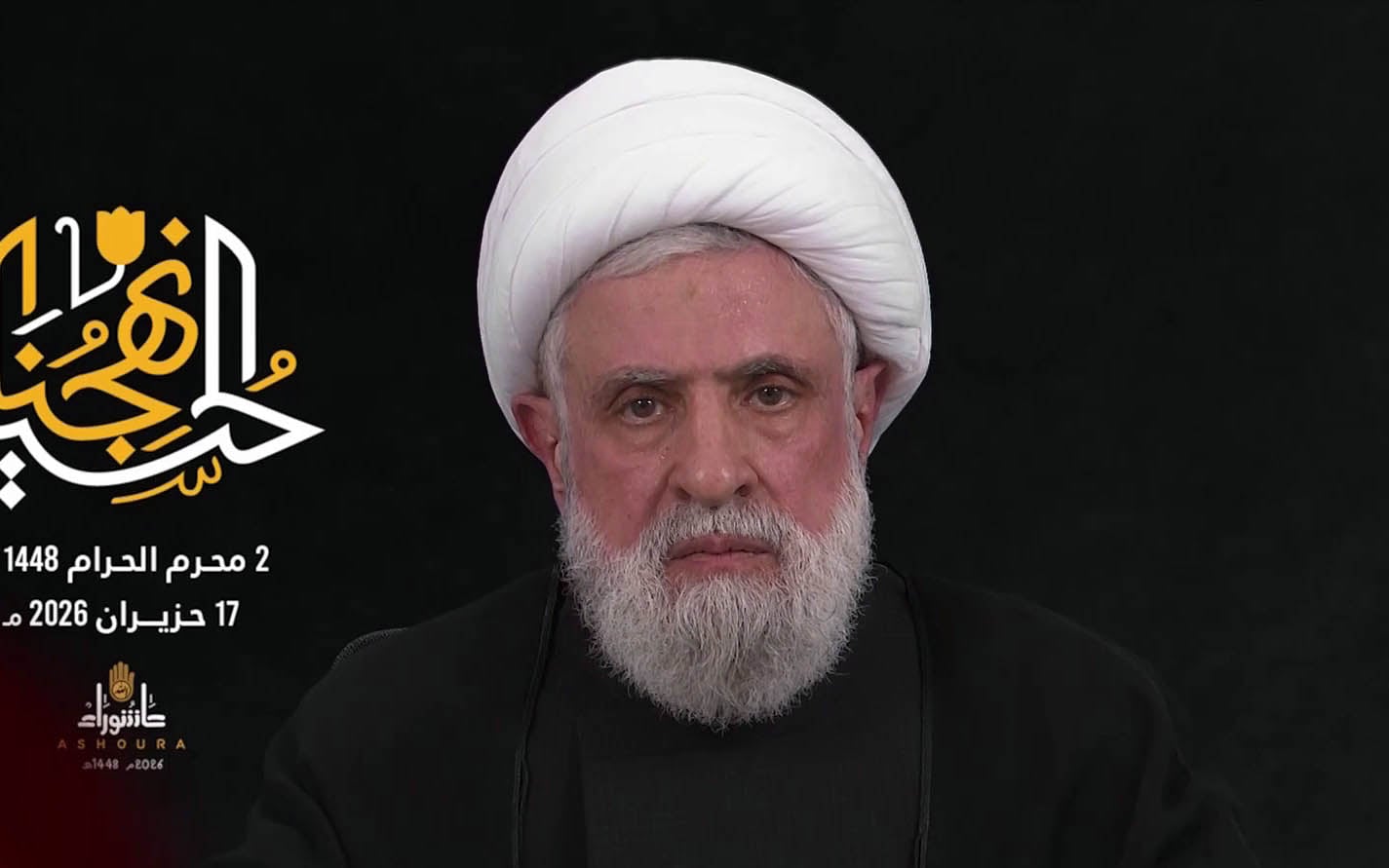
Hezbollah leader Naim Qassem delivers a speech broadcast on June 17, 2026. (Screenshot/Al Manar via X)
Hezbollah chief Naim Qassem accuses Lebanese authorities of subjecting the country’s armed forces to undue pressure by implementing a framework deal agreed with Israel to end hostilities.
The June trilateral framework, to which the United States is also a party, involves the disarmament of the Lebanese terror group and a gradual withdrawal of Israeli forces from Lebanon’s south, where it has occupied several areas.
It also includes the deployment of the Lebanese army to areas where Israel’s military has pulled out, starting in test areas known as “pilot zones.”
“How can you accept this ongoing humiliation of the Lebanese army, exposing it to bombardment and Israeli pressures, instead of acting as its protectors?” Qassem says in a speech.
In talks between Lebanon and Israel in Rome last week, both sides discussed which countries might participate in a committee tasked with verifying the Lebanese army’s deployment in the pilot zones and clearance of Hezbollah weapons and infrastructure, a Lebanese presidency source told AFP.
“Israel is attempting to bind Lebanon to an inquiry committee that oversees the army’s deployment, operations, and internal details. Where is the patriotism? Where is the dignity of the army that ought to be preserved?” says Qassem.
Hezbollah has repeatedly rejected the direct talks and refuses to surrender its weapons.
Washington on Tuesday announced it would sponsor a new round of negotiations between Israel and Lebanon in Rome in early September.
But Qassem reiterates the group’s rejection of the framework deal and called on Lebanese officials to reverse it.
Austrian police: Israeli women, who haven’t been seen in a week, left country willingly
An undated photo showing Mali (left) and Liel Yahalomi, an Israeli mother and daughter who went missing in Vienna on August 7, 2026, and were found alive and well in Argentina on August 14, 2026. (Israel's Embassy in Austria)
Police in Austria have announced that Israeli nationals Mali and Liel Yahalomi, who have been missing for a week, have left the country on their own volition, Haaretz reports.
Meanwhile, the Austrian newspaper Kronen Zeitung says the mother and daughter crossed the Austrian border into Germany and from there flew out of Europe, potentially to South America.
The Yahalomi family issues a statement from Israel demanding that security agencies continue investigating all possible scenarios.
Houthi attack on Yemen’s Mokha reportedly kills six
A military official from Yemen’s internationally recognized government says a Houthi attack on Friday on the port city of Mokha killed six people, two of them security personnel.
The Iran-backed rebels “fired five missiles at commercial ships unloading at the port, and two ships are on fire,” the official says.
Trump dismisses concerns over conditions on US aircraft carrier

The Nimitz-class aircraft carrier USS Abraham Lincoln (CVN 72) transits the Arabian Sea, in a photo released July 1, 2026. (US Navy photo)
US President Donald Trump dismisses concerns over living conditions and the mental health of service members on a US aircraft carrier deployed against Iran, while confirming the ship would soon rotate out.
Asked by reporters whether family members were worried about the situation on the USS Abraham Lincoln, Trump says, “No, they’re not.”
Trump also rejects the idea that the ship — now in its ninth month at sea — had been deployed for too long. “No, no, no, not nearly enough,” he says.
The president meanwhile confirms reports that the ship was due to be swapped out with another aircraft carrier, as the United States remains locked in a stalemate with Iran over control of the Strait of Hormuz and the country’s nuclear program.
“That ship is moving right now or very shortly and it’s being replaced with another very similar ship,” Trump says.
US media, including specialist military publications, have quoted multiple relatives of crew members saying living conditions have deteriorated on the Lincoln. There have also been reports of several suicide attempts.
Democratic lawmakers are calling for probes into the situation.
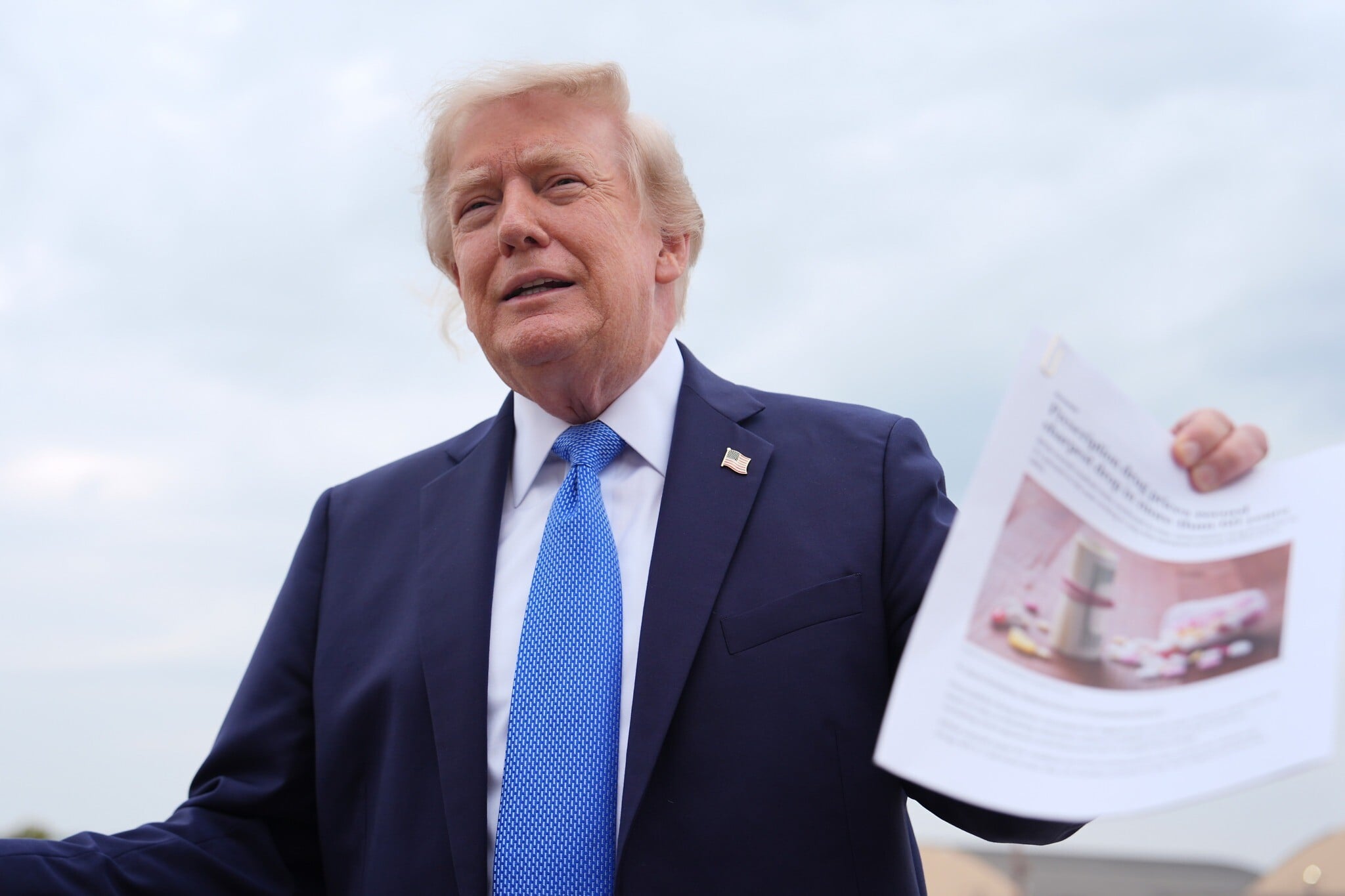
The massive nuclear-powered ship departed California in November 2025 for duty in the South China Sea and was rerouted to the Middle East before US-Israeli attacks on Iran that began February 28.
Jonathan Schroden, chief research officer at the Center for Naval Analyses, tells AFP that carrier strike groups are generally designed for six-month deployments for reasons “including sailor welfare.”
Media coverage of the families’ complaints creates an unwelcome new front for Trump in his attempt to sell the already unpopular war.
The Republican won a shock second term in 2024 partly on his insistence that he would not involve the United States in so-called Mideast forever wars, and the conflict has contributed to dragging down his poll numbers.
Among the more disturbing details emerging from the accounts by sailors’ families was that two sailors had tried to jump overboard. The US military has said that one sailor who fell into the sea on August 3 was recovered.
A US official denied that mental health was an issue.
“We have not observed an increase in suicidal ideation or attempts aboard the ship,” the official says, adding that the Abraham Lincoln has five chaplains available, one psychologist, one social worker, a “prevention coordinator,” and a dog named CAPT Fathom “to support crew morale and emotional welfare.”
“Adapting to life at sea can be difficult, so we’ve learned how to provide resources and help Sailors with these transitions,” the official says.
Trump: US to hit Iran hard economically
US President Donald Trump tells Fox News that the United States will hit Iran hard economically, as Washington and Tehran struggle to reach a deal to end a nearly six month conflict.
His comments came a day after US Treasury Secretary Scott Bessent said the US was going to apply measures that have “never been seen” on Tehran as soon as next week.
Ebola killing a victim every 30 minutes in DR Congo — UN
The Ebola virus in the Democratic Republic of Congo is now killing a victim every 30 minutes, a top UN humanitarian official says, calling for greater international action.
“The outbreak is the fastest growing on record,” Tom Fletcher, Under-Secretary-General for Humanitarian Affairs, says in a statement. “We need speed, scale and solidarity before this virus gets even further ahead of us.”
The outbreak has killed at least 2,128 people out of more than 4,500 confirmed cases since being declared in the DRC on May 15 and the UN has already said it is on course to become the deadliest Ebola eruption ever.
“Ebola is winning in the Democratic Republic of the Congo. We cannot let the virus outrun our response,” Fletcher said as he outlined the latest efforts to contain the virus, which spreads through contact with bodily fluids and causes a hemorrhagic fever.
“The epidemic is killing someone every 30 minutes,” says Fletcher, who warned that “many more people are at risk.”
Fletcher says countries had now donated nearly $300 million to a fund to combat the outbreak.
Trump claims he will soon declare Strait of Hormuz a US territory
US President Donald Trump says that he would be soon declaring the Strait of Hormuz a US territory, escalating his rhetoric over the vital waterway that carries a significant share of global oil supplies.
“After we finish defeating Iran… I’ll be declaring the Hormuz Strait a territory of the United States,” Trump claims at a rally.
Trump doesn’t elaborate on the move and it’s unclear whether it would have any implications, given Iran’s ability to continue to thwart shipping through the channel.
Police locate Israeli mother and daughter in Argentina, week after they were last seen in Vienna

Mali and Liel Yahalomi located on a bus in Argentina by police on August 14, 2026. (Screen capture/Israel Police)
Israel Police announce that officers have located Mali and Liel Yahalomi, who were last seen a week ago in Vienna.
The mother and daughter have been found in Argentina.
Police publish footage showing officers, among them representatives from Israel and Interpol, boarding a bus in the country and introducing themselves to the Yahalomis, who appear confused by the situation, but unharmed.
It’s not yet clear why they cut contact with their family since last Friday in Vienna or why they flew to Argentina.
ברייקינג.
מלי וליאל יהלומי אותרו בארגנטינה. pic.twitter.com/reKJ2TsOSD— Josh Breiner (@JoshBreiner) August 14, 2026
Police allow Yahalomis to continue on their way in Argentina after questioning
A police source tells the Haaretz news site that Mali and Liel Yahalomi left Vienna for Argentina on their own volition in order to start a new life.
The mother and daughter are not suspected of any crime and were allowed to continue on their way after questioning, the source says.


read more: