

Live updates (closed)
 Add ToI as a Preferred Source on Google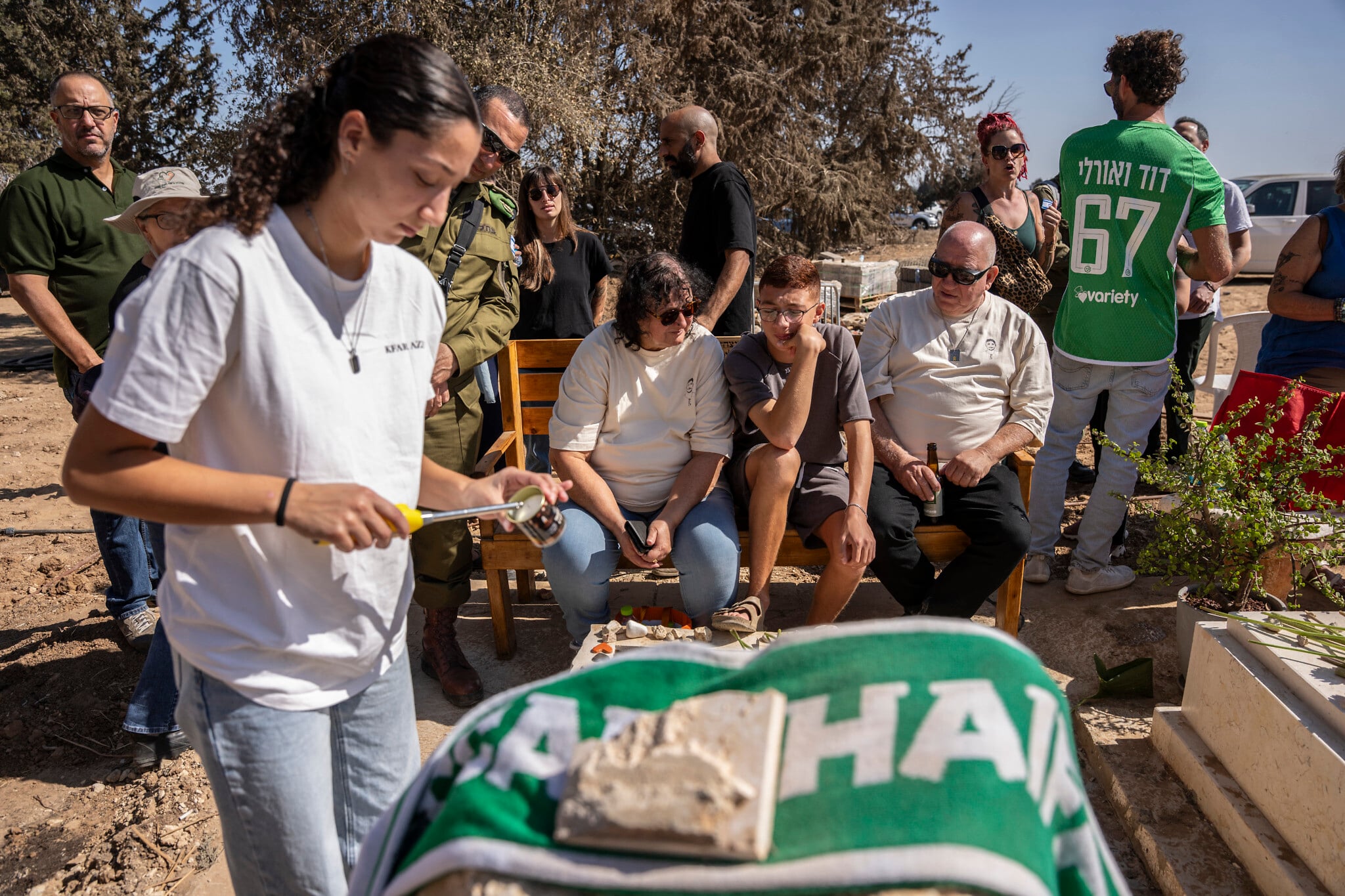
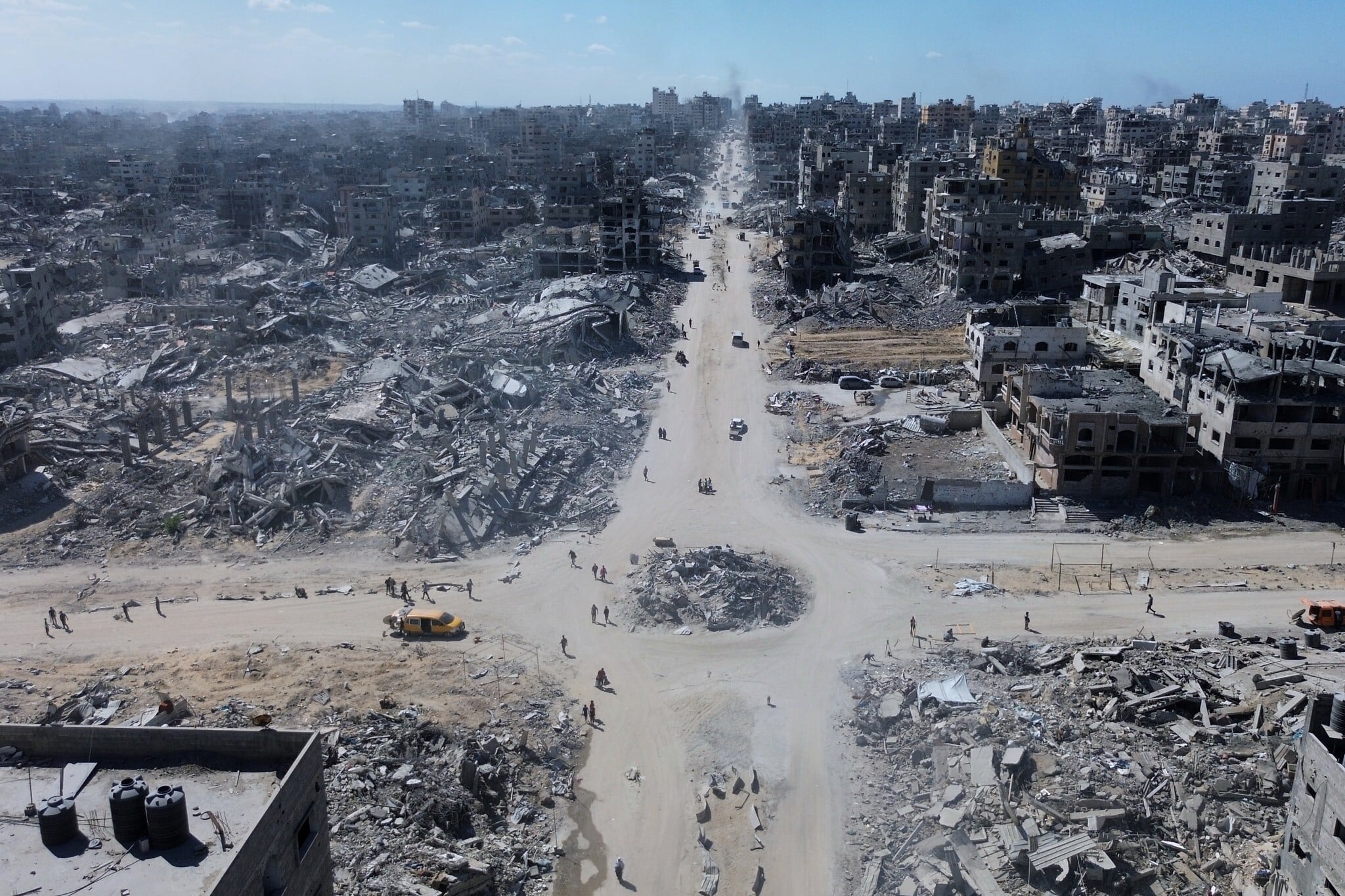
The Times of Israel liveblogged Thursday’s events as they happened.
US denies Hamas violating ceasefire deal, vows no hostage will be ‘left behind’ in Gaza
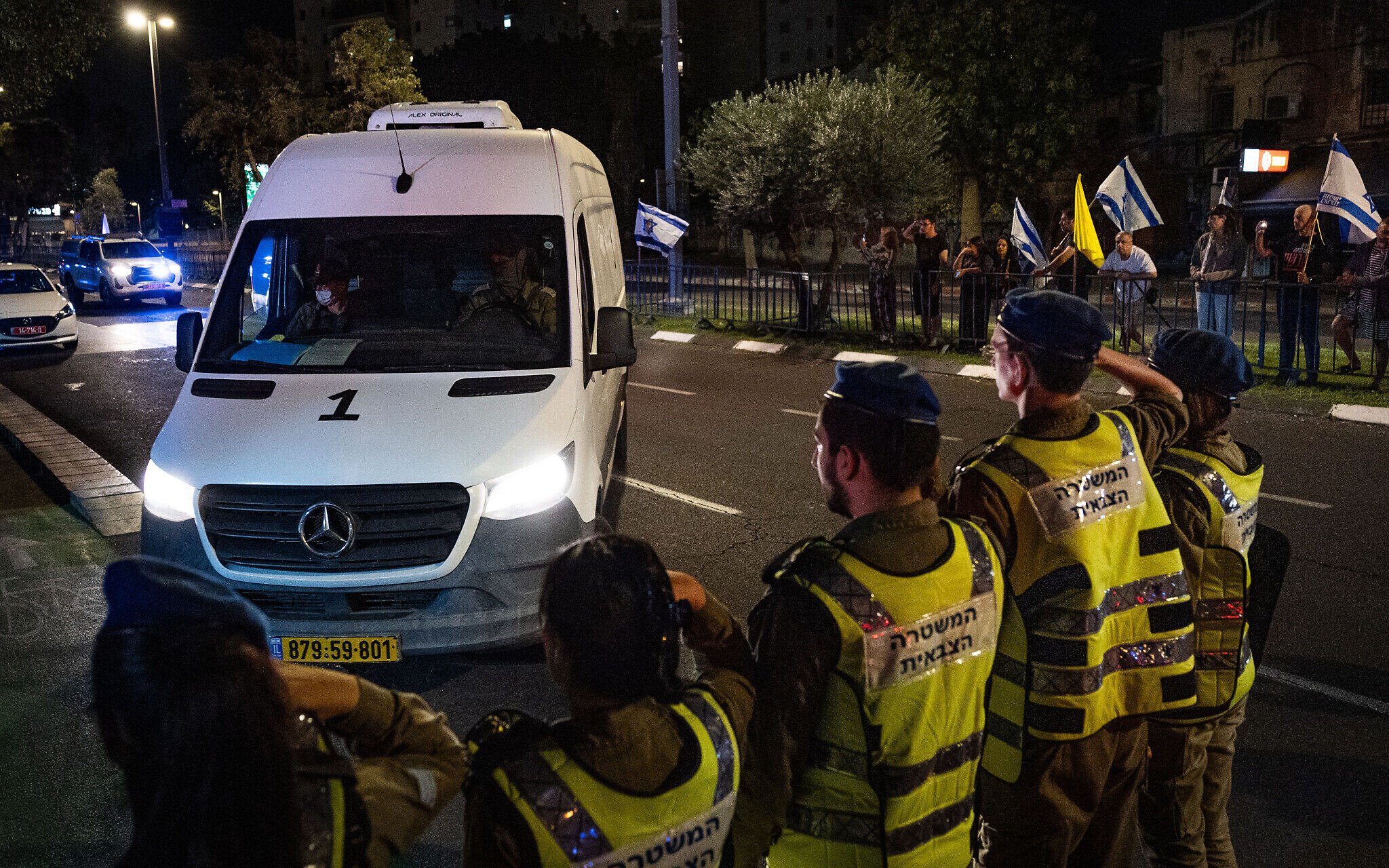
Israeli citizens and soldiers pay their respects as a convoy carrying the bodies of hostages Inbar Haiman and Muhammad el-Atrash arrives at the Abu Kabir forensic institute in Tel Aviv, after they were transferred by Hamas on October 16, 2025. (Yonatan Sindel/Flash90)
The US denies that Hamas is violating the ceasefire deal with Israel, insisting that a dragged out process to return the bodies of hostages held in Gaza was expected, given the difficult conditions on the ground.
“We’ve heard a lot of people saying, ‘Hamas violated the deal, because not all the bodies have been returned.’ The understanding we had with them was we get all the live hostages out, which they did honor that,” says a senior adviser to US President Donald Trump during a briefing with reporters.
“Right now, we have a mechanism in place where we’re working closely with mediators… to do our best to get as many bodies out as possible,” the senior aide says on condition of anonymity. “We continue to give [the mediators] the intelligence that the Israelis have [on where bodies may be located] and we keep working in good faith until we are able to exhaust that mechanism.”
A second top Trump adviser on the briefing — also speaking on condition of anonymity — says, “Hamas did the right thing when they gave all of the 20 live hostages up at the same time. That was a big moment.”
The second Trump adviser notes that it was only possible to begin retrieving bodies once the ceasefire came into place last week, given that Gaza had been an active war zone.
The amount of debris in Gaza dwarfs what was left after the World Trade Center was bombed on 9/11, the second Trump aide claims. “On top of all that debris is a lot of unexploded ordinance, and presumably, under that… there are many bodies.”
“It would have been almost impossible for Hamas — even if they knew where all the 28 bodies were — to mobilize and get them all,” says the second Trump adviser.
“First we got three. Then we got four. Then we got another four,” the aide continues, citing incorrect figures on the number of bodies Hamas returned. It transferred four bodies on both Monday and Tuesday, though one of those was later identified as a Palestinian, while only two bodies — not four — were returned on Wednesday.
“We’re probably going to put together some program where we’re going to ask [Gazans] to see if they can help us to locate bodies, and we’re going to pay rewards for that type of good behavior,” the second Trump adviser reveals.
He adds that the US has been in touch with Turkey, which is willing to send experts to help retrieve bodies, as they have experiences derived from earthquakes. It’s unclear whether Israel will accept such assistance, given the bad blood between Prime Minister Benjamin Netanyahu and Turkish President Recep Tayyip Erdogan, who has likened the Israeli leader to Hitler.
“The sentiment in Israel is always [that Hamas] can do more. What we basically say to the Israeli side… is, ‘Give us whatever intelligence you’re hearing or seeing… If you think that there’s something [the mediators or Hamas] could be doing or should be doing that you don’t think they’re doing, then pass it over and we’ll convey it,” the first Trump adviser says.
While recognizing that it’s a complex effort. the second Trump adviser stresses that the US is committed to retrieving all remaining bodies of hostages.
“We’re not going to leave here until everybody comes home… Nobody is getting left behind,” he says.
US, Israel working to set up safe zone in part of IDF-controlled Gaza where civilians fearing Hamas can flee
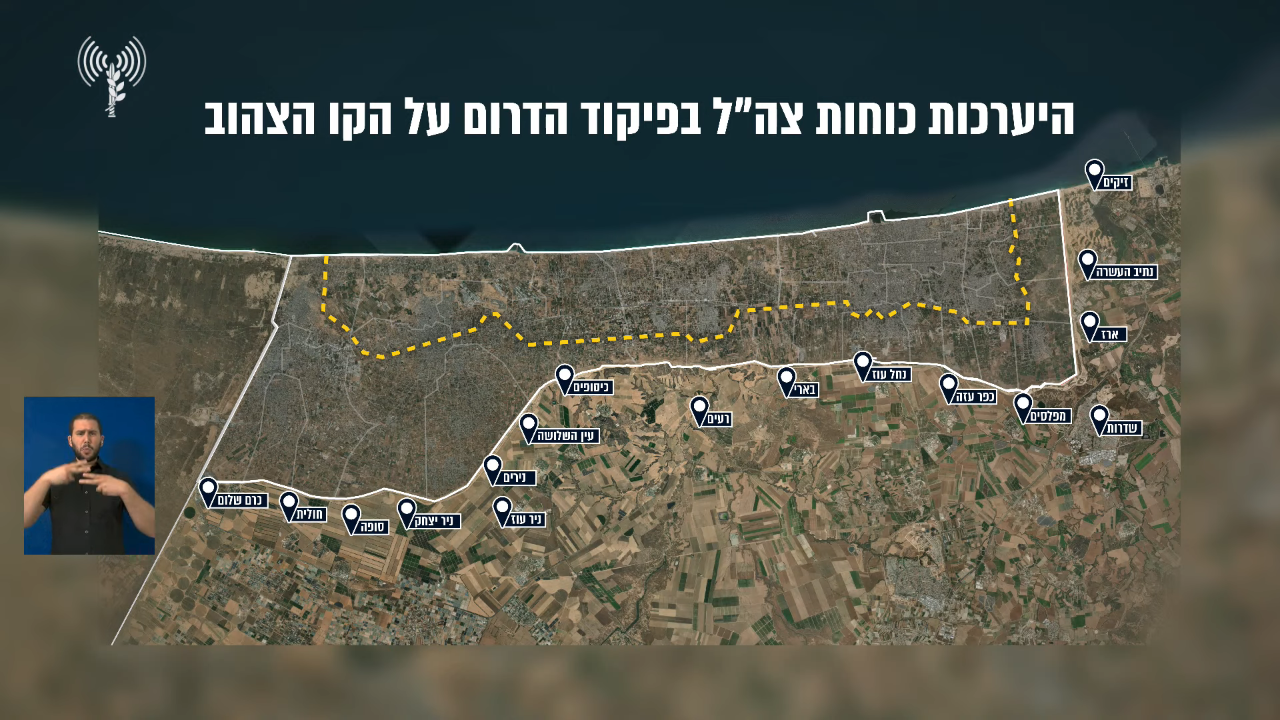
This map published by the IDF on October 10, 2025, shows the IDF's deployment in Gaza following the Gaza ceasefire-hostage deal brokered by US President Donald Trump. (Israel Defense Forces)
The United States is working with Israel to set up a safe zone inside the areas of Gaza still controlled by the IDF to which Palestinian civilians fearing Hamas retribution can flee.
The initiative is part of the US response to the summary executions that Hamas has carried out since the ceasefire came into place last week against dozens of Palestinians from rival gangs and those it has accused of collaborating against Israel. US President Donald Trump initially justified the executions, arguing that the victims were members of “very bad gangs,” but he has since softened his stance slightly and said he’s looking into the matter further. The commander of US forces in the Middle East has taken a harder line, issuing a statement demanding that Hamas cease its targeting of “innocent Palestinian civilians.”
Commenting on the issue during a briefing with reporters, a senior Trump adviser says, “The US working with Israel to try and create some space in the safe zone behind the Yellow Line for people who feel [under] threat to be able to go to so.”
The Yellow Line is the boundary inside Gaza to which the IDF pulled back upon the implementation of the ceasefire, reducing its control over Gaza slightly to 53% of the territory.
“This is in response to the reports we’ve been seeing of Hamas executing rivals,” the senior Trump adviser says, hailing Israel’s willingness to cooperate with the effort.
Israel is “making a big effort to try to embrace and protect and help those who want live peacefully side by side and who are renouncing Hamas and wanting to choose a different path,” he adds.
No timeline was given for when it will be implemented, and Israel has yet to confirm that it is on board.
Trump adviser: Gaza demilitarization ‘very complex,’ we’re working on ‘defining how to get there’
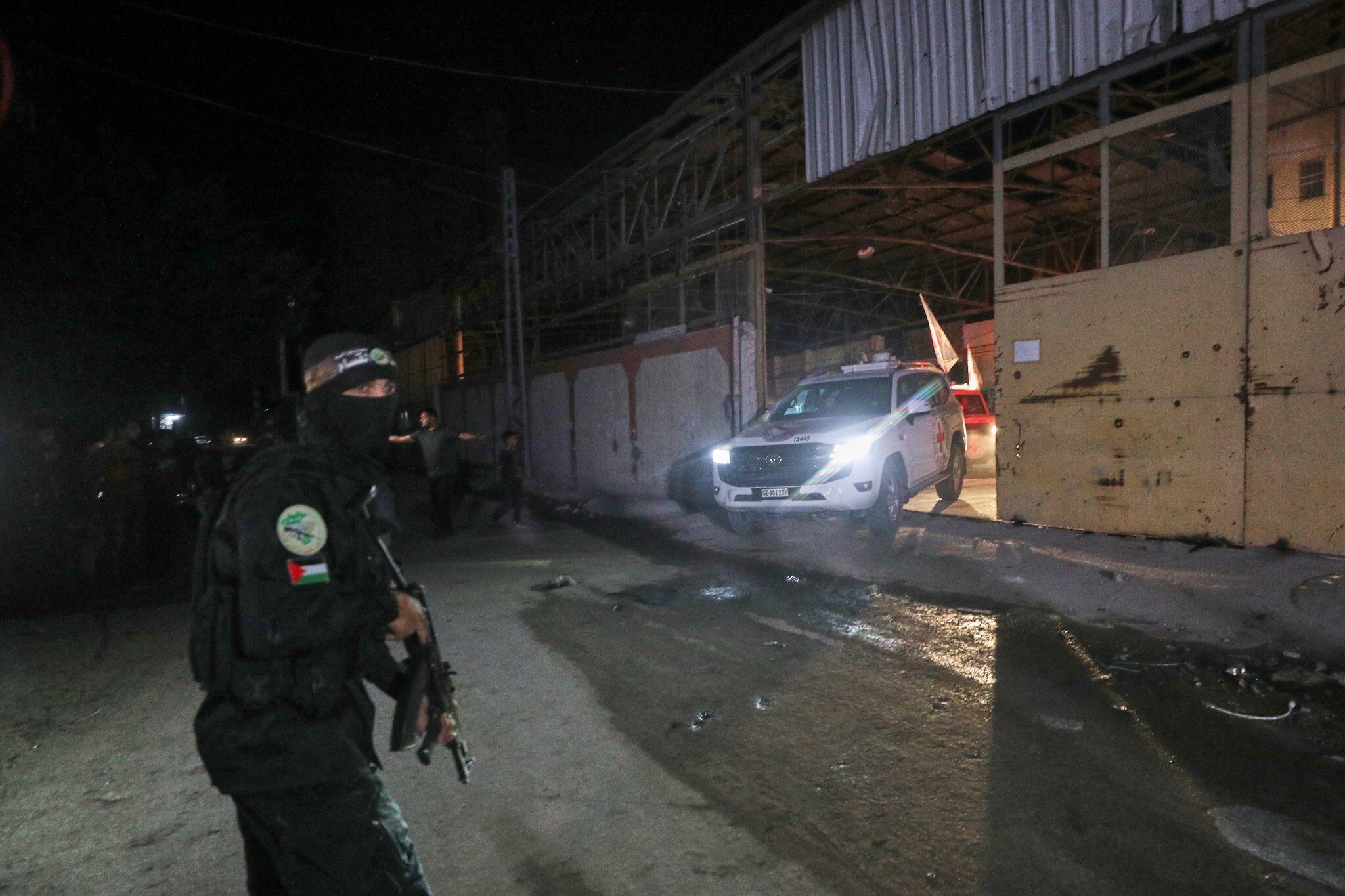
A gunman from the military wing of Hamas stands guard as Red Cross vehicles allegedly transporting coffins containing the bodies of four deceased hostages leave a warehouse for Israel, in Gaza City, October 14, 2025. (AP Photo/Yousef Al Zanoun)
A senior Trump adviser acknowledges that implementing the demilitarization of Gaza will be a very difficult task.
“Right now we’re in the process of defining how to get there in a way where everyone feels safe,” the Trump adviser says during a briefing with reporters.
“It’s not realistic to think everyone’s just going to walk in, drop their arms and say, ‘There you go,’ he says.
“A lot of the people — even on the Hamas side — are fearful of retribution from other people inside Gaza. So it’s a very complex dynamic,” the Trump adviser continues.
“But the sentiment from the Arab mediators and from us is that they still want to continue to work together to find a way to do it,” he adds. “We’re all working very closely, creatively and aggressively to find the right outcome that satisfies everyone’s objectives.”
Regardless, the Trump adviser asserts all mediators agree that “no rebuilding money will go into areas that Hamas controls.”
“Hamas-free, terror-free zones” will be rebuilt first and those areas “hopefully can be the examples for what could be possible in the whole place if this program is successful.”
“We’ll know over the coming weeks if the right plan develops” for demilitarizing Gaza, the Trump adviser says.
“If Hamas tries to reconstitute in a way that will pose a long term threat for Israel, that would be a violation of the agreement, but we’re not at a point yet where anyone feels like the agreement has been violated,” he adds.
Senior Trump adviser says ‘many’ countries have offered to join Gaza security force
A senior adviser to US President Donald Trump says many countries, including Indonesia, have offered to contribute to the International Stabilization Force that is slated to secure Gaza in place of the IDF during the transitional postwar period, according to Washington’s 20-point plan for ending the conflict there.
“With regard to countries who have raised their hand to be a part of the ISF — there are many. Indonesia comes to mind. Many of the different Arab and Muslim countries. The Emirates are in conversations with us. Certainly Egypt is. I think the Qataris are talking to us. Azerbaijan,” says the Trump adviser during a briefing with reporters.
It’s unclear whether any of those countries have actually agreed to send troops. Indonesia is the only country to date that has publicly offered to do so, saying it can send 20,000 soldiers to Gaza, while specifying that it would be under a UN-mandated peacekeeping mission — something that is not outlined in Trump’s plan.
Moreover, Arab officials have repeatedly told The Times of Israel that the UAE and Qatar do not intend to send troops but could assist with funds or training.
US stresses Gazans won’t be forced to leave Strip during reconstruction
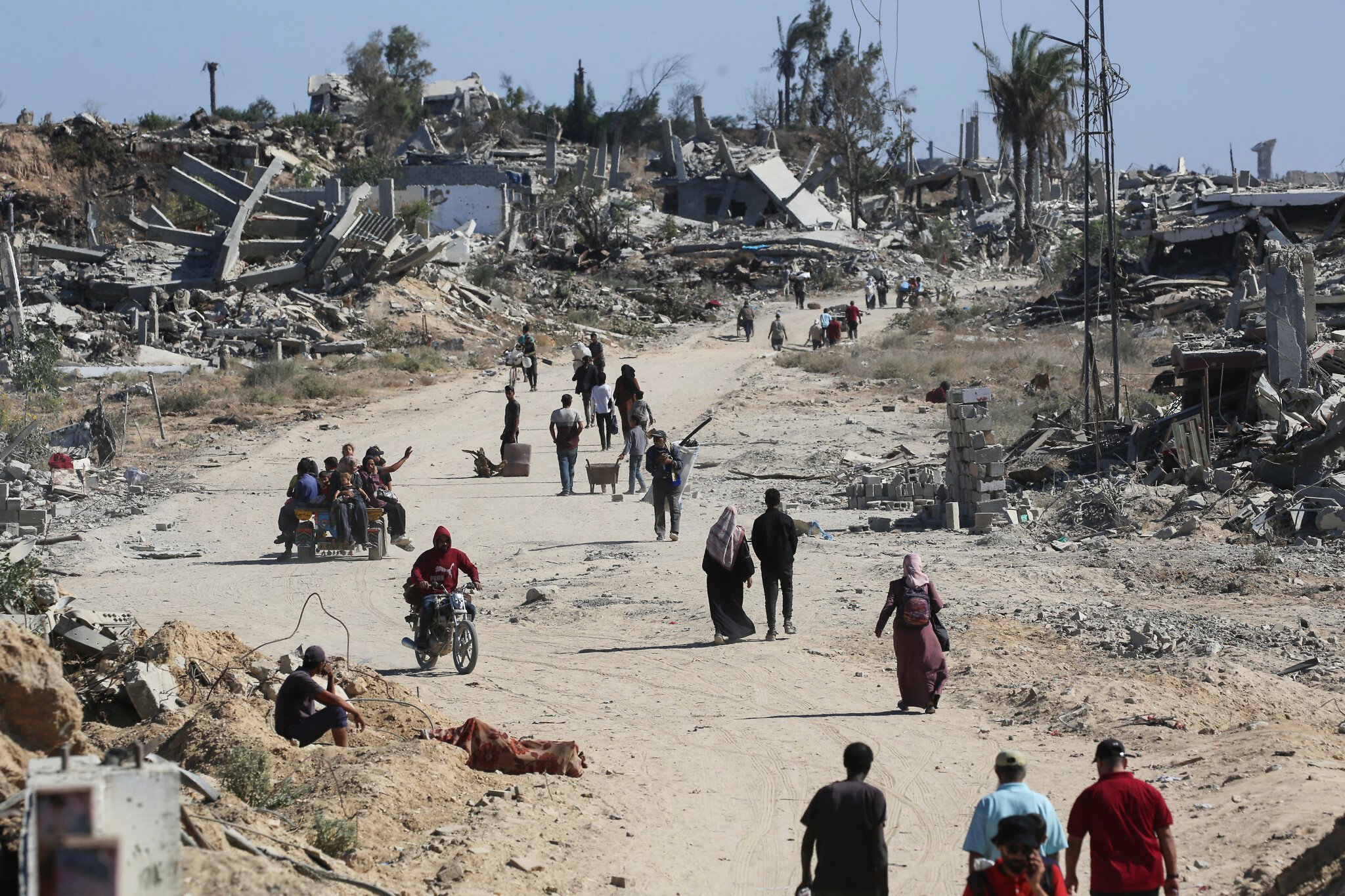
Displaced Palestinians walk past destroyed buildings as they return to their homes in the in al-Zahra area, north of the Nuseirat refugee camp in the central Gaza Strip, on October 14, 2025. (Eyad BABA / AFP)
A senior adviser to US President Donald Trump reiterates that Gazans will not be forced to leave the Strip while it is being rebuilt.
Trump’s plan for ending the war explicitly states that Palestinians will be encouraged to stay in the Gaza Strip, but reporters have continued asking whether anyone will be forced to leave.
The American president had proposed in February that the US take over Gaza and permanently relocate the Strip’s entire population. While the idea was widely embraced in Israel, it was overwhelmingly rejected by the rest of the international community and Trump eventually distanced himself from the initiative.
The US president’s proposal was unveiled shortly after his special envoy Steve Witkoff visited the Gaza and declared that the enclave was largely uninhabitable as it was full of unexploded ordinances.
But in a briefing with reporters on condition of anonymity, the senior Trump adviser indicates that Washington has undergone an about-face on the matter.
“These are tough people. They’ve been through a lot, and they seem to be resilient. They’re coming back to their homes, and they’re pitching tents. People feel very invested in the places where they live. It’s remarkable to see,” he says.
“While there are Gazans who have left because the living conditions are that difficult… no one is forcing any Gazans to leave,” the senior Trump adviser adds.
US looking for Palestinians who can staff technocratic government in post-war Gaza
The US is working to identify and recruit Palestinians to take part in the transitional technocratic government that will administer postwar Gaza, a senior adviser to US President Donald Trump says.
The senior Trump adviser indicates during a briefing with reporters that the US is prioritizing deconfliction, ramping up humanitarian aid, recovering hostages’ remains and demilitarizing Gaza. However, individuals have reached out in the meantime to express interest in joining the technocratic government because they realize that “Hamas is weaker than [it has] ever been.”
A number of candidates for the technocratic government are coming from the Palestinian diaspora.
“Certain Palestinians have said living in the West Bank under the PA (Palestinian Authority) rule has been like living under the mafia, and a lot of the people who wanted to have a good life just had to leave because it’s not a functional place in that regard. And obviously Gaza was run by a terrorist organization,” the Trump adviser says in surprisingly biting criticism of Ramallah, just days after Washington agreed to include PA President Mahmoud Abbas in the Gaza summit held in Sharm el-Sheikh earlier this week during which Trump was seen warmly embracing Abbas during a photo-op.
“There’s a lot of incredibly successful Palestinians in the diaspora who really want to see the suffering of their people end, and they’ve been reaching out to try to be a part of [the technocratic government],” the senior Trump adviser says.
“It’s the first time that they believe that there could be a new alternative created that’s not the Palestinian Authority and not Hamas, that could finally be a leadership that allows the Palestinian people to break free of the poor situations they’ve been in, which has mostly been inflected by poor leadership and bad decisions.”
The Trump-chaired Board of Peace overseeing the technocratic government will ultimately determine who will sit on the latter body, the Trump adviser says. The Board of Peace also has yet to be filled, though.
“It could be very successful if you get the right leaders who are doing it for the right reasons and trying to create a new system, compared to the old patronage and corrupt systems that have failed,” the Trump adviser adds.
As for whether the transitional government will lead to Palestinian self-determination, the senior Trump adviser avoids getting into the issue.
“The goal with this is less to get stuck in these old word games of statehood, sovereignty, governance,” he continues. “Let’s just make this place functional. President Trump is about pragmatism and about results. We’re trying to stay away from the old diplomatic parlor games that have not achieved a better life for the Palestinian people.”
“President Trump believes that the way you get real peace is addressing the issues that matter, which are security and economic opportunity… The goal is [to have] everyone happy to live side by side and benefiting from each other. Then there are many different things that you can call it that could be agreed upon in the future,” the Trump aide continues.
The text of Trump’s 20-point plan is more definitive regarding the issue of Palestinian statehood, though.
“While Gaza redevelopment advances and when the [Palestinian Authority] reform program is faithfully carried out, the conditions may finally be in place for a credible pathway to Palestinian self-determination and statehood, which we recognize as the aspiration of the Palestinian people,” reads point 19.
Point 20 states, “The United States will establish a dialogue between Israel and the Palestinians to agree on a political horizon for peaceful and prosperous co-existence.”
However, it appears that those last two points were included largely to placate Arab partners who have conditioned their support for the plan on it leading to an eventual two-state solution, as they argue that a failure to advance Palestinian political rights will lead to renewed violence.
Further demonstrating that the US may not stand behind the latter two points of its plan, Trump told reporters on Wednesday that his proposal doesn’t get into whether there will be a two-state solution to the Israeli-Palestinian conflict.
“A lot of people like the one-state solution. Some people like the two-state solution. So we’ll have to see. I haven’t commented on that… At some point, I’d decide what I think is right, but I’d be in coordination with other states,” Trump said.
Zamir: IDF ‘failed in its mission’ on Oct. 7, will keep investigating ‘that day and the entire war’
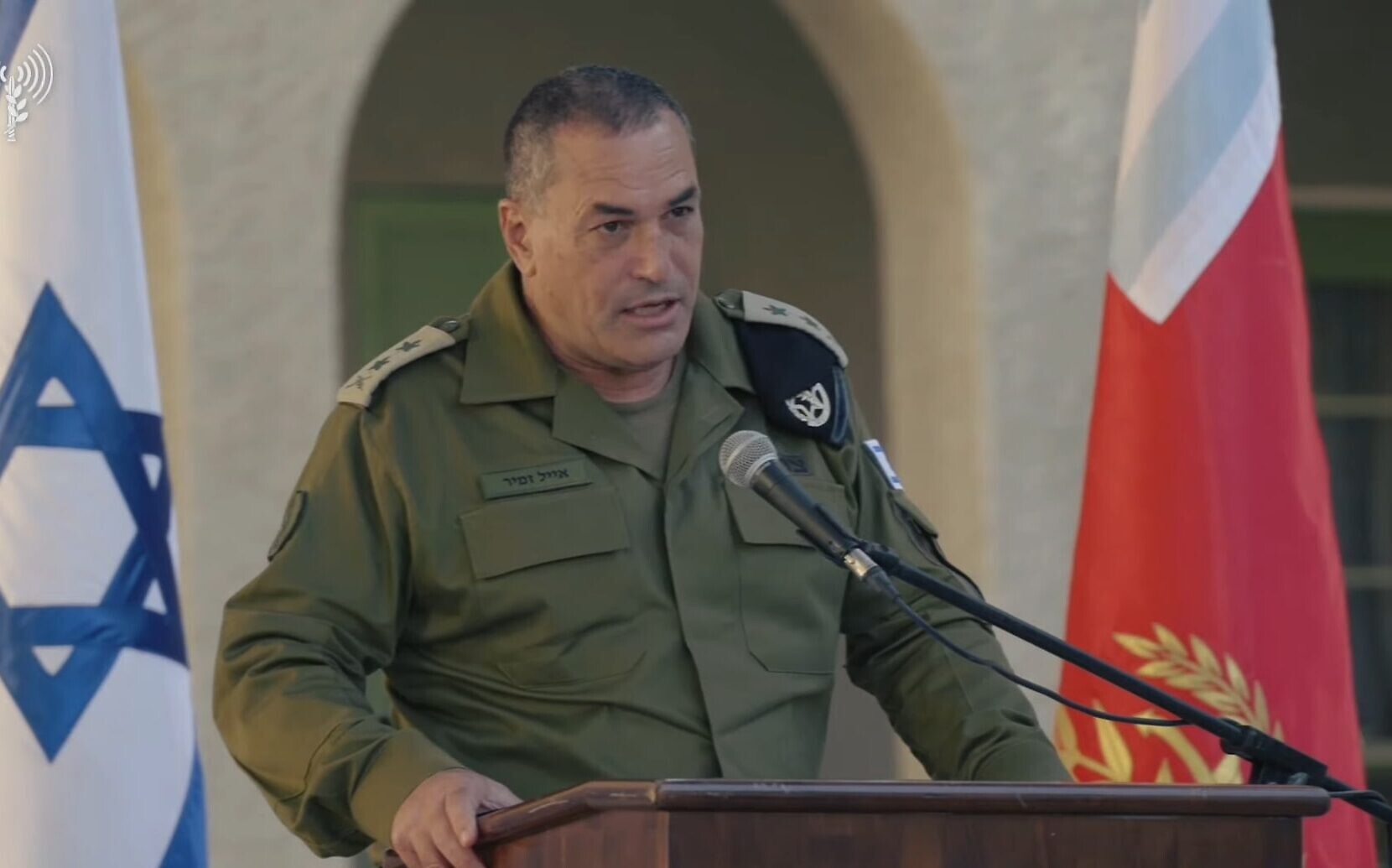
IDF Chief of Staff Lt. Gen. Eyal Zamir speaks at a military ceremony, October 15, 2025. (Israel Defense Forces)
In a letter to troops marking the Hebrew anniversary of the October 7, 2023, Hamas onslaught in southern Israel, IDF Chief of Staff Lt. Gen. Eyal Zamir mourns those murdered in the attack and troops killed fighting in the subsequent war, while hailing the military’s accomplishments over the past two years.
Zamir credits the efforts of Israeli soldiers in helping secure the release of the last living hostages and some of the remaining slain captives as part of a ceasefire deal with Hamas, while vowing “we will not remain silent until we brink back all the fallen for a proper burial.”
The military chief says that on the day of the Hamas-led atrocities, “the Israel Defense Forces failed in its mission to protect the country and its citizens.”
“The correction will come from within, from us. We don’t have the power to change what was, but we do have the power to grow, as individuals and an army, to take responsibility and to learn from the past in order to fortify our security for generations,” Zamir says.
He adds: “We are investigating and will continue to investigate that day and the entire war — truthfully, transparently and professionally. We owe this to the hostages, the murdered and the fallen, to the wounded and the entire State of Israel.”
Army brass marks October 7 anniversary at site of Nahal Oz onslaught
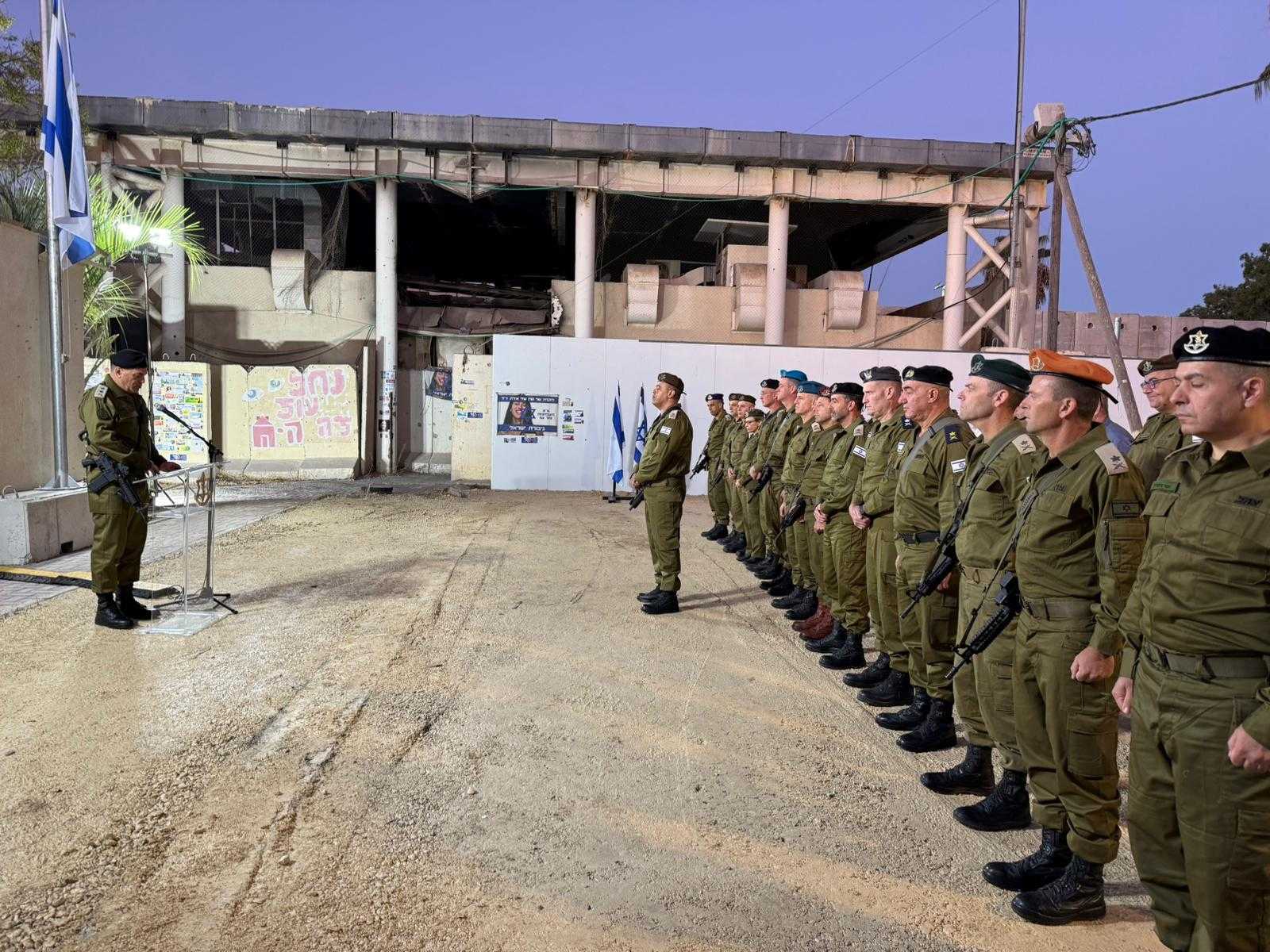
The IDF's General Staff Forum stand for a moment of silence at the Nahal Oz base, marking the Hebrew anniversary of the October 7 onslaught, October 16, 2025. (Israel Defense Forces)
Marking the Hebrew anniversary of the October 7, 2023, onslaught, the military says the IDF’s General Staff Forum held a short ceremony and a moment of silence at the Nahal Oz base, which was overrun by terrorists during the Hamas-led attack.
The IDF says the moment of silence was held at 6:29 a.m., when Hamas’s onslaught began two years ago.
In all, 53 soldiers were killed at the base during the October 7 attack. The toll included 31 combat troops and 22 noncombat soldiers — including 16 female surveillance soldiers. Another 10 troops were abducted — seven female surveillance soldiers and three tank soldiers.
Returned bodies identified as last female hostage Inbar Haiman, slain officer Muhammad el-Atrash
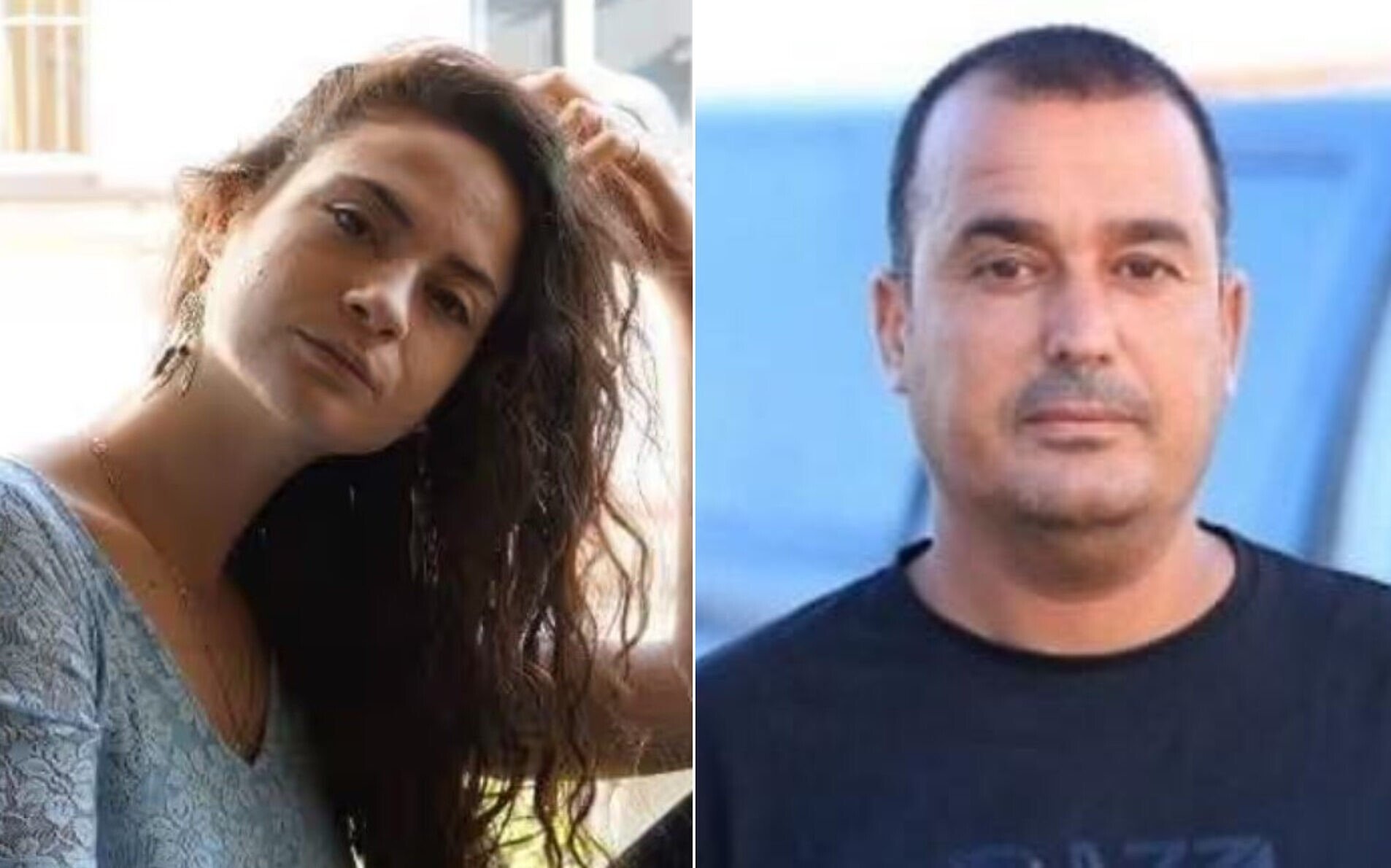
Hostages Inbar Haiman (left) and Sgt. Maj. Muhammad el-Atrash, whose bodies were returned by Hamas late October 15, 2025. (Courtesy)
IDF representatives have notified the families of Inbar Haiman, 27, and Sgt. Maj. Muhammad el-Atrash, 39, that their bodies were returned to Israel by Hamas last night, following their identification by forensic experts, the military says.
Haiman had been murdered by terrorists at the Nova music festival near Re’im on October 7, 2023, and her body was abducted to Gaza, the IDF says, citing intelligence information. Her death was officially declared in December 2023.
She was the last female still held in Gaza.
El-Atrash, a father of 13 who served as a tracker in the Gaza Division’s Northern Brigade, was killed while fighting Hamas terrorists in the Nahal Oz area on the morning of the onslaught, and his body was abducted, the army says. His death was officially declared in June 2024.
The Prime Minister’s Office in a statement says that the government “shares in the deep sorrow of the Haiman and el-Atrash families and all the families of the fallen hostages.”
“The government and all branches of Israel’s national security system are determined, committed, and working tirelessly to bring back all our fallen hostages for proper burial in their homeland,” the PMO adds.
Brother of el-Atrash says recovery of body ‘closes a circle’ for family
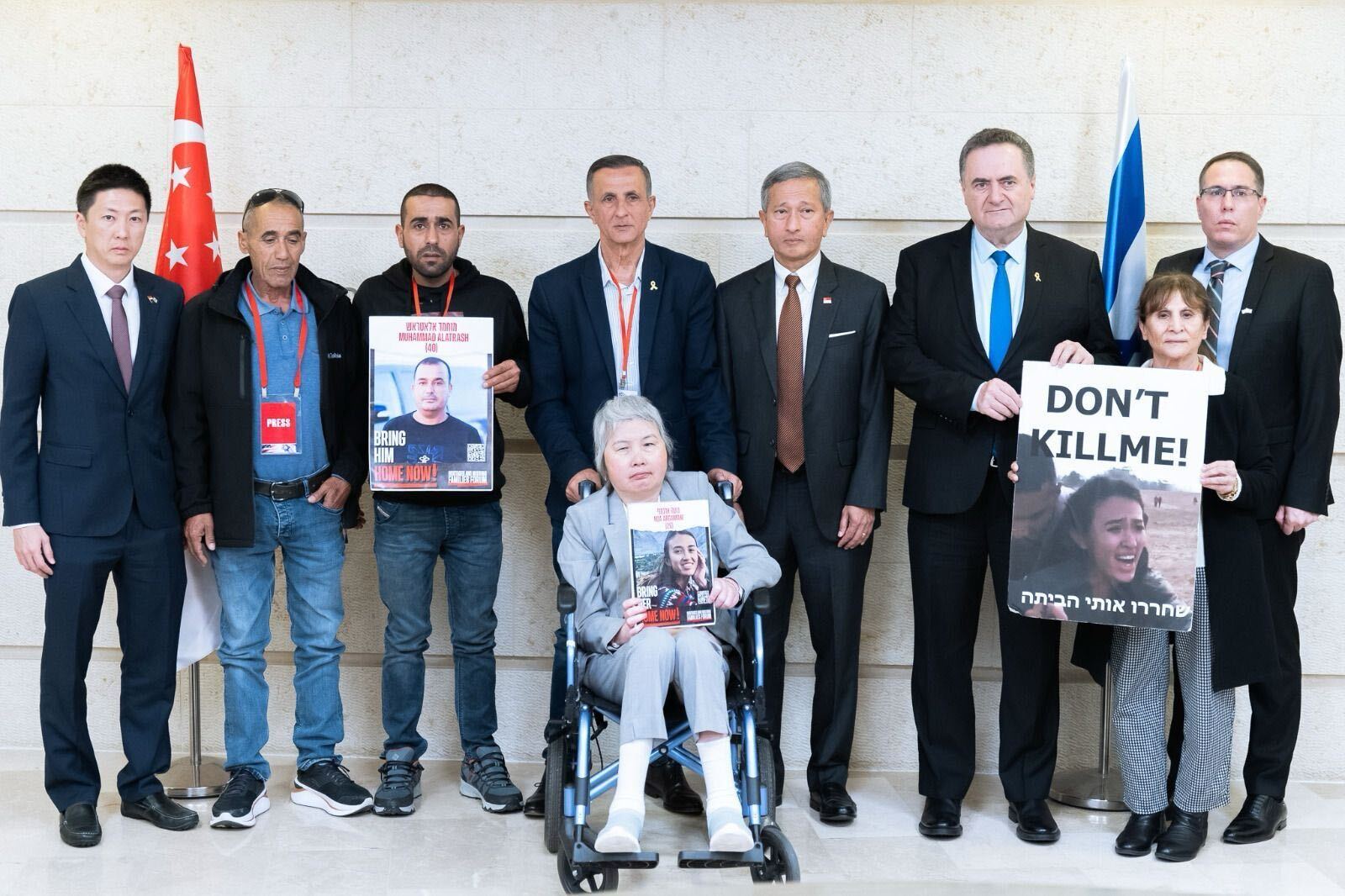
Relatives of hostages Noa Argamani and Mohammad Alatrash meet with Singapore's Foreign Minister Vivian Balakrishnan at the Foreign Ministry on March 19, 2024 (Noga Malsa/GPO)
A brother of Muhammed el-Atrash says the return of his body from Gaza offers family members some comfort after two years of uncertainty.
“At least he should have a grave,” the brother, named as Nimr, tells the Ynet news site. “The circle is finally closed. The last two years were tough for us. For a time we did not know if he was alive or dead. Bringing him for burial closes the circle.”
El-Atrash, a 39-year-old tracker in the Gaza Division’s Northern Brigade from Sa’wa, was killed on October 7 while battling Hamas terrorists in the area of Nahal Oz and his body taken captive to Gaza.
Nimr describes the father of 13 and oldest of 23 siblings as “courageous” and a leader of his family.
“He was responsible, a family man,” he says. “He was a leader, the whole family would go to him for advice as the big brother.”
Hamas said to kill wife, children of Gazan suspected of arming PA-linked groups
Gazan media outlets in Gaza report that Hamas killed the wife and two children of a man suspected of establishing armed groups in Gaza affiliated with the Palestinian Authority.
The man, who is not named, is described as having served as a PA General Intelligence officer before Hamas violently seized control of the Strip in 2007.
According to one report, Hamas members fired an RPG missile at the family home in the Shejaiya neighborhood east of Gaza City, killing the man’s wife Olfat Abu Ajwa, and his children Zaid Abu Ajwa and Youssef Abu Ajwa, both of whom appear to have been minors. The fate of the man is unknown.
According to outlets, the killings took place on Tuesday.
الطفل يوسف حسن أبو عجوة
الطفل زيد حسن أبو عجوة
والدتهم ألفت جهاد أبو عجوةقتلـ ـتهم ميليشيا حما$ أمس بعد أن ضربت منزلهم بقـذيفة RPG، بإذن من ترامب وحماية من إسرائيل
ما ذنب هؤلاء الأطفال وأُمهم؟
ذنبهم الوحيد أن والدهم يعمل ضابطًا في جهاز المخابرات الفلسطينية.حما$ إرهـ ـابية. pic.twitter.com/mIIrI8ZThx
— مصطفـ????ـى عصفــور (@ustafa_ad) October 15, 2025
In recent days, Hamas has reportedly executed dozens of Palestinians suspected of opposing its rule as it has sought to reassert control over areas of the Strip that Israeli soldiers pulled out of late last week.
Report says Pakistan, Azerbaijan, Indonesia likeliest to send troops for Gaza stabilization force
Pakistan is thought likely to supply troops to an international force meant to secure the Gaza Strip, along with Azerbaijan and Indonesia, Politico reports, citing a US defense official and a former defense official.
The countries are described in the report as “top contenders to supply troops,” though no country has yet committed to staff the enterprise, the outlet says, citing the current defense official.
On Wednesday, a Trump adviser named Indonesia and Azerbaijan as two countries that could contribute troops to the International Stabilization Force, along with Egypt, Qatar and the United Arab Emirates.
Indonesia is the only country to date that has publicly offered to send troops for the effort, saying it can send 20,000 soldiers to Gaza, while specifying that it would be under a UN-mandated peacekeeping mission — something that is not outlined in Trump’s plan calling for the ISF.
Politico also reports — without a source — that Qatari, Emirati and Egyptian troops will be stationed at a base inside Israel along with US troops to help monitor the ceasefire.
Several arrests reported after violent anti-Israel protests in Spain
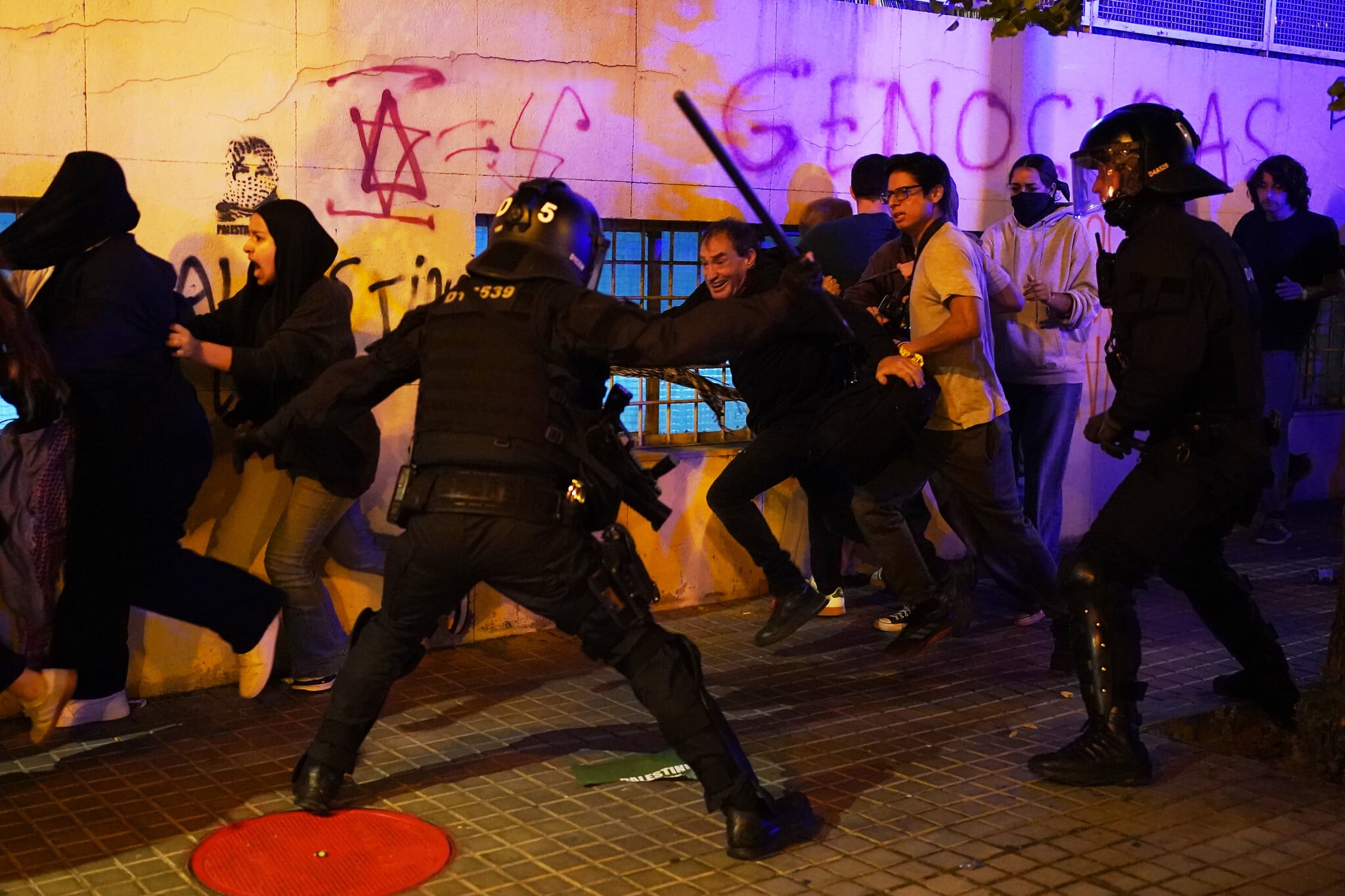
Police clash with demonstrators during a pro-Palestinian protest in Barcelona, Spain, Wednesday, Oct. 15, 2025. (AP/Joan Mateu Parra)
At least 15 people were arrested during large anti-Israel demonstrations in Barcelona yesterday, local newspaper La Vanguardia reports, citing Catalan police.
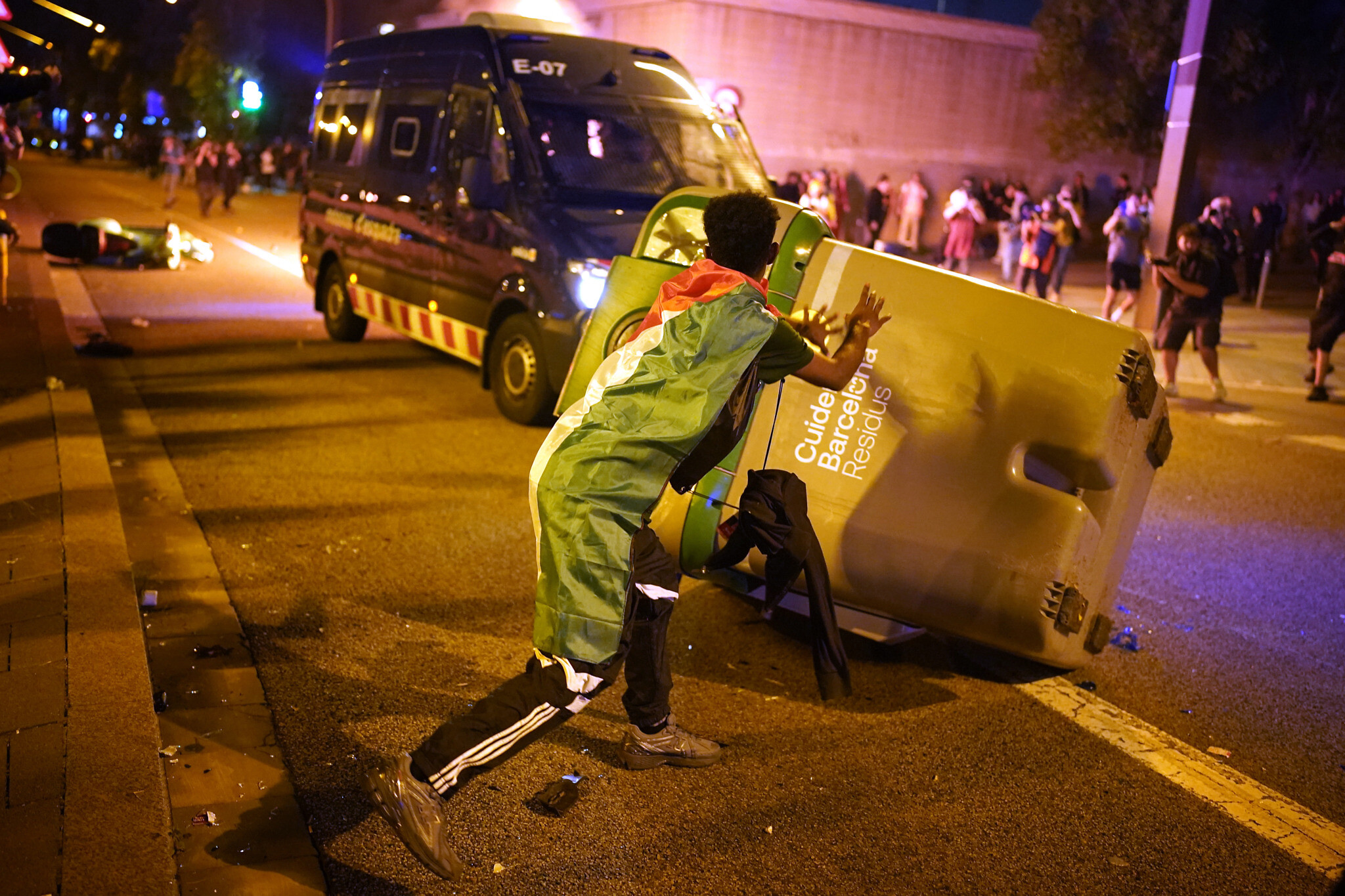
Protesters marched toward the Israeli consulate in the city, attacking and vandalizing businesses accused of collaborating with Israel, including Burger King, McDonalds and Starbucks. Demonstrators also set fire to garbage bins, blocked a central thoroughfare and clashed with riot police.
Están quemando contenedores en la calle Tarragona de Barcelona en la manifestación por Palestina.
No hay ninguna manifestación de la izquierda en la que no haya violencia y disturbios, y no pasa nada.
Basta ya de impunidad para los matones zurdos.pic.twitter.com/V4AKrh9Eqa
— Guaje Salvaje (@GuajeSalvaje) October 15, 2025
Organizers claimed 50,000 people took part in the central march, while police put the figure at 15,000, La Vanguardia reports.
Over 40.000 people took to the Barcelona streets on Wednesday, October 15, during the general strike in support of Palestine and in protest against Israel.
The night ended with heavy clashes between demonstrators and the Catalan police, near the Israeli consulate. pic.twitter.com/iTaR805Men— Eye on Palestine (@EyeonPalestine) October 16, 2025
Protests against alleged genocide in Gaza were reportedly held in 40 cities around Spain.
Protesters in Barcelona also attempted to accost the Hapoel Jerusalem basketball team, forcing players and coaches to change hotels under heavy police guard. The team fell to Manresa in Eurobasket, playing in an empty arena for security reasons.
Elsewhere, five protesters were reported arrested during clashes with police protecting the Hapoel Tel Aviv basketball team ahead of a game against Valencia in the coastal Spanish city, also played in an empty arena.
????Tensión en las protestas propalestinas a las puertas del Roig Arena, en Valencia
Allí se juega esta tarde un partido de la Euroliga de baloncesto entre el Valencia Basket y el Hapoel Tel Aviv
▶Joan Moreno (@RTVEValencia) https://t.co/YG2YEjG94v pic.twitter.com/OhlM2BPPUI
— RTVE Noticias (@rtvenoticias) October 15, 2025
Man seriously hurt as car crashes into Kfar Saba cafe

A car that crashed into a Kfar Saba cafe on October 16, 2025. (used in accordance with Clause 27a of the Copyright Law)
First responders are treating a man with extensive injuries after a car crashed into a Kfar Saba eatery, in what appears to have been a vehicular accident.
According to reports, the incident occurred at a branch of the Nono & Mimi cafe in the central city.
The Magen David Adom emergency service says first responders are attempting to resuscitate a 50-year-old man. It is unclear if he had been in the car or the cafe.
Pictures of the scene show a Tesla crossover vehicle with its front half crashed through a glass wall at the front of the cafe.
US Orthodox rabbinic leader Hauer dies suddenly at 60
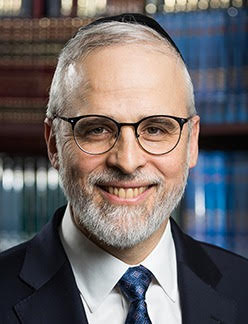
Rabbi Moshe Hauer, Executive Vice President of the Orthodox Union. (Courtesy)
The American Orthodox world is mourning Rabbi Moshe Hauer, executive vice president of the Orthodox Union, who died of a heart attack Tuesday at age 60.
As the rabbinic leader of one of the world’s most important Orthodox institutions since 2020, Hauer led the OU’s communal activities in the United States and served as its primary spokesman. He was an outspoken advocate for Jewish causes in Washington and in local communities.
Hauer also served as the senior rabbi at Congregation Bnai Jacob Shaarei Zion in Baltimore for 26 years.
His sudden death over the Shmini Atzeret holiday came as a surprise to those who knew him.
The OU mourns Hauer as “a true talmid chacham,” or wise scholar. It calls him “a master teacher and communicator, the voice of Torah to the Orthodox community and the voice of Orthodoxy to the world.”
“Rabbi Hauer’s leadership was marked by unwavering dedication, deep compassion, and a vision rooted in faith in Hashem, integrity, and love for Klal Yisrael,” the OU writes on X, using a Hebrew term for the Jewish people. “Whether through his inspiring words, thoughtful counsel, powerful advocacy, or quiet acts of kindness, Rabbi Hauer uplifted those around him and made an impact on every person he encountered.”
With tears in our eyes and hearts breaking, we share the devastating news of the loss of our beloved brother, rabbi, partner, friend, and Executive Vice President Rabbi Moshe Hauer, zt”l.
Rabbi Hauer was a true talmid chacham, a master teacher and communicator, the voice of… pic.twitter.com/iuArUTInWC
— Orthodox Union (@OrthodoxUnion) October 16, 2025
Man injured in Manchester synagogue attack out of hospital
A man injured during the terror attack on a Manchester synagogue on Yom Kippur has been released from the hospital, British media report, citing police.
Yoni Finlay, 39, was hit by a bullet fired by police responding to a stabbing attack at the Heaton Park Hebrew Congregation on October 2. He was said to be helping to barricade the doors of the synagogue to protect other worshipers when he was shot by mistake.
Greater Manchester Police say that Finlay was released from medical care on Wednesday, during the Simchat Torah holiday. He had reportedly undergone seven hours of surgery immediately following the attack.
Two other men injured in the attack remain hospitalized in stable condition, police say. Andrew Franks was stabbed by the attacker, Jihad Al-Shamie, while a security guard, whose name was given as Bernard, was hit by Al-Shamie’s car.
Two men, Melvin Cravitz, 66, and Adrian Daulby, 53, were killed in the attack, committed on the holiest day in the Jewish calendar.
Manchester police indicate in a statement that they are scaling back increased patrols around places of worship across their jurisdiction, including Jewish communities in north Manchester, Bury and Salford after two weeks that stretched manpower.
“As we move back towards more regular resourcing, we remain committed to ensuring our communities – particularly the Jewish community – continue to be in the forefront of our plans to keep the public safe,” police say in a statement.
IDF to start mulling citations for October 7, Gaza fighting, possibly signaling war’s end
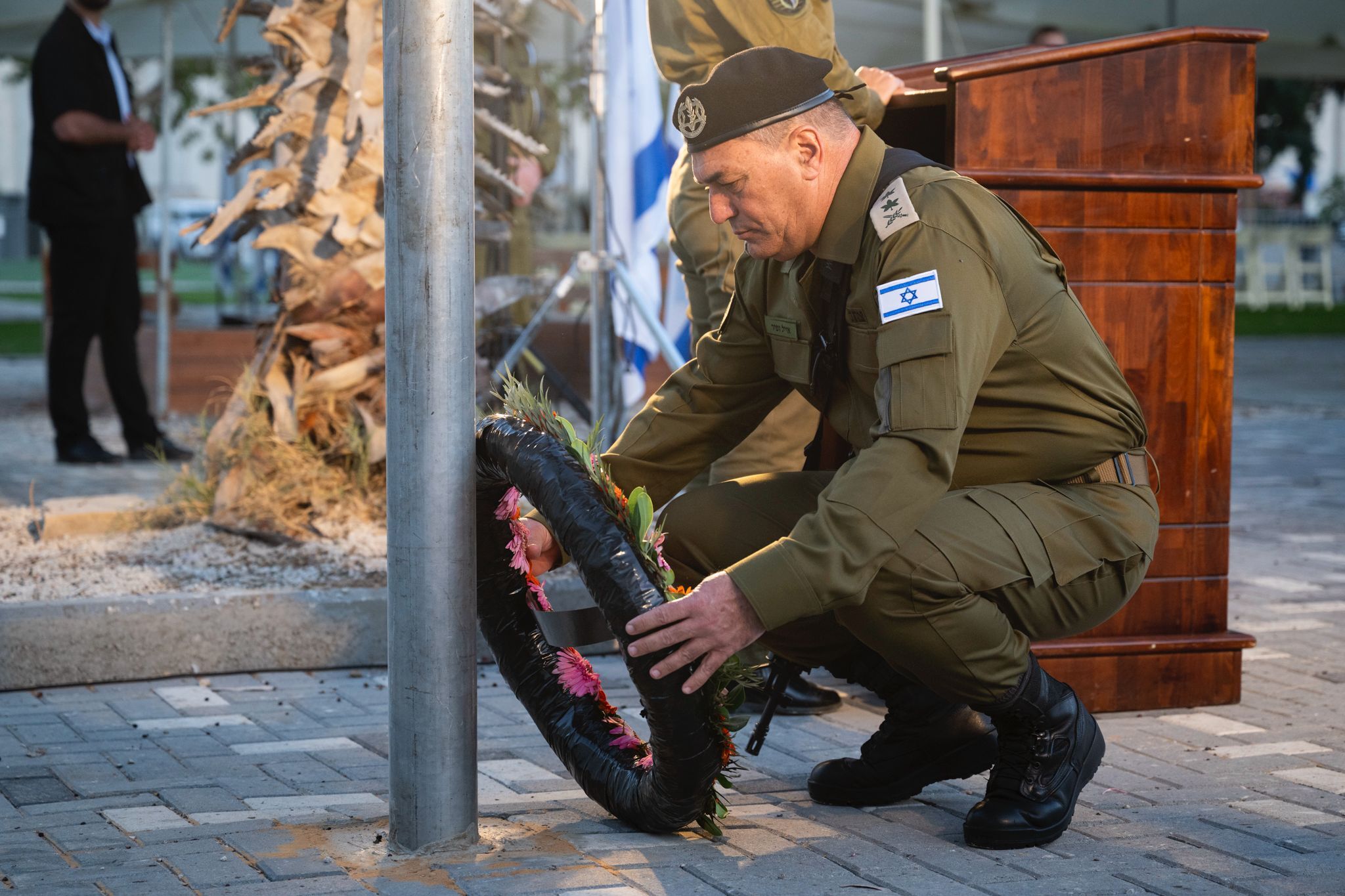
IDF Chief of Staff Lt. Gen. Eyal Zamir lays a wreath during a ceremony at the Nahal Oz base, marking the Hebrew anniversary of the October 7 onslaught, October 16, 2025. (Israel Defense Forces)
IDF Chief of Staff Lt. Gen. Eyal Zamir says the military will establish a committee to determine whether soldiers should receive citations for their conduct during the October 7 onslaught and during the war, a move that could signify that the army considers the war to be over.
“Out of our commitment, we have conducted investigations of the battles and presented them to the communities. We continue to study, examine, and implement the lessons. The IDF will not repeat the mistakes of the past,” Zamir says during a ceremony at the army’s Nahal Oz base marking the Hebrew anniversary of the onslaught.
“From the collapse and loss also grew many stories of heroism, which we must cherish, and therefore we will establish a citations committee,” he says.
The IDF’s top-level citations have historically been awarded to soldiers only after the conclusion of wars. Some of the medals have been awarded for actions outside of wars.
Defense Minister Israel Katz pens a letter to Zamir asking him to submit recommendations on awarding the Medal of Valor, the highest honor that the IDF can give, for “exceptional acts of heroism, courage, and exemplary conduct by soldiers or military units that were demonstrated” during the war.
The medal has been awarded only 40 times in Israel’s history, most recently in 1975 for actions during the Yom Kippur War.
“In this campaign, it will be awarded to those who acted under the most difficult circumstances for the defense and existence of the State of Israel,” Katz says.
Katz says that Zamir should submit his recommendations, based on the work of the citations committee, within 90 days.
The IDF’s two other top-level citations are the Medal of Courage and the Medal of Distinguished Service.
Israel says it is readying to eventually open Rafah crossing to civilian traffic
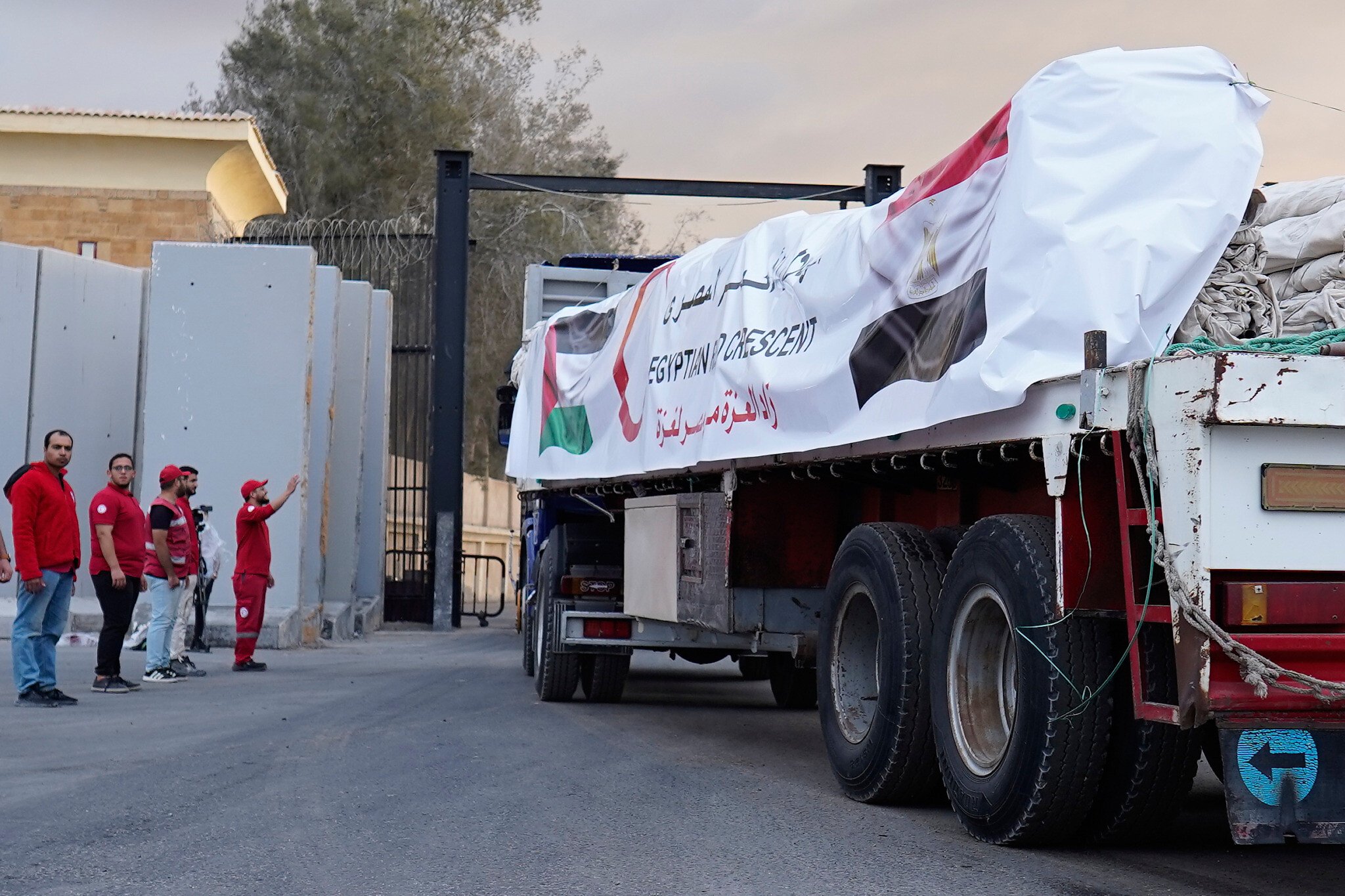
Egyptian Red Crecent members monitor trucks carrying humanitarian aid as they enter the Rafah crossing between Egypt and the Gaza Strip, following an agreement between Israel and Hamas on a ceasefire, October 12, 2025. (AP/Mohamed Arafat)
The Defense Ministry’s COGAT unit says preparations are ongoing with Egypt to open the Rafah border crossing with Gaza for the movement of people on a date to be announced later.
Israel had earlier warned it could keep Rafah shut and reduce aid into the Palestinian enclave due to Hamas failing to return the bodies of dead hostages. The terror group has so far transferred the bodies of nine hostages, out of 28 held in Gaza.
COGAT, which oversees aid flows into the Gaza Strip, says humanitarian aid is entering the territory via the Kerem Shalom crossing with Israel and at other crossings.
“It should be emphasized that humanitarian aid will not pass through the Rafah crossing. This was never agreed upon at any stage,” COGAT adds in a statement sent to Reuters.
Two sources had told Reuters on Wednesday that the Rafah crossing was expected to open for people on Thursday. The crossing is the only portal between the Strip and Egypt.
Shin Bet officer set to be charged over suspected leak to minister, journalists
The Justice Ministry says it plans to charge a Shin Bet officer with criminal wrongdoing over suspicions that they passed sensitive information to Diaspora Affairs Minister Amichai Chikli and two journalists that found its way into the press.
A statement by the Department for Internal Police Investigations says that the officer, whose named is under a gag order, was informed this morning that he is facing indictment, pending a hearing at which he can make his case.
The officer, who was serving in the Shin Bet as a reservist, is accused of passing classified details of a Shin Bet investigation probing concerns that extremist Kahanist ideology was taking root in the police to Chikli, Channel 12 journalist Amit Segal, and Israel Hayom reporter Shirit Avitan Cohen.
The Shin Bet investigation focused on concerns that the extreme far-right ideology was infiltrating into the police under the influence of National Security Minister Itamar Ben Gvir, a former acolyte of the late rabbi Meir Kahane, whose government role puts him in charge of the police.
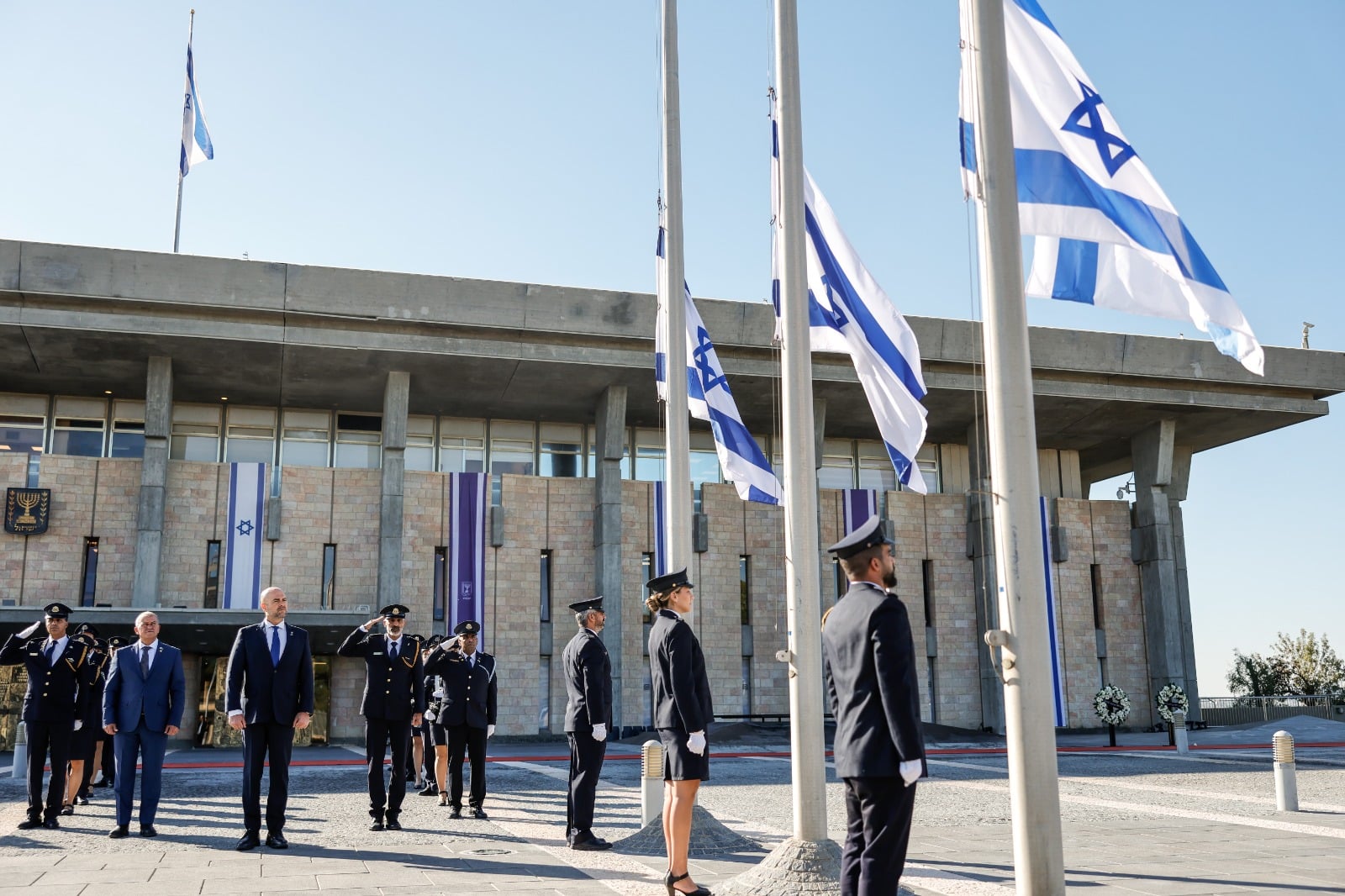
Knesset lowers flags to half-staff to mark October 7 anniversary
Members of the Knesset guard have lowered the flags outside of Israel’s parliament building to half-staff to mark October 7 Remembrance Day, which comes following the Hebrew anniversary of the attack.
Knesset Speaker Amir Ohana lights a memorial lamp at the entrance reserved for lawmakers before laying a wreath outside in memory of the civilian and military victims of Hamas’s attack and the subsequent war.
Ohana is slated to take part in a subsequent memorial for the troops on Mount Herzl at 11 a.m. followed by a state memorial for those killed on October 7 at 2 p.m.
Lowering flags to half staff outside the Knesset (???? נתן ווייל, דוברות הכנסת) pic.twitter.com/R5xumucHm1
— Sam Sokol (@SamuelSokol) October 16, 2025
Family of returned hostage Haiman expresses ‘joy, profound sadness’
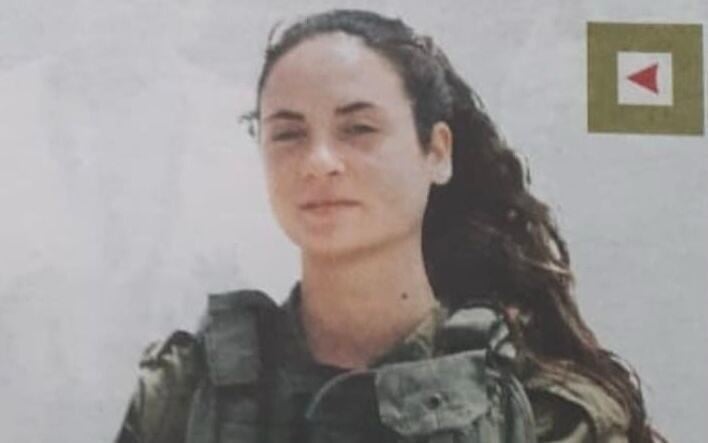
Inbar Haiman in an undated photo provided by her family on October 16, 2025. (Courtesy Hostage and Missing Families Forum)
In a statement, the family of Inbar Haiman says it is dealing with a jumble of emotions after the return of the slain hostage’s body.
“This is a feeling that cannot be described, joy mingled with profound sadness. Now Inbar will receive the rest and honor she so deeply deserves,” the family says in a statement. “We are certain that if Inbar were here with us today, she would urge us to continue fighting for all 19 of her fellow hostages who remain in captivity.”
The family notes that Haiman served as a commander in the co-ed Caracal infantry battalion for three years, publishing a picture of her in uniform.
“We salute you and ask the entire public to come and honor you,” they write.
Gazan reported killed in Khan Younis drone strike
Nasser Hospital in Khan Younis says a Palestinian was killed in a drone strike in the southern part of the Gazan city this morning.
There is no comment from the Israeli military on the reported attack.
The hospital also says a Palestinian shot by the IDF in the nearby village of Kizan al-Najjar on Tuesday has died of his wounds.
The village is located south of Khan Younis, near the yellow line that marks the boundary of where IDF forces may be positioned under the ceasefire agreement.
In recent months, an armed militia opposed to Hamas and operating with Israeli support has been active in the village.
There is also no Israeli response to that reported shooting.
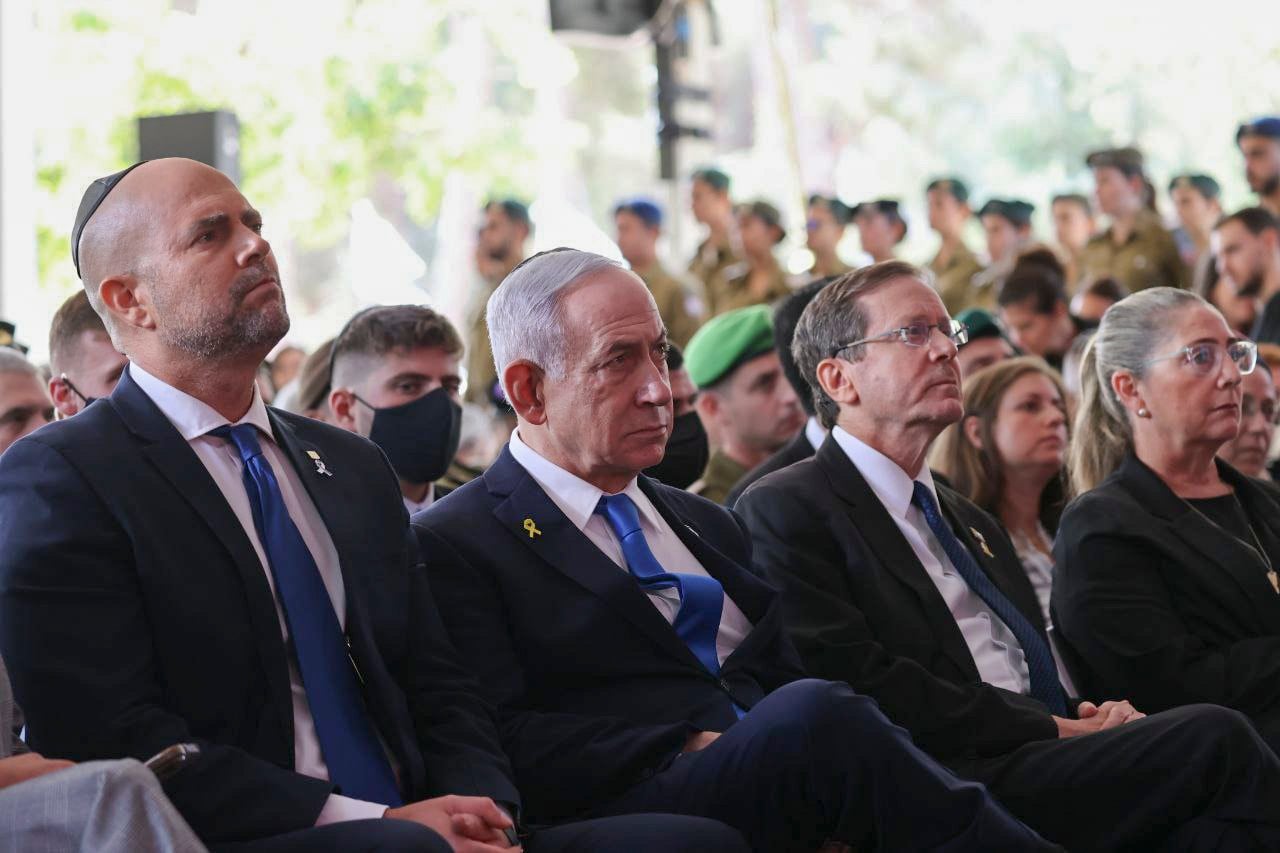
Leaders gather for Mount Herzl ceremony honoring October 7 fallen soldiers
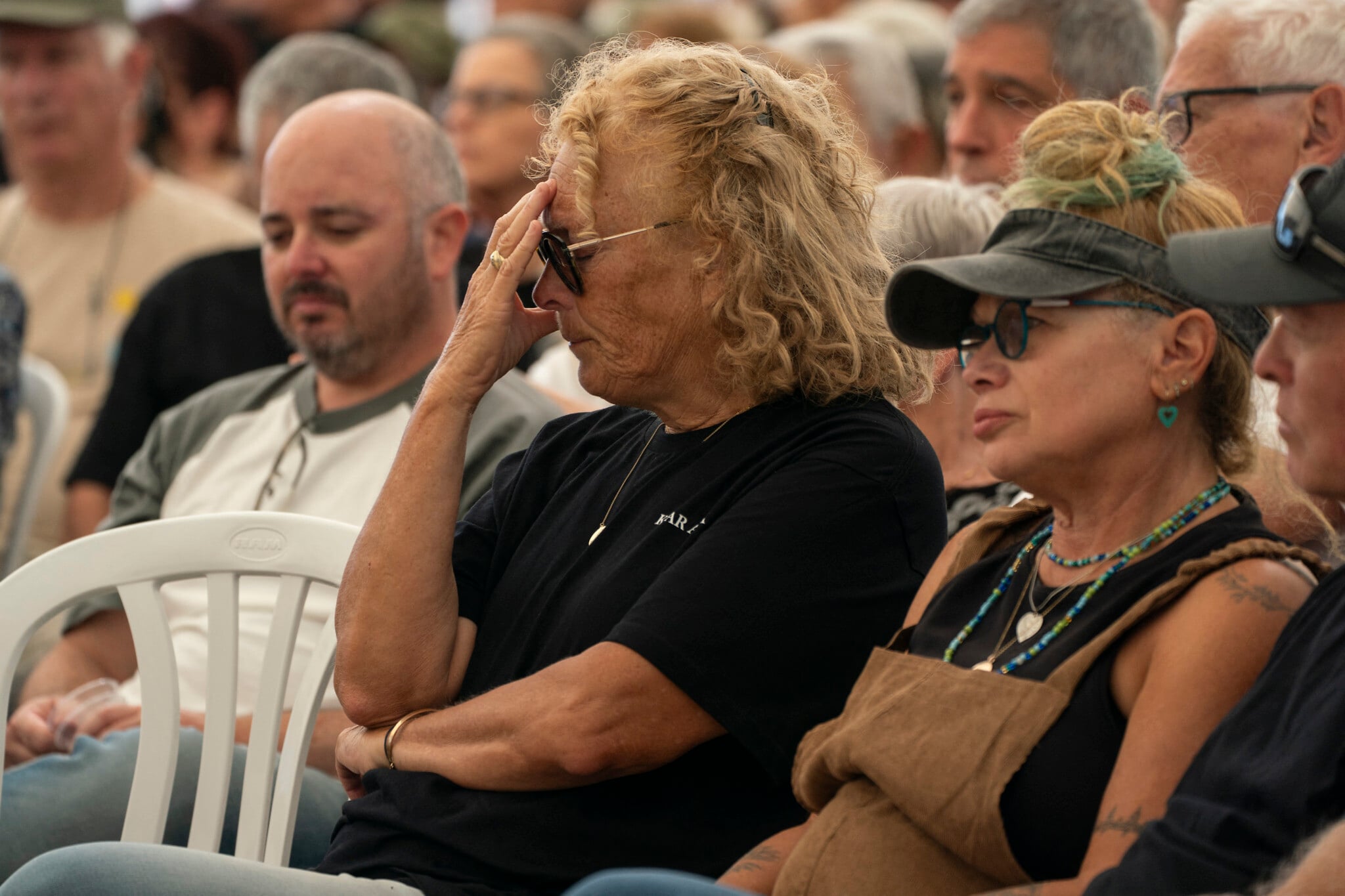
An official state ceremony marking October 7 Remembrance Day is underway at Jerusalem’s Mount Herzl military cemetery, two days after the Hebrew anniversary of the Hamas-led invasion and massacre in southern Israel.
Prime Minister Benjamin Netanyahu, President Isaac Herzog, the heads of the security agencies, and other senior officials are in attendance as the event opens with a memorial for the soldiers killed during the attack and in the ensuing war in Gaza.
Later, at 2 p.m., a separate ceremony will honor the civilians murdered in the attacks.
Hostages’ families demand government halt ceasefire deal until bodies returned
The Hostage and Missing Families Forum calls on Israel’s government to cease implementing a ceasefire agreement ending the war in Gaza until the bodies of 19 hostages remaining in Gaza are returned.
“At a time that Hamas is violating the agreements and still holding 19 hostages, there is no room for Israel to advance unilateral steps,” the group says in a statement. “Any diplomatic or military action that does not ensure their return is an abandonment of Israel’s civilians.”
“There will be no victory and no revival until they are all here,” the group adds.
Members of the forum made a similar appeal to IDF chief Eyal Zamir yesterday.
On Wednesday, a senior adviser to US President Donald Trump denied that Hamas was violating the deal by continuing to hold on to bodies, claiming that the terror group was doing all it could to retrieve them.
The group has so far released nine out of 28 hostages whose bodies are in Gaza.
IDF denies involvement in alleged southern Gaza drone strike
The Israeli military says it not aware of any airstrikes being carried out in the Khan Younis area of the southern Gaza Strip today.
Nasser Hospital in Khan Younis said earlier that a Palestinian was killed in an alleged drone strike in the southern part of the Gazan city this morning.
The IDF has repeatedly warned Palestinians against approaching areas in Gaza under Israeli military control during the ceasefire.
Drone sirens sound in Eilat
Sirens warning of a suspected drone infiltration sound in Israel’s southernmost city of Eilat, in what may be the first such attack since a ceasefire went into effect last week.
The IDF says it is looking into the details.
The Houthis in Yemen have targeted Eilat with drones numerous times, though attacks appeared to have stopped with the halt of fighting in the Gaza Strip.
IDF: Eilat siren was false alarm
The siren that sounded in Israel’s southernmost city of Eilat a short while ago was a false alarm, the IDF reports.
The Houthis in Yemen stopped launching drones and ballistic missiles at Israel with the start of the ceasefire in the Gaza Strip.
President rails against resurgent polarization at October 7 memorial
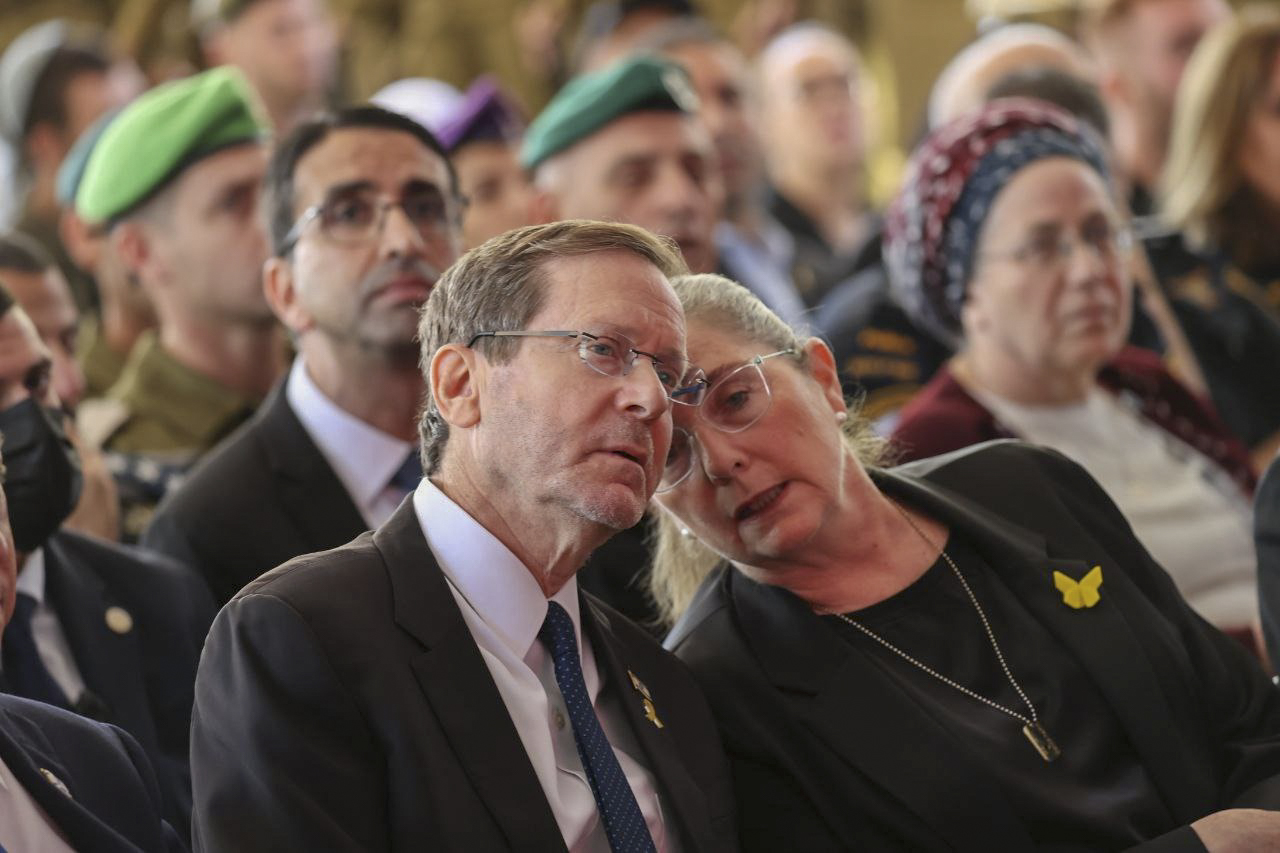
President Isaac Herzog, left, and his wife Michal attend a state ceremony marking the anniversary of the Hamas terrorist attack on October 7, at Mount Herzl military cemetery in Jerusalem, on October 16, 2025. (Alex Kolomoisky/POOL)
Speaking at the official October 7 Remembrance Day ceremony at the Mount Herzl military cemetery, President Isaac Herzog calls for national unity in honor of the soldiers who fell during the Hamas-led massacre two years ago and the subsequent war in Gaza.
The president begins by expressing gratitude to the parents of the fallen soldiers, telling them, “Thank you for the sons you raised — valiant soldiers who did not hesitate to go forth to save Israel, to defeat the enemy, and to bring back the hostages. Soldiers who carried pictures of the hostages in their pockets, and courage in their hearts.”
He adds, “It is no coincidence that United States President Donald Trump, in his [Monday] address to the Knesset, made a point of thanking the soldiers of the IDF, praising their heroism and their contribution to the historic turning point now unfolding.”
He notes that, with the return of the final living hostages in Gaza on Monday under Trump’s ceasefire plan and the ongoing return of the remaining deceased hostages, “these days are of immense historical and emotional weight — filled both with relief and with the deepest pain and sorrow.”
He adds, though, that “the mission is not complete,” apparently referring to the bodies of 19 hostages remaining in the Strip.
“We must act, by every means and through every channel at our disposal, until every one of the fallen and the hostages — down to the very last — is brought home,” he declares.
Turning to address what comes next as the war winds down, Herzog calls for national unity: “After two years of war, we must begin to create a horizon for the future – a ‘day after’ — both inwardly and outwardly.”
“It horrifies me to see and hear that even now, as we continue to bury our dead, the spirit of division, polarization, and hatred once again raises its ugly head,” he says. “And when we do not surrender to the extremists and the agitators among us – when we choose to unite around a shared flag and a common purpose – there is no task we cannot achieve.”
“The heroism and nobility of the sons and daughters who fell in the heavy battles of these past two years will forever be a source of strength and resilience for us. In the darkness of these days, we will salute them and walk in their light — in their memory, in their honor, for their sake, and for ours,” he says.
Norway convicts US embassy guard who spied for Iran and Russia to protest Gaza war
A Norwegian court has sentenced to three years and seven months in prison a former US embassy security guard who said he spied for Russia and Iran to protest American support for Israel.
The 28-year-old Norwegian man is convicted of providing floor plans, personal details of embassy staff and their families, and information about activities at the US embassy between March and November 2024.
In exchange, he was paid 10,000 euros ($11,700) from Russian intelligence and 0.17 bitcoin from Iranian intelligence, the court ruled yesterday, according to documents now made public.
During his trial, the accused admitted to spying that he said was in protest against the United States’ backing of Israel’s offensive in Gaza, but denied the charge of aggravated espionage for which he was convicted, claiming the information he transmitted was not classified.
IDF publishes new picture of Hamas terror chief Sinwar, killed 1 year ago
Marking the second Hebrew anniversary of the October 7, 2023, onslaught, the IDF publishes a new image showing senior commanders standing above the body of Hamas leader and October 7 architect Yahya Sinwar, who was killed in a chance encounter with troops in southern Gaza’s Rafah exactly a year ago.
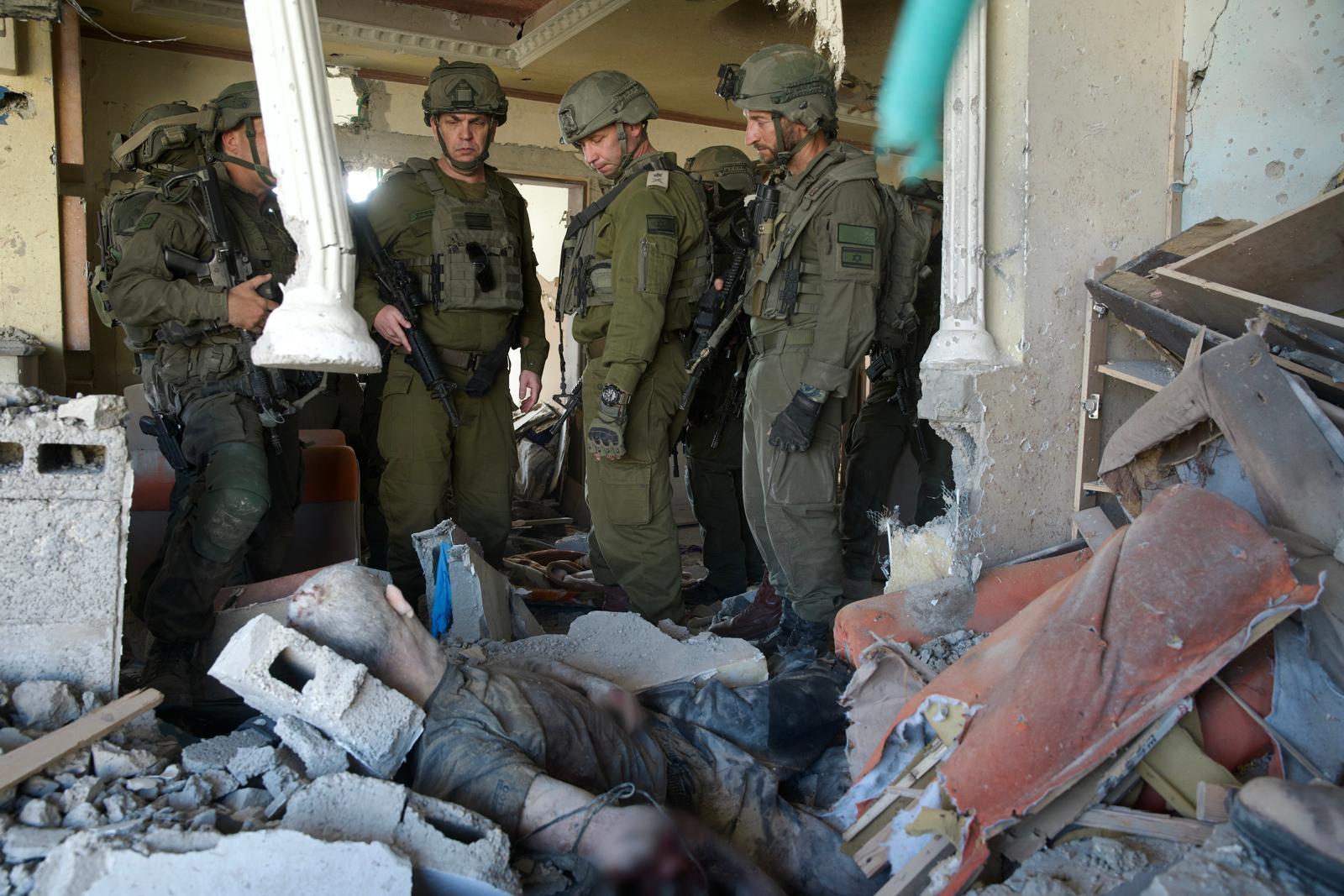
The image shows former Southern Command chief Maj. Gen. Yaron Finkelman, former Operations Directorate chief Maj. Gen. Oded Basiuk, and Gaza Division chief Brig. Gen. Barak Hiram standing over Sinwar’s body on October 17, 2024, a day after he had been killed.
The photo is released by the military as part of a set of iconic images taken by combat photographers during the war, which will be displayed in an exhibition at the Yitzhak Rabin Center in Tel Aviv from Sunday.
Read more: At the site of Sinwar’s elimination, IDF commander says incident was ‘not a fluke’
In tribute to fallen troops, a bellicose Netanyahu says Israel will recover all hostages, ‘complete the victory’
Speaking at the state ceremony marking October 7 Remembrance Day at Mount Herzl, Prime Minister Benjamin Netanyahu says Israel is “committed to bringing back every last” hostage, while vowing to still achieve all of Israel’s war goals in Gaza and continue battling Iran and Tehran-backed groups seeking the country’s destruction.
“The struggle is not over. But one thing is clear today: Anyone who raises a hand against us already knows he will pay a very heavy price for his aggression,” the premier warns. “We are determined to complete the victory that will shape the order of our lives for many years.”
“I know the magnitude of your suffering,” he tells the families of fallen soldiers, expressing the nation’s thanks for “all the soldiers who fought in the war: Jews, Druze, Christians, Muslims, Bedouin, Circassians, and members of other groups – they stood shoulder to shoulder to achieve all the war’s objectives.”
“And indeed we will achieve all the objectives of the war,” Netanyahu vows.
During the speech, he pushes back against accusation that Israel’s military campaign constitutes a genocide, saying the term more aptly applies to what Israel was subjected to on October 7.
On that day, he says, “we received a shocking illustration of the expression ‘genocide,'” emphasizing that he is “not talking about a fictitious genocide – one hurled at us in antisemitic libels by those who wish us ill.”
“If those murderers had been able to do more, they would have slaughtered every one of us. This is the real genocide,” Netanyahu says of the Hamas-led terrorists, adding that the attack alerted Israel to the intention of the “regime in Iran and its terror branches to strangle Israel to death in a ring of deadly fire.”
“But our enemies did not calculate one thing: the power within us. We rose to our feet as one,” he says. “We shifted the focus of battle into enemy territory; we struck it with crushing blows.”
Netanyahu calls Israel “the dam against the forces of destruction of radical Islam,” hailing the country’s troops as “the protective wall that separates us from them… They have done it with supreme heroism, with astonishing resourcefulness.”
“From the valley of weeping [on October 7] we reached Mount Hermon and the skies of Tehran, [and] the heart-shaking embrace of the families of the hostages with their loved ones,” he says.
Enemies trying to rearm, but there are chances to expand peace, Netanyahu says
Continuing his speech at the state ceremony marking October 7 Remembrance Day at Mount Herzl, Prime Minister Benjamin Netanyahu says that “great challenges” from Israel’s enemies as well as “great opportunities” for peace lie ahead as the war in Gaza winds down.
While hailing the military successes of the war, Netanyahu says, “Great challenges still lie ahead from our enemies who seek to rearm,” in possible reference to the regime in Tehran, whose nuclear facilities Israel attacked in June.
“Great challenges – and alongside them, dramatic and great opportunities to widen the circle of peace,” he says, reiterating his assertion that Israel is poised to expand normalization and peace agreements with neighboring Arab countries following the war.
Netanyahu adds that national unity is required moving forward: “We are operating on both levels at once, and what is needed on both is unity – unity in war and unity in peace. We will achieve all our goals. Only through internal cohesion, mutual responsibility, and strengthening the bonds that unite rather than divide.”
Mediators said seeking pressure on Israel to advance Gaza talks before bodies returned
Qatari news channel Al-Arabi reports that mediators are asking the US to pressure Israel to drop the issue of seeking the return of hostages’ bodies and move on to the next stage of negotiations aimed at ending fighting in Gaza.
Cairo-based correspondent Tamer Abu Rob reports, without sources, that mediators have promised that efforts to locate hostages are already underway by Egyptian teams, and that Turkish assistance will soon begin operating in Gaza for the same purpose.
According to the report, mediators told the United States that Hamas is sharing all the information it has on the matter.
The report seems to dovetail with comments from senior advisers to US President Donald Trump on Wednesday who indicated that Hamas was doing what it could, while noting that Turkey could soon enter the picture. Egypt’s involvement in finding the bodies was previously reported.
“The sentiment in Israel is always [that Hamas] can do more. What we basically say to the Israeli side… is, ‘Give us whatever intelligence you’re hearing or seeing,” one Trump adviser said. “If you think that there’s something [the mediators or Hamas] could be doing or should be doing that you don’t think they’re doing, then pass it over and we’ll convey it.”
Israel has indicated that it will not engage in talks expected to focus on Gaza’s reconstruction and administration until the first stage of the deal is complete with the return of all hostages dead and alive.
Israel sends bodies of 30 Palestinians to Gaza in line with deal, Red Cross says
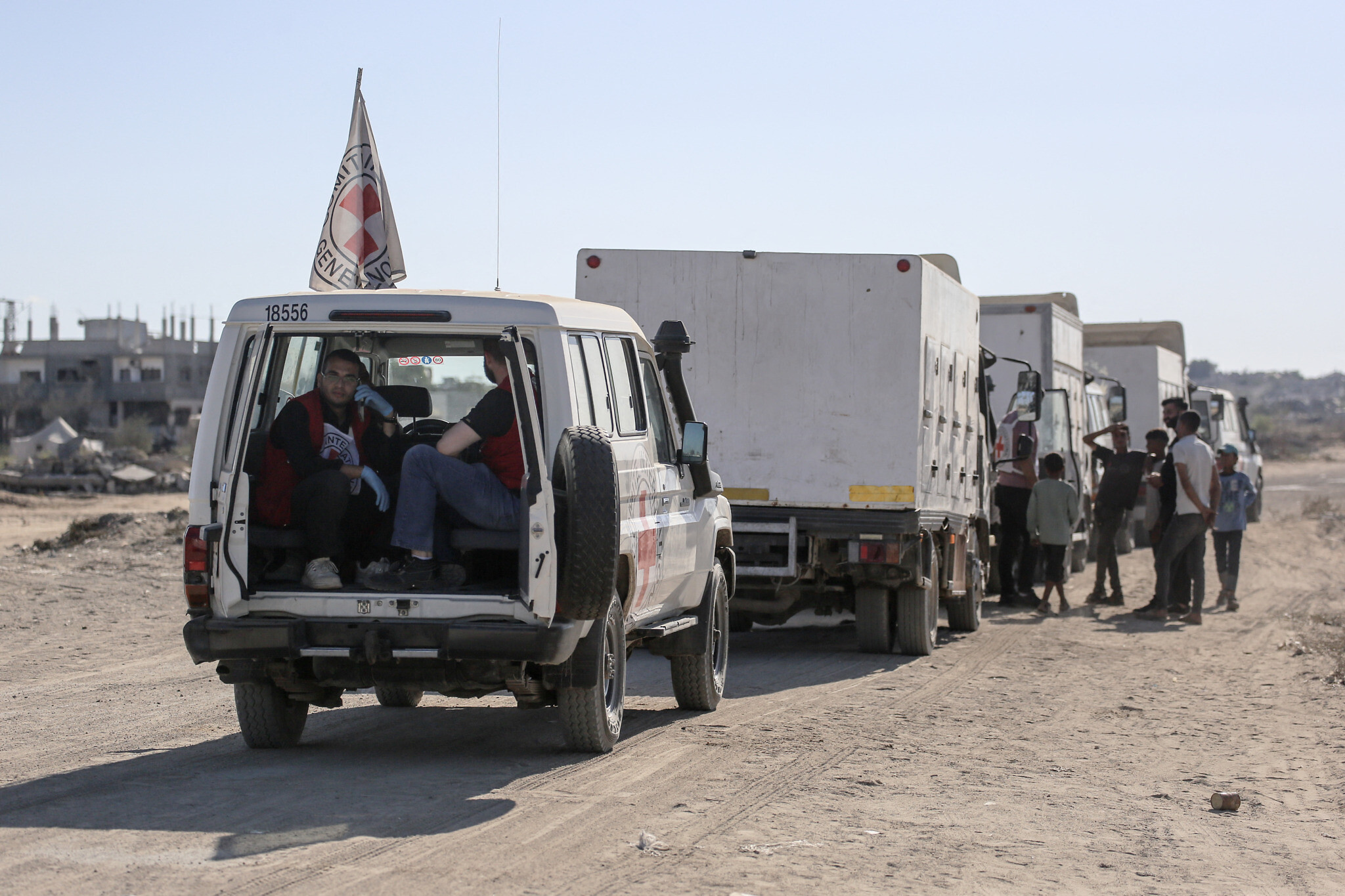
Vehicles of the International Committee of the Red Cross, including refrigerated trucks, prepare to depart for the Kissufim crossing, located east of Deir el-Balah in the central Gaza Strip, to receive the bodies of Palestinians that have been held in Israeli custody on October 15, 2025. (Bashar TALEB / AFP)
A senior Red Cross official tells The Times of Israel that the ICRC has transferred the bodies of 30 Palestinians to the Gaza Strip.
The number of bodies handed over matches the formula of 1 hostage for 15 Palestinians agreed on in the US-backed ceasefire deal, after Hamas returned two slain captives last night.
There are currently no plans for a further handover of hostage bodies, says the official, but it is “all under discussion.”
Shas head urges Netanyahu to freeze Gaza deal until Hamas returns bodies
Shas chairman Aryeh Deri is urging Prime Minister Benjamin Netanyahu to halt any steps being taken pursuant to Israel’s ceasefire deal with Hamas until the terror organization returns the rest of the bodies of hostages being held in the Gaza Strip.
“I demand from the prime minister and the government to immediately halt all parts of the agreement with Hamas, including the opening of the Rafah crossing, the entry of aid, and any associated action, until Hamas returns the bodies to us and cooperates fully and seriously on this matter,” Deri tweets, adding, “We are committed to bringing all our sons to a Jewish burial.”
While not a member of the government, Deri holds a seat as an observer on the high-level security cabinet.
The Hamas terror group has so far released nine out of 28 hostages whose bodies are in Gaza, with the bodies of 19 slain hostages yet to be returned.
Earlier today, the Hostages and Missing Families Forum called on the government to halt steps toward a ceasefire agreement ending the war in Gaza until the remaining bodies are returned.
“Hamas is violating the agreements,” the group said, asserting that “any diplomatic or military action that does not ensure their return is an abandonment of Israel’s civilians.”
Thousands pay last respects to soldier Tamir Nimrodi at Kfar Saba funeral
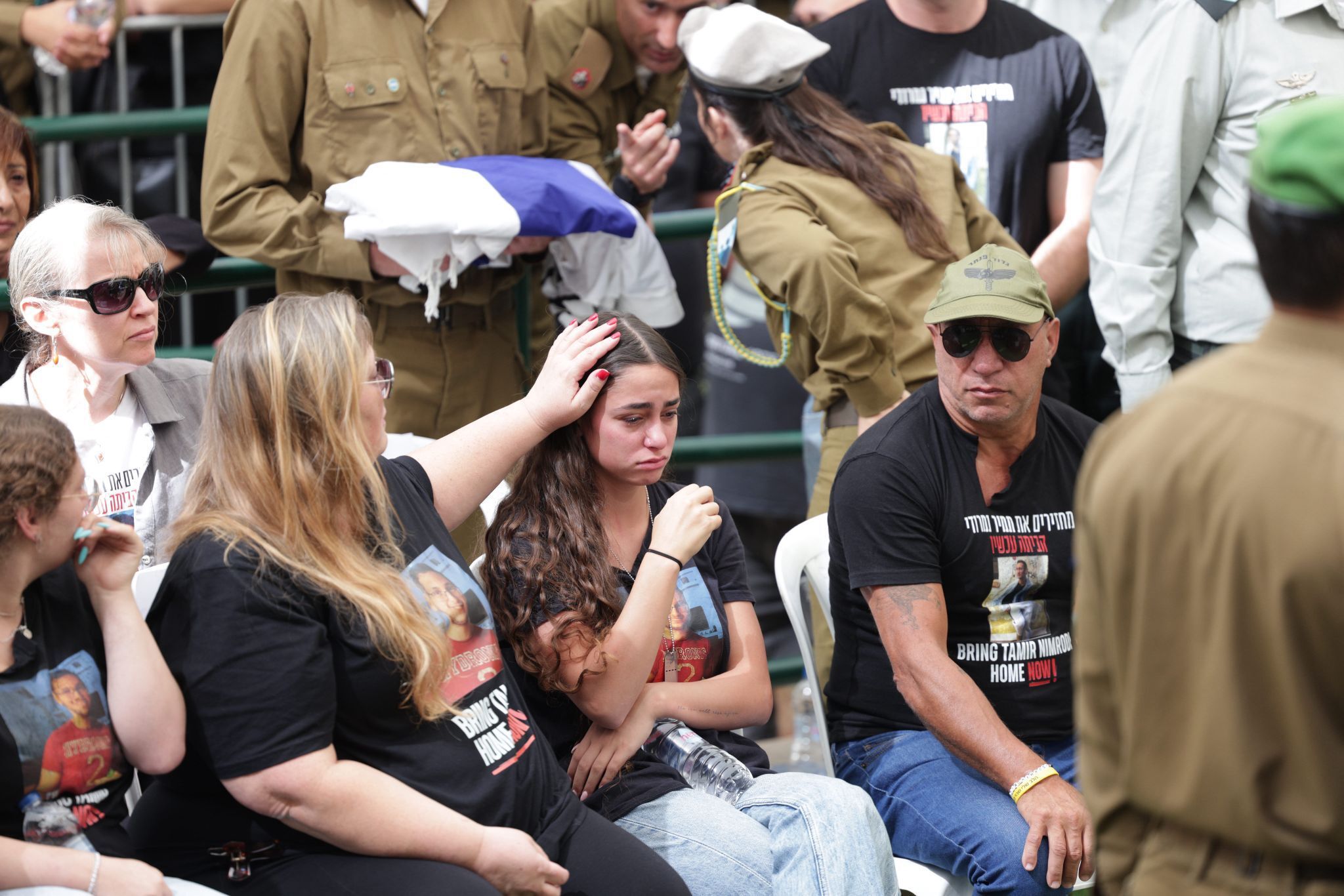
Herut Nimrodi, left, daughter Mika Nimrodi, and Alon Nimrodi mourn at the funeral of their son and brother, Tamir Nimrodi, October 16, 2025, at the Kfar Saba military cemetery. (Credit Alon Gilboa/Hostages Forum)
A funeral for Tamir Nimrodi, whose body was returned to Israel on Tuesday after being held by Hamas for two years, draws thousands to the military cemetery in Kfar Saba.
Nimrodi, 18, a soldier taken hostage from his base near the Erez Crossing on October 7, 2023, was killed soon after during an IDF air raid.
His father Alon Nimrodi, tells his son in a eulogy that he fought every possible way to bring him home.
He describes Tamir’s powerful hugs, his rolling laughter with his sisters, his anxiety and the medication that he abandoned when he enlisted.
“You fought bravely against your own fears,” says Nimrodi. “Minutes after you were kidnapped, with that same look of terror, you pulled yourself together and wove a quick and clever plan that you thought might help you survive.”
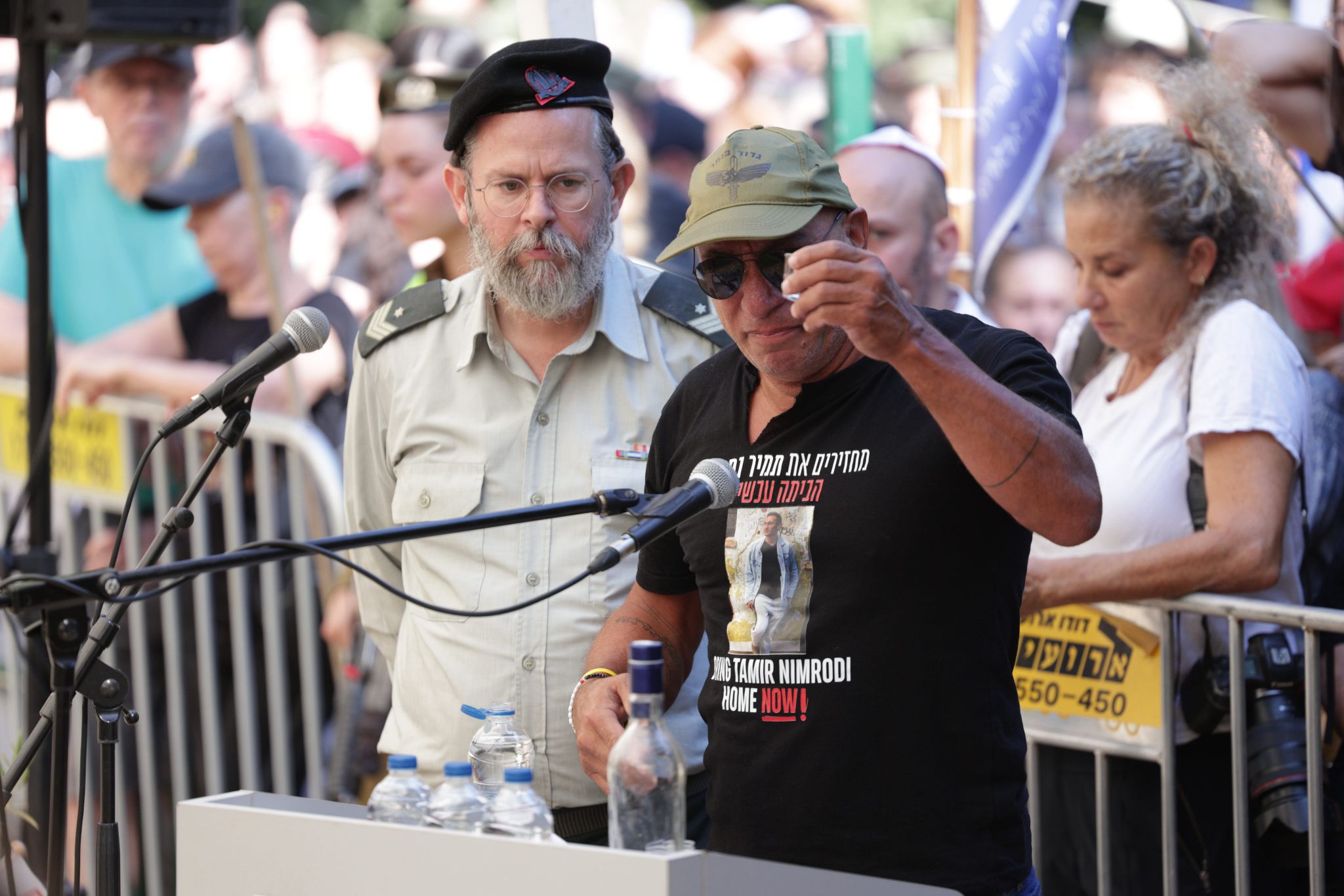
His father also speaks about the feelings of guilt he has for pushing his son to enlist, telling him there was no draft-dodging in their family, and that he didn’t oppose his son’s placement on the Gaza Strip border.
“I will forever blame myself for pushing you to enlist. I told you that in our household there is no such thing as draft-dodging. I didn’t oppose your deployment on the Gaza border. Forgive me, my firstborn, my beloved — forgive me!” says Nimrodi.
(Nimrodi had ADHD and Sensory Processing Disorder, and was initially enlisted with a low profile, his mother said in a Ynet (Hebrew) interview in January, but got his profile raised and had interviewed for officer training a week before the Hamas attack.)
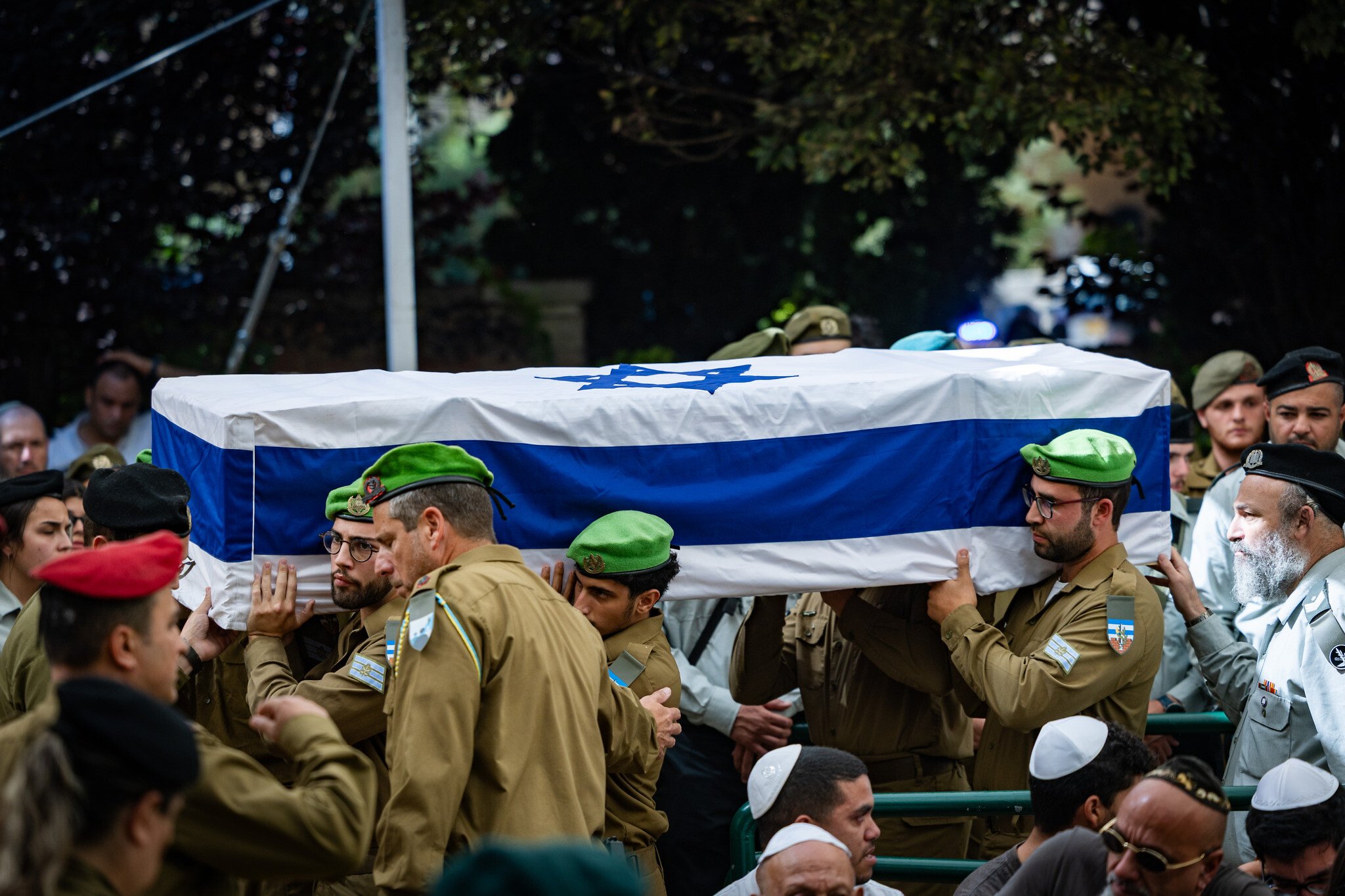
Nimrodi’s sister, Amit, 14, tells her brother she misses him, her best friend, and misses the nights they stayed up talking.
She mentions the note found inside her brother’s uniform, when he wrote that his goals were to help as many people as possible, to build a close circle of friends, and not to hurt anyone.
“To me, that is your will,” says Amit, “and I will do everything I can to fulfill it.”
Former party activist ordered to pay Avigdor Liberman NIS 200,000 over claim he ordered hit on senior cop
The Petah Tikva Magistrate’s Court orders former Yisrael Beytenu activist Yossi Kamisa to pay party chairman Avigdor Liberman NIS 200,000 ($60,000) in damages for defamation over a statement he made in 2022 claiming that Liberman had offered him $100,000 to kill a police superintendent.
Kamisa wrote on social media in 2022 that Liberman made the offer to him 20 years ago. Liberman emphatically denied the claim and alleged it was orchestrated by then-opposition leader Benjamin Netanyahu to smear him ahead of that year’s November 1 elections.
Kamisa also claimed that Liberman had operated a Jericho casino whose proceeds benefited terror organizations, and that he’d had secret business dealings in Congo.
“The truth is stronger than any lie. Even when there are those who try to run campaigns of slander and blood libels, in the end justice is revealed,” Liberman says following the ruling.
Minister bans Brothers in Arms and other groups that encourage avoiding military service from schools
The Brothers in Arms anti-government protest group and “all organizations that encouraged refusal” to serve the military will not be allowed to enter Israeli schools, Education Minister Yoav Kisch announces.
In a tweet, the Likud politician says that Brothers in Arms, which encouraged reservists to refuse volunteer duty during the 2023 judicial overhaul protests, had “harmed the security of the state” and that “such entities will not enter schools, period.”
“No enlistment refusal in our schools,” he writes, denying having known in advance about a recent case in which the organization was invited to a school.
In response, Omri Ronen, one of the group’s founders, notes on X that Kisch is part of a government supported by ultra-Orthodox parties that actively support draft dodging by members of the Haredi community.
Herzog calls for probe into October 7 failures ‘worthy’ of day’s victims
Speaking at a state ceremony commemorating the civilian victims of the Hamas-led October 7, 2023, attack, President Isaac Herzog asks forgiveness on behalf of the State of Israel for the “failure” to protect its citizens on that day, calling for a probe to “investigate the disaster thoroughly.”
In his second address today at the Har Herzl military cemetery, following this morning’s ceremony held for fallen soldiers during the war in Gaza, Herzog tells bereaved families of civilian victims that “nothing can heal your world that was destroyed.”
“All that is left for me is to embrace you, to ask forgiveness on behalf of the State of Israel – for the failure and for not having defended you on that dreadful day – and to hope, on behalf of an entire people, that you will be granted relief and consolation, and that we will investigate the disaster thoroughly, broadly and comprehensively, and be worthy of your sacrifice,” he says.
Herzog’s comments come as the government continues to vigorously oppose the establishment of a state commission of inquiry into the October 7 attack, originally because such an inquiry could not be conducted while Israel was at war, but later due to arguments by several cabinet ministers that such a commission would be biased against the government. On Wednesday, the High Court of Justice told the government that there is “no real argument” against the need to establish such an inquiry.
Continuing his speech, Herzog reiterates his call for national unity, saying: “In the last two years we have learned well that we are sisters and brothers… this brotherhood is the life force that pulses within us.”
“We learned that without it we may be in real existential danger… It is not possible — simply not possible – that even now, as we bury our abducted dead, the ones returning to us from [Hamas captivity], the spirit of factionalism, polarization and hatred rises its ugly head again. We must remember: This people and this state are greater than any one of us.”
Justice minister proposes tribunal with power to sentence October 7 perpetrators to death
Justice Minister Yariv Levin has introduced legislation to the Knesset that would establish a special criminal tribunal to try Gazans accused of carrying out massacres and atrocities on October 7, 2023, in a process that could result in death sentences being handed down to those convicted.
Under the legislation, the tribunal will be staffed by 15 judges who are either qualified to serve on Israel’s Supreme Court or international jurists deemed by the justice minister in consultation with the foreign minister to have the appropriate qualifications.
The tribunal will be able to try Gazans captured in Israel from October 7, 2023, to October 14 that year and accused of being Hamas operatives, thought to number in the hundreds, for crimes listed under Israel’s 1950 Law for the Prevention of Genocide, which is based on the 1948 Genocide Convention.
The state would be able to seek a death sentence, although that decision would need to be approved by the prime minister in consultation with senior security officials.
Levin supports the death penalty for those convicted of such crimes, and the indictments have been drafted to enable the suspects to be tried for crimes punishable by death.
In a statement to the press, Levin says that intensive work has been conducted since the October 7 Hamas invasion by the State Attorney’s Office, the police, and the Shin Bet, which carried out comprehensive investigations into the those detained in Israel during and immediately following the attacks, including gathering “unprecedented volumes of evidence” against them.
Draft indictments have been produced, but due to the large number of cases and the special circumstances of the crimes they are alleged to have committed, Levin says a need arose to make a number of legislative amendments “to ensure that the legal process is conducted efficiently and that justice is both done and seen.”
The Knesset Constitution Law and Justice Committee has already begun deliberations on the legislation, and Levin is seeking to bring the bill to its first reading in the Knesset and advance it as quickly as possible, now that the living hostages held by Hamas in Gaza have been returned.
Levin’s statement to the press was issued together with Knesset Constitution, Law and Justice Committee Chairman Simcha Rothman and committee member MK Yulia Malinovsky of the Yisrael Beytenu opposition party.
Two reported killed by Israeli fire in eastern Gaza
Palestinian media report that two people were killed in an Israeli strike south of Abasan al-Kabira, east of Khan Younis.
The area is under Israeli control according to the agreed-upon ceasefire lines.
The IDF has not yet issued a response. It has warned Gazan civilians to avoid areas where troops are present.
‘You will forever remain my pure 18-year-old boy’: Herut Nimrodi parts from slain hostage son Tamir Nimrodi
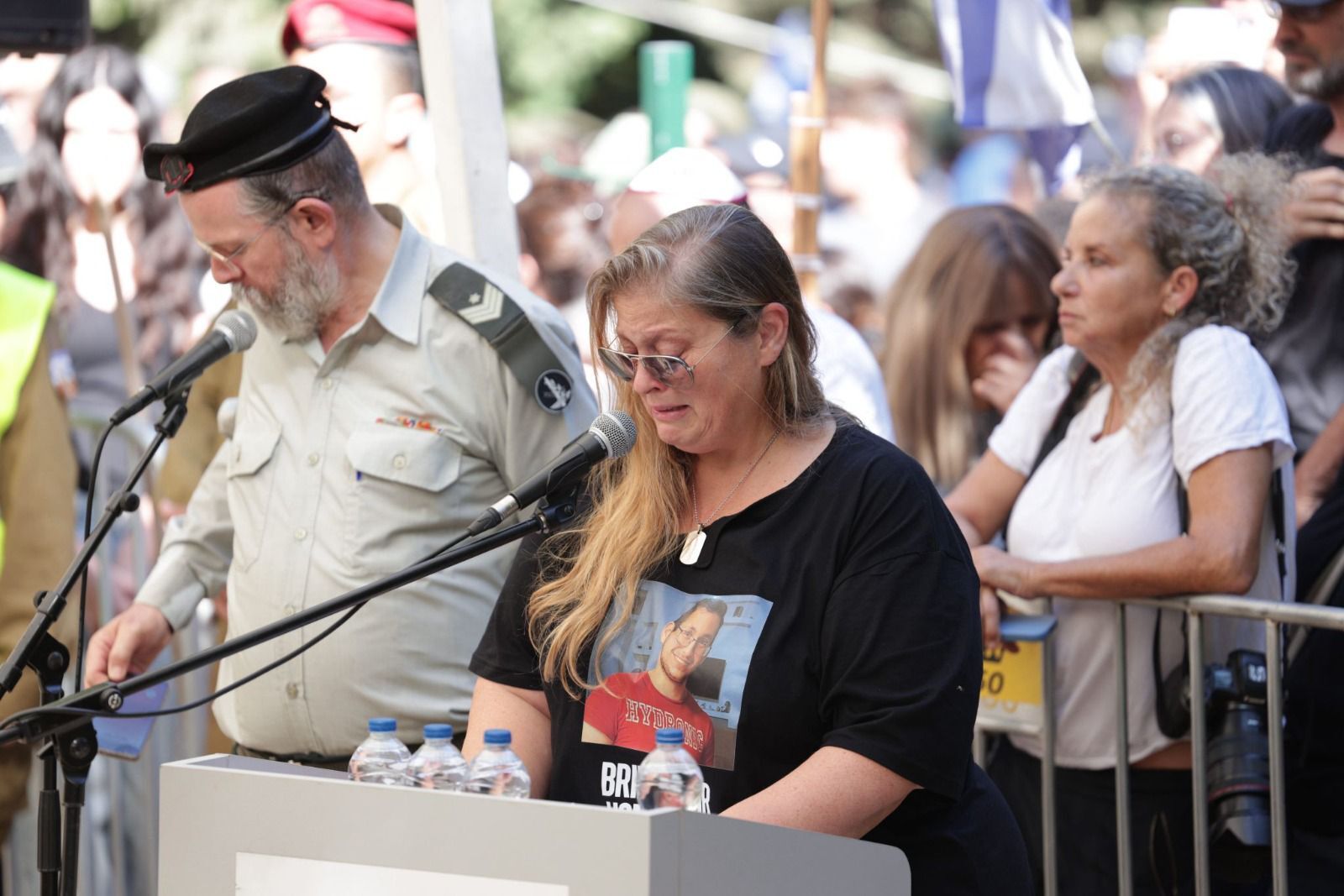
Herut Nimrodi, mother of slain hostage soldier Tamir Nimrodi, at his funeral in Kfar Saba on October 15, 2025. (Alon Gilboa/Hostages and Missing Families Forum)
Herut Nimrodi, the mother of slain hostage soldier Tamir Nimrodi, says in a eulogy for her son that he is being buried on the same day he was killed two years ago, on the 24th day of the Hebrew calendar month of Tishrei.
“I received the news that shattered my heart, crushed every shred of hope, emptied me of the little strength I had left,” says Nimrodi. “Your body has been identified and returned to Israel. You are here. You’ve come back.”
She notes that she is standing closer to him now than she has in the last two years, but without being able to hug him, and without healing or peace.
Nimrodi tells her son to rest, knowing that his soul is finally free, beside her, and says she knows that she will eventually find joy on this earth.
She promises him that she will not sink, and that she will take care of herself and his sisters.
“We will meet again, face to face, someday in the future,” says Nimrodi. “Me, with wrinkles and white hair, and you… You will forever remain my pure 18-year-old boy.”
Houthis announce death of military commander said to have been wounded in IDF strikes
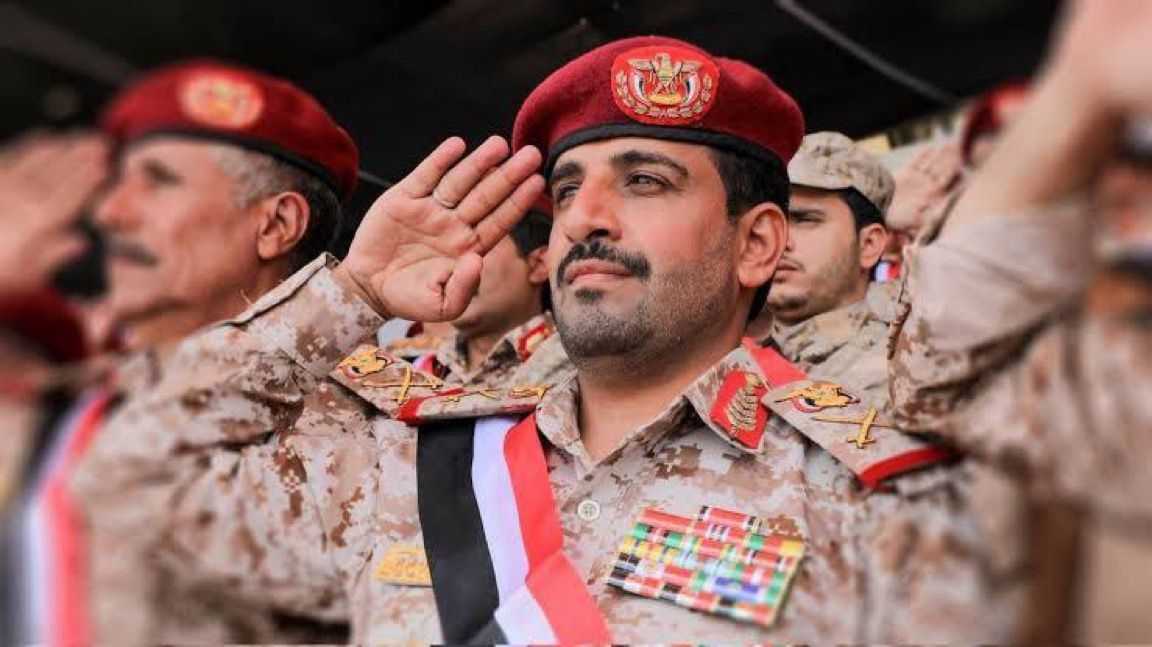
Houthi chief of staff Muhammad al-Ghamari, in an undated photo. (Social media)
The military commander of the Houthi rebels in Yemen, Muhammad al-Ghamari, has died, the Iran-backed group announces.
It says that he died “in the course of his jihadist work.”
Israel carried out an assassination attempt against al-Ghamari and other senior Houthi officials on June 12. At the time, reports indicated that al-Ghamari had survived but was severely wounded.
The IDF confirmed at the time that it had targeted him, but said that the results of the attack were unclear.
Al-Ghamari was also reportedly among the targets of an Israeli strike on Houthi leaders in August, in which the Houthi prime minister was killed, along with a dozen other officials.
Eitan Horn discharged from hospital, days after release from Hamas captivity

Newly released hostage Eitan Horn (left) seen with his brothers Amos and Iair at Tel Aviv’s Ichilov Medical Center on Monday, October 13, 2025. (Hostages Families Forum)
Eitan Horn, a released hostage who arrived at Tel Aviv’s Ichilov Medical Center on Monday, has been discharged from the hospital after completing all the necessary tests, a statement from Ichilov says.
The hospital says it will continue to accompany him and his family, and monitor his medical state, conducting further tests as necessary.
The hospital also calls on the public and the media to continue to respect the family’s privacy.
Israel’s fight against terror will ‘continue with full force,’ Netanyahu vows at Oct. 7 memorial
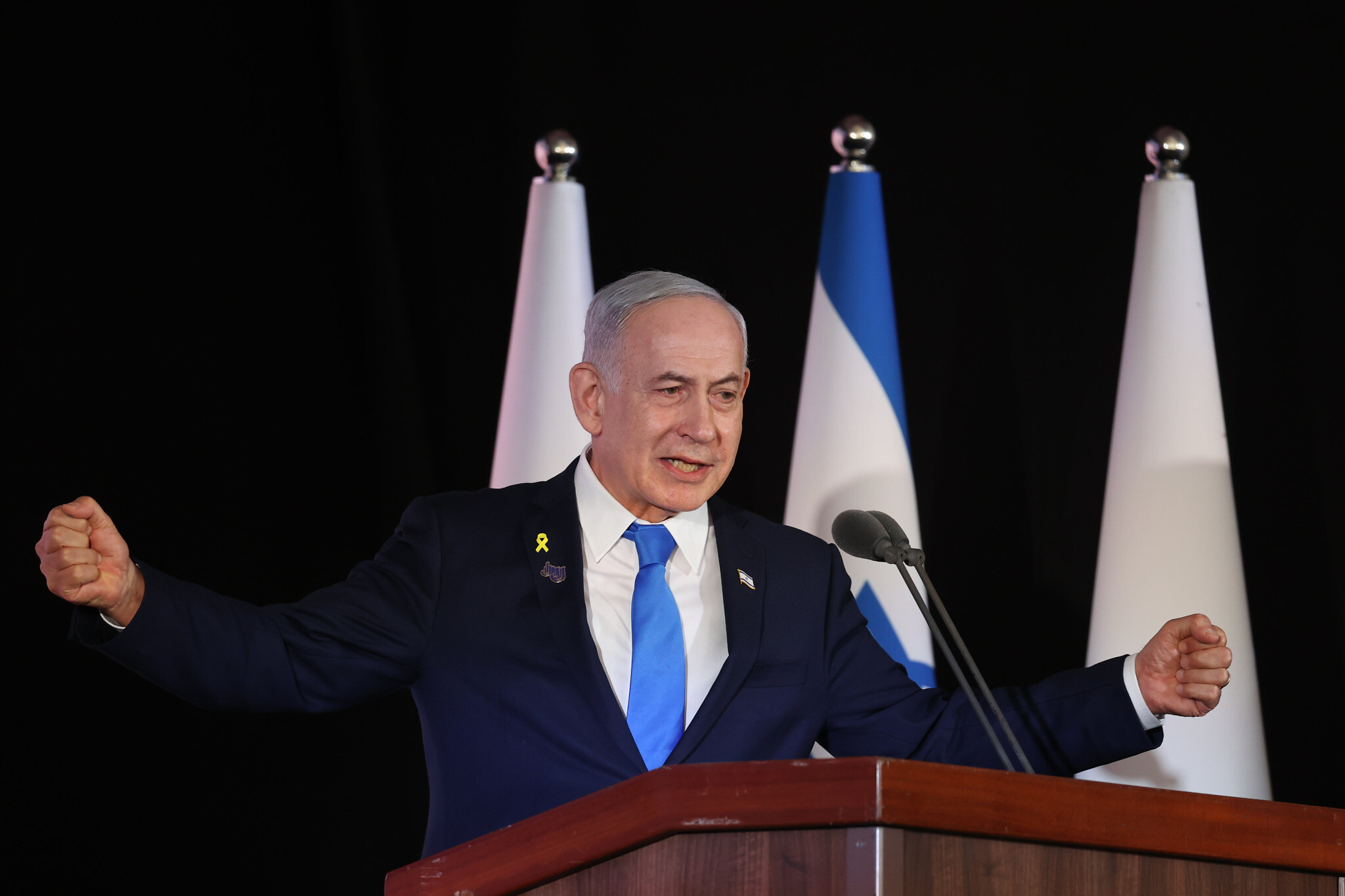
Prime Minister Benjamin Netanyahu speaks at a state ceremony marking the Hebrew calendar anniversary of the October 7, 2023, attacks, at the Mount Herzl military cemetery in Jerusalem, on October 16, 2025. (Alex Kolomoisky/POOL)
Delivering his second address at the state memorial ceremony marking two years since the Hamas-led October 7, 2023, attack, Prime Minister Benjamin Netanyahu pays tribute to the civilians killed in the massacre and in terror attacks during the ensuing war in Gaza, vowing that Israel’s battle against terror “will continue with full force.”
Speaking at Jerusalem’s Mount Herzl military cemetery, the premier says, “The list of names of terror victims… bears witness to the heavy price bound to our fundamental right to be a free people in our land.”
“Despite October 7 being another chapter in the long war for our national existence, those events also stand among the peaks of barbarity known to humanity in the modern era,” he continues, describing the atrocities committed by Hamas-led terrorists that day: “They beheaded, abducted, raped, tortured, and burned their victims, and even filmed their actions live — including their cries of joy.”
Netanyahu says that “during [his] last visit to the United States,” which took place last month and during which he agreed to US President Donald Trump’s framework to end the war in Gaza, he “insisted that the footage of the atrocities… be shown… be made available [to] world leaders and to the general public abroad.”
Netanyahu appears to be referring to the public diplomacy campaign Israel ran during his speech at the United Nations General Assembly, where he sported a QR code on his lapel, which, if scanned, opened a link to footage of the atrocities carried out by Hamas on October 7.
The premier reiterates that “our struggle against terror will continue with full force,” and vows that Israel “will not allow evil to raise its head. We will exact the full price from anyone who harms us.”
“At the same time, we will continue to build our country with tremendous momentum,” he says.
Netanyahu also commemorated “the terrible losses from all enemy actions during the war, including victims of the missiles Iran launched at Israeli cities” during the 12-day war with Iran in June.
The memory of Israel’s victims on October 7 and throughout the war “will not only turn to the past; it will accompany us in our actions to secure a good future, a safe future – to stand up to the challenges from our enemies and to widen the circle of peace with our neighbors,” vows Netanyahu.
“Above all, we need unity – unity in war, unity in peace. May the memory of the victims of hostile acts be held with us for generations to come,” he adds.
Katz confirms Houthi military chief was fatally wounded in August strike targeting group’s top officials
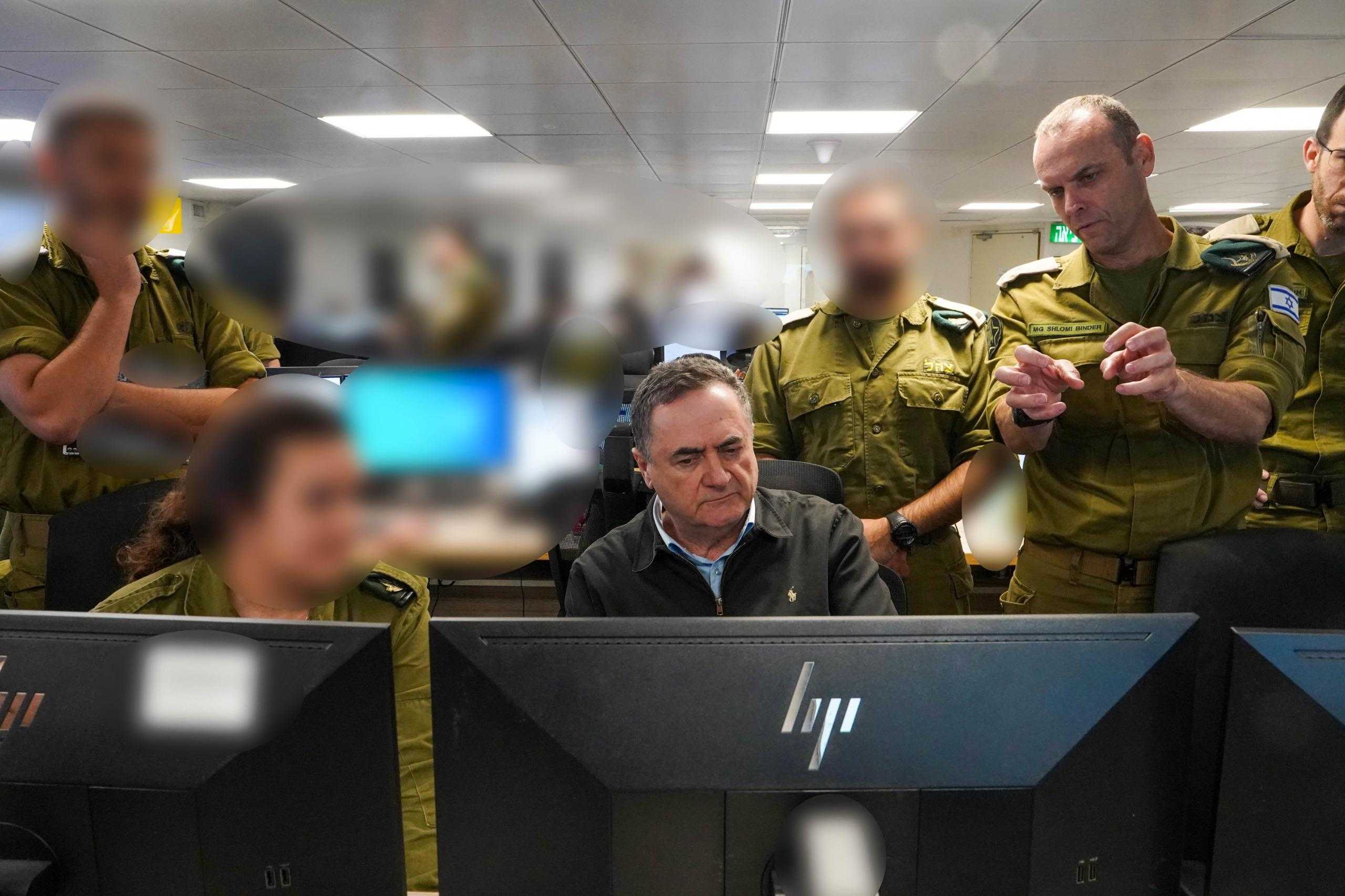
Defense Minister Israel Katz and IDF Intelligence Directorate chief Maj. Gen. Shlomi Binder are seen at a command center, in a photo issued on October 16, 2025. (Ariel Hermoni/Defense Ministry)
Defense Minister Israel Katz says Houthi military chief of staff Muhammad al-Ghamari was killed as a result of Israel’s strike on the Iran-backed group’s leaders in August.
The strike had killed the Houthi prime minister and around a dozen other ministers.
Al-Ghamari was apparently fatally wounded in the attack. He was also wounded in an Israeli strike in June.
“He joins his friends, the eliminated members of the Axis of Evil, in the depths of hell,” Katz says.
Katz says he also visited the Military Intelligence Directorate’s so-called “Houthi command center” today with the directorate’s chief, Maj. Gen. Shlomi Binder, where he thanked the soldiers and commanders “for the excellent work they have done and have yet to do against the Houthis in the future.”
The Houthis did not detail how al-Ghamari was killed in their announcement of his death today.
Sergey Matatov named as uninvolved victim of Route 443 gang-related shootout

Paramedics arrive ar the scene of a shooting that injured three men on Route 443 on October 15, 2025. (Magen David Adom)
One of the people killed in the highway shootout in central Israel yesterday is named as Sergey Matatov, a civil engineer shot by armed motorcyclists during a targeted ambush linked to a gang-related dispute in Lod.
Matatov, who leaves behind his wife and young son, served many days on reserve duty, Hebrew outlets report. He had been driving to work on Route 443 north of Modiin when criminals driving a stolen motorcycle opened fire at three passengers in a jeep.
Two of the men in the jeep reportedly escaped their vehicle and tried to flee their attackers on foot while Matatov, fearing a terror attack, also stopped and got out of his car with his gun in hand. One of the motorcyclists dismounted and chased after the two men with an assault rifle, which is when the reservist was struck by a stray bullet, according to Haaretz, citing the ongoing police probe into the incident.
The gunman was shot and killed by IDF troops passing by the scene. His accomplice continued on the motorcycle but was soon arrested by officers from the Modiin police station.
Police are requesting a court extend the detained suspect’s detention and also plan to interrogate the jeep passengers targeted in the ambush, two of whom were seriously injured from the gunfire.
According to police’s initial findings, the shooting is linked to a violent dispute between rival factions of the Abu Qatifan crime family, based out of Lod.
NY anti-Israel activists to hold vigil for Hamas terror chief Yahya Sinwar on anniversary of his death
New York anti-Israel activists will hold a vigil for former Hamas chief Yahya Sinwar today in the Bronx to mark the first anniversary of his death.
IDF forces killed Sinwar, the architect of the October 2023 assault, in Gaza a year ago, on October 16, 2024.
The Bronx Anti-War Coalition announces a vigil for Sinwar “and all martyrs in the struggle against Zionism and US-led western imperialism” in the South Bronx neighborhood.
The group tells attendees to bring candles, flowers and “photos of martyrs.”
The event announcement is shared widely by anti-Israel activist groups in the city, including the anti-Israel campus coalition at Columbia University.
Earlier this year, New York activists held a funeral ceremony for Hassan Nasrallah, the head of the Hezbollah terror group, whom the IDF assassinated last September.
Eitan Horn welcomed back to his hometown of Kfar Saba after two years of captivity
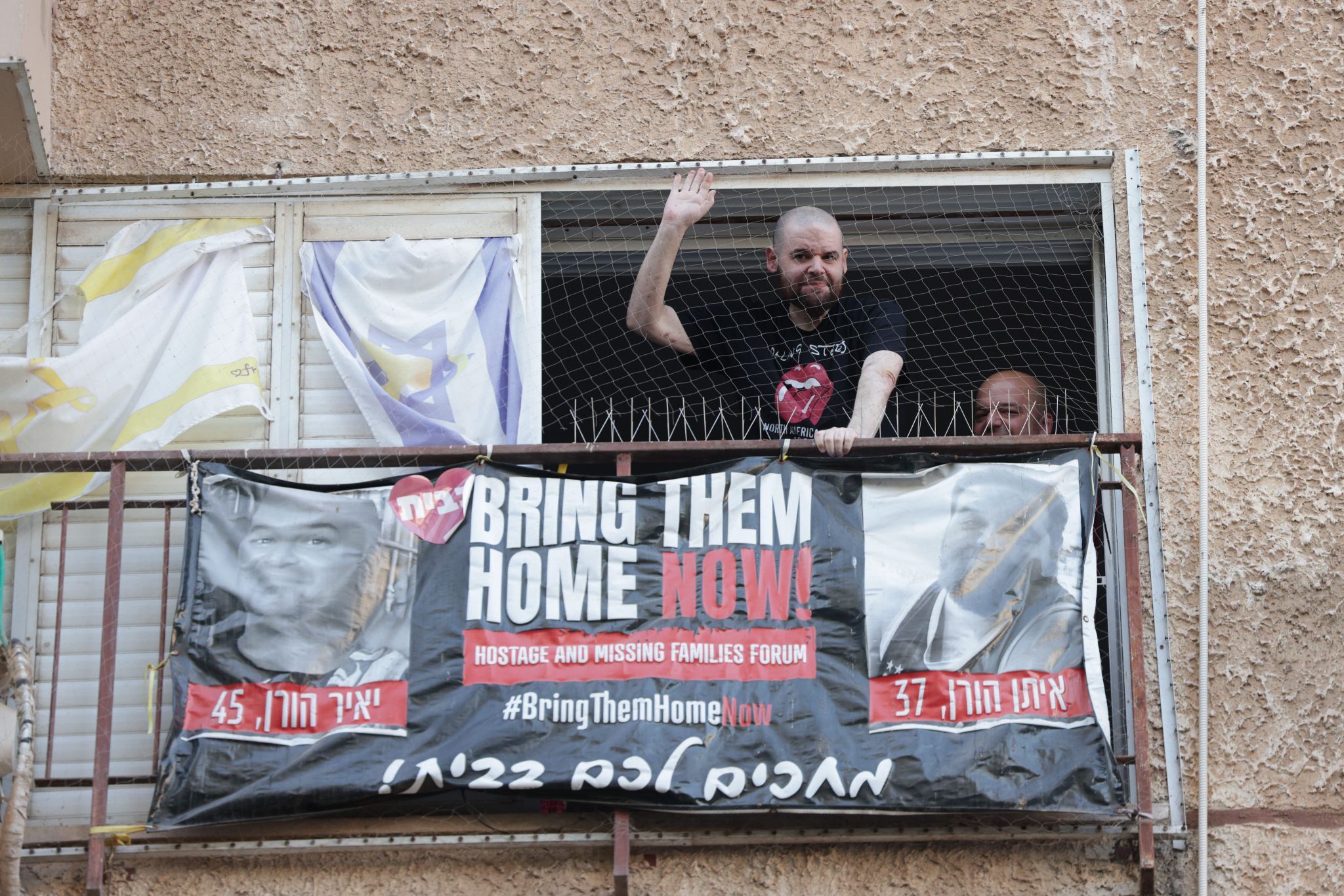
Released hostage Eitan Horn waves from the window of his home in Kfar Saba on October 16, 2025, as overjoyed neighbors throng the streets to welcome him.(Danor Aharon/Israeli Pro-Democracy Protest Movement)
Released hostage Eitan Horn is welcomed back to his hometown of Kfar Saba by overjoyed neighbors, after more than two years in Hamas captivity.
Horn was discharged from the hospital today, following his release from Gaza on Monday.
Residents of the city took to the streets with Israeli flags to welcome him home, after the Kfar Saba municipality published a statement encouraging them to do so.
Horn is photographed waving at his supporters from the window of his home, which has a large banner demanding his release from captivity attached to it.
Released hostage Nimrod Cohen discharged from hospital, returns home to Rehovot
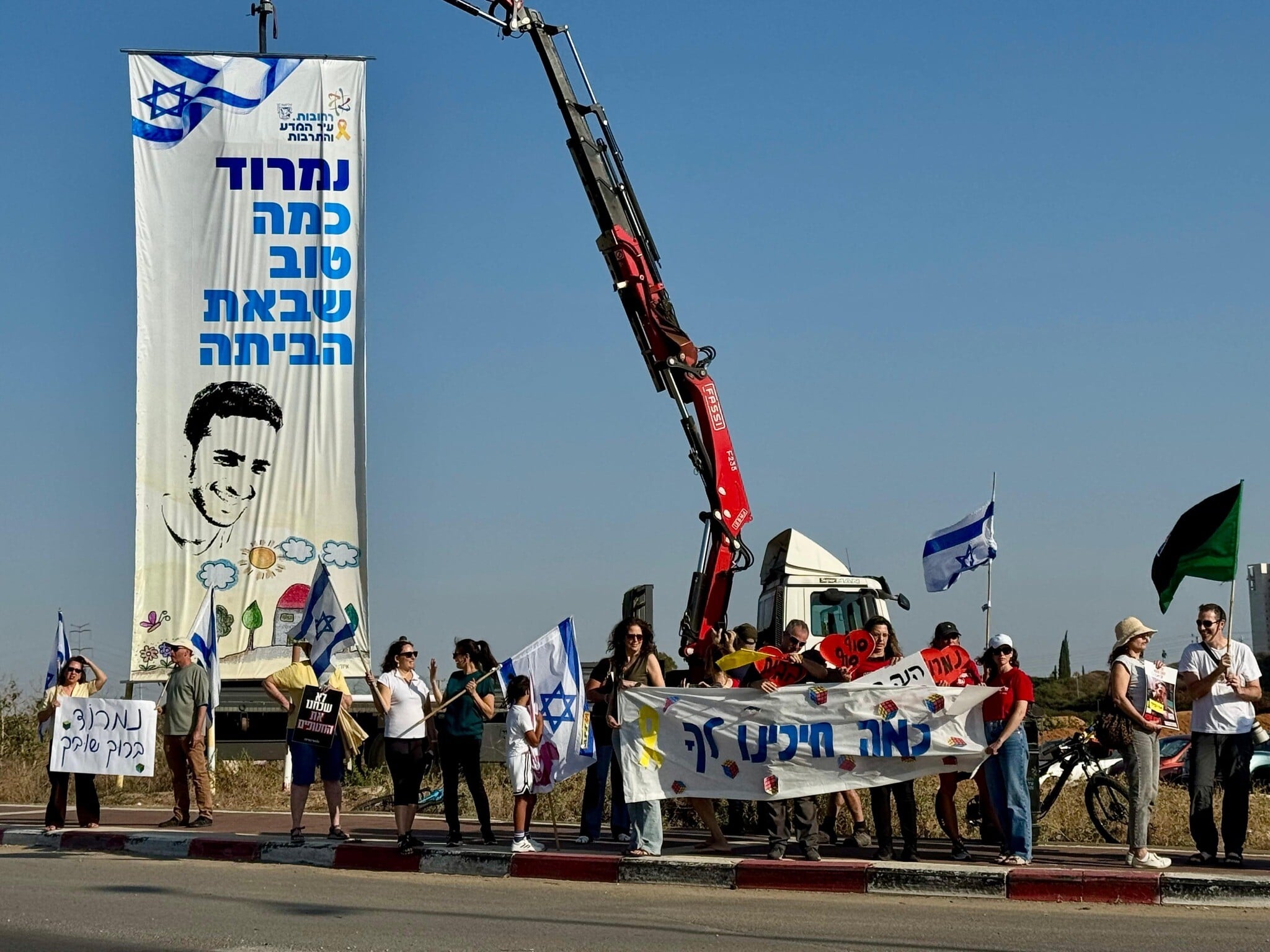
Residents of Rehovot await the return home of released hostage Nimrod Cohen, holding a banner that reads: 'Nimrod, it's so good that you've come home' (Vardit Alon-Korpel/Israeli Pro-Democracy Protest Movement)
Released hostage soldier Nimrod Cohen has been discharged from Ichilov Hospital, days after his release from Hamas captivity on Monday.
He is greeted with cheers and applause as he arrives in his hometown of Rehovot for the first time in two years, waving an Israeli flag out the window of the car as it drives slowly through the crowds.
Ahead of his return, the Rehovot Municipality encouraged residents to line the route to his home and “greet him with hugs, love, and Israeli flags.”
The municipality says it has replaced the old banners it had put up calling for Cohen’s release with new ones reading “Nimrod, it’s so good that you’ve come home.”
נמרוד כהן בדרך חזרה הביתה pic.twitter.com/kX1GhzQdWc
— חדר מלחמה (@waroomisrael) October 16, 2025
After death of Houthi military chief, PM vows Israel will get at everyone who threatens it
After the Houthis announce that their military chief of staff, Muhammad al-Ghamari, has died, Prime Minister Benjamin Netanyahu boasts that “another chief of staff was eliminated from the ranks of terror leaders who sought to harm us.”
“We will reach everyone,” Netanyahu promises in a statement.
His office says that “Israel’s determined hand will reach everyone who has tried to harm us and made it their goal to destroy Israel.”
Defense Minister Israel Katz confirmed that Ghamari was killed as a result of Israel’s strike on the Iran-backed group’s leaders in August.
Poll: On back of hostage deal success, Netanyahu’s Likud would win 34 seats if elections held today; his bloc would be near Knesset majority
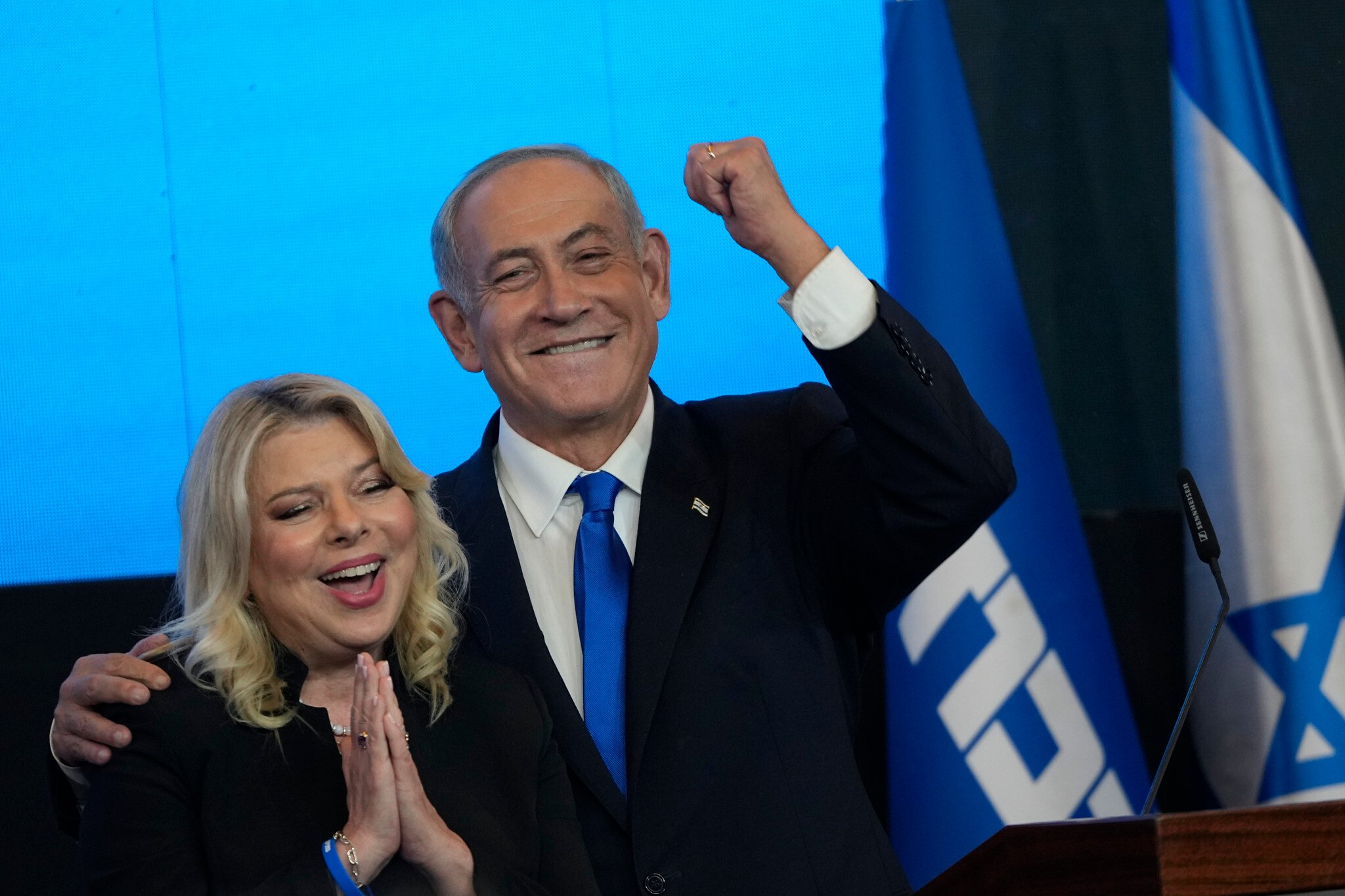
Likud leader Benjamin Netanyahu addresses supporters at the party's campaign headquarters in Jerusalem early on November 2, 2022, with his wife Sara at his side, as votes are counted in the general elections. (AP Photo/Tsafrir Abayov)
If elections were held today, Prime Minister Benjamin Netanyahu’s Likud party would win 34 seats, according to a poll conducted by Zman Yisrael, The Times of Israel’s Hebrew-language sister site, marking a dramatic increase in support for the premier following the release of the living hostages and the ceasefire in Gaza.
This is the best result that Likud has received in any election poll since the Hamas assault of October 7, 2023, and the outbreak of war in Gaza.
In contrast, the new party of former prime minister Naftali Bennett, seen as Netanyahu’s main rival in the next elections, would receive just 20 seats if elections were held today.
The boost to Likud’s numbers means that the parties belonging to the coalition would receive 59 seats in a new round of elections — just one short of the 60-seat majority required to form a government.
The Zionist anti-Netanyahu bloc, led by Bennett, would receive 53 seats, far short of a Knesset majority. The Arab-majority Hadash-Ta’al and Islamist Ra’am parties would receive eight seats in total.
Several parties are hovering around the 4-seat mark, meaning just above the 3.25% electoral threshold, putting them at risk of slipping below it and missing out on entering the Knesset altogether, the Zman Yisrael poll shows.
The third-largest party in the Knesset after Likud and Bennett 2026 would be Avigdor Liberman’s Yisrael Beytenu, with 10 seats. After him would be the ultra-Orthodox Shas party with nine seats, and fellow Haredi party United Torah Judaism with seven.
Yair Lapid’s centrist Yesh Atid party and Yair Golan’s left-wing Democrats would receive seven seats each, while Gadi Eisenkot’s Yashar! and Itamar Ben Gvir’s Otzma Yehudit would each win five spots.
Heading up the rear are Ra’am, Hadash-Ta’al, Bezalel Smotrich’s Religious Zionism, and Benny Gantz’s Blue and White, each with four seats.
Neither Yoaz Hendel’s HaMiluimnikim (The Reservists) party nor Palestinian nationalist party Balad would pass the electoral threshold.
The poll was conducted yesterday and today, among a representative sample of 404 respondents, with a 4.8% margin of error.
Knesset defense committee chair Bismuth submits outline for potential Haredi draft bill to legal advisor
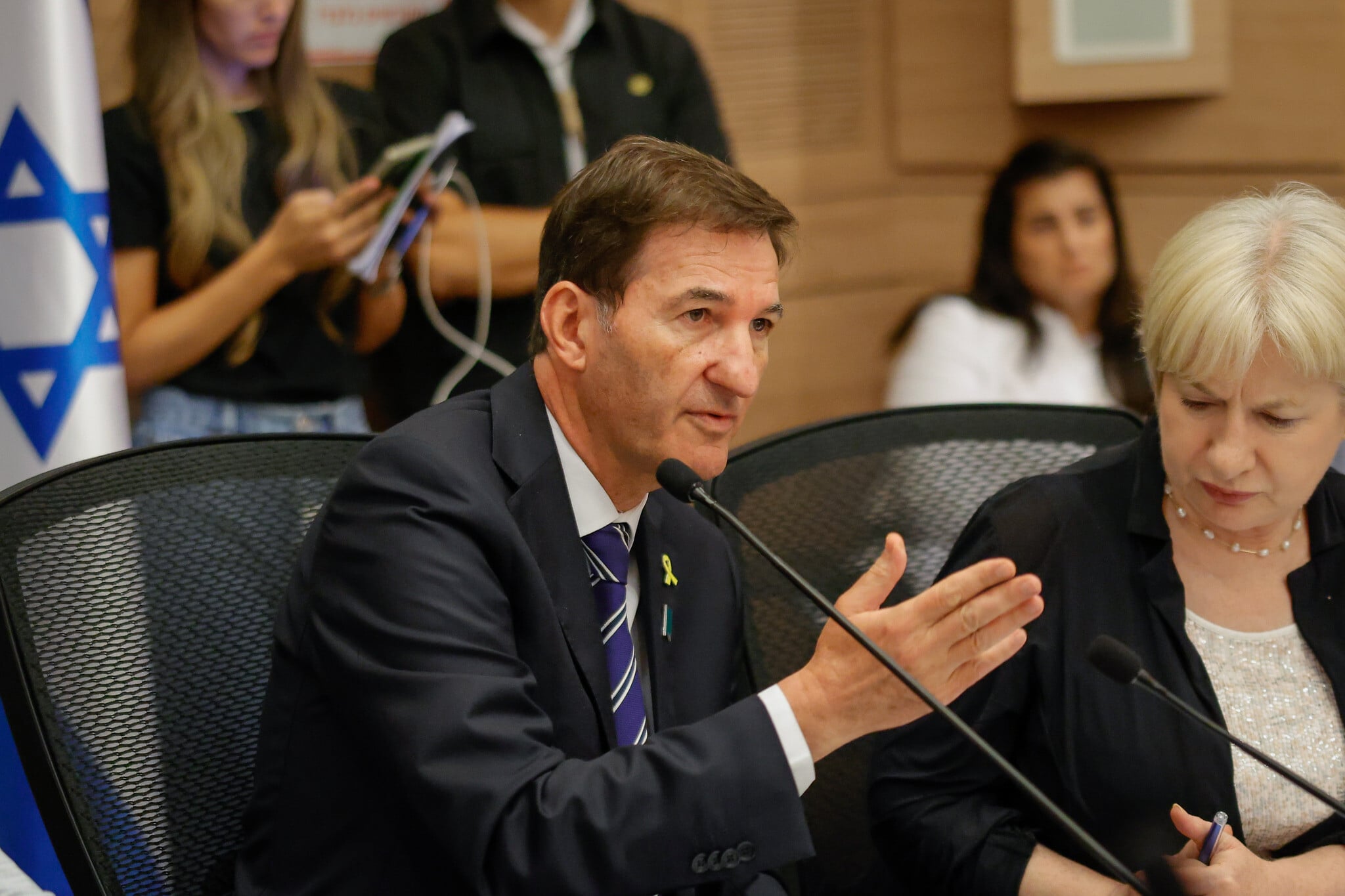
MK Boaz Bismuth chairs a meeting of the Knesset Foreign Affairs and Defense Committee, September 3, 2025. (Noam Moskowitz, Office of the Knesset Spokesperson)
Knesset Foreign Affairs and Defense Committee chairman Boaz Bismuth announces that he has submitted a document outlining the principles of a potential ultra-Orthodox draft bill to the committee’s legal advisor.
The Likud lawmaker’s office says that “based on the document, a draft law will be formulated in the coming days that will guide the committee in the continuation of the legislative process to regulate the issue of conscription.”
In a statement, Bismuth thanks Prime Minister Benjamin Netanyahu and the defense establishment — as well as former Shas MK Ariel Attias, who represented the Haredi parties in negotiations over the controversial bill.
“We are moving forward to approve a historic law, a necessary and inevitable step for Israel’s security and future,” Bismuth says.
According to the Kan public broadcaster, the document stipulates that within five years, 50 percent of the annual Haredi draft cohort will be conscripted, and the age of exemption will remain 26. Yeshiva budgets will only be cut for failing to meet enlistment quotas after a year, and personal sanctions will only go into effect after two years if the overall enlistment goal is not met.
“The principles of the evasion law that the ultra-Orthodox activists drafted for MK Boaz Bismuth are intended to thwart the recruitment of the ultra-Orthodox and to legalize the return of Shas ministers to the government,” alleges Yisrael Beytenu chairman Avigdor Liberman.
EU diplomat says US role in Gaza security force still unclear, delaying mission
The American role in the emerging International Security Force for Gaza remains ill-defined, which is keeping the mission from being finalized, a European diplomat tells The Times of Israel.
“The intention of the US is not completely clear,” says the official. ” It’s not yet clear if it’s just to set up a C2 [command and control] structure and that’s it, or if they’re going to also participate in the force itself on the ground.”
“A lot depends on what the US will do, because there are some other nations who said they would be interested to participate, but we will ask first to have a guarantee that the US also are involved in the forces itself,” says the diplomat.
“That is the case for some of the Arab countries,” the official says.
The mandate of the force also remains in the air. “Would it be safeguarding order? Would it be, rather, a mission of training Palestinian forces? And in this case, where and how many? There are a lot of things that remain blurred for now.”
The diplomat says there should be clarity “in the coming days.”
Discussions are taking place right now between governments, but representatives may gather in Egypt next week.
Israel has shared intel on location of hostage bodies in Gaza with mediating countries, official says
Israel has shared the intelligence it has on the location of hostage bodies in Gaza with the mediating countries, an Israeli official says.
“In coordination with the United States and the mediators,” says the official, “Israel is exerting pressure to complete the stage of returning all the bodies held by Hamas.”
The bodies of 19 hostages have yet to be returned to Israel.
Police say officer fired at suspicious vehicle near Egyptian Embassy in Tel Aviv; driver fled the scene
Police say one of their officers opened fire at a suspicious vehicle that approached the Egyptian embassy in Tel Aviv earlier today.
Searches are underway for the driver who fled the scene, Hebrew outlets report.
Law enforcement located the vehicle and is currently inspecting it. No injuries have been reported in the incident.
IDF says it struck underground Hezbollah weapons storage sites in southern, eastern Lebanon
The Israeli Air Force struck underground Hezbollah facilities used by the terror group to store weapons in southern Lebanon and in the eastern Beqaa Valley a short while ago, the military says.
“The Hezbollah terror organization continues in its efforts to reestablish terrorist infrastructure across Lebanon, which is a blatant violation of the agreements between Lebanon and Israel,” the IDF adds.
????غارة اسرائيلية تستهدف شمسطار pic.twitter.com/A48MaoXadn
— bintjbeil.org (@bintjbeilnews) October 16, 2025
Turkish disaster relief experts said helping to locate bodies of hostages in Gaza
Turkey has sent 81 disaster relief experts to Gaza Strip, some of whom will help with finding the remains of 19 hostages still unaccounted for, a Turkish defense ministry source says.
“There is already a team of 81 AFAD staff there,” the source says, referring to Turkey’s disaster relief agency, indicating that “one team will be in charge of seeking and finding the bodies.”
Trump speaking with Putin ahead of Zelensky’s upcoming White House visit
US President Donald Trump says he is having a lengthy conversation with Russian counterpart Vladimir Putin, a day before Ukrainian President Volodymyr Zelensky plans to visit the White House to seek more support in the war with Russia.
Zelensky will meet Trump to push for more military support as Kyiv and Moscow escalate their war with massive attacks on energy systems, while NATO struggles to respond to a spate of Russian air incursions.
Trump confirms he is speaking with Putin in a social media post during the discussion. “The conversation is ongoing, a lengthy one, and I will report the contents, as will President Putin, at its conclusion,” Trump writes on his Truth Social platform.
Ukraine is seeking US Tomahawk long-range missiles, which would put Moscow and other major Russian cities within range of missile fire from Ukraine.
Trump has said he could supply the weapons to Ukraine if Putin fails to come to the negotiating table.
Palestinian reports: 11-year-old boy shot dead by IDF troops near Hebron
Mohammad Bahjat Al-Hallaq, allegedly shot dead by IDF troops in the southern West Bank on October 16, 2025. (Wafa)
Palestinian media reports that an 11-year-old boy, identified as Mohammad Bahjat Al-Hallaq, was shot dead by the IDF a short while ago.
According to the reports, the incident occurred in the village of al-Rihiya, south of Hebron.
The IDF has not yet issued a response.
The official Palestinian Authority news site Wafa reports that troops opened fire on a group of children while they were playing soccer on a school playground and that a 4th grade boy was also struck in the pelvis. He was rushed to the hospital in critical condition.
Former captive Emily Damari reunites with newly-freed hostages Gali and Ziv Berman
Former hostage Emily Damari is reunited with her close friends, newly-freed hostages Gali and Ziv Berman, after more than two years apart from one another.
Damari and the Berman twins were abducted from their homes in Kibbutz Kfar Aza on October 7, 2023. Damari was released during a previous ceasefire and hostage release deal in January 2025, while the twins were freed just days ago, on Monday.
The three can be seen tightly embracing one another as they reunite at Sheba hospital, in a video aired by the Kan public broadcaster.
אמילי דמארי באיחוד מרגש עם שורדי השבי גלי וזיוי ברמן: "כמה הקלה ללב שלי. לנפש שלי. אין מילים שיכולות לתאר את מה שאני מרגישה"https://t.co/sqriSgk5i3@AnnaPines_ pic.twitter.com/qlfjvXSEgm
— כאן חדשות (@kann_news) October 16, 2025
Sa’ar claims Hamas is able to return bodies of additional hostages, is choosing not to
Foreign Minister Gideon Sa’ar says that Hamas could give back more slain hostages, contradicting assessments made by senior US officials.
In Rome with his Italian counterpart Antoni Tajani, Sa’ar stresses “that Israel knows full well that Hamas is capable of returning additional bodies and is choosing not to do so,” according to his office. Sa’ar calls it an “extremely serious matter.”
Hamas has returned the bodies of 9 of the 28 slain hostages it held at the beginning of the week.
Slain hostage Eitan Levy laid to rest in Bat Yam after body returned to Israel
Shahar Levy, son of Eitan Levy, whose body was returned to Israel from Gaza, eulogizes his father on October 16, 2025. (Omer Shusheim/Hostages and Missing Families Forum)
Shahar Levy eulogizes his father, Eitan Levy, whose body was returned to Israel by Hamas earlier this week.
Levy, a taxi driver from Bat Yam, was killed by terrorists as he drove a passenger to Kibbutz Be’eri early in the morning of October 7, 2023.
He is buried in his hometown of Bat Yam.
“Dad, I’ve learned what it means to live without a father,” says Levy. “What it means to wake up every day and be the man of the house. To take care of Mom, of Sani, of Chen — all of them broken and falling apart each day because they miss you so much. Riff and River, who’ve become little men themselves, keep searching for your presence all the time. And me… I’m broken too. As if someone shot me straight through the heart.”
He tells his father he is getting married in March, and that when he has children, he will name a son after him.
“Yes, we had our hard moments — the arguments between a father and son — but I know you forgive me, because I made mistakes, and I want you to know, up there among the angels, that I forgive you too — with a heart that’s broken, but whole,” says Levy.
“My father, my new life is a life alongside grief, alongside loss.
I’m learning to love, to laugh, to work — but always with a hole in my heart. The place that belongs to you,” he says.
Shift 101 stages sit-in at Dizengoff Square to demand return of hostage bodies
Members of Shift 101 gather on October 16, 2025, at Dizengoff Square in Tel Aviv, calling to bring home the bodies of the remaining hostages. (Ran Melamed/Shift 101)
Shift 101, the silent sit-in protest group, gathers at Dizengoff Square in Tel Aviv to demand the release of all 19 deceased hostages still being held by Hamas.
The protestors are joined by bereaved families, as well as by regular attendee Maccabit Meyer, the aunt of released hostages Ziv and Gali Berman; Lee Siegel, brother of released hostage Keith Siegel; and Shay Dickmann, cousin of murdered hostage Carmel Gat.
The white-clad members of Shift 101 usually gather outside national buildings and sites, but tonight congregate at the Dizengoff Square, which over the past two years has become an official memorial site for all those lost on October 7 and in the ensuing war, with photos, mementos, and keepsakes of the fallen propped on the large fountain in the center of the square.
Nearby, protesters are also gathering at Begin Gate outside the Defense Ministry to call for the release of the final hostages.
‘Hamas is killing hundreds’: Head of Khan Younis militia pleads for international community to protect Gazans against Hamas executions
Hossam al-Astal, a militia leader operating with Israeli support in the Khan Younis area of southern Gaza, demands that the world protect Gaza’s residents from Hamas’s terror, amid a wave of executions and killings carried out by the terror group.
In a video obtained by The Times of Israel, al-Astal thanks US President Trump for his efforts toward the ceasefire, but adds that after saving Gazans from Israeli bombardment, the president should now save them from Hamas.
Hossam al-Astal, a militia leader operating with Israeli support in the Khan Younis area of southern Gaza calls for the international community to protect Gazans from Hamas amid wave of executions, in a video published on October 16, 2025. (Courtesy)
“Hamas is killing hundreds of children, women, youths and elderly people. Under what charge? We came out of a military war into a war of terrorists,” he declares. “Today, Hamas is waging terror against the people in Gaza, killing with RPGs. Hamas is 100% ISIS,” he says, calling on the international community to protect Gaza’s residents from Hamas.
Adding “a message to the people in Gaza and to the whole world,” al-Astal says his militia is not “seeking to rule Gaza or gain influence.”
“We want to move the people from Hamas’s rule to civilian rule that will serve the residents. We want peace and we want to live. We are not fighting Hamas today in order to rule,” he insists.
In a conversation with The Times of Israel after the video was recorded, al-Astal stresses that his group is continuing to fight Hamas.
Israel believes Hamas has 10-plus hostages’ bodies it could return now, official says, as PM convenes advisers to discuss response to alleged breach of deal
Prime Minister Benjamin Netanyahu is set to meet with close advisers tonight to discuss possible responses to what Israel calls Hamas violations of the ceasefire agreement, as the terror group has yet to return 19 bodies of hostages to Israel.
The terror group has insisted that it handed over all it could locate for now.
But a senior Israeli official tells Channel 12 that Israel does not believe this is the case, and that in reality, “There is a double-digit number of hostages that it can return.”
Hamas has returned 9 of the 28 deceased hostages held in Gaza when the ceasefire went into effect on Friday.
Earlier, Foreign Minister Gideon Sa’ar said in Naples that “we know, as a matter of fact, they can easily bring back a significant number of dead hostages and give them back according to the agreement. What they are doing right now – it’s a fundamental breach of the agreement.”
Israel gave precise coordinates of locations where it believes hostages are buried to Egypt, Qatar, and Turkey, according to Channel 12.
Security officials are suggesting that until more bodies are returned, Israel should prevent materials for rebuilding Gaza from entering the Strip, or delay the opening of Rafah Crossing for people, Channel 12 reports.
Egypt has delivered a stern message to Hamas that it must meet its obligations under the ceasefire deal, says the outlet, but is also urging Israel not to apply additional pressure on Hamas yet.
IDF confirms killing Houthi military chief in August strike on Yemeni capital
The IDF confirms in a statement that it killed Houthi military chief of staff Muhammad al-Ghamari in an airstrike in Yemen in August.
The August 28 strike in Sanaa had also killed the Houthi prime minister and around a dozen other top officials in the Iran-backed terror group.
Earlier, the Houthis confirmed al-Ghamari’s death in a statement, without providing any further details.
The IDF says al-Ghamari had served as Houthi chief of staff since 2016, after several other senior roles. Over the years, he played “a key role in building the military capabilities” of the Houthis, the military says.
Al-Ghamari had received training by operatives from Lebanon’s Hezbollah and Iran’s Islamic Revolutionary Guard Corps, in Syria, Lebanon, and Iran, according to the IDF.
During the war, the military says al-Ghamari was involved in planning and carrying out ballistic missile, drone, and cruise missile attacks against Israel and commercial ships sailing in the Red Sea.
Trump: If Hamas doesn’t stop killing Gazans, ‘we will have no choice but to go in and kill them’

US President Donald Trump speaks during an event in the Oval Office at the White House, October 15, 2025, in Washington. (AP Photo/John McDonnell)
US President Donald Trump warns, “If Hamas continues to kill people in Gaza, which was not the deal, we will have no choice but to go in and kill them.”
The Truth Social message caps off a 48-hour reversal of Trump’s position on Hamas’s summary execution of several dozen Palestinians from rival gangs and Gazans it has accused of collaborating with Israel.
Trump claimed on Tuesday that he had given Hamas “approval for a period of time” to carry out the killings, asserting that Hamas was targeting some “very bad gangs.” By Wednesday, though, the commander of US forces in the Middle East called on Hamas to immediately stop attacks on “innocent Palestinian civilians.”
Hours later, Trump told CNN he was doing “more research on it… It could be gangs plus.”
While Trump spoke in “we” terms when talking about who would carry out his threat against Hamas, he has in the past clarified that he is referring to Israel regarding such retribution and that US troops will not be needed in Gaza.
Contradicting Israel, White House says it will take time for Hamas to locate remaining bodies of hostages
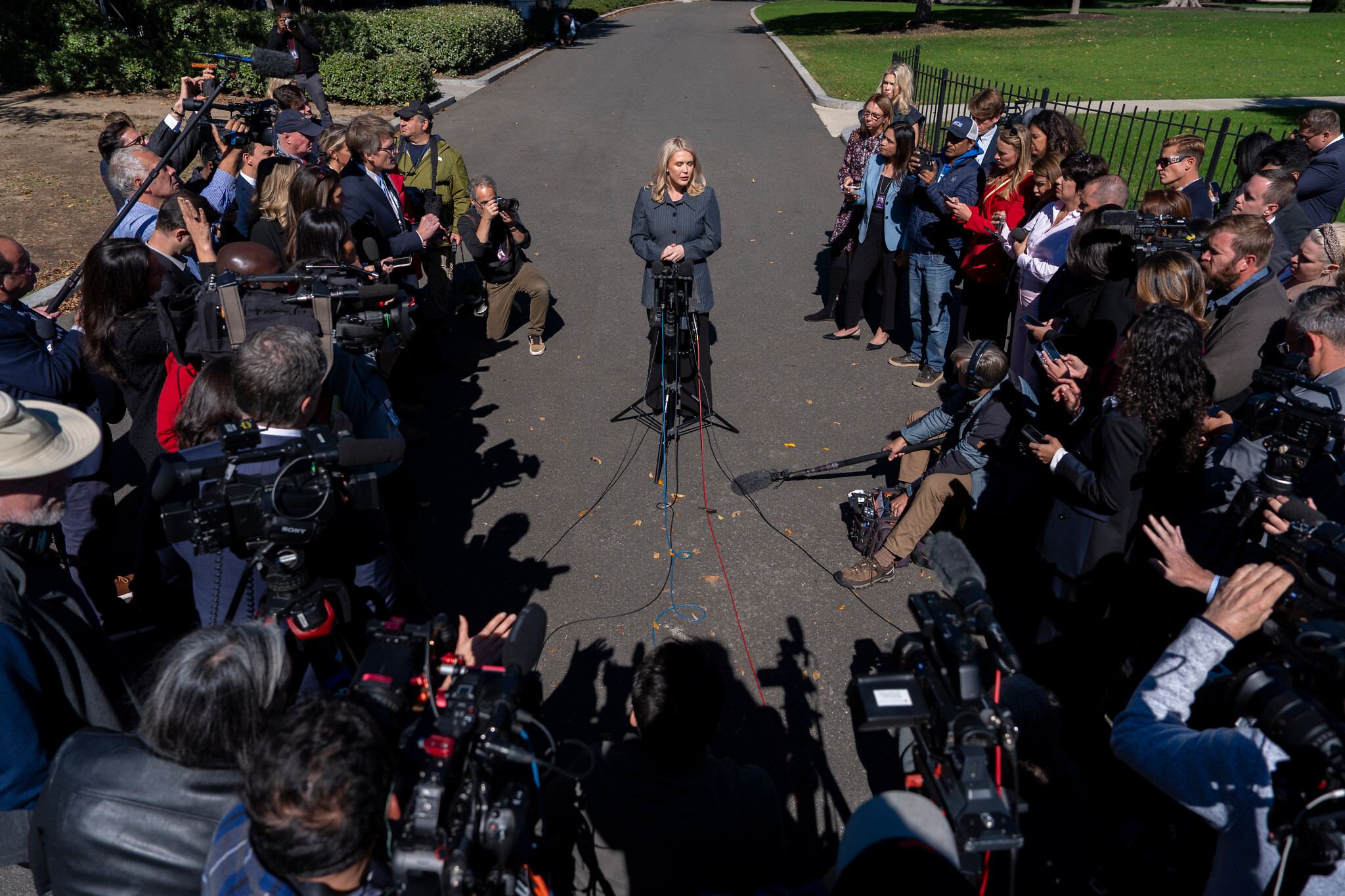
White House press secretary Karoline Leavitt speaks with reporters at the White House, October 16, 2025, in Washington. (AP Photo/Alex Brandon)
White House press secretary Karoline Leavitt says, “It’s going to take some time and some special equipment” to retrieve the remaining 19 bodies of deceased hostages from Gaza to Israel.
The comment to reporters outside the White House appears to be the first time that the Trump administration has gone on the record to clarify that the body retrieval process won’t be immediate after a pair of top advisers to US President Donald Trump held a briefing yesterday on condition of anonymity during which they asserted that Hamas is not in violation of the ceasefire deal and that the terror group is doing all it can to retrieve the hostages’ bodies to date, given that many of them are buried deep under rubble.
Israel has pushed back on the notion and argues that Hamas is slow-walking the process and could produce at least a dozen or so more bodies than it has.
Leavitt declines to give a timeline for how long the US will give Hamas to retrieve the remaining bodies.
“The administration is fully committed to helping all sides get that done. It was part of the deal, and we’re going to see it through,” she says.
Report: Dermer told Witkoff, Kushner that Hamas violating deal by withholding bodies of hostages
Strategic Affairs Adviser Ron Dermer told top White House advisers Steve Witkoff and Jared Kushner yesterday that Hamas is violating the ceasefire agreement, according to Channel 12.
The Commander of US Central Command, Adm. Brad Cooper, was also on the call, per the report.
The US is publicly insisting that Hamas is in compliance with the deal and is simply unable at this time to hand over any more bodies of hostages.
Kushner responded that intelligence on the location of the hostages should be given to Hamas, and then it will be clear based on Hamas’s actions whether it is trying to recover all the slain hostages, according to the outlet.
The three officials spoke today by phone as well.
While Washington insists that all the remaining slain hostages must be returned, it wants to move to talks on the second phase of the ceasefire deal before everybody is returned.
The Trump administration wants to start rebuilding Rafah as an example for what Gaza can become if the deal is completed and Hamas is disarmed, reports the outlet.
IDF: Palestinian shot dead after hurling explosive at Israeli troops in Qabatiya, in the West Bank
A Palestinian who hurled an explosive device at Israeli soldiers during operations in the northern West Bank city of Qabatiya this evening was shot dead, the military says.
The IDF says the forces of the Paratroopers Brigade’s reconnaissance unit were not hurt by the bomb.
‘Don’t kill me, I’m your human shield:’ Ex-hostage Yosef-Haim Ohana repeatedly convinced captors not to shoot him

Yosef-Haim Ohana arrives at a hospital following his release from two years of captivity in Gaza, October 13, 2025. (Shauli Landner/Government Press Office)
Ex-hostage Yosef-Haim Ohana had to persuade his captors not to kill him multiple times, Channel 12 reports, publishing new details from his captivity as shared by his parents.
“I had to convince my captors through logical reasoning why it was not worth it for them to kill me,” he shared with his family after his return on Monday. “I found myself seconds from having a bullet in my head multiple times.”
According to his father, Rabbi Avi Ohana, his son learned Arabic while he was in Gaza, and he would tell his captors that he was more valuable to them alive.
“Wait a second — before you shoot, what will you get out of it?” Yosef-Haim would ask them, the rabbi explains in an interview with Channel 12. “The State of Israel will give you a lot for me [alive]; you will get a lot; I am your human shield.”
At times, one of the terrorists holding Ohana captive would respond that while he may have been right, killing him would give him “more satisfaction.”
Ohana, 25, was taken captive at the Nova festival on October 7, 2023.
While in captivity, he managed to hide from his captors that he was a commander in the IDF’s Givati Brigade, Channel 12 says, by telling them that he’d had to persuade the army to recruit him, and that he was assigned to a very junior position before being booted shortly after.
He also shared with his family that he experienced severe physical and psychological abuse.
Channel 12 poll: Likud would be largest party if elections held today, though Netanyahu bloc wouldn’t have ruling majority
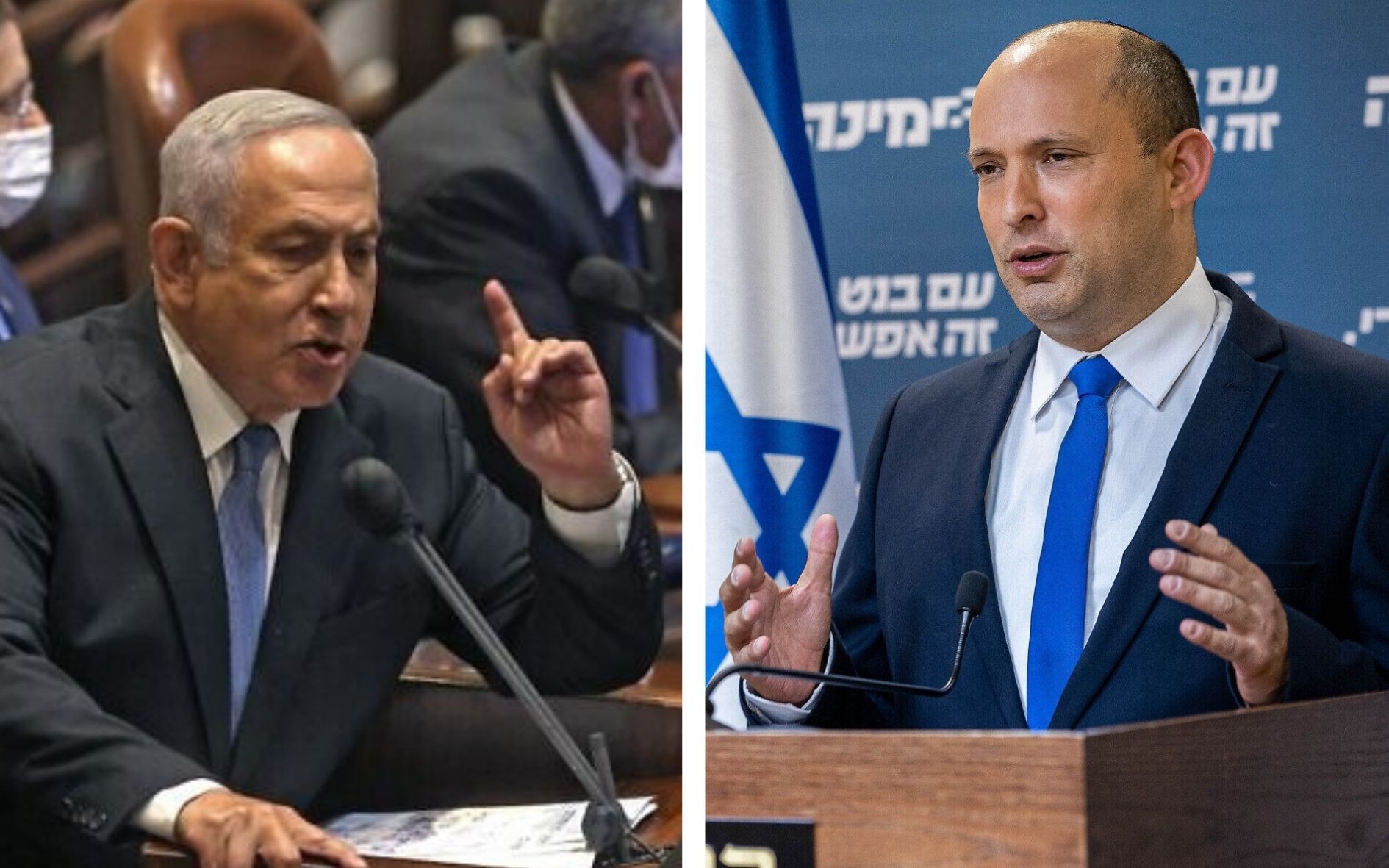
Likud leader Benjamin Netanyahu (left) and then-prime minister Naftali Bennett. (Menahem Kahana/AFP; Yonatan Sindel/ Flash90)
A Channel 12 poll finds that Prime Minister Benjamin Netanyahu’s Likud party would receive 27 seats if elections were held today, and would once again be the largest party in the 120-seat Knesset.
The poll indicates that Netanyahu is enjoying increased support in the wake of the ceasefire and hostage release deal in Gaza, as in the previous Channel 12 survey last month, Likud was polling at 24 seats.
Former prime minister Naftali Bennett’s party, Bennett 2026, — seen as Likud’s main rival in the next election — trails in second place, with 22 seats, according to the poll. This, too, is an increase of three seats compared to the previous survey conducted by the network.
Despite Likud’s lead, the poll finds that the parties that make up the current coalition would be trailing behind the anti-Netanyahu Zionist bloc led by Bennett, although both blocs would be short of the 60-seat majority required to form a government.
According to Channel 12, Netanyahu’s bloc, comprised of Likud (27), Shas (9), Otzma Yehudit (8), and United Torah Judaism (7), would be nine seats short of a majority, with 51 seats.
Meanwhile, it finds that Bennett’s bloc, comprised of Bennett 2026 (22), The Democrats (11), Yesh Atid (9), Yisrael Beytenu (9), and Gadi Eisenkot’s Yashar (8), would fall just one seat short of 60, with 59 mandates.
Bezalel Smotrich’s Religious Zionism and Benny Gantz’s Blue and White would fall below the threshold, as would Yoaz Hendel’s HaMiluimnikim (The Reservists), and the Palestinian nationalist party Balad.
As such, Channel 12 finds that any bloc wishing to form a government would need to rely on the Islamist Ra’am party or Arab-majority Hadash-Ta’al to do so.
Both parties would receive five seats.
Bennett’s short-lived “change government” counted Ra’am, led by Mansour Abbas, among its numbers, but it is not clear if he or his allies would be willing to work with the party again in the future.
The poll also finds that 46% of the public believes Israel must hold elections as soon as possible, while 44% say it is best to wait until October 2026, when the government’s term ends.
Separately, Channel 12’s pollsters ask the public whether they believe Israel should establish a state commission of inquiry into the failures surrounding the October 7, 2023, onslaught, and who, in their opinion, won the war.
Fifty-seven percent of respondents say that Israel must establish a state commission of inquiry, while 27% believe a government probe will suffice, and 16% said they don’t know.
Lastly, 48% of respondents believe that neither Israel nor Hamas won the war. Another 36% respond that Israel won, while 9% say Hamas did and another 7% say they don’t know.
IDF says it carried out strikes against Hezbollah sites in southern Lebanon village
The IDF says it carried out airstrikes against several Hezbollah sites near the southern Lebanon village of Mazraat Sinay, which were being used by the terror group to restore its capabilities.
Among the targets was a quarry where Hezbollah produced concrete to rebuild its facilities that were destroyed during the fighting last year, according to the IDF.
Additionally, the military says it hit a site used by an environmental group known as “Green Without Borders,” which the IDF has previously exposed as a Hezbollah front for conducting clandestine activities along the Israel-Lebanon border.
“The site had been used to conceal terror activity for the purpose of restoring Hezbollah’s infrastructure in southern Lebanon under a civilian guise,” the army says.
England’s Aston Villa bars Maccabi Tel Aviv fans from attending match next month due to safety concerns
The English soccer club Aston Villa announces that the club has been advised that no Maccabi Tel Aviv fans will be allowed to attend next month’s Europa League meeting between the two sides over “public safety concerns.”
In a statement, Villa says it has “been informed that no away fans may attend the UEFA Europa League match with Maccabi Tel Aviv on Thursday, November 6, following an instruction from the Safety Advisory Group (SAG).”
The SAG is the body responsible for issuing safety certificates for every match at Villa Park.
The statement adds: “The SAG have formally written to the club and UEFA to advise no away fans will be permitted to attend Villa Park for this fixture.
“West Midlands Police have advised the SAG that they have public safety concerns outside the stadium bowl and the ability to deal with any potential protests on the night.”
Villa says they are in “continuous dialogue” with the Israeli club and the local authorities, “with the safety of supporters attending the match and the safety of local residents at the forefront of any decision.”
Local police said earlier that they had classified the fixture as “high risk” following a “thorough assessment.”
“This decision is based on current intelligence and previous incidents, including violent clashes and hate crime offenses that occurred during the 2024 Uefa Europa League match between Ajax and Maccabi Tel Aviv in Amsterdam,” a spokesperson for the force says.
Last November’s match between Dutch side Ajax and Maccabi Tel Aviv saw supporters of the Israeli team being assaulted in Amsterdam in hit-and-run attacks.
PM, Trump said to speak amid disagreements over approach to Hamas failing to hand over all hostage bodies
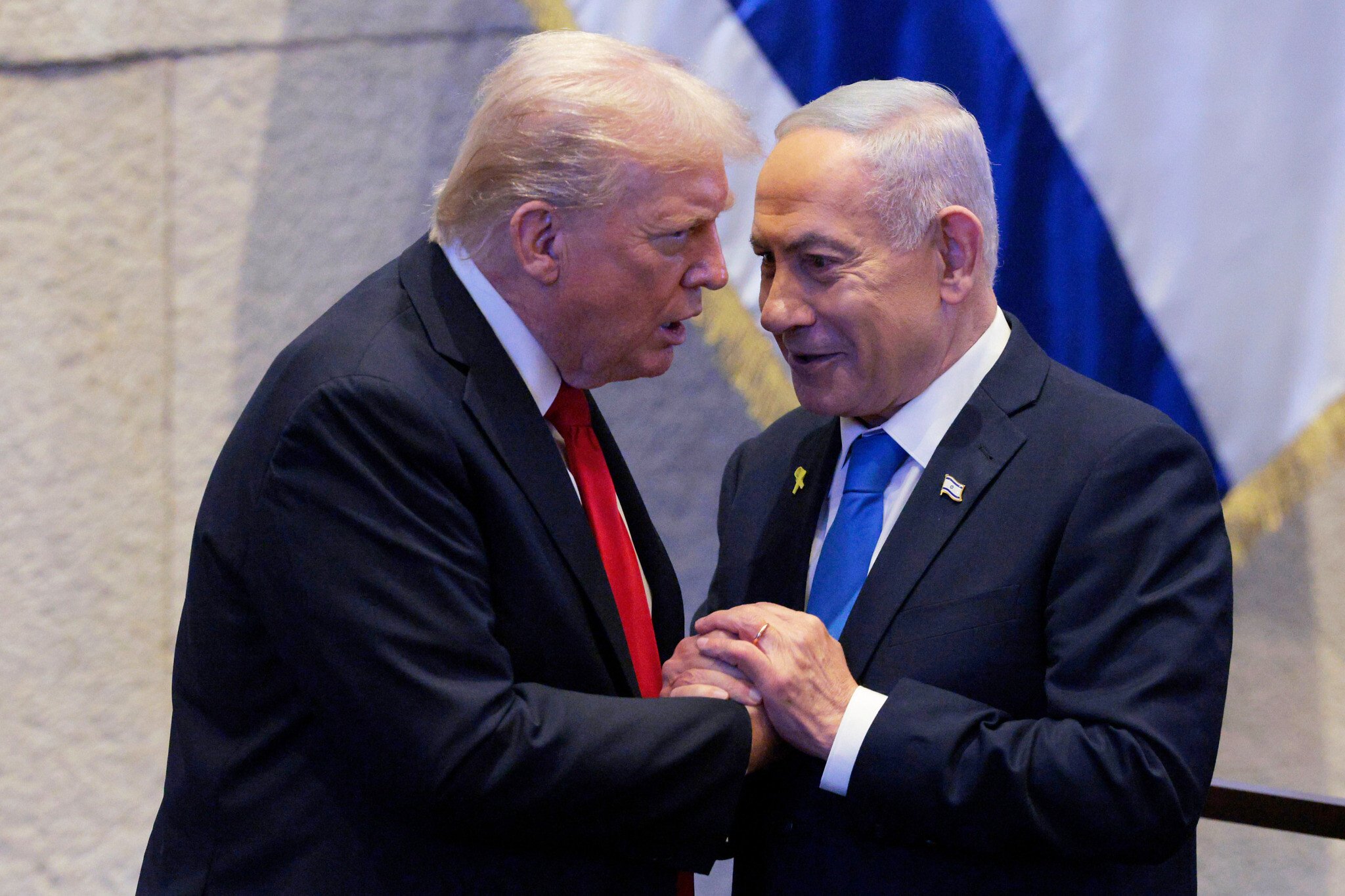
US President Donald Trump (left) speaks with Prime Minister Benjamin Netanyahu in the Knesset, October 13, 2025. (Chip Somodevilla/ Pool via AP)
Amid disagreement over their approach to Hamas failing to hand over most of the 28 bodies of slain hostages it held at the time of the ceasefire, Prime Minister Benjamin Netanyahu speaks by phone with US President Donald Trump, according to multiple Hebrew-language media reports.
Netanyahu updates Trump on the steps Israel plans to take in response to Hamas transferring only 9 bodies thus far, Israel Hayom reports.
Trump expresses his support for the Israeli decision, according to the outlet.
Lebanon says six wounded in strikes Israel said targeted Hezbollah facilities
Lebanon’s health ministry says that Israeli strikes in the south had wounded six people, after Israel said it had targeted facilities belonging to Hezbollah.
Lebanese President Joseph Aoun, however, insists Israel’s strikes targeted “civilian facilities,” and condemns what he says is a breach of a ceasefire negotiated last year.
“The repeated Israeli aggression comes as part of a systematic policy aimed at destroying productive infrastructure, hindering economic recovery, and undermining national stability under false security pretexts,” Aoun charges.
According to an initial toll from the Lebanese health ministry, the strikes earlier injured one person in Bnaafoul, in the Saida district, and wounded five in Ansar, in the Nabatieh district.
The IDF said earlier that it had targeted several Hezbollah facilities, as well as a site used by an environmental group known as “Green Without Borders,” which the IDF has previously exposed as a Hezbollah front for conducting clandestine activities along the Israel-Lebanon border.
Emanuel Fabian contributed to this report.
Government hostage envoy tells families that Israel will increase pressure on Hamas to hand over remaining bodies
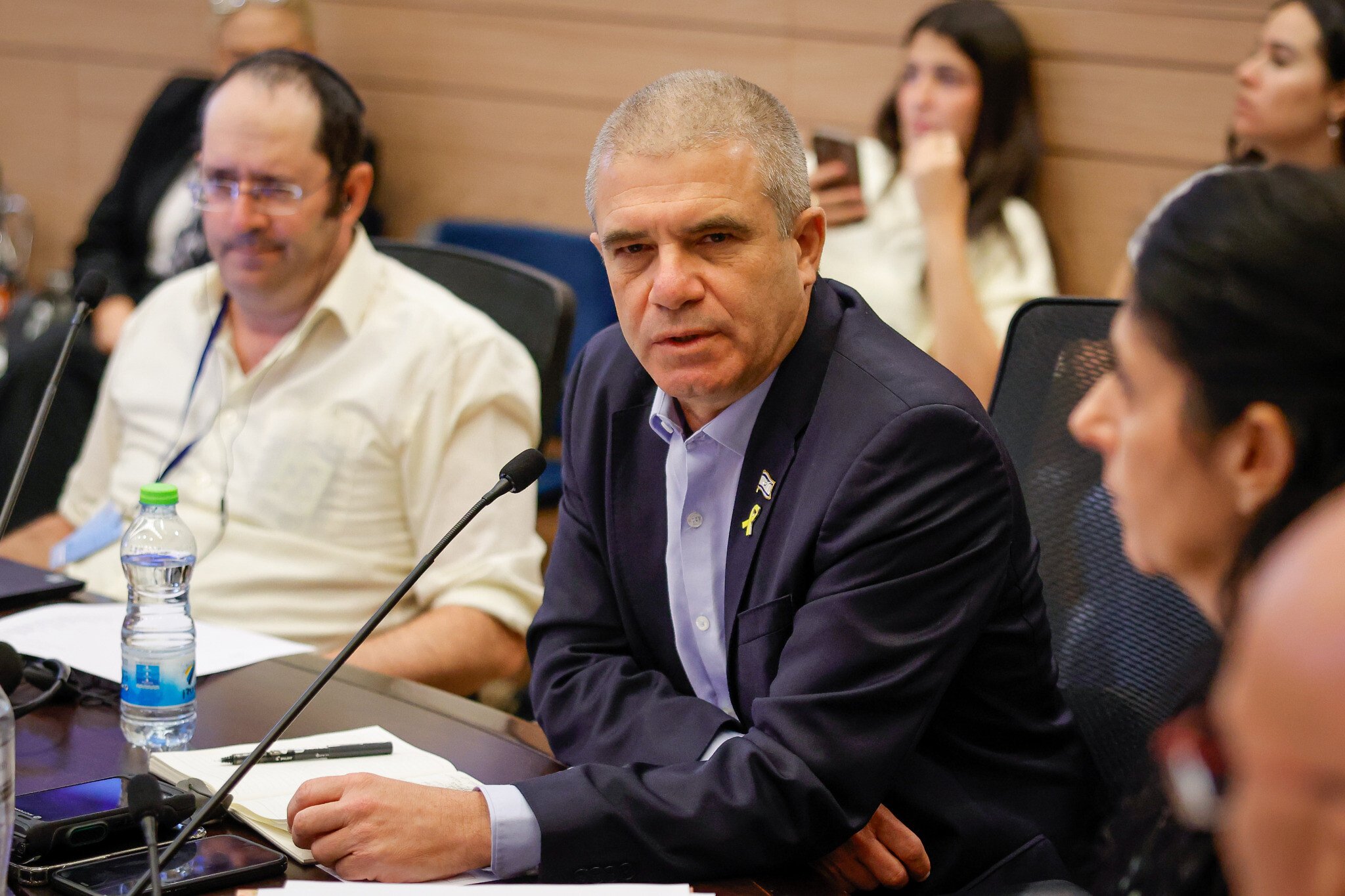
Prime Minister Benjamin Netanyahu’s hostage point man Gal Hirsch attends a meeting of the Knesset National Security Committee, September 28, 2025. (Noam Moskowitz, Office of the Knesset Spokesperson)
The government’s point man on the hostages, Gal Hirsch, has told the families of the remaining deceased hostages that Hamas is set to face increased pressure to hand over the remaining bodies.
He told the families that he would not elaborate on the matter at this stage.
Earlier this evening, Prime Minister Benjamin Netanyahu met with close advisers to discuss potential steps that Israel could take to pressure Hamas to hand over the remaining 19 bodies.
Trump clarifies US won’t ‘go in and kill’ Hamas operatives in Gaza as suggested earlier, but may back others to do so
US President Donald Trump clarifies that the US is not planning to directly intervene in Gaza, after he said earlier that “if Hamas continues to kill people in Gaza… we will have no choice but to go in and kill them.”
In response to a question from a reporter, Trump says that although “somebody will go in” to Gaza, “it’s not going to be us.”
“We won’t have to” enter Gaza, says the US president. “There are people very nearby that will go in, they’ll do the trick very easily, but under our auspices.”
John Bolton, Trump’s ex-national security advisor, charged with transmission, retention of national defense intel
John Bolton, Donald Trump’s former national security advisor, has been indicted, a person familiar with the matter says, marking the third time in recent weeks that the Justice Department has secured criminal charges against one of the Republican president’s critics.
He has been charged with transmission and retention of national defense information, court records show.
The indictment comes after court documents made public last month revealed that Bolton was under federal investigation for potential mishandling of classified information. The CNN report did not say what Bolton had been charged with.
A lawyer for Bolton has previously denied that Bolton engaged in wrongdoing.


read more: