The Associated Press has conducted an in-depth review of its operations in Nazi Germany, concluding that the news agency acted as “forthrightly and independently as possible.” But the review also found AP handled some situations inadequately.
The review was undertaken after an article published last year contended that the AP allowed Nazi propagandists to exert some influence over its news photo report in the 1930s by maintaining a photo subsidiary in Germany, registered under a restrictive Nazi press law.
The author, historian Harriet Scharnberg, also identified AP German photographers who were drafted into or joined Nazi military propaganda units during World War II, some while still being paid by AP.
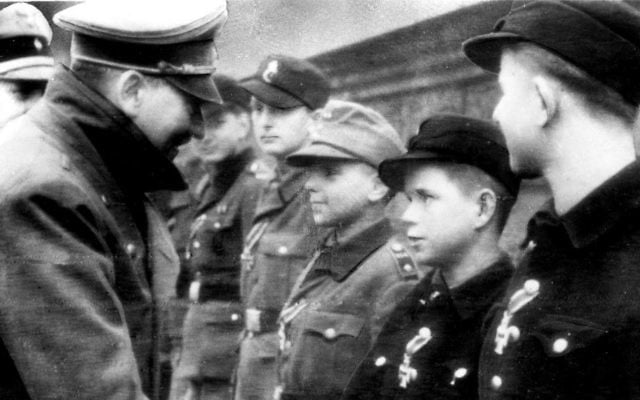
Adolf Hitler, left, shakes hands with 12-year-old Alfred Czech, a Hitler Youth soldier, after the young veteran of battles in Pomerania and Upper and Lower Silesia was awarded the Iron Cross at Hitler’s headquarters in Germany on March 19, 1945, according to the German caption that accompanied the photo, taken by a Nazi photographer. The image is the last photo AP has of Hitler before his suicide a few weeks later. The photo was distributed by Buro Laux, a German Foreign Ministry conduit for photos, and transmitted to The Associated Press via the photo agency Pressens Bild in neutral Sweden. (Buro Laux/Pressens Bild via AP)
AP’s review disputes Scharnberg’s conclusion that the news agency was in any way complicit with the Nazi regime during the years 1933-41, when the agency was present in the country. The AP was kicked out of Germany when the United States entered World War II in December 1941.
“We recognize that AP should have done some things differently during this period, for example protesting when AP photos were exploited by the Nazis for propaganda within Germany and refusing to employ German photographers with active political affiliations and loyalties,” the report says.
“However, suggestions that AP at any point sought to help the Nazis or their heinous cause are simply wrong,” it adds.
— AP
Help us report truthfully on social media
As a multimedia journalist, my job is to take the quality, fact-based journalism produced by The Times of Israel newsroom and make it accessible across every platform — from Instagram posts to podcasts to short-form videos.
This is how many, especially young people, consume news these days. But misinformation is rampant on social media. Our team at ToI produces accurate, responsible short-form reporting on Israel and the Jewish world.
If you believe in the importance of factual social media journalism, please consider joining our reader support group, The Times of Israel Community. Your financial support is essential to sustain responsible multimedia reporting.
We’re really pleased that you’ve read X Times of Israel articles in the past month.
That’s why we started the Times of Israel - to provide discerning readers like you with must-read coverage of Israel and the Jewish world.
So now we have a request. Unlike other news outlets, we haven’t put up a paywall. But as the journalism we do is costly, we invite readers for whom The Times of Israel has become important to help support our work by joining The Times of Israel Community.
For as little as $6 a month you can help support our quality journalism while enjoying The Times of Israel AD-FREE, as well as accessing exclusive content available only to Times of Israel Community members.
Thank you, David Horovitz, Founding Editor of The Times of Israel


 From the Liveblog of
Wednesday, May 10, 2017
From the Liveblog of
Wednesday, May 10, 2017
 Add ToI as a Preferred Source on Google