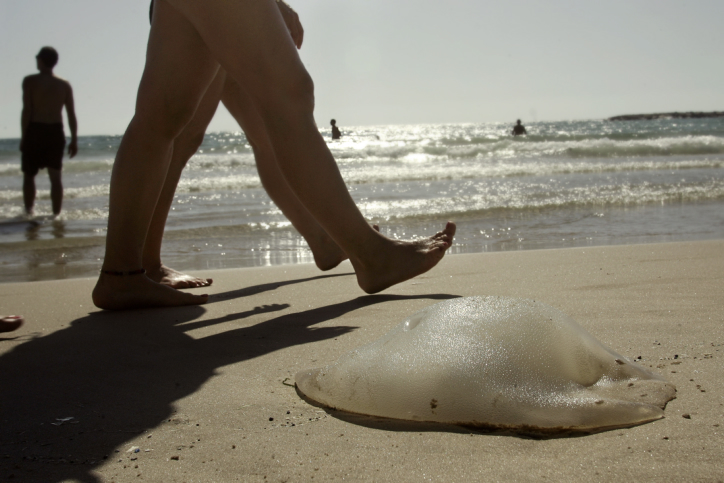
Swimmers wanting to avoid being stung by jellyfish may want to watch the sky as much as the sea after Israeli researchers found a link between their arrival and the phase of the moon.
An Israeli study finds that the lunar calendar is a key determinant of when jellyfish arrive on beaches.
In the middle of the lunar months — the days before and during the full moon — jellyfish are far more likely to swarm the beach, potentially stinging humans, according to the research conducted by the Israel Electric Corporation in conjunction with the University of Haifa in northern Israel.
A dead jellyfish on the beach. (Uri Lenz/ Flash90)
“We were surprised by our findings,” researcher Avi Algazi says. “We knew the moon has a big influence on a lot of things but we didn’t so far have statistical data on the correlation between jellyfish and the moon.”
The jellyfish are a threat to Israel’s power supply as they get sucked into the country’s main power station, which uses sea water for cooling.
The researchers looked at when the power station was most badly affected by the jellyfish and correlated it with the moon and water temperatures. In total, 94 percent of jellyfish swarms arrived after the middle of the year when the seas are warmer and during the second and third weeks of the lunar month.
— AFP
Help us report truthfully on social media
As a multimedia journalist, my job is to take the quality, fact-based journalism produced by The Times of Israel newsroom and make it accessible across every platform — from Instagram posts to podcasts to short-form videos.
This is how many, especially young people, consume news these days. But misinformation is rampant on social media. Our team at ToI produces accurate, responsible short-form reporting on Israel and the Jewish world.
If you believe in the importance of factual social media journalism, please consider joining our reader support group, The Times of Israel Community. Your financial support is essential to sustain responsible multimedia reporting.
We’re really pleased that you’ve read X Times of Israel articles in the past month.
That’s why we started the Times of Israel - to provide discerning readers like you with must-read coverage of Israel and the Jewish world.
So now we have a request. Unlike other news outlets, we haven’t put up a paywall. But as the journalism we do is costly, we invite readers for whom The Times of Israel has become important to help support our work by joining The Times of Israel Community.
For as little as $6 a month you can help support our quality journalism while enjoying The Times of Israel AD-FREE, as well as accessing exclusive content available only to Times of Israel Community members.
Thank you, David Horovitz, Founding Editor of The Times of Israel


 From the Liveblog of
Thursday, August 25, 2016
From the Liveblog of
Thursday, August 25, 2016
 Add ToI as a Preferred Source on Google