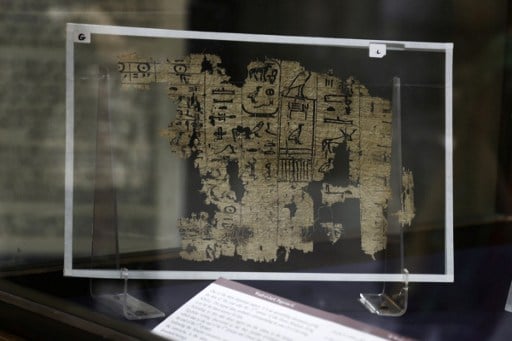
The Egyptian Museum in Cairo is showcasing for the first time the earliest writing from ancient Egypt found on papyrus, detailing work on the Great Pyramid of Giza, antiquities officials said Thursday.
The papyri were discovered near Wadi el-Jarf port, 25 kilometers (15 miles) south of the Gulf of Suez town of Zafarana, the antiquities ministry said.
The find by a French-Egyptian team unearths papers telling of the daily lives of port workers who transported huge limestone blocks to Cairo in the 26th century BCE during King Khufu’s rule to build the Great Pyramid, intended to be his burial structure.
One document was a “diary by government official Merer (the beloved) with statistics and administrative details” of his work, said Sayed Mahfouz, who co-led the 2013 discovery.
Merer led a team of around 40, according to the ministry.
Get The Times of Israel's Daily Edition
by email and never miss our top stories
By signing up, you agree to the
terms
The documents also list revenues transferred from various Egyptian provinces to feed pyramid builders and pay their wages, Mahfouz said.
Revenue was written in red, while what was paid to workers would be written in black, said Mahfouz.
“It gives for every day an account of the work of this crew transporting limestone blocks from the quarries of Turah on the east bank of the Nile to the Pyramid of Khufu at Giza plateau through the Nile and its canals,” the ministry said.
It said the papyri “indicate the highly efficient administrative system during Khufu’s reign.”
We can't do this work alone.

The war with Iran has been draining for all of us in Israel. But when I heard about a high casualty incident – ballistic missile impacts in Arad and Dimona that left nearly 200 people wounded – I drank a cup of coffee, packed a bag, and headed south.
There, I spoke with Shilgit, the head of an after-school program for underprivileged youth. Standing outside her destroyed center, Shilgit said it was a miracle that no children were hurt and spoke about the community coming together in the hours since.
As a Times of Israel reporter, I’m committed to telling stories of resilience like Shilgit’s. But my colleagues and I can't do this alone. If you value work like this, please consider joining our reader support group, The Times of Israel Community. Your financial support is essential to keep real human reporting like this going.
— Stav Levaton, military reporter
Yes, I'll join
Yes, I'll join
Already a member? Sign in to stop seeing this
You're a dedicated reader

We’re really pleased that you’ve read X Times of Israel articles in the past month.
That’s why we started the Times of Israel - to provide discerning readers like you with must-read coverage of Israel and the Jewish world.
So now we have a request. Unlike other news outlets, we haven’t put up a paywall. But as the journalism we do is costly, we invite readers for whom The Times of Israel has become important to help support our work by joining The Times of Israel Community.
For as little as $6 a month you can help support our quality journalism while enjoying The Times of Israel AD-FREE, as well as accessing exclusive content available only to Times of Israel Community members.
Thank you,
David Horovitz, Founding Editor of The Times of Israel
Join Our Community
Join Our Community
Already a member? Sign in to stop seeing this