

One year after Pittsburgh massacre, new JFNA head urges Jews to stand together
Six weeks into his job as CEO of Jewish Federations of North America, Eric Fingerhut’s to-do list includes anti-Semitism, bipartisan support of Israel and engaging youth
 Add ToI as a Preferred Source on Google
Reporter at The Times of Israel
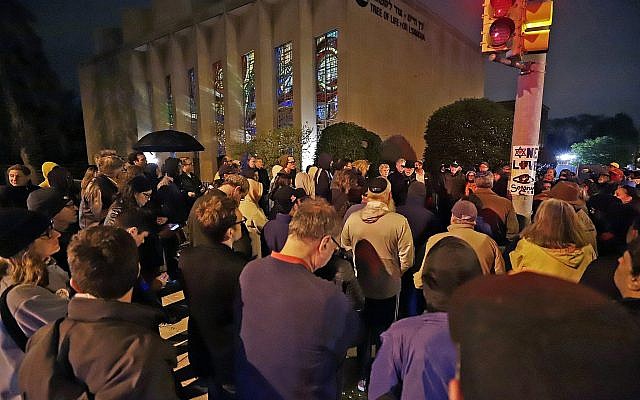
NEW YORK — Foremost on Eric Fingerhut’s mind this Sunday will be the names of the 11 people killed exactly one year ago in the worst act of anti-Semitism in US history.
“We feel very strongly that Jews around the world should stand in solidarity on Sunday and remember their names. We won’t let it be forgotten,” said Fingerhut, president and CEO of the Jewish Federations of North America (JFNA).
Just six weeks on the job Fingerhut finds himself in a reflective mood — for what the America Jewish community can do to honor the lives lost that day and for how to inspire American Jews going forward.
And if he ever feels overwhelmed in his new position as head of the JFNA, he can draw upon his experience serving in the Ohio state legislature, or perhaps his term representing Ohio’s 19th District in the 103rd US Congress.
“When you run for public office, you get a chance to be in diverse communities. You spend time with people of different backgrounds, different religions and different beliefs,” Fingerhut told The Times of Israel. “I have knowledge of how to work together to build consensus, to find common priorities.”
Fingerhut has already identified several of those priorities, including ramping up security at Jewish institutions, working to inspire a new generation of Jews, advocating for Israel as well as making sure Jewish communal life reflects the ever-changing demographics in the US.
It’s no small feat considering the size of the country’s Jewish population.
JFNA represents 147 Jewish federations and more than 300 network communities. It raises and distributes over $2 billion annually through planned giving and endowment programs. It supports social welfare, social services and educational needs, and is also involved in philanthropy, disability, foreign policy, homeland security and health care.
“It’s a staggering infrastructure. It makes me humble and makes me realize that such good fortune brings about tremendous responsibility,” Fingerhut said.
Fingerhut’s sense of responsibility has been ingrained in him since childhood. Hailing from Cleveland, Ohio, Fingerhut comes from modest means. His mother worked as a receptionist at the Federation-supported Jewish News for more than 30 years and his father sold insurance.
“I was the first generation in my family to go to college. My grandparents were part of the mass wave of immigrants to come here in the 1900s. These are things I’ll never forget. So for me to now be in a position of leadership brings a feeling of tremendous responsibility,” he said.
The Times of Israel recently had the opportunity to speak with the newly appointed Fingerhut via Skype. The following interview has been edited for brevity and clarity.
Before we talk about your vision for JFNA, can you speak about the campaign JFNA launched to remember victims of the Tree of Life Synagogue shooting in Pittsburgh, as October 27 marks one year since the attack?
It was the worst anti-Semitic attack in the history of the United States. We lost 11 precious souls that day. We feel very strongly that Jews around the world should stand in solidarity on Sunday and remember their names.
We are hoping everyone will [participate in our] Pause with Pittsburgh [initiative]. We tried to model it on Yom HaZikaron [Memorial Day] in Israel where the siren sounds and everyone stops what they’re doing to remember. People can go to our website, sign up and get alerts to see what’s going on. The idea is that everyone will stop what they’re doing at 5 p.m., the exact moment the Pittsburgh community will be coming together.
We won’t let it be forgotten, we can’t let it be forgotten.
The anniversary comes just after the American Jewish Committee released a survey that showed 9 out of 10 Americans see anti-Semitism in the US as a problem that is only getting worse.
Tragically, the poll was not an aberration. This is the reality now.
It’s true the Jewish community in the US is one of the most successful Diasporas in the history of the Jewish people. It has flourished, in large part, because of a lack of discrimination over the last 40 to 50 years. Jews in America haven’t experienced anti-Semitism like Jews in other countries.
However, there is an increase in anti-Semitism, attacks like Pittsburgh and Poway [California], and it is causing alarm.
The entire network of Federations will not wait for this to get worse. We will take very clear steps to address it. Not only in the realm of security, which is necessary, but also in getting people to participate in the civic life in our country. We have to take an active role.
Going back a bit, did your experience serving in government prepare you for your new position?
Absolutely. The United of States of America has always represented such a beacon of freedom and hope for me. I’ve always felt a part of American civic life.
In the legislature I learned you find the things you share in common with people and work on them. But you also cannot get anything done unless you are willing to work with people with whom you disagree. Those were skills I acquired that I can use now given the Jewish community is so broad and so diverse, with so many different viewpoints.
Speaking of bringing people together, more than one Democratic presidential candidate has said they support or would consider tying aid to Israel to its settlement policy. How will JFNA navigate the campaign season while maintaining its big tent approach?
We’ve always had folks in both political parties. No doubt people have strong opinions. I do think that a broad swath of the Jewish community strongly supports Israel and understands it is our ally in the Middle East. So we will make sure our alliance is strong.
I look at it this way — our grandparents’ generation helped create Israel; they were in the room when Golda Meir was barnstorming across America raising money. Our parents’ generation was raising emergency funds in 1967 and 1973 and all those other treacherous moments, like when the Iron Curtain fell or when the Ethiopian Jews got out. So what is our generation’s mission in this regard? I believe it is to build on those connections with Israel and strengthen them for the next generation. It’s in our DNA to do that.
Lastly, in your position at Hillel International you worked to inspire Jewish students to make a commitment to Jewish life and learning. How will you use your position as president and CEO of JFNA to inspire, especially in areas within the Jewish community that might feel marginalized, such as LGBTQ Jews and Jews of color?
I loved my time at Hillel and I loved working with college-age people. I found Hillel to be a bit of a canary in the coalmine regarding certain issues. For example, issues of diversity and inclusion get looked at in a much different way on campuses. Young people expect and demand a different level of inclusion, and they should. Our communal institutions must respond to these issues.
For a long time the American Jewish community looked mostly the same. The demographics are changing and we’re changing. No one pretends the work is done.


The Times of Israel Community.