

Poll: German far-rightists would win 10% if vote held today
‘Alternative for Germany’ riding on wave of anti-immigrant sentiment’; party head calls on Merkel to resign over refugee crsis
- See more Times of Israel on Google - add us as a Preferred Source
Sue Surkes is The Times of Israel's environment reporter
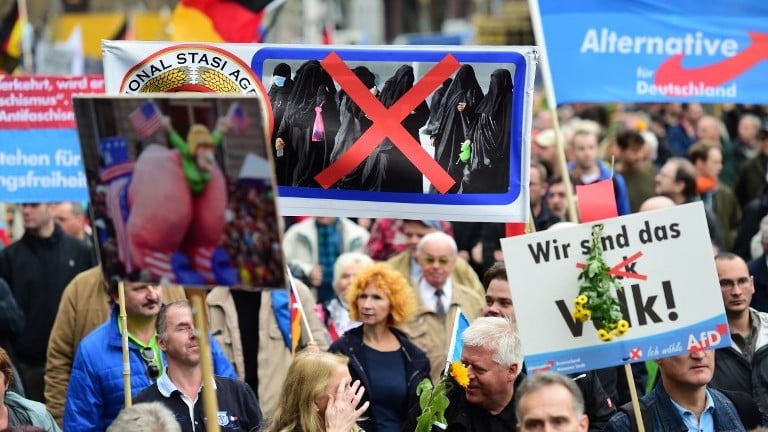
The far-right Alternative for Germany (AfD) party would cross the electoral threshold and become the third largest party in Germany, were national elections to be held now, according to a poll published this week.
With the support of 10.5% of those surveyed, the party — established only two years ago — would come in behind the ruling Christian Democratic Union (CDU)/Christian Social Union (CSU) alliance, at 34.5%, and the Social Democrats (SPD), at 23.5%. It would beat the Greens and The Left, which garnered 9.5% each.
The survey was carried out by a non-partisan organization, Wahlrecht (Right to Vote), which asks Germans every Sunday which party would win their support.
Back in 2013, Alternative for Germany narrowly failed to clear the 5% threshold in the German federal election. A year later, in 2014, it won 7.1% of the votes in the European election and seven out of 96 German seats. It currently has representatives in five German state parliaments.
Its rocketing success is attributed to rising opposition within Germany to Chancellor Angela Merkel’s open-door policy to refugees from war-torn countries such as Syria. The German paper Die Welt reported last week that 950,000 asylum seekers have entered Germany during 2015, a considerable increase on the official government figure of 800,000.
Wahlrecht’s surveys show the AfD’s support climbing upwards, from 8% a month ago and 6% a month before that. By contrast, the CDU/CSU alliance’s share of support has gone down from 38% two months ago.
A separate survey, carried out for the mass-circulation Bild newspaper, showed that 48% of those polled do not want Merkel to continue after the German elections in 2017, while 44% do.

The AfD was launched in 2013 as a center-right, middle-class party opposed to the Euro, foreign immigration and Turkish membership in the EU. But the party’s founder Bernd Lucke quit in July, after a more right-wing rival, Frauke Petry, beat him in a leadership vote.
At an AfD convention in Hanover on Sunday, Petry called on Merkel to resign over her handling of the refugee crisis.
Petry was swept into the leadership role in part through the support of a far-right faction with roots in east Germany. Earlier this year, leaders of this faction caused controversy by refusing to condemn an organization widely viewed as neo-Nazi.
In September of last year, the party ousted a member of its east Brandenburg branch, Jan-Ulrich Weiss, for his Facebook post suggesting that British Jewish banker Baron Jacob Rothschild controlled the world’s banks, financed wars, and controlled the media and the oil industry.
Opposition to immigration within Germany has turned violent on occasion. In October, German police discovered a far right-wing plot to bomb government shelters for asylum seekers in the Bavarian town of Bamberg.
Dissent can also be heard within Merkel’s government. Last Thursday, the interior minister, Thomas de Maiziere, departed from the Chancellor’s line by calling for an EU limit on refugees.
On Monday, apparently frustrated by the reluctance of some EU partners to accept refugees, Merkel led a coalition of nine EU member countries willing every year to take in hundreds of thousands of those fleeing via Turkey.
Merkel’s party is to meet next month to formulate a platform on the refugee issue, according to a report in the Yediot Ahronot newspaper Tuesday. The report says one clause to be discussed states that refugees wishing to stay in Germany will have to recognize Israel’s right to exist.









The Times of Israel Community.