

Rare 2,000-year-old jar valued by Jewish law on display for Knesset anniversary
The artifact is part of an archaeological exhibition aimed at highlighting the models of Jewish communal leadership from ancient times to the modern Israeli parliament
 Add ToI as a Preferred Source on Google
Rossella Tercatin is The Times of Israel's archaeology and religions reporter.
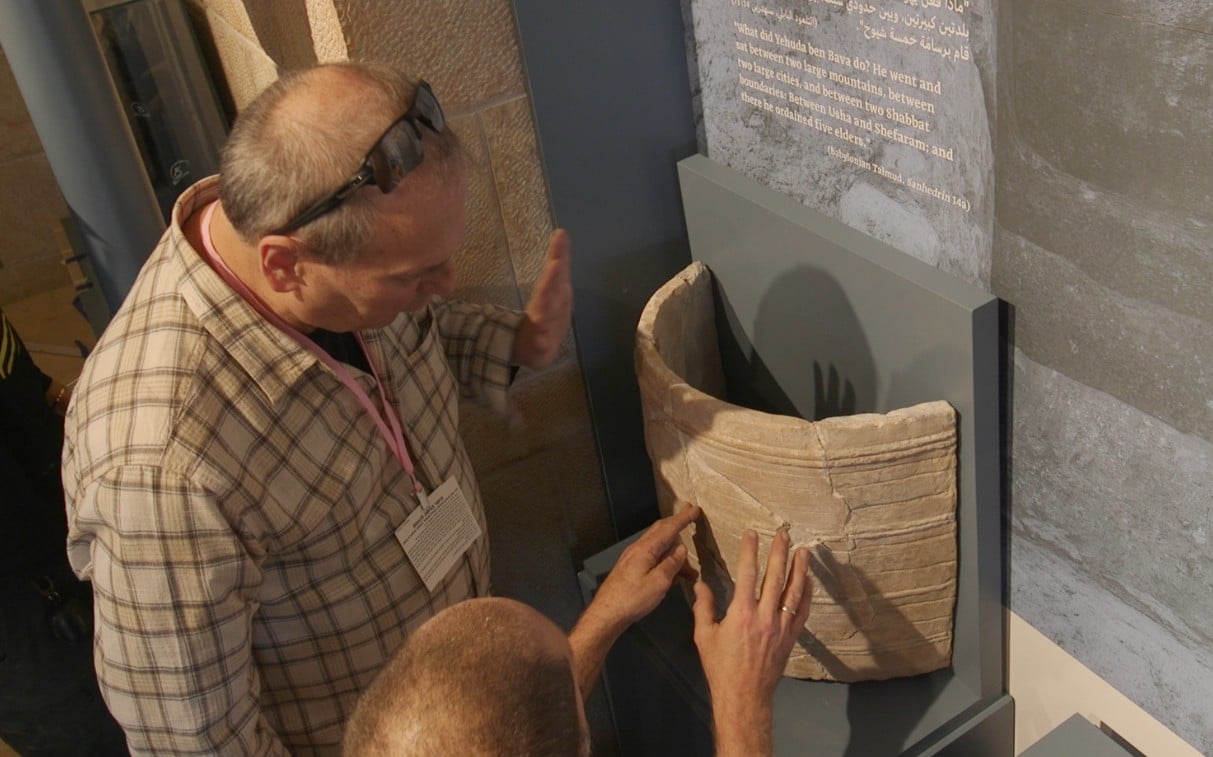
A rare 2,000-year-old stone vessel recently uncovered in the Galilee is on display for the first time as part of the exhibition, “From the Great Assembly to the Knesset” at the Knesset in Jerusalem to celebrate the building’s 60th anniversary, the Israel Antiquities Authority announced in a statement on Monday.
Experts have identified the barrel-shaped jar with an open mouth as a “kalal,” a type of vessel popular in the early Roman period, which is mentioned in Jewish sources. Jews at the time favored stone vessels over regular pottery, as they were not susceptible to receiving ritual impurity according to Jewish law.
The vessel — of an unusually large size, about 80 centimeters (about 31.5 inches) high and 50 centimeters (just over 19.5 inches) wide — was uncovered at the Pundaka de Lavi site in the Lower Galilee, in an excavation conducted by the IAA, in cooperation with the Keren Kayemeth LeIsrael–Jewish National Fund (KKL-JNF).
“This find reflects a high level of strict halachic adherence and a cohesive and well-defined Jewish lifestyle, and illuminates the character of the Galilee as an active and vibrant living space during the Mishnah and Talmud periods – the very region within which the leadership of the Jewish people also flourished and functioned,” Dr. Einat Ambar-Armon, director of the IAA Northern Region Community-Educational Center, said according to the statement, referring to the foundational texts of rabbinic Judaism.
The exhibit aims to explain the models of Jewish communal leadership from biblical times to the modern Knesset.
The Great Assembly, known in Hebrew as the Knesset HaGedola, was, according to Jewish tradition, a body of around 120 sages and prophets who operated after the people’s return to the land of Israel following the Babylonian Exile in the second half of the sixth century BCE.
Little is known about Jewish life in the subsequent centuries, but some essential developments, including the codification of the biblical canon, occurred during that period. The modern Knesset takes its name and number of members from its ancient precursor.
“The archaeological findings presented in the exhibition illuminate the activities of Jewish leadership institutions throughout the generations, and the continuous connection between Jewish history and the Knesset — the House of Representatives of the State of Israel,” the IAA exhibition curators Adi Ziv-Esudri, Alegre Savariego, Navit Popovich-Geller, and Deborah Ben-Ami said, according to the statement.
The artifacts on display include two fragments of an inscription (an original piece and a replica) discovered in Jerusalem about a century apart. The lower part, whose original can be found at the Louvre Museum in Paris, was unearthed by the French archaeologist Louis Félicien De Soucy south of the Temple Mount, and features the word “prison” or “imprisoned”; the higher part was uncovered in the 1960s by iconic Israeli archaeologist Benjamin Mazar and bears the last letters of the words “elders,” suggesting that the inscription referred to the legal powers of the members of the Sanhedrin, a judicial and legislative body that was active in the Second Temple Period (586 BCE to 70 CE).
The exhibition also features coins and pottery from the Galilee from the period following the destruction of the Second Temple at the hands of the Romans in 70 CE, and an 1,800-year-old basalt door decorated with a seven-branched menorah from Tiberias.









The Times of Israel Community.