

Trump suggests sunlight and disinfectant injections could cure coronavirus
Some scientists point to the spread of virus in warm countries to disprove the claim, while others warn of dangers of ingesting cleaning materials
 Add ToI as a Preferred Source on Google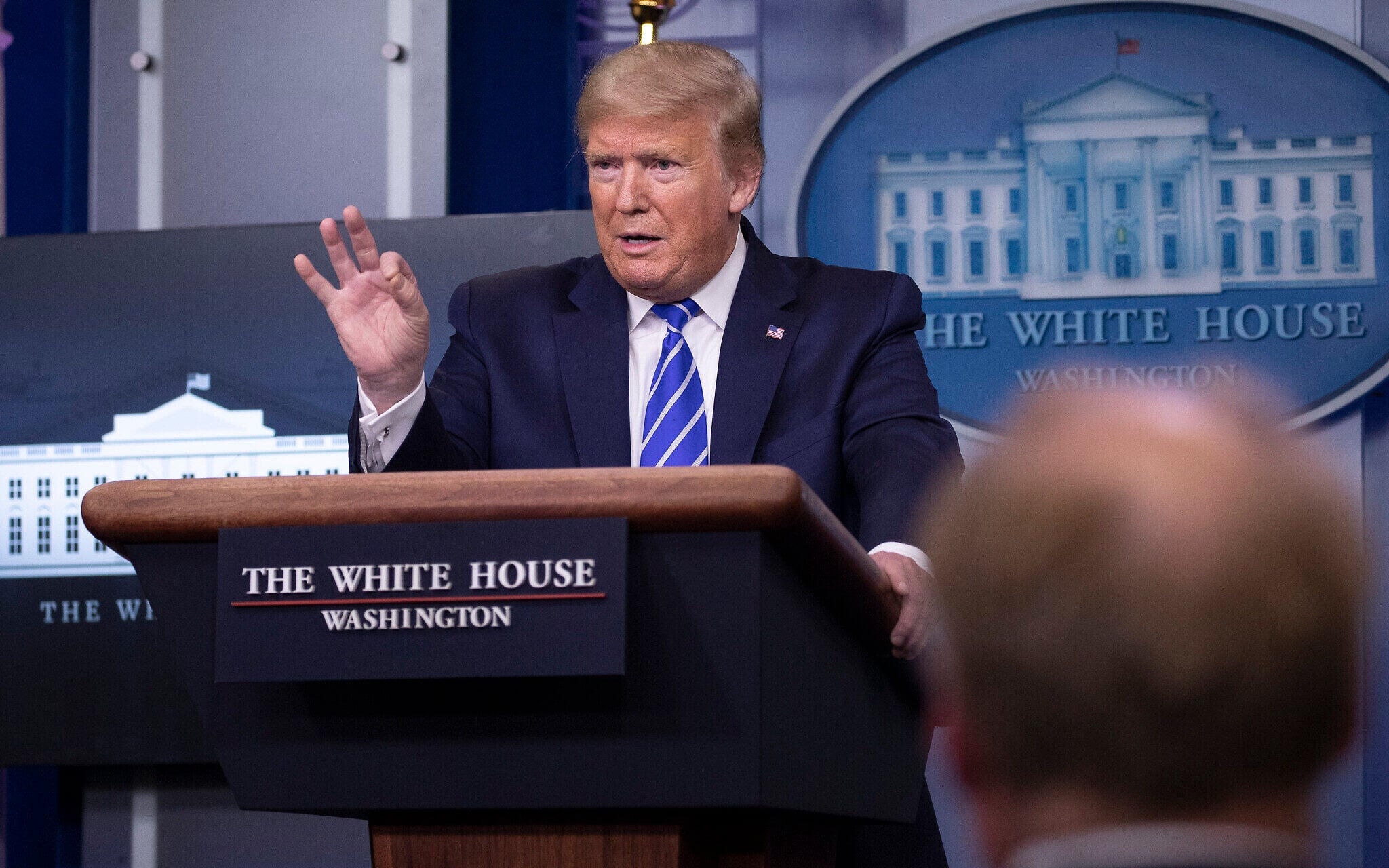
The White House is pitching “emerging” research on the benefits of sunlight and humidity in diminishing the threat of the coronavirus as US President Donald Trump encourages states to move to reopen their economies.
Past studies have not found good evidence that the warmer temperatures and higher humidity of spring and summer will help tamp down the spread of the virus.
But William Bryan of the Department of Homeland Security said at a White House briefing Thursday that there are “emerging results” from new research that suggest solar light has a powerful effect in killing the virus on surfaces and in the air. He said scientists have seen a similar effect from higher temperatures and humidity. A biocontainment lab in Maryland has been conducting testing on the virus since February, Bryan said.
“The virus is dying at a much more rapid pace just from exposure to higher temperatures and just from exposure to humidity,” Bryan said.

Bryan said having more knowledge about this could help governors when making decisions about how and when to open their state economies. However, he stressed that the emerging results of the light and heat studies do not replace social distancing recommendations.
Trump, who has consistently looked for hopeful news about containing the virus, was asked if it was dangerous to make people think they would be safe by going outside in the heat, considering that so many people have died in Florida.
“I hope people enjoy the sun. And if it has an impact, that’s great,” Trump replied, adding, “It’s just a suggestion from a brilliant lab by a very, very smart, perhaps brilliant man.”
“So supposing we hit the body with a tremendous — whether it’s ultraviolet or just a very powerful light — and I think you said that hasn’t been checked because of the testing,” Trump said, addressing Bryan, according to NBC News. “And then I said, supposing you brought the light inside the body, which you can do either through the skin or some other way, and I think you said you’re going to test that, too.”
“I’m here to present ideas, because we want ideas to get rid of this thing. And if heat is good, and if sunlight is good, that’s a great thing as far as I’m concerned,” the president said.
Trump noted that the researchers were also looking at the effects of disinfectants on the virus and wondered aloud if they could be injected into people.
“I see the disinfectant that knocks it out in a minute, one minute. And is there a way we can do something like that by injection inside or almost a cleaning? As you see, it gets in the lungs, it does a tremendous number on the lungs, so it would be interesting to check that,” Trump said.
Bryan said there was no consideration of that.
Food and Drug Administration chief Dr. Stephen Hahn told CNN that he “certainly wouldn’t recommend the internal ingestion of a disinfectant.”
The president has often talked up prospects for new therapies and offered rosy timelines for the development of a vaccine.
Earlier in the month, scientific advisers told the White House that there’s no good evidence yet that the heat and humidity of summer will rein in the virus without continued public health measures.

Researchers convened by the National Academies of Sciences, Engineering and Medicine analyzed studies done so far to test virus survival under different laboratory conditions as well as tracking where and how COVID-19 has spread so far.
“Given that countries currently in ‘summer’ climates, such as Australia and Iran, are experiencing rapid virus spread, a decrease in cases with increases in humidity and temperature elsewhere should not be assumed,” the researchers wrote earlier in April in response to questions from the White House Office of Science and Technology.
In addition, the report cited the global lack of immunity to the new virus and concluded, “if there is an effect of temperature and humidity on transmission, it may not be as apparent as with other respiratory viruses for which there is at least some preexisting partial immunity.”
They noted that during 10 previous flu pandemics, regardless of what season they started, all had a peak second wave about six months after the virus first emerged.
In March, Dr. Michael Ryan, the World Health Organization’s emergencies chief. said, “We have to assume that the virus will continue to have the capacity to spread, and it’s a false hope to say yes, it will just disappear in the summertime like influenza.”





The Times of Israel Community.