

Turned away by cops, Likud MK denies trying to break Temple Mount ban
After suggesting he would defy prime minister’s directive keeping lawmakers off holy site, Yehudah Glick is seen being blocked as he approaches entrance
 Add ToI as a Preferred Source on Google
Tamar Pileggi is a breaking news editor at The Times of Israel.
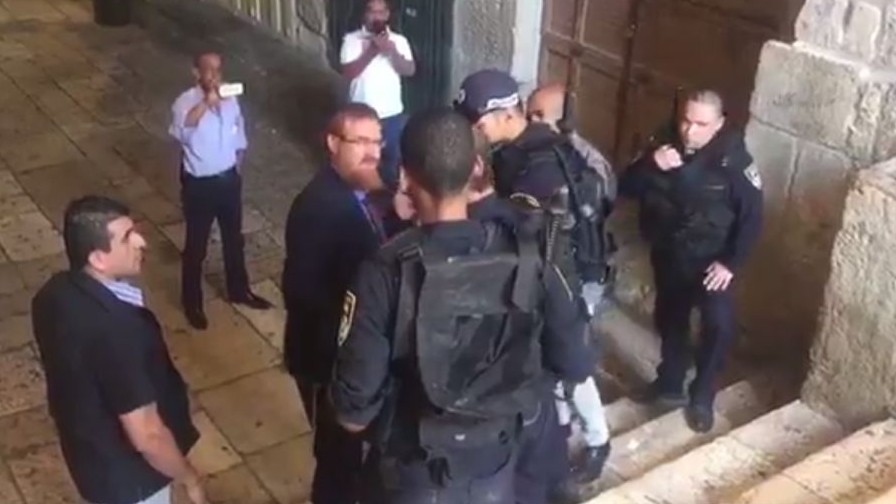
Right-wing Temple Mount activist and freshman Likud MK Yehudah Glick on Monday denied reports he was caught attempting to defy Prime Minister Benjamin Netanyahu’s ban on Israeli lawmakers from visiting the flashpoint holy site in Jerusalem.
In a video of the Monday morning incident obtained by Channel 10, four police officers can be seen blocking Glick’s path as he attempted to ascend the stairs of the Temple Mount’s eastern entrance reserved for Muslim worshipers.
The controversial activist is then seen extending his hand to the officers, assuring them he “simply came to wish everyone a happy and quiet new year.”
He then prayed by the police checkpoint outside the compound.
Glick himself recorded the encounter, and streamed it to his followers on social media.
Several onlookers who appear to be Palestinian Muslim worshipers can also be seen filming the incident.
ח"כ @YehudahGlick ניסה לעלות להר הבית למרות האיסור של רה"מ, נבלם על ידי השוטרים ותיעד את האירוע ב"פייסבוק לייב" pic.twitter.com/2CBOnlRjne
— חדשות 13 (@newsisrael13) September 19, 2016
Later on Monday morning, Glick took to Facebook to deny reports he sought to ascend the Temple Mount in contravention of Netanyahu’s ban, which was reissued on Sunday in a bid to calm spiraling tensions.
“I am a law-abiding person and I do not intend to violate the prime minister and police order banning Knesset members from the Temple Mount,” he wrote in a post. “The reports saying I attempted to enter the Temple Mount are unfounded.”
But a day earlier, hours after Netanyahu authorized Knesset Speaker Yuli Edelstein to extend an almost year-long ban on lawmakers, Glick suggested he would consider violating the directive.
Glick on Sunday lamented the “unfortunate directive,” and said that “of course I will respect it.” However, he also added that “if this directive continues for a long time, it’s not impossible that I will weigh violating the ruling.”
Glick has long campaigned for allowing Jewish prayer on the Temple Mount, a move that would overturn the status-quo agreement that would very likely inflame tensions and lead to fresh violence.
In 2014, Glick was shot four times by a Palestinian from East Jerusalem over his vocal advocacy on behalf of Jews’ prayer rights on the Temple Mount.
After he was sworn in to the Knesset as a member of the Likud party earlier this year, Glick pledged to work within the legislature to change the “absurd and evil” arrangements governing the volatile compound.
The morning before being sworn in, he ascended the Temple Mount and was chided by Netanyahu, who told him, “Don’t do that to me again.”
In a bid to quell tensions over the holy site that helped spark months of Palestinian terror attacks and protests in the West Bank, Netanyahu last October ordered police to prevent Israeli lawmakers and ministers from visiting the Jerusalem site.
On Sunday, Netanyahu reissued the ban amid a sharp uptick in Palestinian attacks over the weekend, which sparked fears that the regular attacks that marked 2015 and early 2016 could return.
The Temple Mount has been at the center of months-long tensions between Israel and the Palestinians — the latter fear a growing Jewish presence at the site, which is also home to the Al-Aqsa Mosque.
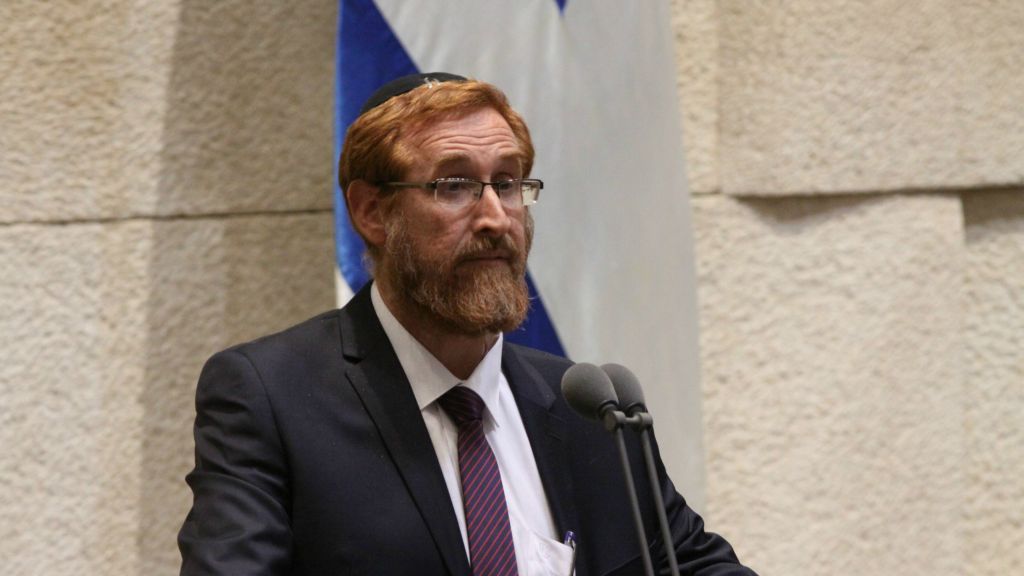
Jews believe the site was home to the First and Second Jewish Temples before being destroyed by the Babylonians and Romans, and thus revere it as the holiest site in Judaism. The complex also houses Islam’s third-holiest shrine, the Al-Aqsa Mosque.
Current rules governing the site dictated by a five-decade-old status-quo agreement between Israel and the Jerusalem Islamic Waqf allow Jews to visit during set hours but not to pray at the site, for fear of stoking tensions.
Netanyahu has vowed to keep the status-quo agreement in place, as the merest rumors of changes to regulations in the compound have led to flareups of Palestinian violence.





The Times of Israel Community.