

Under Haredi pressure, ministers halve fine hike for schools defying virus rules
Education institutions to now pay NIS 10,000 for opening against pandemic regulations, as will those who illegally hold a public event or open their business
 Add ToI as a Preferred Source on Google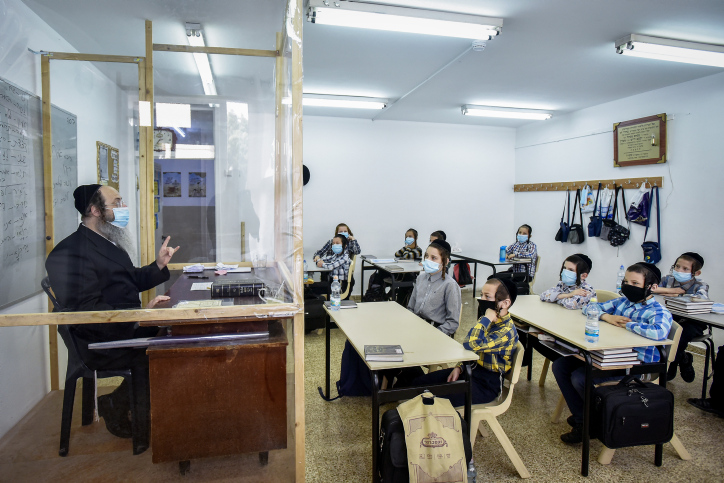
Facing pressure from Prime Minister Benjamin Netanyahu’s ultra-Orthodox coalition partners, the Ministerial Committee for Legislation on Tuesday green-lit a softened version of an initiative to raise the fines for violations of coronavirus lockdown restrictions.
Most significantly, the fine for defying the ban on opening education institutions (other than preschools and grades 1-4) will be upped from NIS 5,000 ($1,467) to NIS 10,000 ($2,935) instead of the originally planned NIS 20,000 ($5,870).
The Haredi parties have insisted the fines for schools single out their community since the majority of institutions found to be violating the rules so far have been ultra-Orthodox. They have threatened to break with the coalition and vote against the bill to hike the fines.
Ministers agreed that the current NIS 5,000 fine for holding a party, conference, ceremony, festival, entertainment or art show in violation of the rules would also be increased to NIS 10,000 instead of the originally proposed NIS 20,000.
In keeping with the original plan, however, businesses that open illegally will also face a fine of NIS 10,000, up from the current NIS 5,000.
The Ynet news site quoted sources in the United Torah Judaism party rejecting the apparent compromise halving the proposed new fines, saying it had not been discussed with them.
It was not immediately clear whether they would vote in favor of the bill when it is raised in the Knesset plenum. The proposal still requires three Knesset votes to become law. A date for the votes has yet to be officially announced.
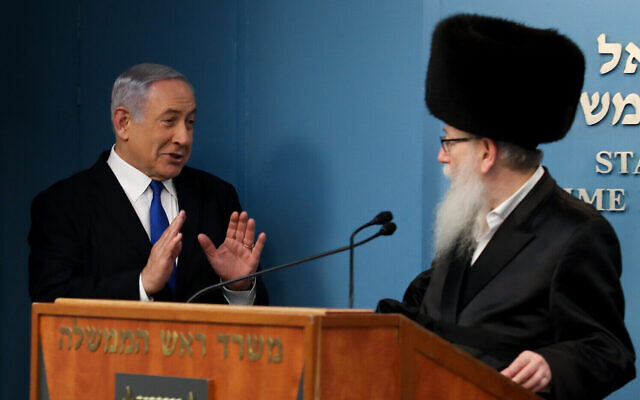
During the meeting, Minister Ze’ev Elkin of the ruling Likud party accused Minister Ya’akov Avitan of Shas of “encouraging people to violate the regulations,” after Avitan demanded that the number of participants allowed at events be raised alongside the fine hike.
The committee meeting on the bill had been pushed off by a day amid pressure from the ultra-Orthodox.
Israel sharply brought down its daily coronavirus infection rates from some 8,000 in mid-September to several hundred by late October with a nationwide lockdown, which it began to gradually ease two weeks ago. So far, only preschools and grades 1-4 have been permitted to restart. Other grades have continued with remote learning, though there is little infrastructure or willingness to use online learning in the ultra-Orthodox community.
The reopening of schools in May, after the first nationwide closure, and again in September at the start of the school year, was blamed for upticks in virus cases around the country.
Many ultra-Orthodox schools for boys reopened earlier this month in defiance of the government rules. Since the start of the pandemic, synagogue worship has also been linked to the spread of the virus.
After over a month of national lockdown that succeeded in curbing high infection rates but also paralyzed much of the economy and public life, the government has struggled to agree on how to ease the restrictions, with pressure from some ministers to quickly lift the closure facing opposition from other cabinet members — among them the prime minister — who want to move more cautiously.
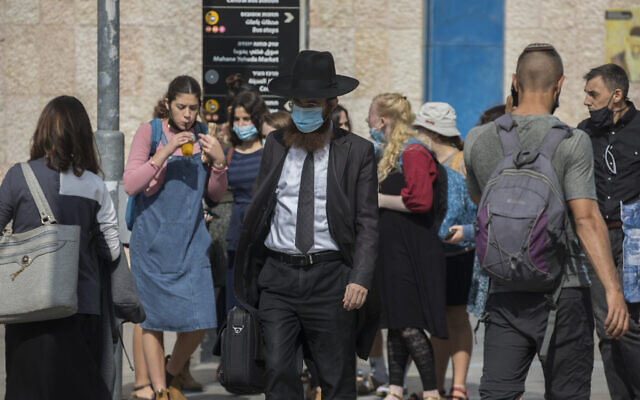
At Monday’s cabinet meeting, Interior Minister Aryeh Deri, who leads Shas, pleaded against increasing the fines for education institutions, according to leaks from the meeting reported by Hebrew media.
At the meeting, ministers were presented with figures showing that Israel’s basic reproduction number, or the rate of new cases stemming from each coronavirus infection, had reached the level at which health officials have previously said they would recommend scaling back some of the steps taken to ease the lockdown.

Meir Ben-Shabbat, head of the National Security Council, reportedly confirmed that the R-number for transmission was “at least” 0.8 and that although the number of new cases was not yet trending upwards, the rate of decrease had slowed.
Health Ministry data published Wednesday evening indicated the basic reproduction number had dropped slightly and was now below the 0.8 mark.
The ministry said 776 new cases of the coronavirus had been diagnosed Monday and 513 were diagnosed by 6 p.m. Tuesday, indicating the drop in daily new cases had leveled out since the government began rolling back the lockdown restrictions.
The ministry said there were 9,890 active cases, of which 393 were in serious condition, including 171 on ventilators. The death toll was 2,592, 12 more than the number given in the morning’s roundup.
Testing levels continued to be relatively low, with 34,208 tests conducted Monday and 24,252 so far Tuesday, despite a ministry campaign to encourage widespread testing. The positivity rate appeared to be steady at just over two percent — 2.3% Monday and 2.1% so far Tuesday.
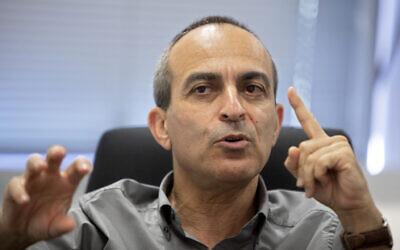
Meanwhile, Ronni Gamzu, the outgoing official overseeing the government’s coronavirus response, said Tuesday that he was aiming to change his “traffic light” plan — in which cities, towns and neighborhoods are color-coded according to their infection rate, with localized restrictions depending on the designation — to make it stricter.
Speaking with mayors and regional council heads, Gamzu said he would work to get more cities designated as “red” — meaning flagged as having high infection rates — since “that would include several cities where we know there’s an outbreak.”
According to Health Ministry data on Monday, the rate of positive tests had risen from around two percent throughout last week to 2.9% on Saturday and 3.1% on Sunday.








The Times of Israel Community.