

With jobs in short supply, will Bethlehem slouch toward bedlam?
Residents of the West Bank city care more about making a living than starting an intifada, but some fear rampant unemployment could change that
 Add ToI as a Preferred Source on Google
Avi Issacharoff, The Times of Israel's Middle East analyst, fills the same role for Walla, the leading portal in Israel. He is also a guest commentator on many different radio shows and current affairs programs on television. Until 2012, he was a reporter and commentator on Arab affairs for the Haaretz newspaper. He also lectures on modern Palestinian history at Tel Aviv University, and is currently writing a script for an action-drama series for the Israeli satellite Television "YES." Born in Jerusalem, he graduated cum laude from Ben Gurion University with a B.A. in Middle Eastern studies and then earned his M.A. from Tel Aviv University on the same subject, also cum laude. A fluent Arabic speaker, Avi was the Middle East Affairs correspondent for Israeli Public Radio covering the Israeli-Palestinian conflict, the war in Iraq and the Arab countries between the years 2003-2006. Avi directed and edited short documentary films on Israeli television programs dealing with the Middle East. In 2002 he won the "best reporter" award for the "Israel Radio” for his coverage of the second intifada. In 2004, together with Amos Harel, he wrote "The Seventh War - How we won and why we lost the war with the Palestinians." A year later the book won an award from the Institute for Strategic Studies for containing the best research on security affairs in Israel. In 2008, Issacharoff and Harel published their second book, entitled "34 Days - The Story of the Second Lebanon War," which won the same prize.
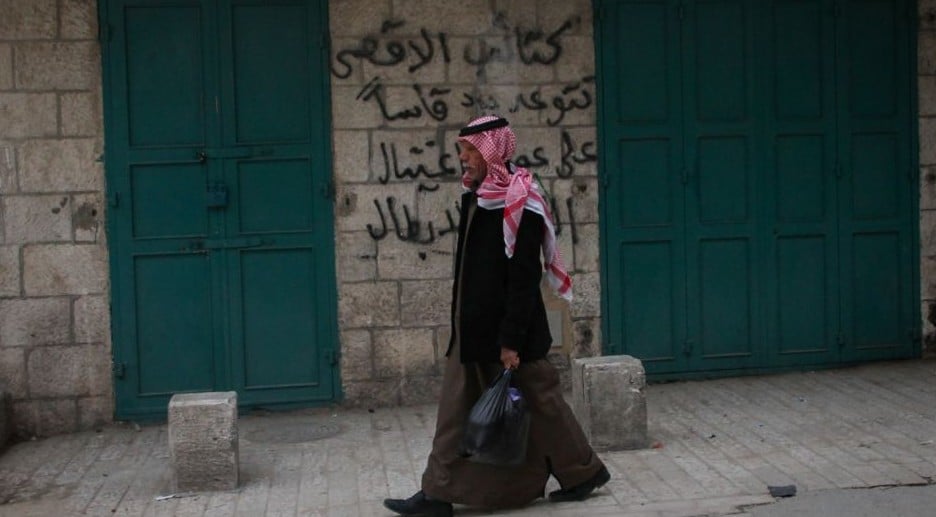
BETHLEHEM — Walid Abou Ayash welcomes us into his tattoo shop, just a few hundred meters from the Church of the Nativity, on the upward slope of a street leading to the marketplace. His arms are covered with colorful tattoos, and on his chest is a tattoo of Jesus.
He opened his unusual shop, which he says is the only one of its kind in the West Bank, after spending a great deal of time learning the craft in a tattoo shop on Jaffa Street in Jerusalem.
“My customers are mostly Christian, and very few Muslims,” he says. “For them, it’s haram — forbidden. It’s also forbidden for you Jews.”
He says that quite a few Christian tourists visiting Bethlehem, the birthplace of Jesus according to Christian belief, ask for a cross tattoo, perhaps wishing to etch the spiritual experience onto their bodies. So from time to time, dozens of men and women, old and young, may be seen in Abou Ayash’s small (and awesome) shop, waiting their turn for a cross tattoo.
“I work with all the Christian groups — Copts, Assyrians, Armenians,” he says. “Everyone wants a cross. I have a special license to run this store, but yes, I am afraid of all kinds of radical Muslim groups who may try to hurt us.”
A sample tattoo appears on the plasma screen, in English, on a person’s arm. “Lior, even when I’m not with you, I’m always with you,” it reads in English, with the date, January 18. In this case, it was a Jewish couple who insisted that Walid tattoo the symbol of their love on their skin.
Just about 30 meters away from Walid’s shop, many Muslim worshipers are arriving at Bethlehem’s main mosque for prayers. Hundreds of Christian tourists gather in front of the church entrance just opposite.
The group of Christian pilgrims is a large one, and more and more groups arrive, most of them straight from Israel. This is Bethlehem, a city where Christians and Muslims learned to coexist and where tourism used to be the main industry, with marked dependence on the Israeli component.
Relations between adherents of the various faiths have been marked by turbulence, particularly since the start of the Second Intifada. The current situation might be described as much more quiet and calm. But Muslims may still be heard complaining about the power and wealth that the Christians have accumulated.
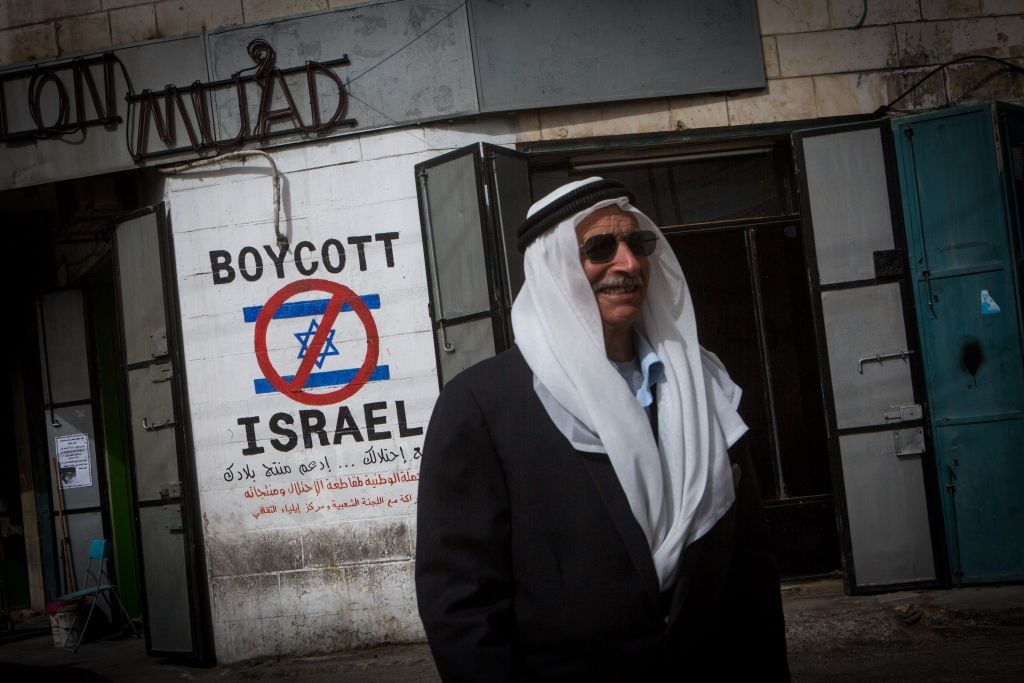
The Abu Nayef brothers opened the Stars and Bucks café, a knockoff of the American Starbucks chain, in the next street. Adel, who also owns a restaurant that serves Arab-style food, says that 10 to 12 Christian families are the ones who make the big profits from tourism in Bethlehem.
“They own hotels and souvenir shops — and, of course, the others who make big money are the Israelis,” he says. “The tourists hardly walk around in the city. They don’t do any shopping except in the souvenir shops that belong to those same families. So the ones who come to sleep here are usually poorer tourists, like Nigerians and Egyptians.”
He adds that tourism dropped off steeply during the months of last summer’s war in Gaza and immediately afterward. “Don’t get me wrong; the economic situation here is very bad,” he says. “Only a few people go to work in Israel. Seventy percent of the young people here don’t have jobs.”
The local market is fairly close to the Stars and Bucks café. Although there seems to be a lot of traffic here, everyone, without exception, complains about the economic situation. The popular local food sold at the market stalls is grilled calf and sheep liver in pita bread. Several young men from Bethlehem are getting haircuts at Samih’s barber shop. All of them are Muslim students at the university except Mohammed, the barber, who is just 22 years old. The others, Muataz and Mahmoud, are unemployed. They share a dream: to leave Bethlehem and the territories and live abroad.
“I’m studying communications engineering in university and will be graduating next year,” says 21-year-old Muataz. “Then I want to get out of here and go to work in the United Arab Emirates. Why? Because there are no jobs here. Even those who have jobs earn nothing. Nobody wants to open a business in this city. My brothers do not have permits to work in Israel. Nobody here cares about the political issue, Hamas or Fatah. Everybody wants to get out, including all my friends here.”
His friend Mahmoud, 21, feels the same. “I will look for a job here, but I want to move to the Persian Gulf, where a person can find a job with a good salary,” he says.
Why is the city so quiet?
“Because nobody wants problems. The moment you do something, you’ll get arrested, either by the Israelis or by the Palestinian Authority.”
And how are relations with the Christians here? Would you be allowed to marry a Christian woman?
“In principle, there is no problem between Christians and Muslims. We have Christian friends and everything is all right. But getting married is a different story. If a Muslim man wants to marry a Christian woman, her family will prevent it. If a Christian man wants to marry a Muslim woman, her family won’t consent.”
The stories of attacks by Muslims, mostly activists in the organizations, against Christian residents of Bethlehem and Beit Jala, seem like distant history. Terrorists fired on the Jewish neighborhood of Gilo from houses in Beit Jala early in the Second Intifada. The Israeli army returned fire at the houses, which belonged to well-off Christian families. The houses had been taken over by armed men, some of whom came from areas outside Bethlehem, who did with them as they wished — and the Christian homeowners were the ones who paid the price.
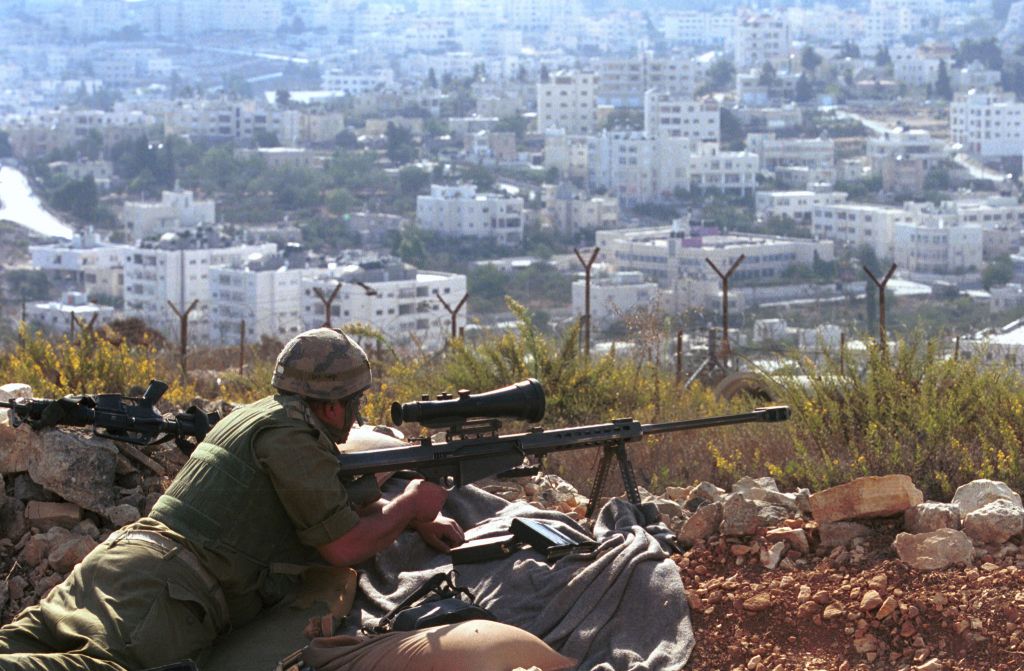
Quite a few Christian families left Bethlehem during that time, but emigration from the city now crosses religious lines.
“The Christians and the Muslims live together well enough,” says 40-year-old Mohammed Sabatin from the village of Husan, who owns the children’s clothing shop in the marketplace. “Sometimes there are small personal problems, a few quarrels, but nothing beyond that. The situation is calm, in general. But economically, things are very bad. There’s a huge unemployment rate.
“And we Muslims don’t work in tourism at all. Maybe two percent of the ones who work in that industry are Muslim. The rest are Christian. Look at what’s happening with the stores around the church — all of them are owned by well-known Christian families. If they made every tourist pay ten dollars for a visit to the city and distributed those funds among the residents, the economic situation would be much better.
“But everybody keeps their money to themselves. Who is responsible for that? The government. And I tell you that if the economic situation keeps on the way it is and the unemployment rate keeps going up, that will lead to an intifada.”
But even Mohammed admits that nobody here really wants an intifada anymore. “The young people? They want to work and get married. They don’t want war or an intifada. And me, I’ve got four children. I do business with Israel. Do you think I can think about anything but business? But if my children are hungry, then of course I’ll think about other things.”
And why isn’t there an intifada? After all, you say that the economic situation is bad.
“That’s because the Palestinian Authority doesn’t want chaos. We want law and order, and they’ll be kept as long as things stay the way they are. Most of the Palestinian economy is dependent on the Palestinian Authority’s salaries, so there’s no interest in hurting the Palestinian Authority and governmental stability.”
In the meantime another group, this one from Ukraine, enters the Church of the Nativity. The Palestinian guide speaks fluent Russian. Most groups arrive with an Israeli guide who steps aside for the Palestinian one. After the visit to the church, they will have lunch at The Square Restaurant in Bethlehem and return to Israel to sleep.
Tamer, a tour guide from East Jerusalem, came with a group from Germany. He works with an Israeli tour company that works in the “alternative tourism” genre. “They come to see the sources of the conflict. They come to understand the situation, not just to tour,” he says.
The church itself is divided into Greek Orthodox, Armenian and Catholic sections, each with its own area. A Palestinian police officer is on duty there; his main task is to stand between the priests from the various denominations who sometimes quarrel with one another over power and space within the Church of the Nativity.
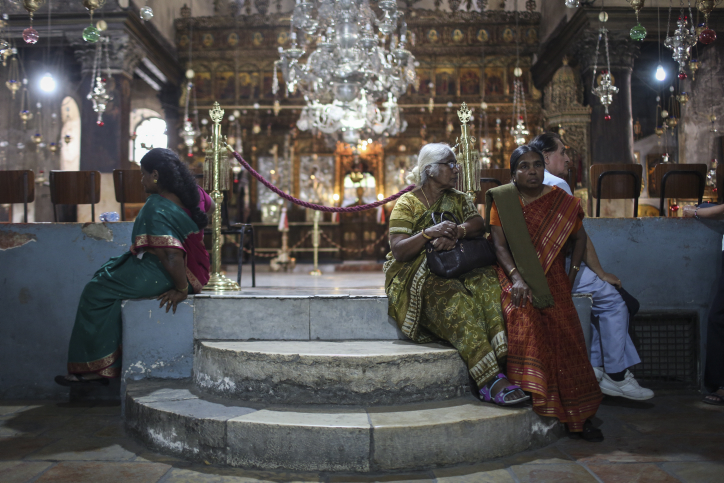
A guide approaches a couple touring the church on their own and offers his services, and they turn him down politely. He says that the number of tourists in Bethlehem dropped because of the recent war in Gaza and the situation in the Middle East.
“These people do not understand the region,” he says. “They do not know the difference between Gaza and Bethlehem or between Islamic State and the West Bank. It’s all the same thing to them, so now quite a few Christian tourists are afraid to come here. The economic situation is getting bad. Tourism does not bring in enough money for the residents of the city, but only for a small group of people, and more and more people want to leave. They don’t want chaos, and they’ve gotten tired of fighting.”
Deheishe
“Twelve thousand people live here in one of the highest population densities in the world; the houses are piled together, and the house of every extended family branches out in ugly cement growths, rooms and niches, rusty iron beams spread throughout as sinews, jutting like disconnected fingers,” David Grossman wrote in his book “The Yellow Wind.”
Twenty-eight years have gone by since the publication of “The Yellow Wind,” which begins with a description of the Deheishe refugee camp south of Bethlehem. Hard as it is to believe, not much has changed inside the camp during that time.
Change can be seen clearly on its outskirts, though; a large shopping complex is being constructed opposite, and a new, modern fuel station has replaced the old one. A large cultural, sports and business center, funded by the Russian government, is being built at Deheishe’s northern end, facing toward Bethlehem. The new buildings of a college and a cultural center are being constructed to the east.
Everything is so different from what happens in the alleyways of the camp itself. The number of inhabitants here has increased to 13,500, and instead of the water cisterns and raw sewage that Grossman describes, the water is collected in large black tanks on the roofs of residential buildings and the sewage has been taken care of. But the overcrowding, poverty, unemployment and hardship remain as they were.
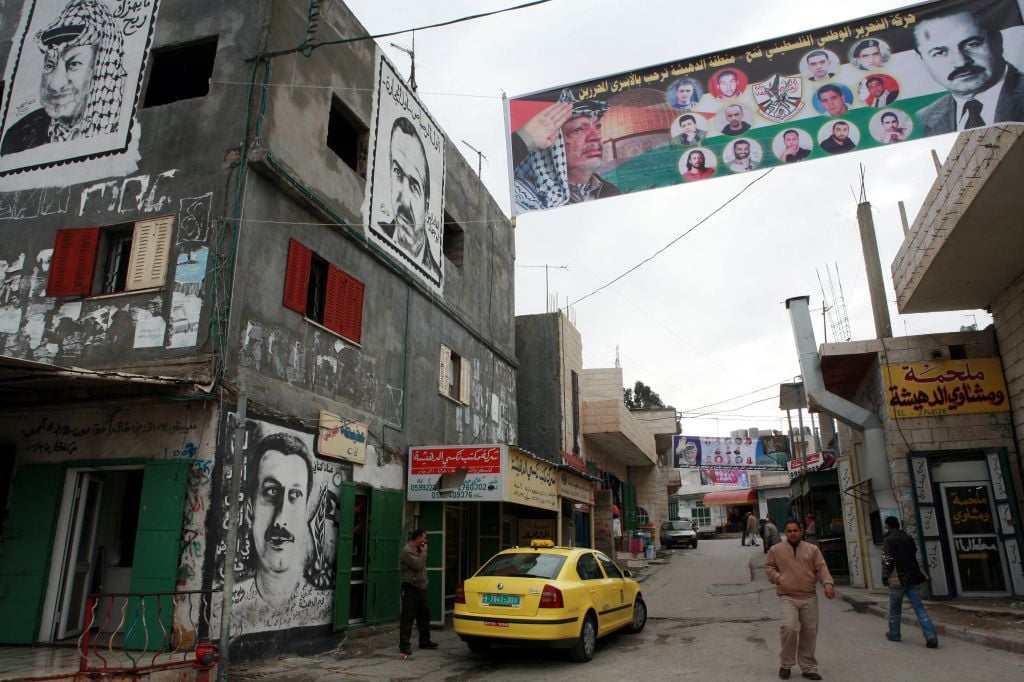
The First Intifada broke out the year that Grossman wrote his book. But here, despair has taken over everything. Here one would be hard-pressed to find even young people who talk about things in terms of violence or uprising.
“The young people in the camp have no work. I’m talking about almost everybody,” says Mamoun Lahham, the head of the Phoenix Community Center in Deheishe. “They do not work in tourism, and they have no permits to work in Israel. A few of them work for the Palestinian Authority. That’s it.
“Those who can leave the camp do so, but not many people here have money. There are many problems here: lack of jobs, overcrowding, affronts to human dignity and drugs too. But unlike other refugee camps, there is no clear separation here between the camp and the city. Deheishe is part of Bethlehem. It’s not like Balata and Jenin. Also, the residents here have integrated well with the Palestinian Authority. The governor of Jenin, the head of the General Intelligence Service, the directors of the military courts, journalists — they all come from here, from Deheishe.
“It’s true that unemployment is higher in the camp because the families from the city control the tourism and real-estate markets. But the higher education rate here is one of the highest in the West Bank, even higher than in West Jerusalem. I have two sisters, both physicians. One works at Hadassah University Hospital in Ein Karem.
“People want to make a living here, too. And if you have a good source of livelihood, then it is obvious that you won’t be talking about the right of return or war or intifada.”
So where do you think the Palestinians are headed today?
“In my opinion, the ideology has been replaced. Most of us have given up on the dream of the two-state solution and replaced it with one state for two peoples. I tell you: I am even willing for us not to be given the right to vote for the Knesset. We will be Israeli citizens. We will be able to travel freely and work and go abroad. And we don’t need the right to vote for the Knesset. You will take us as we are, with the refugee problem. Under an Israeli government, yes. Let them run things for us.”
The marks of burnt tires can be seen on the camp’s main road. “The Palestinian Authority arrested a 56-year-old resident of Deheishe for not paying his electric bill,” Lahham said. “So all of us — residents and members of all the organizations — went out to a demonstration and blocked the road. It doesn’t make sense that people who have no money to pay their electric bill should be arrested.”
There is lively foot traffic in the camp itself. The laborers — most of whom work illegally and entered Israel by roundabout ways — are coming back from work. Graffiti, most of it in praise of the Popular Front for the Liberation of Palestine and other terrorists such as the ones who perpetrated the massacre in the synagogue in Jerusalem’s Har Nof neighborhood, can be seen on every street corner.
Just two weeks ago, a young local man was killed by Israeli army gunfire in a conflict that developed during efforts to arrest suspected terrorists. Although the situation is calm now, it seems that like everywhere else in the Middle East, everything is temporary.


The Times of Israel Community.