

As terror wave surges, so does friction in Netanyahu’s coalition
Attacked by all sides, PM may try to create a broad unity government
 Add ToI as a Preferred Source on Google
Raphael Ahren is a former diplomatic correspondent at The Times of Israel.
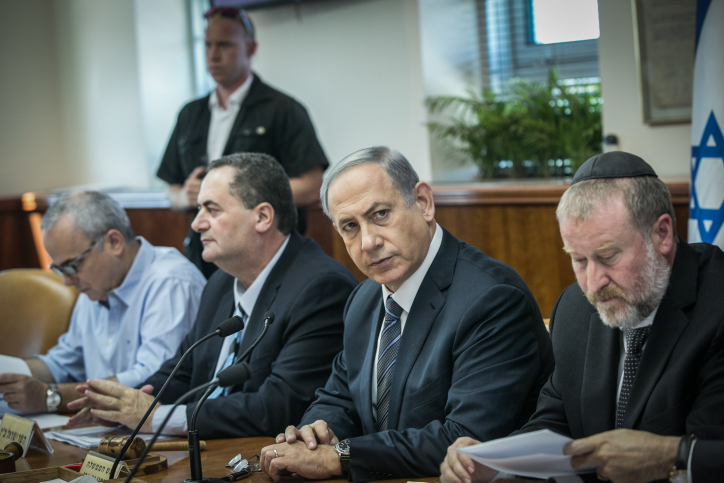
As the current wave of terrorist attack continues unabated, pressure on Prime Minister Benjamin Netanyahu is intensifying, forcing him to act — not only in the security realm but also in the political arena, where he might find himself having to make decisions that could dramatically change the face of the current government.
Netanyahu entered full crisis mode even before he returned to Israel from last week’s visit to New York, convening countless security deliberations and announcing steps designed to curb the violence and restore calm.
So far, however, his steps have failed to yield significant results, with stabbings and other attempted terror attacks being perpetrated on a near-hourly basis on Wednesday and Thursday.
In light of the escalating security situation, the prime minister has been under attack by politicians from the left and right flanks of the opposition and even from within his own coalition.
Netanyahu’s ban on politicians entering the Temple Mount, announced Wednesday evening, particularly angered the members of the national-religious Jewish Home party, which wants to see Jewish access to the holy site increased and not reduced. His steadfast refusal to build new settlements in the West Bank, or even to expand existing neighborhoods in East Jerusalem, is infuriating Education Minister Naftali Bennett’s party even more. The Jewish Home lawmakers expects the current purely right-wing-religious government to provide an “appropriate Zionist response” to the current wave of terror — which, in their view, would mean further cementing Israel’s hold over the Land of Israel by building beyond the Green Line.
Netanyahu has so far withstood this pressure, citing concerns about Israel’s standing in the international community. First he indicated to members of the cabinet that the US administration threatened to support a French-led resolution in the United Nations Security Council calling for a rapid Israeli withdrawal from the West Bank. Washington denied ever having issued such a threat.
Netanyahu then resorted to saying that an Israeli announcement of settlement expansion could seriously complicate his upcoming meeting with President Barack Obama, during which he intends to discuss upgrading US military assistance to Israel in the wake of the Iran nuclear deal. (For months, the prime minister refused to talk about this topic with Washington, arguing this could be understood as a tacit approval of the Iran accord. Apparently, these concerns are no longer relevant.)
There are thus three possible scenarios for the immediate future of Israel’s political setup.
A grand coalition. Increasingly bothered by the constant complaints from the left, the center and the right about this inability to provide safety for Israel’s citizens, Netanyahu might attempt to build a national unity government. By replacing Jewish Home with the center-left Zionist Union, he would achieve long-elusive political stability, increasing the coalition’s current size from 61 seats — a razor-sharp majority in the 120-member house — to a much more comfortable 77.
Netanyahu has never been on good terms with Bennett and his confidante Justice Minister Ayelet Shaked (with whom the prime minister hasn’t held a single one-on-one work meeting since he took office in May). He might therefore relish getting rid of the party, which poses one of the greatest challenges to his claim over Israel’s national camp.
By bringing in the Zionist Union, led by Isaac Herzog and Tzipi Livni, Netanyahu would gain much credit in the international arena. Herzog has been vehemently attacking the government for its ostensible inaction on the Palestinian front, but he never explicitly declared that he’d never join it. The current wave of terrorism demands unity, and the need to relaunch peace negotiations with the Palestinians is more pressing than ever, Herzog might tell his party, in explaining why he wants to become Netanyahu’s foreign minister in a grand coalition.
New elections. If Herzog and his party refuse to join a national unity government, and Bennett and his men don’t get what they want, Israel might be headed to the polls again. It’s a somewhat unlikely but not entirely outlandish scenario.
Bennett, whose party garnered a disappointing eight Knesset seats in the elections in March, might calculate that he stands to gain from another round, especially one called in the context of a wave of terrorism, in which voters tends to flock to the right. If Netanyahu doesn’t give in to the Jewish Home’s demands — more drastic measures against rioters and terrorists, enhanced Jewish access to the Temple Mount and settlement expansion — it might pose a formidable threat to his rule. Even Yisrael Beytenu chief Avigdor Liberman, with his six Knesset seats, couldn’t bail him out.
If Bennett bolts, only the Zionist Union, or the centrist Yesh Atid party headed by Yair Lapid, could rescue Israel’s 34th government. Given Lapid’s very harsh criticism of Netanyahu’s leadership, and his own ambitions to become prime minister, that would be unlikely.
Status quo. Netanyahu’s impressive political survival skills have earned him the nickname “the magician,” and it’s possible that he will, once again, emerge from the current crisis unscathed. Despite the growing unhappiness on his right flank, he might be able to convince the critics within his own coalition that anyone who rattles the cage actually helps the enemy.
After several days of incessant news about terror attacks and attempted terror attacks, no one has yet seriously threatened a major coalition crisis. If the current wave of violence slows down in the coming days, chances are that everything will stay the same and Netanyahu’s fourth term as prime minister will continue.








The Times of Israel Community.