

Court orders state to explain migrant detentions
High Court decree follows petition claiming Israel’s jailing of asylum-seekers is illegal and ‘torments innocent people’
 Add ToI as a Preferred Source on Google
Stuart Winer is a breaking news editor at The Times of Israel.
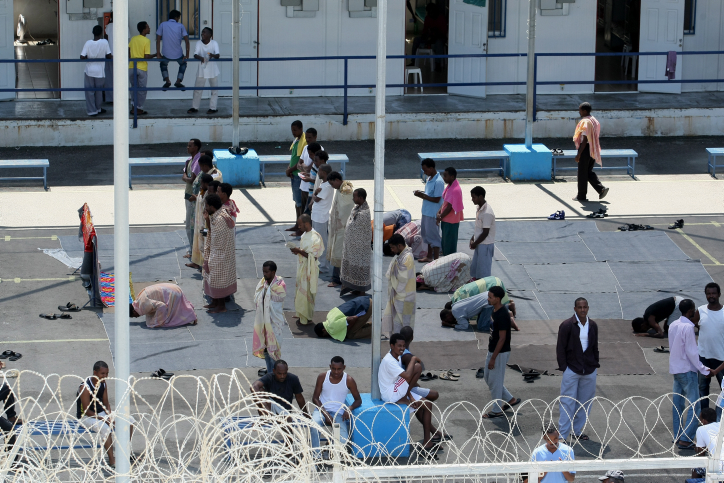
The High Court on Tuesday ordered the government to explain the legality behind a law that allows the arrest and lengthy detention of illegal migrants, saying it would suspend the legislation if not given a sufficient response.
A panel of three judges led by court President Asher Grunis gave the state until April 30 to justify additions to the Law to Prevent Infiltration, which allows for Israel to detain asylum-seekers for lengthy periods.
The amendments to the law were made in January 2012 and have resulted in the detention of over 2,000 people who entered the county in recent months, and who are being held in the south of the country, according to the Association for Civil Rights in Israel, one of the petitioners.
In October 2012, five Israeli rights organizations filed a petition against laws that allow those who illegally enter Israel from the Sinai Peninsula to be held in detention centers for up to three years.
On Tuesday, the United Nations High Commissioner for Refugees submitted an amicus curiae, or friend of the court, brief to the High Court in support of the petition, Haaretz reported. UNHCR wrote that it considers that the provisions of the law are not in conformity with international human rights and refugee law standards.
Five asylum seekers from Eritrea and Sudan who are being held at the Saharonim center in the south of Israel were present in the Jerusalem courtroom during the session.
“The Law to Prevent Infiltration is one of the most extreme laws ever enacted in Israel,” said Attorney Yonatan Berman of the Clinic for Migrants’ Rights at the Academic Center of Law and Business, one of the partners to the petition. “It torments innocent people, including women and children, refugees and victims of torture, whose only crime is attempting to flee for their lives. This is a stain on our law books, and we have a legal and moral obligation to invalidate it.”
In response, the state argued that the laws are not as strict as the petition makes out and that dozens have been released from the detention centers, Ynet reported.
The state also noted that by going directly to the High Court, rather than first going through the administrative courts, the petitioners circumvented the appropriate legal channels.
A flood of immigrants from African countries in recent years have entered Israel, claiming asylum-seeker status. While thousands have settled in Tel Aviv and elsewhere, Israel has sought to stem the tide, building a fence along its border with Egypt and putting those who cross the border into detention.
Most of the detainees are Eritrean or Sudanese, and by the government’s own directives they cannot be returned to their home countries due to the threat to their lives, ACRI said.
The migrants often head to Israel to escape wars and persecution in their native countries, a circumstance that makes it difficult for Israel to deport them due to the inherent dangers they face if they return home.
The government has also sought to repatriate the migrants, offering them money to return, or threatening them with extended jail time if they don’t.
A UN official recently said that Israel’s policies contravened international law, which protects asylum-seekers from being sent back into danger zones.










The Times of Israel Community.