

German, Dutch vacationers warned to evacuate Sinai
Travel advisory comes week after deadly bus blast and could serve to further harm Egypt’s shrinking tourism industry
 Add ToI as a Preferred Source on Google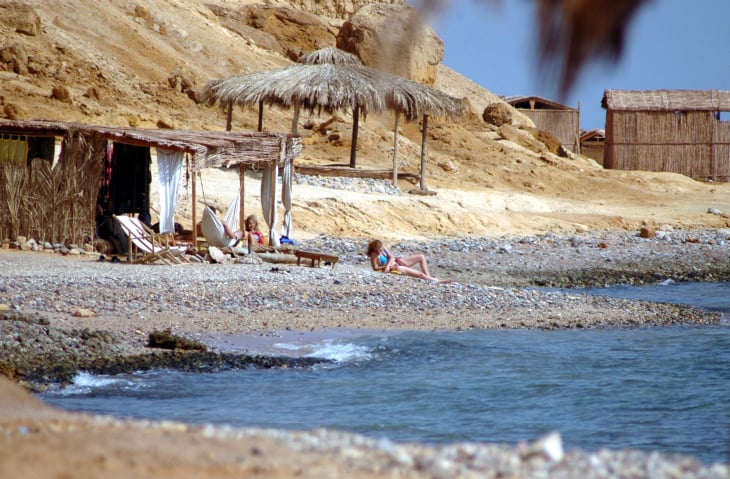
German and Dutch vacationers in the southern Sinai were urged to leave the peninsula Thursday as Berlin and Amsterdam issued terror warnings for the area.
The warning comes a week after a bus carrying Korean tourists from the Sinai into Israel was bombed, killing four, and could serve to dampen Egypt’s already hurting tourism industry.
German tour operators said they were arranging to have vacationers in Sharm el-Sheikh and the southern Sinai evacuated before the weekend early Thursday.
Berlin said travel to other parts of the country was inadvisable and should be done with caution.
Later in the day, the Netherlands issued a similar warning, with Dutch tour operators saying they would also evacuate vacationers.
The Sinai has experienced growing unrest since the ouster of president Mohammed Morsi in July 2013. The group behind the deadly bus blast, Ansar Bayt al-Maqdis, reportedly warned of further attacks in a statement last week telling tourists to leave the area.
Germany is a top source of tourists for Egypt, and its Red Sea coast is a popular destination for German tourists seeking sunshine during Europe’s winter months.
Tourism accounted for 11 percent of Egypt’s GDP until recently. On Thursday, officials in Cairo said tourism had dropped 31 percent between December 2012 and December 2013.
In 2010, the sector was one of the most powerful engines of the country’s economy, bringing in more than 14.7 million tourists and some $12 billion in revenue. It employed around 13 percent of the workforce and raked in one-fifth of Egypt’s foreign currency.
The 2011 revolt against longtime president Hosni Mubarak, and the ensuing instability, hit it hard: That year, visitors dropped to 9.6 million, earning the country $8.8 billion. In 2012, the industry slowly clawed back, with around 10.5 million tourists coming.
Last year, however, saw the ouster of Morsi and escalating violence as authorities cracked down on his Muslim Brotherhood, and visitors dropped to 9.5 million, fewer even than 2011. The large majority of those tourists — nearly three-quarters of them — stuck to the Red Sea resorts.
Still, even south Sinai has felt the blow. In Sharm el-Sheikh, Sinai’s main Red Sea resort, about 100 miles (160 kilometers) south of Taba, occupancy at the city’s hotels is currently averaging around 45 percent, but most guests are Egyptians enjoying vastly discounted rates, according to tourism workers.
The last major attacks on tourists came in a string of militant bombings against resorts in southern Sinai between 2004 and 2006, killing about 120 people. But the tourism industry quickly rebounded.
This time, however, the industry is already deeply weakened, particularly in the Nile Valley, which was the traditional attraction for tourists with its wealth of pharaonic antiquities.
Cairo, home to the Giza Pyramids and the Sphinx and the famed Egyptian Museum, sees few visitors. The past three years have seen repeated eruptions of violence. Since Morsi’s ouster, nearly daily protests by his supporters often turn into clashes with police.









The Times of Israel Community.