

Hit the books, not the blacks
The approaching first day of school means nothing can push education stories off the front page, not even the police commish calling Israelis from the Ethiopian community ‘natural criminal suspects’
 Add ToI as a Preferred Source on Google
Joshua Davidovich is The Times of Israel's Deputy Editor
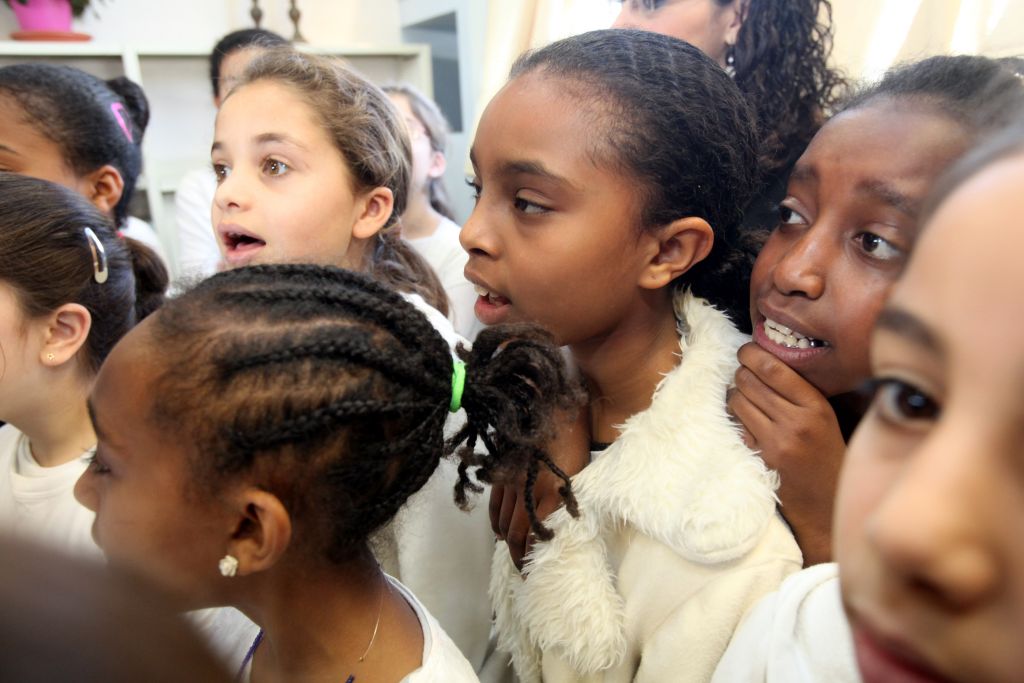
For those suckled upon American newspapers from their youngest days, it can be hard to cotton to the Israeli press’s different ways of going about the business of journalism. The beginning of the school year is one of the most pronounced examples.
While the first day of school, or even back-to-school shopping, might be worth a standalone photo or maybe a single story in American newspapers, in Israel the weeks before school are marked by a yearly ritual of newspapers getting more and more excited and shrill with their coverage with each passing day, capped by the obligatory “Shalom kita aleph” (Hello first grade) headline which readers can expect in the next day or two.
And while Wednesday’s papers are certainly a prime example of that phenomenon, with back-to-school stories leading all three major Hebrew-language papers, there’s also a sense of familiarity, as the coverage – some celebratory, some critical – is accompanied by a scandal that would make any American feel like they are back in the old country: the police commissioner saying blacks are naturally suspect.
But why lead with the latest instance of long-simmering tensions between the force and the country’s Ethiopian community when there are cute kids to photograph, their little backpacks all packed a day ahead of time, smiling and ready to scamper off to class. Such pictures feature on both Yedioth Ahronoths’s and Israel Hayom’s front pages. The proximity to Thursday’s first day of school means stories that would normally be relegated to the back pages are given coverage front and center Wednesday.
Yedioth gives the cold hard numbers – 2,185,000 students in 4,733 schools and 18,972 kindergartens, up against 177,945 teachers – but also reports that with a day to go, everything is not hunky dunky in some corners, despite the Education Ministry’s bigger-than-normal budget and promises to make smaller classes and focus on upping high school math scores. Witness one Hadar Cohen, a seventh-grader who has essentially fallen through the cracks after her old school closed and she wasn’t placed in a new one.
“My friends are all about books and supplies for school, and only I didn’t buy anything because I don’t know where I’ll be learning. It’s a really not nice feeling,” she’s quoted saying (with the paper also reporting that it costs parents an average of NIS 200,000 to put a kid through school, the lack of purchasing might not be a bad thing).
That’s not the only issue to pop up. Haaretz leads off with reports that the ministry has decided to cut back on small groups in first and second grade for learning reading and math. The paper notes that this will save the ministry a cool NIS 315 million, and is being defended as no longer needed because classes are now smaller, though many classes still have as many 34 students.
“To say that reducing the class size to 32 or 34 students is the same as splitting into small groups of 20 students and makes this unnecessary really shows contempt for the students and the parents,” a mother of a first-grader to be is quoted saying. “It’s clear the children will be hurt by this move, and it’s too bad that all the welcome progress is coming at the expense of another achievement made in the past.”
With stories as exciting as that, it’s not hard to see why some papers go off and do some enterprising reportage, like Israel Hayom, which leads off with its own survey of students. Among the results it finds are that 87 percent of students find their teachers good, very good or excellent, but only 44% think school has prepared them well for life. Not surprisingly, 55% are sad that summer vacation is coming to an end, with 23% happy to go back to school and 22% too cool to care.
The results of the survey dovetail with a state-run poll released earlier this month that found most parents happy with their kids’ schools but not with the school system as a whole. Writing a guest column in Israel Hayom, Education Ministry Director Michal Cohen cites the survey, but somehow comes to the opposite conclusion.
“The results of the survey … show a large majority of parents in Israel satisfied with the education system. The numbers testify to the large reform happening in the education system in the last few years. They show the hard pedagogical work by administrators and teachers, and the fruit of the large programs advanced by the system over the last years,” she writes.
Cohen is apparently not the only bureaucrat blind to gaps between what large institutions are doing and what is happening on the streets, as evidenced by a firestorm sparked Tuesday when police chief Roni Alsheich said it was natural for police to be suspicious of Israelis of Ethiopian heritage, as immigrants are more likely to commit crime.

Despite Alsheich also admitting that there has been too much policing of Ethiopians, the resulting outcry was as swift as it was furious. “This is not the first time we’re hearing that [the police] relate to us as criminals. Now the chief of police comes along and says that black is suspicious. I am black; I am a criminal [and] it’s also natural for a policeman to think that way. It’s normal. It’s not a distortion,” Ethiopian community activist Inbar Bugala is quoted saying, sarcastically, in Haaretz. “In essence, with one sentence, the police chief has summarized and confirmed all of our complaints since the protest.”
The sentiment is repeated in an open letter to Alsheich by reporter Dani Adino Ababa in Yedioth, who verbally spanks the police chief in a screed that will be familiar to Americans horrified that a country built on immigrants would then turn on them (full disclosure: I am an immigrant to Israel, the son of an immigrant to the US, though I doubt Alsheich was talking about me and my European forebears).
“Maybe you don’t know, but the State of Israel is a state of immigrants. Your father immigrated from Yemen, your mother came from a family of Moroccan immigrants. They immigrated here just like me. They were also once chronic suspects. And now the tables have turned. You, their son, suspects that I am a perpetual criminal. I have three children, they are Israelis with kinky hair – and they are also suspects in your eyes, because they are black,” he writes.
In a move shocking nobody, Israel Hayom, often seen as a government mouthpiece, puts the cart before the horse, leading its front page not with Alsheich’s comments, but Public Security Minister Gilad Erdan’s defense of him. (The paper’s own lede is itself a defense of Alsheich of sorts, asking “Words taken out of context, or an attempt to point out a problem and how to deal with it?”)
“The commissioner did not justify the phenomenon of ‘excessive policing’ against Israelis of Ethiopian extraction, and didn’t back it. He did exactly the opposite,” Erdan is quoted saying, conveniently forgetting the part where he called blacks natural suspects. “He said bravely that there’s a problem and the police are dealing with it.”









The Times of Israel Community.