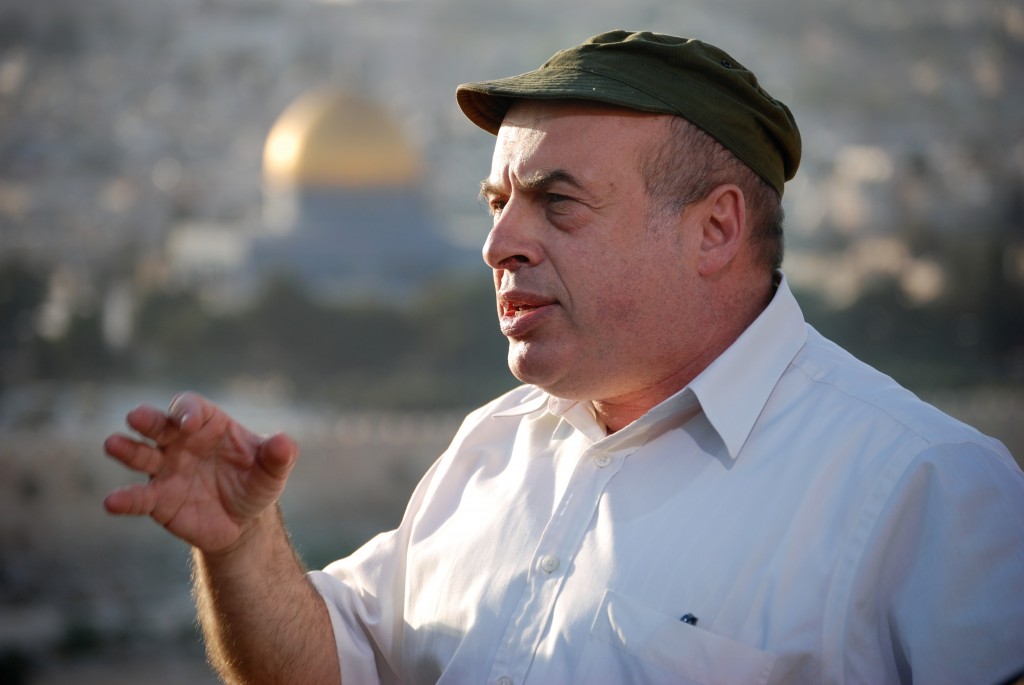
JERUSALEM (JTA) — Jewish Agency Chairman Natan Sharansky was given a green light by Israeli Prime Minister Benjamin Netanyahu to pursue his plan for a permanent egalitarian prayer space at the Western Wall.
Netanyahu told Sharansky to continue reviewing the situation with Zvi Hauser, the director general of the Prime Minister’s Office, and Yaakov Amidror, Netanyahu’s national security adviser, Jewish Agency spokesman Benjamin Rutland told JTA on Monday. The progress was first reported earlier in the day by the Israeli daily Haaretz, which cited unnamed sources.
Netanyahu and Sharansky met last week in London, where they were attending the funeral of former British Prime Minister Margaret Thatcher, and discussed the plan and its progress.
An illustration of Natan Sharansky’s proposal, which will expand the Western Wall and create a permanent egalitarian space in the Robinson’s Arch area. (photo credit: Creative Commons/Graphics by Uri Fintzy/JTA)
The plan calls for the Robinson’s Arch archeological site at the southern part of the Western Wall to be used as a permanent space for egalitarian prayer. Under the proposal, the Western Wall plaza would be expanded to encompass the additional prayer space. The two sections of the plaza, separated by the Mugrabi Bridge, would share a common entrance.
Sharansky was charged by Netanyahu last year with finding a solution to mounting tensions over women’s prayer at the Western Wall. After three months of consultations with a wide spectrum of Israeli and American Jewish leaders, Sharansky unveiled the proposal to Jewish leaders earlier this month in New York.
Get The Times of Israel's Daily Editionby email and never miss our top stories
“One Western Wall for one Jewish people,” Sharansky said in a statement following his New York presentation. “In this way, the Kotel will once again be a symbol of unity among the Jewish people, and not one of discord and strife.”
Help us report truthfully on social media
As a multimedia journalist, my job is to take the quality, fact-based journalism produced by The Times of Israel newsroom and make it accessible across every platform — from Instagram posts to podcasts to short-form videos.
This is how many, especially young people, consume news these days. But misinformation is rampant on social media. Our team at ToI produces accurate, responsible short-form reporting on Israel and the Jewish world.
If you believe in the importance of factual social media journalism, please consider joining our reader support group, The Times of Israel Community. Your financial support is essential to sustain responsible multimedia reporting.
We’re really pleased that you’ve read X Times of Israel articles in the past month.
That’s why we started the Times of Israel - to provide discerning readers like you with must-read coverage of Israel and the Jewish world.
So now we have a request. Unlike other news outlets, we haven’t put up a paywall. But as the journalism we do is costly, we invite readers for whom The Times of Israel has become important to help support our work by joining The Times of Israel Community.
For as little as $6 a month you can help support our quality journalism while enjoying The Times of Israel AD-FREE, as well as accessing exclusive content available only to Times of Israel Community members.
Thank you, David Horovitz, Founding Editor of The Times of Israel


 Add ToI as a Preferred Source on Google