

Netanyahu to present ‘softened’ Jewish state bill for Sunday cabinet vote
Livni, Elkin, Shaked reportedly on board with new draft of legislation that seeks to enshrine both Israel’s unique Jewish status and its democracy
 Add ToI as a Preferred Source on Google
Marissa Newman is The Times of Israel political correspondent.

Prime Minister Benjamin Netanyahu is expected to present to a full cabinet vote on Sunday a “softened” version of a controversial bill that would enshrine Israel’s Jewish status in its constitutional laws.
The new draft would seek to define Israel as a “Jewish and democratic state, which upholds the rights of all its citizens under law.”
Netanyahu’s favored draft is aimed to give equal weight to the principles of Israel as a democracy and as a Jewish state. “The right to national self-determination in the State of Israel is unique to the Jewish people,” it specifies. “The State of Israel is a democratic state, founded on the principles of freedom, justice and peace, in accordance with the vision of Israel’s prophets, and upholds the individual rights of all of its citizens according to the law.”
This wording is intended by Netanyahu, among other implications, to make plain that Israel is not obligated to extend national rights to its minorities, the Yedioth Ahronoth daily reported on Thursday. Nonetheless, it said that the legislation department of the Justice Ministry considers the Netanyahu draft to adequately represent the necessary principle of equality, and quoted a legal opinion prepared by the department to this effect: “A correct legal reading of the wording shows that equality is included among the principles that form the basis” of the proposed legislation.
An earlier version of the bill was criticized by Justice Minister Tzipi Livni, who also postponed the vote this past Sunday to next week. Netanyahu had offered his support in principle for this earlier draft of the bill, though he said revisions would need to be made before the proposed legislation fulfilled its goal of lending “balance” to the judicial system.
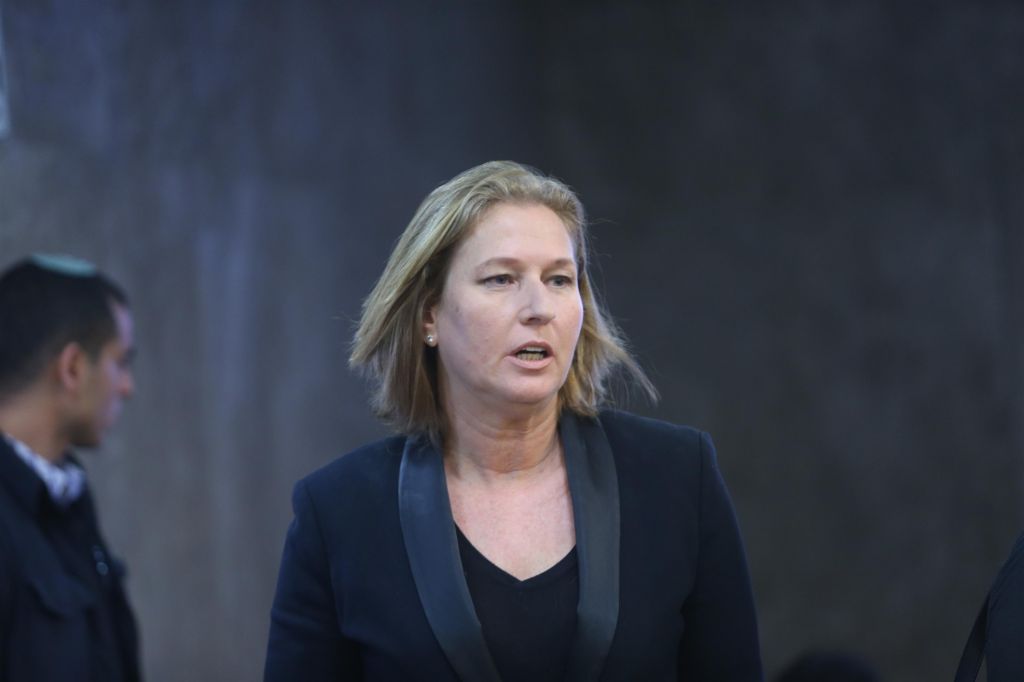
Livni, MK Ze’ev Elkin — the coalition chairman who initiated the version of the bill that prompted Sunday’s ministerial dispute — and MK Ayelet Shaked (Jewish Home), have all agreed to the new wording, Israel Radio reported on Wednesday.
At a Likud faction meeting Monday, Netanyahu said the bill was a “response to those who are skeptical about the right of the Jews to their nation-state. In the State of Israel, every citizen has rights, regardless of religion, race, and gender, which are anchored in law. The issue of a Jewish and democratic state is not anchored; therefore we will insist that the law passes.”
The Elkin version was meant to be put to a ministerial vote on Sunday, but it was postponed by Livni by a week. Shortly afterward, outflanking Livni, Netanyahu announced he would push the bill through to a full government cabinet ballot, which has the authority to forward legislation to the Knesset plenum for a vote.
The justice minister defended her decision on Monday, saying that the previous version of the bill may contradict the Declaration of Independence, which already addresses Israel’s Jewish status.
“I liked it that Prime Minister Benjamin Netanyahu said that he was in favor of equality, but the bills of MK Ze’ev Elkin and the Jewish Home don’t include this, and therefore I postponed the debate,” Livni said. “We are not against the ‘Jewish state’ bill, but we are against legislation that harms the Declaration of Independence,” Livni said.

The Elkin proposal on the table was one of several different bills seeking to define Israel as a Jewish state that have been circling in the Knesset in recent years — none of which has made much progress in the plenum — and was considered to present the most extreme version of such a law.
The bill seeks to anchor Israel’s definition as a Jewish state in the country’s Basic Laws. The Elkin version reportedly defined Israel’s democracy as subservient to its Jewish character and demoted Arabic from its status as an official language.
Livni and others objected to those two clauses and, according to a document procured by the Ynet news website, has prepared her own version of the bill. According to the report, the Elkin bill presented Israel’s Jewish and democratic status in separate clauses, while Livni’s draft links the two. Her bill is also said to explicitly defend the rights of non-Jewish minorities in Israel, and does not demote Arabic from it current status as an official language. And whereas Elkin’s bill calls on the judicial system to utilize Jewish law “as a source of inspiration,” and enshrines its national anthem and holidays in the Basic Laws, Livni’s does not. If, as reported, Livni is now backing Netanyahu’s draft, her version may now be shelved.
After Sunday, when the aborted cabinet debate on the bill prompted ministerial dispute, rumors flashed through Israeli political circles intimating that the prime minister was contemplating seeking to muster an alternative coalition or move toward early elections. And Yesh Atid party leader Yair Lapid on Monday played down but did not deny reports that one of his advisers had been seeking to construct a new government headed by Lapid and without Netanyahu.
Seeking to quell rumors of imminent elections or dramatic coalition changes, both Finance Minister Lapid and Foreign Minister Avigdor Liberman stressed later Monday that they were opposed to holding elections in the near future. And by evening Livni was reported by Channel 2 to be working on her draft of the “Jewish state” bill that could be acceptable to all coalition parties. Then, on Wednesday, came news of Netanyahu’s version.









The Times of Israel Community.