

Rediscovered Hula frog shown to be last member of lost group
Species, thought to be extinct until recently, is only survivor from genus that disappeared a million years ago, according to study
 Add ToI as a Preferred Source on Google
Aaron Kalman is a former writer and breaking news editor for the Times of Israel
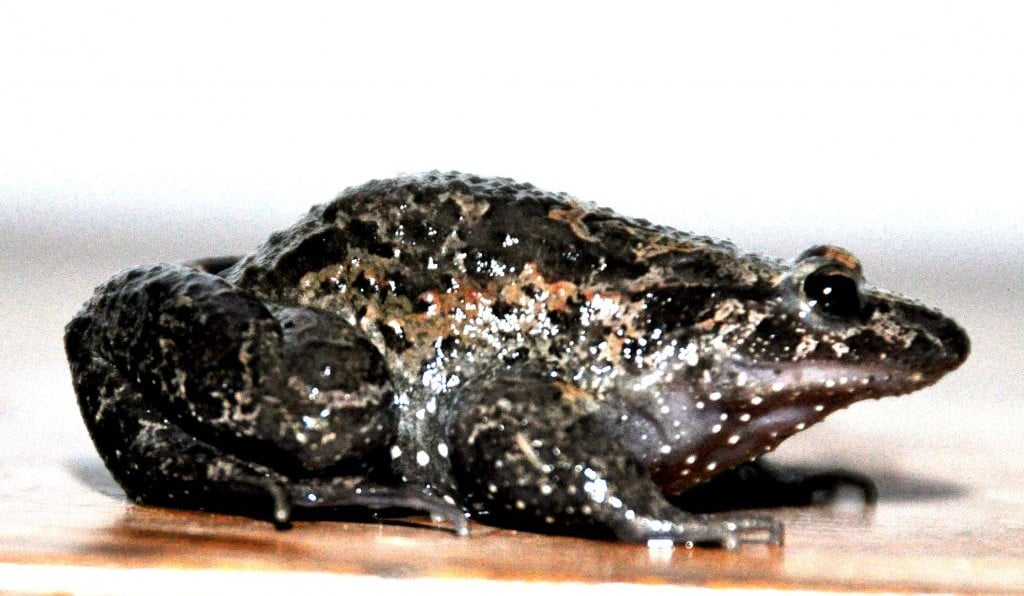
A frog species native to Israel’s north which was declared extinct has been rediscovered and dubbed a “living fossil” — not only of its own species but of an entire genetic group, Jerusalem’s Hebrew University announced Tuesday.
Discovered in the Hula Valley in the 1940s, the “Hula painted frog” was thought to have disappeared following the drying up of the Hula Lake at the end of the 1950s, and was declared extinct by the International Union for Conservation of Nature in 1996.
The frog — individuals of which were found in the Hula swamp area two years ago — turned out “to be a unique ‘living fossil,’ without close relatives among other living frogs,” the university said in a statement.
A team of Israeli, German and French researchers authored a report in the scientific journal Nature Communications, published Tuesday, which details the results of a genetic study of the amphibian, finding that the rediscovered Hula is actually the only living species of its kind.
“The Hula frog differs strongly from its other living relatives, the painted frogs from northern and western Africa. Instead, the Hula frog is related to a genus of fossil frogs, Latonia, which were found over much of Europe dating back to prehistoric periods and has been considered extinct for about a million years,” Hebrew University said.
The team — led by Hebrew University’s Rebecca Biton, Prof. Sarig Gafny of the Ruppin Academic Center and Dr. Vlad Brumfeld of the Weizmann Institute of Science — conducted “genetic analyses of rediscovered individuals” as well as “morphologic analyses of extant and fossil bones,” according to the statement.
“The results imply that the Hula painted frog is not merely another rare species of frog, but is actually the sole representative of an ancient clade of frogs (a group with a single common ancestor),” the university said.










The Times of Israel Community.