

A day late but with no shortage of opinions, Israel’s press wallows in the Trump win
While Trump booster Israel Hayom celebrates by telling pundits to eat their hats, the rest of the media cooks up a slurry of sadness, despair, question marks and maybe some silver linings
 Add ToI as a Preferred Source on Google
Joshua Davidovich is The Times of Israel's Deputy Editor
Israel’s inconvenient location halfway across the world from the US means that it’s a day behind much of the Western world in reporting on the shock election triumph of Donald Trump two days earlier. But despite the time lag, and the distance of a few thousand miles, plus the fact that Israel is not, yet, officially part of the United States of America, Israeli papers – as with much of the world — go full bore in reporting on the election.
That wall-to-wall coverage is a mix of shock, despair, confusion and yes even joy – that last emotion courtesy of Israel Hayom, the Sheldon Adelson-owned tabloid that made its peace with Trump early on and has rooted for him ever since.
But being a day behind, and an ocean and a continent away from the action, has its upsides too — namely, that rather than just report on the results and prognosticate about what they might mean, papers are able to focus on reactions to Trump’s win, in the US, around the world, and of course, at home in Israel.
Israeli papers being Israeli papers, the opinions of their pen jockeys seem to take precedence over all else. Hence you have a main headline in broadsheet Haaretz’s front page touting “shock around the world,” followed by 16 (!) commentaries, analyses and other takes (hot and otherwise) telegraphing shock and a range of other mostly unhappy emotions by their own writers and editors, from top dog Aluf Benn all the way down to op-ed writer Uri Misgav. (The effect of the 16 columns, all lined up in two neat rows, creates a front page nearly as ugly as some of Trump’s comments on women, at least in this former page designer’s opinion.)
While a few of the columns indeed deal with how the world can, will and has reacted, and some with how it will affect Israel, many of them are the writer waxing poetic and despondent on Trump’s election victory.
“Trump’s victory on Tuesday night doesn’t change the fact that he was the worst candidate in living memory to run for president for a major party,” writes the paper’s Anshel Pfeffer in one such column. “His campaign was the worst ever waged and his ground operation sucked. He didn’t win thanks to any genius strategy or political tactic. He won despite everything. This American election wasn’t about politics. … There was a more powerful factor that motivated voters to disregard all his seemingly fatal deficiencies and vote for him. Trump’s manifest failings, his crookedness, indecency and deep hatred for anyone who would not worship at the shrine of the Donald simply did not concern them as much as something much more powerful. Fear. Fear of change. Fear of old certainties being swept away. Fear in the erosion of traditional values and, above all, fear of hope in a better but unassured future. Fear trumps reason. It trumps decency and values. It defies logic.”
That same vein of gloom runs through a column by Yedioth Ahronoth political analyst Sima Kadmon, who wonders how a man like Trump could have garnered the support of so many Americans.
“If I could I would ask an American citizen not who they would want to answer the red telephone at 3 a.m. I would ask them: Would they let their 13-year-old daughter be alone in a room with the new president? When did this happen, that the world so changed? How did it happen that a man so vulgar, extroverted, an outspoken reality TV star, with houses coated in gold, gets the keys to the White House from a man so elegant, cool and cultured, who redefined the look of the American presidency,” she writes, before adding that Israelis who continue to vote for Prime Minister Benjamin Netanyahu should not be surprised. “The US elections just proved to us what we should already have known, and that’s that there’s no room in the world today for staid candidates. The more you are blunt, rude, arrogant and prone to exaggeration, without any inhibitions of political correctness, the more your chances of getting elected.”
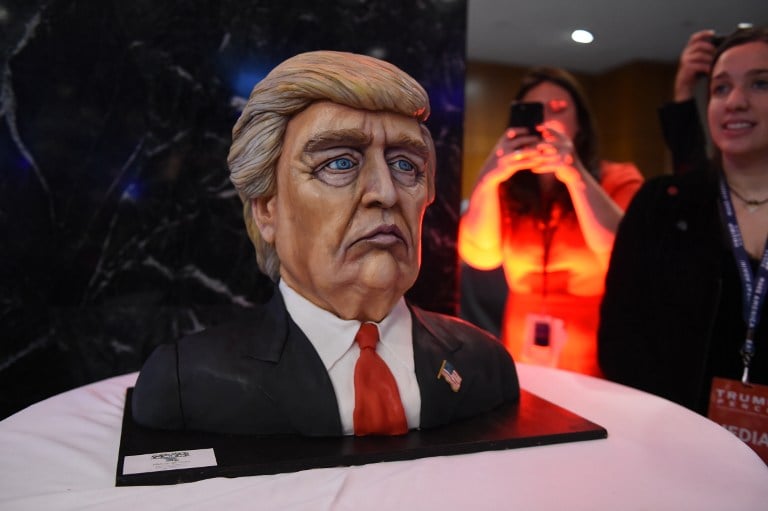
Unsurprisingly, the picture is totally reversed in Israel Hayom, which gushes over Trump’s win, starting with Boaz Bismuth’s breathless dispatch from Trump’s election night speech, which he titles “a once-in-a-lifetime-night,” and accompanies with a picture of himself standing next a kosher cake made in the shape of Trump’s bust.
Bismuth starts off by calling Trump a “once-in-a-generation candidate” in a good way, and does little to hide his joy over Trump’s win, the lamestream media’s loss and that cake, which he will both have and eat.
“On my way out, between all the police cars, firetrucks and ambulances blocking the entrance to the hotel I got stuck by the cake again. Some of the police were taking pictures with the cake, and putting their police hats on it. Afterward, they traded hats with some Trump supporters around. Apropos the hats: there were enough red caps for every one of the analysts and journalists who will now need to eat theirs,” he writes. “And I was only able to think, what sweet revenge for Trump. Three-four years ago he was made fun of by President Obama at a party. Now he’s going to sleep in his bed in the White House.”
It’s surreal to watch this 2011 video of Obama and Seth Meyers taunting Trump about a presidential run pic.twitter.com/XkZNGmzcUx
— Business Insider (@BusinessInsider) November 9, 2016
Bismuth isn’t the only one happy with Trump’s win. In Haaretz, Gideon Levy finds a silver lining in the fact that perhaps the unpredictable Trump will pull support for Israel.
“A Trump who loses interest in the Middle East could also be a Trump who doesn’t support the occupation. The settlers’ rejoicing is premature. It could well turn into a cry of distress. Trump will never be a friend of the Palestinians, of course, just as he will not be a friend of all the world’s weak, but he could turn out to be a true isolationist and as such undo his country’s blind, automatic and bewildering commitment to Israel,” he writes.
While Levy’s hot take is likely more far-fetched than the thoughts of a Trump presidency a year ago, he’s far from the only one to look for bright spots
In Yedioth Ahronoth, Nahum Barnea dubs Trump’s victory a “November Revolution,” and predicts (or wildly guesses, in his words) that despite all his wild promises about building walls and throwing Clinton in jail, the billionaire president elect really has little intention of taking such rash actions.
“However, Trump will feel a need to prove to those who voted for him that he is listening to their cries,” he writes. “They voted for him because they want change, Even most who didn’t vote for him want change – that’s the main message that led his campaign. He will need to provide them with some change or, at least, the appearance of such.”
Meanwhile, other analysts note the difficulty in predicting how close Trump and Netanyahu can truly expect to be.
“The bottom line – this is a puzzle,” Yedioth’s Itamar Eichner writes in his top line. “That’s how top Israeli officials described Trump’s expected relations with Israel. On the one hand, they say, he loves Israel bigly, but on the other, he’s a man whose behavior is difficult to predict.”
Similarly, in Haaretz Barak Ravid reports that Netanyahu is “ambivalent” about Trump.
“A political source who spoke with Netanyahu in recent months said the prime minister sounded a bit concerned about the possibility of a Trump victory, especially as the real estate mogul was a total enigma and an unpredictable politician,” he writes. “Netanyahu has known Hillary Clinton, her family, her big donors and other people close to her for more than 20 years, for better and for worse. He knows how to work with them, how to influence them and how to reach deals and understandings with them. Trump, however, is a trip into the unknown for Netanyahu. It’s impossible to know what he’ll do when he takes office and what his policies will be on the Palestinians, Iran and Syria.”
That ambivalence is possibly reflected in Israel Hayom’s burying of Trump and Netanyahu’s phone call all the way on page 17.
שימו לב לכותרות הזהות.
מתאים רק לעיתון שחושב שהעולם מתחיל ומסתיים אצלו.. pic.twitter.com/ZFMndiQUfW— בני רבינוביץ (@benirabin) November 10, 2016
One can also read what they may into Yedioth’s use of the same headline “The world is in shock” to describe both Trump’s win and the September 11, 2001, attacks, as noted by a journalist on Twitter, though the paper also calls the Trump win a 9/11 (referencing both the attacks and the date of the election results in the world outside the US) for the media, pundits and pollsters, so it’s clearly lost all sense of proportion.
The pen that backs the winner is mightier
For more disproportion and taking aim at the media, where Trump and Netanyahu will almost certainly find common ground at least, one need look no further than Israel Hayom, which as a mouthpiece for both, can safely put itself outside the category of actual journalism.
Rather than taking the win as graciously as Trump did in his surprisingly calm victory speech, the paper’s Amos Regev repeats the line about journalists needing to eat their hats, but shows himself to be chowing down on a shit sandwich instead.
Regev, sporting perfect 20/20 hindsight, pens a scathing missive lambasting the media for failing to see Trump’s win coming, while tooting his own paper’s horn for backing the winner.
“They were wrong and misleading. They did it intentionally and not out of naiveté. I humble submit that we at Israel Hayom were not wrong. Because we spoke to people at eye level and understood the story. And others did not,” he writes in a column replete with pictures of him and Bismuth meeting Trump and various front pages showing the paper’s commitment to the candidate, as if backing a winner is what journalism is really about. “In Israel it’s clear that the media will refuse to recognize its mistakes. The same analysts that were mistaken yesterday will continue to commentate today, as if nothing happened. Those who can’t read the hearts of their own, in Israel – how can they know what’s happening in another country, America, across the sea? Truly, they will not succeed. Israel Hayom will succeed. They need to do soul searching, for their readers, watchers, listeners, and for themselves.”



The Times of Israel Community.