

American-Jewish summer camps make aliya
New generation of Israeli sleepaway camps builds Jewish identity in the holy land
 Add ToI as a Preferred Source on Google
Ben Sales is a news editor at The Times of Israel
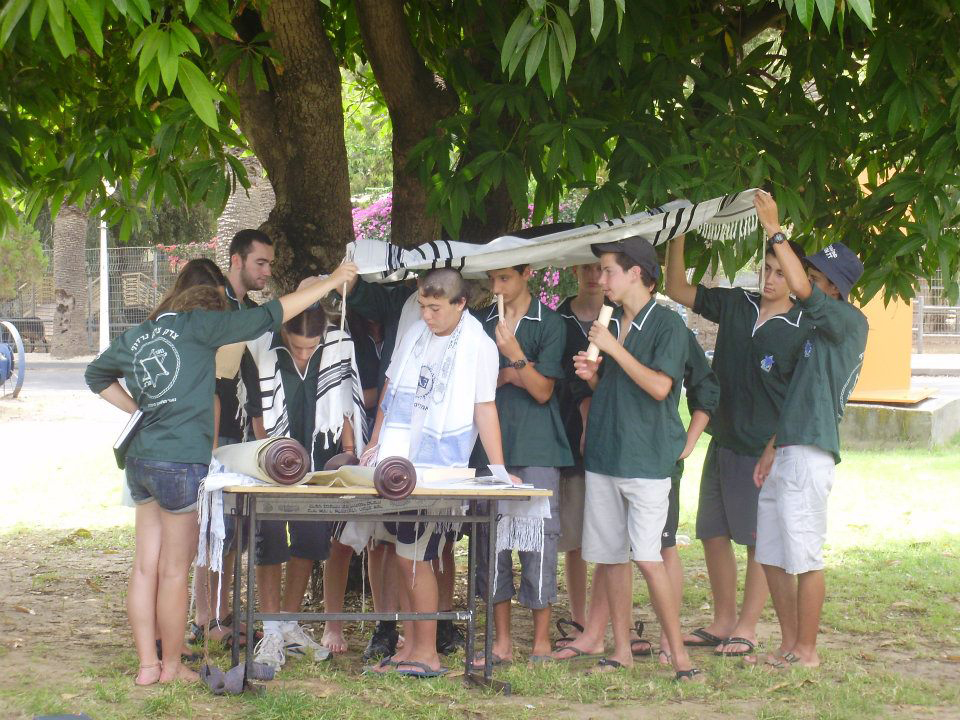
AYANOT, Israel (JTA) — Raised in a small and intimate Jewish community, Gal Herman, 14, has always been active in his local Reform youth group, attending services and participating in events.
So it was an easy decision to spend summer at the Reform sleepaway camp a few hours away, where he could play sports, go hiking and learn about Judaism with his peers.
Herman’s story may sound American, but he’s from Kibbutz Lotan, deep in Israel’s Negev Desert, and his camp is 11 miles south of Tel Aviv. He attends Camp Havaya, run by Noar Telem, the Israeli Reform movement’s youth group.
Noting the success of American camps, some Israeli educators are trying to adapt the concept to fit their youth when it comes to informal Jewish education and identity building.
“The idea we try to foster is that we are part of the Jewish people and you have to be an active Jew, to make that a real part of your life,” said Leora Ezrachi-Vered, Havaya’s director. “We felt that sticking with this model gives us a unique product.”
On a weekday morning at Havaya, groups of teens work around ovens, hoping to bake lemon cakes in a building surrounded by trees and beaten by a midday sun. Across a nearby lush green field, another group of teenagers grasps rough ropes and crouches around a series of logs, as members of the nature staff teach them how to tie knots.
Fifteen minutes later, counselors signal the kids to rush to the cafeteria for a typical camp lunch — salad, noodles and fruit juice.
Aside from nature programming and cooking, Havaya campers study Jewish texts together, pray twice a day, go on camping trips and complete a ropes course once a summer. And unlike campers at most other Israeli sleepaway camps, Havaya campers sleep in dormitories rather than tents.
Summer camps have existed in Israel for decades, but most last only a few days and are focused more on outdoor living. Educational and Jewish enrichment at a weeks-long camp is a more novel concept. In addition to Havaya, Camp Ramah in Israel attracts children from families associated with the country’s Conservative, or Masorti, movement. The independent Camp Kimama offers training in technology and English lessons to Israeli campers and their peers who come from abroad.
Another effort, called the Counterpoint Israel Program, aims to adapt the American day-camp model to five low-income towns in Israel’s South. Run by Yeshiva University’s Center for the Jewish Future, it imports groups of 10 American Jewish counselors to teach children arts, English and sports — and to keep them off the street during the potentially restless summer months.
At one of the camps, sitting on a clean, beige-tiled floor of a community center in Kiryat Malachi, an assortment of Sephardi, Ethiopian and Russian Israeli 12- to 15-year-olds bang on darbukas, traditional Middle Eastern handheld drums.
Their teacher, a local resident with long peyot and tzitzit, motions for them to listen.
“Doom, doom, ta, ta, ta,” he says, standing in the middle of the circle. He repeats the sounds on his darbuka with precisely timed taps and tells the kids to copy him.
Many of the activities at Counterpoint mirror those at American Jewish day camps: arts and crafts, music, outdoor activities and sports (though the basketball court is missing nets, surrounded by litter and sometimes doubles as a soccer field). But at Counterpoint, recreational activities double as enrichment ones.
Unlike at most American Jewish camps, many of the participants here come from broken homes and attend low-performing schools.
“American kids are used to going to summer camp; they take it for granted,” said Ayelet Kahane, 23, a recent Yeshiva University graduate and one of the head counselors. “You come to a place like this and they’re crazy, but if you ask any of the kids they say they’re having an amazing time.”
A difference in attitude is not all that separates Israeli day campers from American ones. Because of the intimacy in many of Israel’s small southern towns, counselors often see their campers outside of camp and come to their families’ homes for Shabbat dinner.
Back at Havaya, Jewish programming takes on a different emphasis than it would in the United States. Jewish values and the country’s much-discussed political process are much more intertwined here.
“What I try to promote more than Jewish continuity is Jewish peoplehood,” said Ezrachi-Vered. “To marry a Jew is a no-brainer. Our religion is more about how am I changing Israeli society? How can I make it more pluralistic, more equal?”
But just as American Jewish camps teach about Israel, efforts such as Havaya make sure to teach their campers about the American Jewish experience.
“The way we pray and the tunes we use are very inspired by Americans. When Debbie Friedman passed away, kids knew her tunes,” Ezrachi-Vered said about the singer-songwriter, who was particularly popular in the Reform movement.
Of course, while campers such as Herman enjoy the Jewish content, they may also have the same qualms as some American Jewish campers.
“Sometimes there are too many prayers,” Herman said. “Sometimes it’s too much. Sometimes you have to sit uncomfortably, and it’s outside, and it’s sunny and it’s hot.”
The longest session at Havaya is two weeks — a long time to be away for some campers. That works well for Herman. He thinks camp “is not short,” but he doesn’t get homesick.
“It’s fun,” he said. “It feels like family.”



The Times of Israel Community.