

Attorney general warns legal challenge could derail Deri ministerial post
Yehuda Weinstein says court could prevent convicted Shas leader from receiving Economy Ministry as set in coalition deal
 Add ToI as a Preferred Source on Google
Judah Ari Gross is The Times of Israel's religions and Diaspora affairs correspondent.
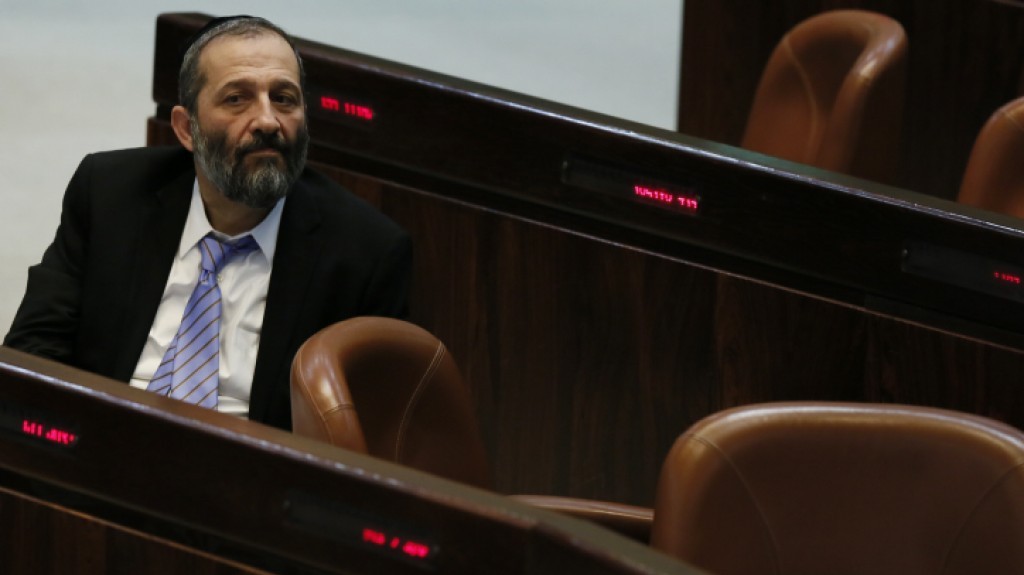
Attorney General Yehuda Weinstein warned of legal difficulties the government would face should Shas party head Aryeh Deri, who served jail time for a graft conviction, be appointed economy minister, in a decision released Thursday.
In the 23-page decision, first published by the Ynet news site Thursday morning, Weinstein clarified that there exists “no legal impediment to Deri’s appointment as a minister in the government.” He said the High Court of Justice could still put the kibosh on the appointment.
Prime Minister Benjamin Netanyahu is slated to swear in his government Thursday evening, with Deri taking over the Economy Ministry. The Shas leader was convicted on corruption charges in 1999 and later served nearly two years in jail.
In 2011, he returned to politics and retook the leadership of his ultra-Orthodox party, after staying out of politics for the seven years required for those sentenced to prison along with a designation of moral turpitude.
No legal claim against Deri’s appointment has been filed, but Weinstein said if one is, the High Court had a fair amount of leeway in deciding whether a convicted criminal can serve as a minister.
“This is a decision that arouses legal difficulties,” Weinstein wrote, “due to Deri’s onerous criminal past and the harm to the public’s trust in the administration’s morality and the correctness of its actions, which Deri’s appointment as a minister is liable to cause.”
Even more potentially damning, Weinstein added, is that Deri is not “someone who has recognized his sins and taken responsibility for his actions.”
In 1990 the police began investigating Deri on charges of corruption. Throughout the investigation, which dragged on for several years, Deri refused to respond to the charges against him, Weinstein pointed out in his report.
Deri was finally indicted in 1993 in two cases.
After a drawn-out, five-year trial on one set of charges, Deri was found guilty by the Jerusalem District Court of taking $155,000 in bribes. He appealed the decision, and while some charges against him were dropped, the appellate court found that Deri had also received an additional $60,000, free vacations abroad, a free one-night visit to a Jerusalem hotel and another unknown sum of money that was deposited in his loved one’s bank accounts.
Deri was sentenced to a three-year prison term but served only 22 months in Maasiyahu prison, receiving an early release for good behavior.
Upon his release, however, Deri was then prosecuted for the second case against him. The Jerusalem Magistrate’s Court found Deri guilty of violating public trust when, in just one instance, he worked to allocate NIS 400,000 for the creation of a beit midrash — a Jewish house of learning — in Jerusalem that was named for his father- and mother-in-law.
The court found that Deri “worked against the interests of his public position in favor of his personal ones, and should have stopped himself from handling an issue that dealt with his family members.”
Deri was found guilty and sentenced to three months’ probation and an NIS 10,000 fine.
While the Basic Law governing the Knesset only restricts the appointment of a minister for seven years after a jail sentence, the last Knesset’s Ministerial Committee for Legislation discussed an amendment that would remove the seven-year limit on the restriction, making it illegal to ever appoint a minister who had been convicted of a crime while serving in the Knesset or the government, Weinstein said.
This law did not move forward as the government was dissolved just a few days later.
The Shas party responded to Weinstein’s letter in a statement, claiming the charges against Deri are “based on events that occurred 30 years ago.”
The party added, “Shas praises the prime minister’s intention to finalize the formation of the government as quickly as possible in order to deal with pressing demands of the public.”
The bulk of Weinstein’s concerns were based on two possible precedent-setting cases. In 1993, the High Court prevented the appointment of Yossi Ginosar to the position of director general of the Housing and Construction Ministry because of his previous legal troubles as a high-ranking Shin Bet official.
Ginosar was embroiled in the so-called Bus 300 affair, in which Shin Bet officials were caught covering up the killing of Palestinian terrorists after they had been detained. He was later pardoned by the president.
And in 2007, the Supreme Court discussed the appointment of Haim Ramon to a ministerial position, ultimately upholding the government’s selection despite Ramon having been found guilty earlier that year of sexual harassment.
In this case, as in those two, Weinstein pointed out, “there is a need to balance the clear public interest in retaining the proper moral level of public candidates with the interest of representation — the desire to allow the public to be represented by their elected official.”
Additionally, Weinstein wrote, with this being a ministerial position, the appearance of the candidate as “clean” is of even greater importance.










The Times of Israel Community.